
The Behavioral Home Remedy for Insomnia That Outperforms Pills: How to Use CBT-I Techniques Without a Therapist
The Supplement Trap: Why Pills Don't Fix Chronic Insomnia
If you've spent money on melatonin gummies, valerian root capsules, or OTC sleep aids like diphenhydramine (Benadryl, ZzzQuil) and found yourself staring at the ceiling night after night, you are not alone — and you are not failing. The numbers tell a clear story: nearly two-thirds of American adults have tried melatonin at some point, according to the American Academy of Sleep Medicine, yet as many as 15% of adults continue to live with regular insomnia. That gap between widespread supplement use and persistent sleeplessness is not a coincidence.
The problem is structural. Melatonin is more effective for jet lag than for chronic insomnia, and the supplement industry operates with minimal FDA oversight. Studies have found that the actual melatonin content in a bottle can range from 83% less to 478% more than what the label claims. Valerian root carries low-to-moderate evidence for sleep improvement, and both valerian and kava have been linked to potentially serious liver concerns. OTC antihistamines like diphenhydramine and doxylamine produce next-day grogginess, build tolerance within days, and are flagged by the Beers Criteria as potentially inappropriate for older adults.
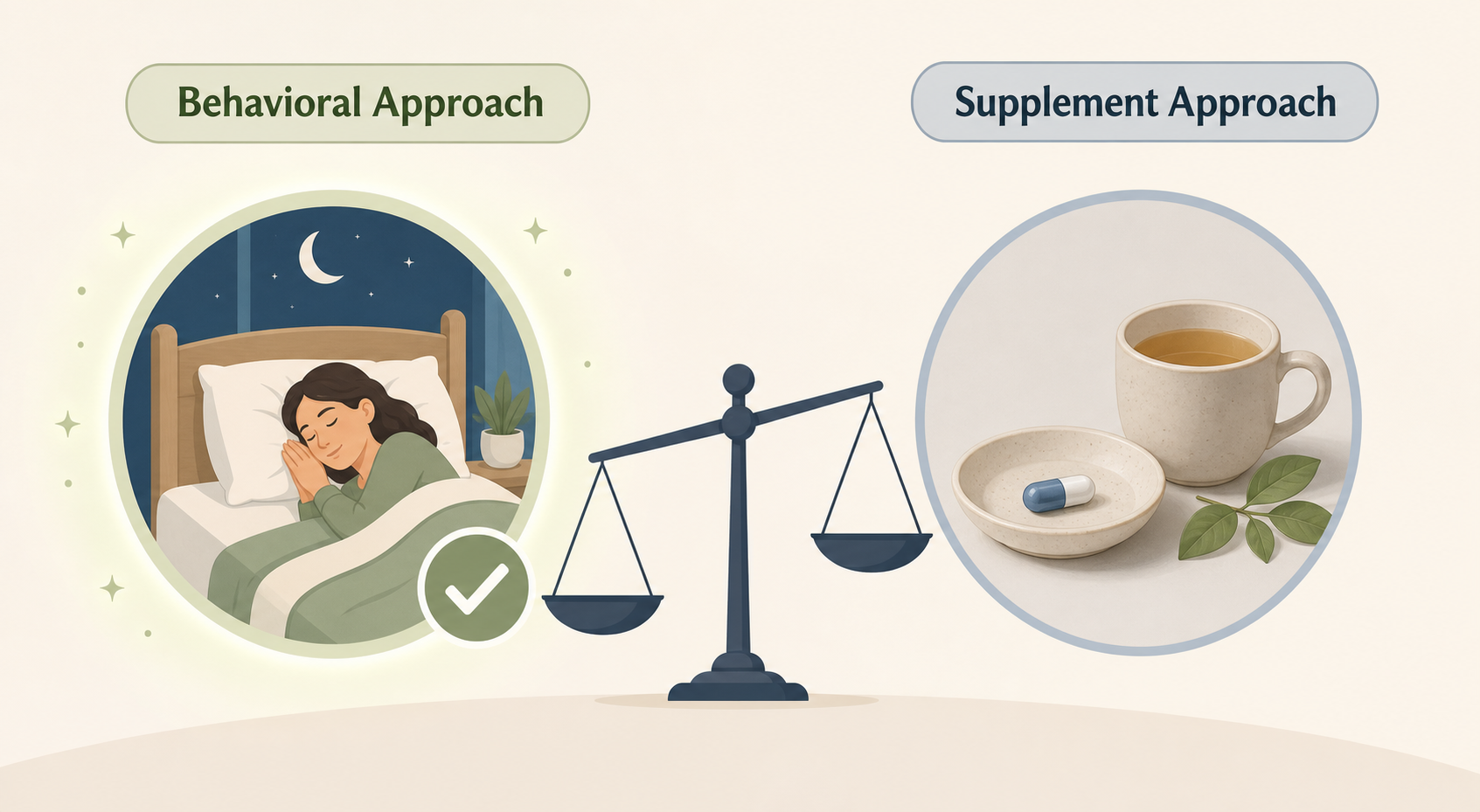
The real issue is not that supplements are useless — it is that they treat symptoms rather than causes. Chronic insomnia is maintained by a set of behavioral and cognitive patterns: spending too much time in bed awake, associating the bedroom with frustration, and catastrophizing about the consequences of a bad night. No pill, regardless of its mechanism, can rewire those patterns. A behavioral approach can.
Why CBT-I Is the Gold Standard for Insomnia
Cognitive behavioral therapy for insomnia (CBT-I) is not an alternative therapy or a fringe approach. It is the recommended first-line treatment for chronic insomnia according to the American Academy of Sleep Medicine, the American College of Physicians, and the European Sleep Research Society. Major medical institutions including the Mayo Clinic and Johns Hopkins Medicine endorse it as the first treatment to try before any medication.
The evidence base is substantial. Meta-analyses show that CBT-I matches the short-term efficacy of prescription sleep medications like zolpidem and temazepam, and it consistently outperforms them over the long term. While medications produce faster initial results, their effects fade as tolerance develops. CBT-I produces durable, sustained improvements in sleep quality that persist after treatment ends — because it addresses the underlying mechanisms that maintain insomnia rather than temporarily sedating the brain.
For readers who want the full clinical context, our CBT-I for Insomnia FAQ covers what the therapy involves and who it helps, and our 2026 AASM guideline analysis explains how CBT-I compares to medication and combination approaches. The rest of this guide focuses on what you can do on your own, starting tonight.
Four Self-Directed Techniques You Can Use Tonight
CBT-I is typically delivered over 6 to 8 sessions with a trained therapist, but its core components are straightforward enough that motivated individuals can begin applying them immediately. These four techniques form the foundation of the protocol.
1. Stimulus Control: Rebuild the Bed-Sleep Connection
Stimulus control is arguably the single most effective behavioral intervention for insomnia. The principle is simple: the bed must become a strong cue for sleep, not for wakefulness. If you spend hours in bed awake — worrying, scrolling, tossing — your brain learns to associate the bed with arousal rather than rest.
The rule is direct: if you cannot fall asleep within approximately 20 minutes, get out of bed. Go to another room, keep the lights dim, and do something quiet (reading a physical book, listening to calm music) until you feel sleepy. Return to bed only when you are sleepy. Repeat as needed throughout the night. The same rule applies to middle-of-the-night awakenings.
This technique feels counterintuitive — most people assume they should stay in bed and try harder. But trying harder activates the sympathetic nervous system, which is the opposite of what you need. Getting up breaks the cycle of frustration and re-teaches your brain that the bed is for sleeping, not for lying awake.
For a deeper explanation of the conditioning logic behind each rule, see our Stimulus Control Therapy guide.
2. Sleep Restriction Therapy: Consolidate Your Sleep Window
Sleep restriction therapy addresses a common pattern in chronic insomnia: spending far more time in bed than actually sleeping. If you lie in bed for 9 hours but only sleep 5, your sleep efficiency is around 55% — well below the healthy range of 85% or higher. The brain learns that the bed is a place where wakefulness is normal.
Sleep restriction temporarily limits your time in bed to match your actual average sleep time. If you sleep 5 hours per night on average, you set an initial sleep window of 5 hours (never less than 5.5 hours for safety). You maintain a consistent wake time every day, and you do not go to bed until the window allows. This mild sleep deprivation builds sleep pressure, making it easier to fall asleep and stay asleep.
For a complete walkthrough of how to calculate your sleep window and adjust it week by week, refer to our Sleep Restriction Therapy step-by-step guide.
3. Cognitive Reframing: Challenge the Catastrophic Thoughts
Insomnia feeds on itself through a loop of catastrophic thinking. The thought "If I don't fall asleep in the next hour, tomorrow will be a disaster" triggers anxiety, which releases cortisol and adrenaline, which makes sleep even harder. This is the cognitive component of CBT-I, and it is just as important as the behavioral techniques.
The goal is not to eliminate negative thoughts — that is unrealistic — but to defuse them. When you notice the thought "I'm never going to fall asleep," replace it with a more accurate and less threatening alternative: "I may not fall asleep immediately, but I have gotten through nights like this before, and I can function tomorrow even on less sleep than I'd like." This shift reduces the emotional charge around sleeplessness and breaks the anxiety-insomnia feedback loop.
A practical exercise: keep a notepad by the bed. When you catch yourself spiraling, write down the thought, then write a balanced response. The act of externalizing the thought onto paper reduces its grip.
4. Relaxation Training: Activate the Parasympathetic Nervous System
Relaxation techniques directly counter the physiological hyperarousal that characterizes insomnia. Two methods have the strongest evidence base and are simple enough to learn in one session.
- Progressive muscle relaxation: Lie in bed and systematically tense and then release each muscle group, starting at your toes and working up to your face. Hold each tension for 5 seconds, then release for 10 seconds. This creates a physical signal of relaxation that the brain interprets as safety.
- Diaphragmatic breathing: Place one hand on your chest and one on your belly. Breathe in slowly through your nose for 4 seconds, feeling your belly rise (not your chest). Hold for 4 seconds. Exhale slowly through your mouth for 6 seconds. Repeat for 5 minutes. The extended exhale activates the vagus nerve and shifts the nervous system toward rest.
These techniques are not meant to force sleep — they are meant to create the physiological conditions under which sleep can occur naturally. If sleep does not come, that is fine. The goal is relaxation, not sleep itself.
What the Research Shows: CBT-I vs. Supplements and OTC Aids
The table below summarizes how CBT-I compares to the most commonly used non-prescription sleep aids across the dimensions that matter most for chronic insomnia. The data draws from meta-analyses, systematic reviews, and clinical guidelines cited throughout this article.
| Factor | CBT-I | Melatonin | Valerian Root | OTC Antihistamines (diphenhydramine / doxylamine) |
|---|---|---|---|---|
| Efficacy for chronic insomnia | Strong — matches short-term drug efficacy; outperforms long-term | Limited — more effective for jet lag and circadian issues than chronic insomnia | Low to moderate — meta-analyses show small improvements in sleep latency and quality | Moderate short-term — tolerance develops within 3–7 days; efficacy drops sharply |
| Safety profile | Excellent — no known adverse effects | Good — generally well tolerated; long-term safety data limited | Moderate — liver toxicity documented in case reports; interaction risk with sedatives | Moderate — anticholinergic effects; linked to dementia risk with long-term use in older adults |
| Side effects | None — temporary sleepiness during sleep restriction phase is expected, not a side effect | Headache, dizziness, daytime drowsiness | Morning drowsiness, gastrointestinal upset | Next-day grogginess, dry mouth, constipation, urinary retention |
| Tolerance risk | None — effects improve over time | Low — some users report reduced effectiveness | Low — limited data on long-term use | High — tolerance develops within days; dose escalation common |
| Long-term outcomes | Durable — benefits persist for months to years after treatment ends | Unknown — most studies are short-term | Unknown — few long-term studies | Poor — tolerance and side effects limit sustained use |
| Cost | Free (self-directed); $0–$50 (digital apps); $500–$1,500 (therapist-led) | $5–$20 per bottle | $8–$15 per bottle | $5–$15 per bottle |
How to Start: A Step-by-Step Self-Guided Protocol
The following protocol combines stimulus control and sleep restriction into a structured weekly plan. It is adapted from standard CBT-I protocols used in clinical settings and is safe for most adults without comorbid medical or psychiatric conditions.
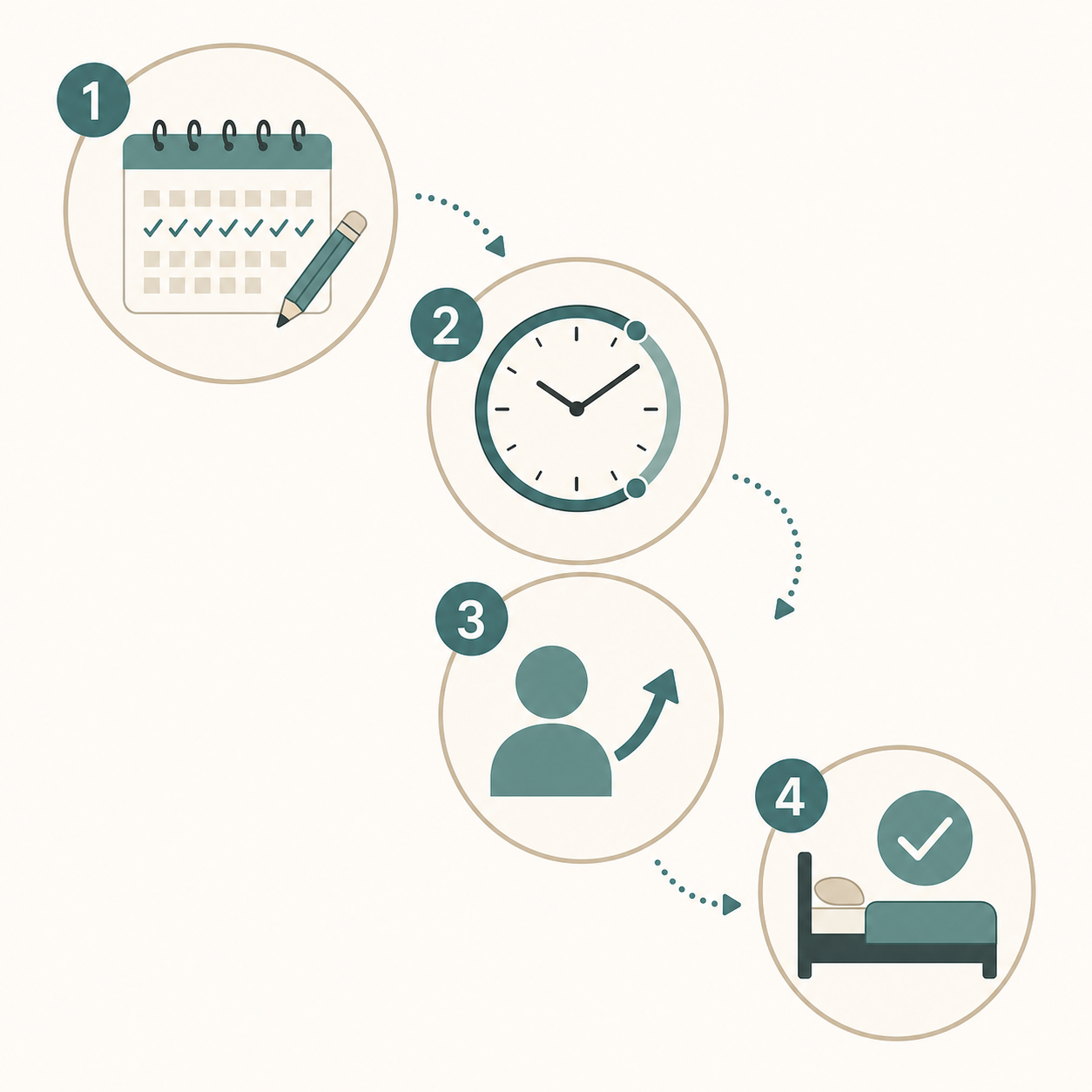
- Track your sleep for 1 week. Use a simple sleep diary: record the time you got into bed, the estimated time you fell asleep, the number and duration of night awakenings, the time you woke up, and the time you got out of bed. Do not use a sleep tracker for this — self-reported estimates are sufficient and avoid the anxiety that trackers can cause.
- Calculate your average total sleep time. Add up the total sleep time for each night and divide by 7. This is your baseline. Also calculate your sleep efficiency: total sleep time divided by total time in bed, multiplied by 100. If your efficiency is below 85%, sleep restriction is likely to help.
- Set your initial sleep window. Your time in bed should equal your average total sleep time, rounded up to the nearest half hour. Never set a window shorter than 5.5 hours, even if your average is lower. Choose a consistent wake time that fits your schedule, then count backward to determine your bedtime.
- Maintain a consistent wake time 7 days per week. This is the most important rule. A consistent wake time anchors your circadian rhythm and builds sleep pressure at the right time each evening. Do not sleep in on weekends — it undermines the entire protocol.
- Apply stimulus control rules during the adjustment period. If you are in bed and cannot fall asleep within 20 minutes, get up. If you wake up in the middle of the night and cannot fall back asleep within 20 minutes, get up. Return to bed only when you feel sleepy.
- Adjust the sleep window weekly. After 1 week, recalculate your sleep efficiency. If it is above 85–90%, add 15–30 minutes to your sleep window (by going to bed earlier). If it is below 85%, keep the window the same for another week. Continue this process until you reach a sleep window of 7–8 hours with consistently high efficiency.
If you hit a plateau — your sleep efficiency stays below 85% for two consecutive weeks despite following the protocol — consult our Sleep Restriction Therapy troubleshooting guide for common stalls and how to address them.
Digital CBT-I: App-Based Programs That Work
If you prefer guided support but cannot access a therapist, structured digital CBT-I programs offer a middle ground. Programs like Sleepio and the free CBT-i Coach app (developed by the Department of Veterans Affairs) provide automated sleep window calculations, stimulus control reminders, cognitive restructuring exercises, and progress tracking. Randomized controlled trials have shown that digital CBT-I produces clinically meaningful improvements in insomnia severity, sleep efficiency, and sleep quality — though effect sizes are slightly smaller than therapist-led programs.
Digital programs are particularly useful for readers who want the structure of a formal protocol without the cost or scheduling demands of in-person therapy. They are not a replacement for professional treatment in complex cases, but they are a significant step up from self-directed trial and error.
When Professional Help Is Needed
Self-directed CBT-I is safe and effective for most adults with uncomplicated chronic insomnia, but it is not appropriate for everyone. The following situations warrant professional evaluation before — or instead of — a self-directed protocol.
- Chronic insomnia lasting more than 3 months that has not responded to consistent self-directed effort over 4–6 weeks.
- Comorbid psychiatric conditions such as major depression, generalized anxiety disorder, bipolar disorder, or post-traumatic stress disorder. Sleep restriction can temporarily worsen mood symptoms in some individuals.
- Suspected sleep apnea (loud snoring, gasping, witnessed pauses in breathing, excessive daytime sleepiness despite adequate sleep time) or restless legs syndrome (uncomfortable leg sensations that improve with movement). These conditions require specific diagnostic evaluation and treatment.
- Excessive daytime impairment from sleep restriction that does not improve after widening the sleep window. If you cannot safely drive or work during the adjustment phase, professional guidance is needed.
For readers who want to explore whether their insomnia is linked to another condition, our Sleep Conditions index provides structured reference pages for sleep apnea, restless legs syndrome, circadian rhythm disorders, and other conditions that can mimic or coexist with insomnia.