
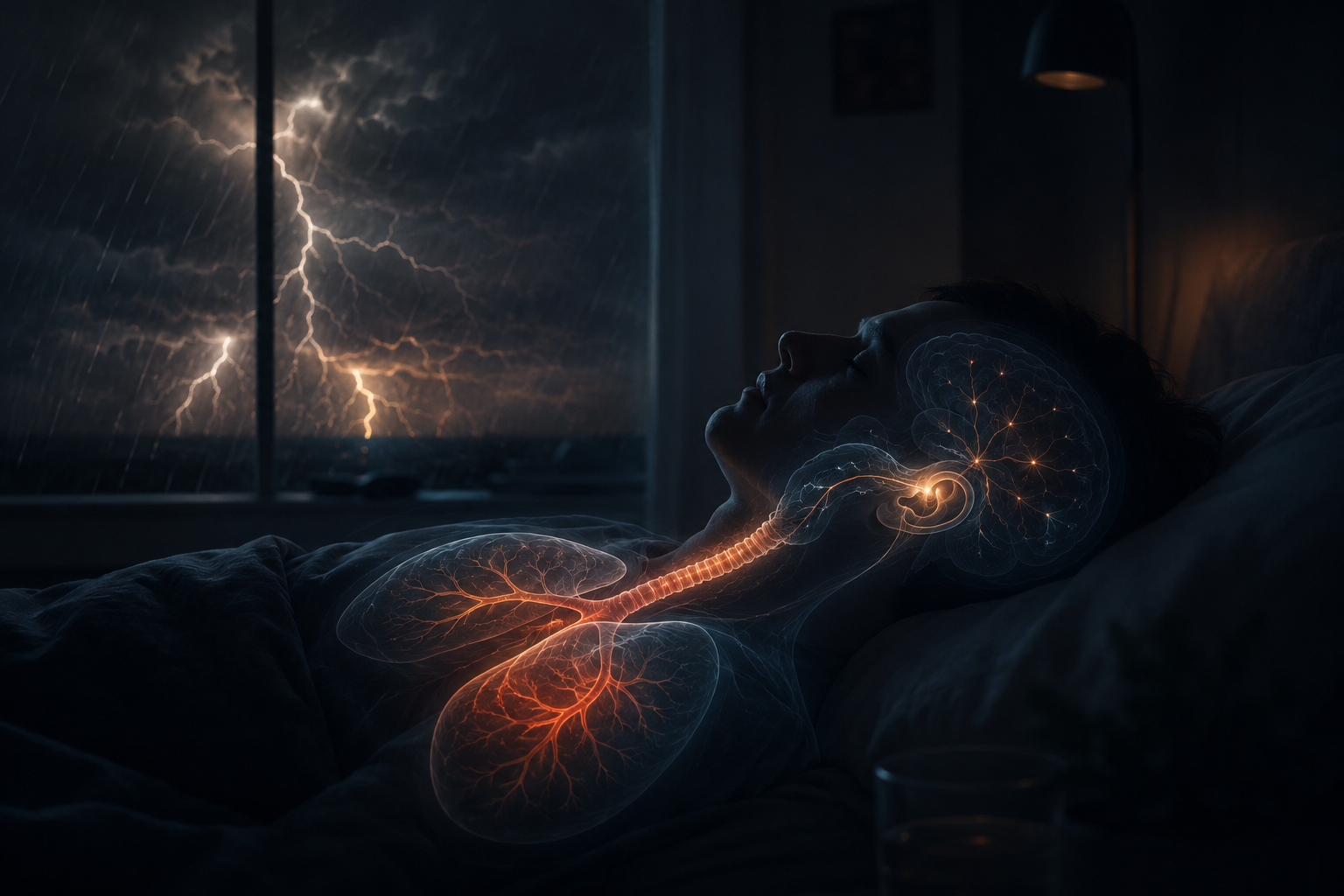
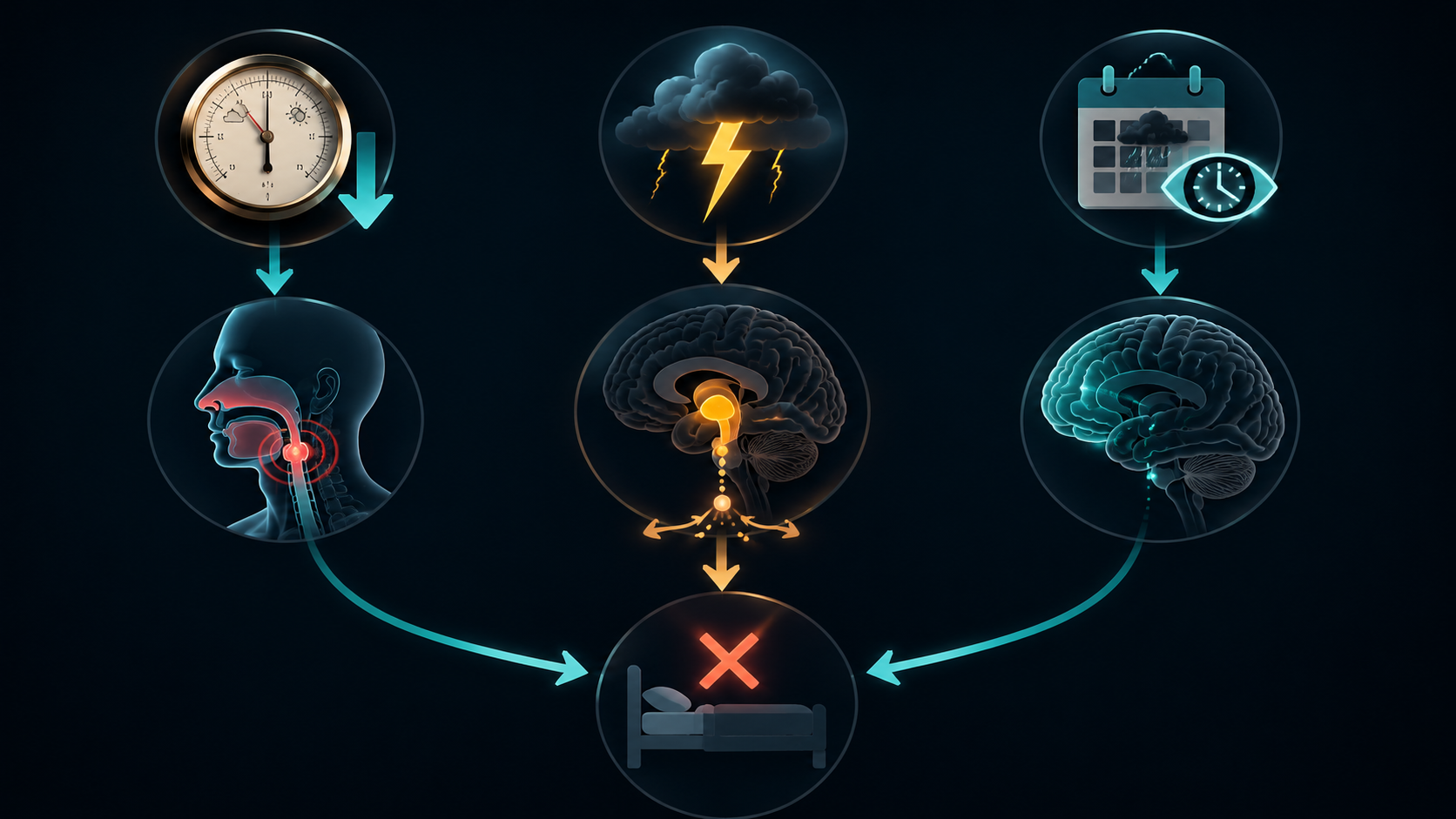
If storms are keeping you awake at night, the most useful answer is not that you are being dramatic. In some people, stormy weather stacks three real stressors on the same night: lower air pressure can make obstructive breathing events more likely, thunder can trigger involuntary arousal, and the brain can start guarding sleep hours before the first raindrop falls. [1][2][3]
When pressure drops, breathing can get less forgiving
In the Doherty et al. pilot study of 537 adults, the obstructive apnea index, or OAI, rose by about 0.3 events per hour for each 1-mB drop in ambient pressure; the lowest-pressure quartile had an OAI of 23.9 versus 17.1 in the highest quartile, with p=0.01, although the overall AHI did not reach significance. The authors described the work as exploratory, so the cleanest reading is that falling pressure may nudge vulnerable airways in the wrong direction rather than guaranteeing a bad night for everyone. [1]
That matters because lower pressure may let airway tissue expand a little and irritate nerves, which can increase resistance in a throat that already narrows during sleep. The people most likely to notice are the ones who already snore, wake choking, or suspect sleep apnea on ordinary nights. [1]
Thunder does not need permission to wake you
Thunder is different from worry because it can trigger the acoustic startle reflex before the conscious brain has time to decide the sound is safe. The amygdala shifts the body toward threat detection, the HPA axis releases cortisol and adrenaline, and repeated thunderclaps can keep sleep fragmented across the night. [2]
That is also why the body may stay alert after the loudest sound has passed. The hormone side of that cascade is covered in more detail in our cortisol-melatonin conflict piece, where the same mismatch helps explain why sleep does not always come back quickly once the room is quiet.
Sometimes the storm starts earlier than the storm
For many readers, the roughest part is not the storm itself but the hours spent anticipating it: checking forecasts, scanning for warnings, and mentally rehearsing the worst case. Counseling material describing storms and sleep calls out this "night before" pattern directly, because the body can begin treating sleep as something that needs defending long before the weather arrives. [3]
Once that happens, the bedroom stops feeling like a place to power down. It starts to feel provisional, and the brain keeps watching the clock, the window, and the forecast at the same time it is supposed to let go.
If the forecast-driven part is the strongest pattern for you, the deeper explanation lives in How Hurricane Anxiety Disrupts Sleep at Every Phase, where the anticipatory loop is traced from warning to bedtime to the next morning.
When to think beyond weather fear
Cleveland Clinic notes that about 8% of adults experience a specific phobia in a 12-month period, which is useful context here only if you keep it broad: that figure is about specific phobias overall, not astraphobia alone. [4] Fear can be part of the picture, but it does not explain every night of snoring, choking, gasping, or repeated awakenings.
That is why storms keeping you awake at night usually reads less like a character flaw and more like a convergence problem: a throat that is easier to obstruct, a startle system that fires before thought, and a brain that starts standing watch ahead of time. If choking or gasping shows up with the weather, sleep apnea deserves attention; if dread starts hours before the clouds arrive, the forecast loop itself may be doing part of the damage.
References
- Barometric pressure and obstructive sleep apnea in adults - Journal of Clinical Sleep Medicine (Doherty et al., 2010) - https://pmc.ncbi.nlm.nih.gov/articles/PMC2854702/
- Noise and Sleep - Sleep Foundation - https://www.sleepfoundation.org/noise-and-sleep
- Storms, Tornadoes & Sleep - Eunoia Wellness Counseling - https://www.eunoiawellnesscounseling.com/blog/storms-tornadoes-sleep
- Astraphobia - Cleveland Clinic - https://my.clevelandclinic.org/health/diseases/22101-astraphobia
Comments
Join the discussion with an anonymous comment.