
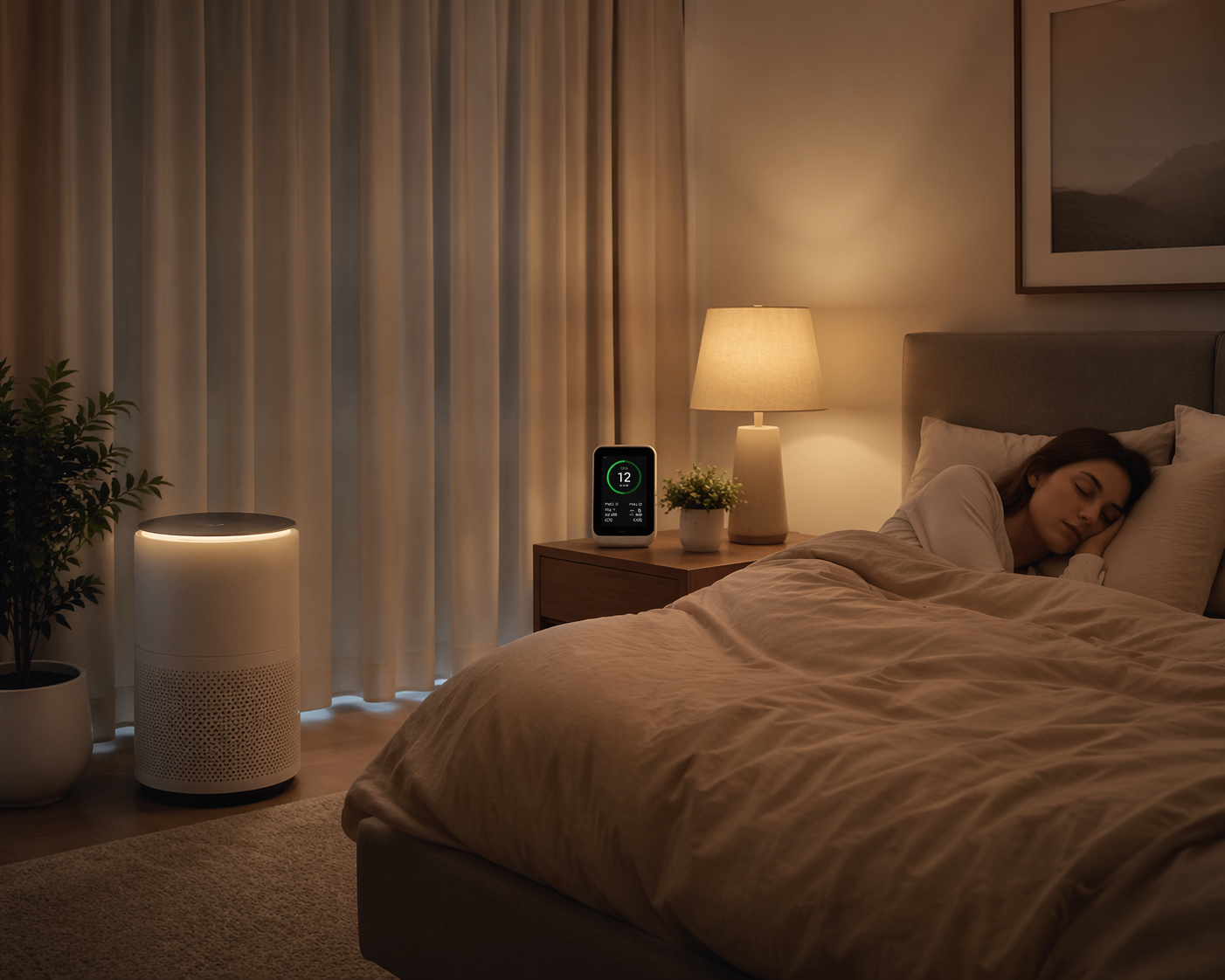
If an air quality health advisory arrives before bed and the AQI is over 100, do not open the windows for “fresh air.” Make one bedroom the clean-sleep room, close it up early, run HEPA filtration, keep filtered air moving through the HVAC if you have it, and remove the indoor sources that can ruin the room after you have sealed it. The American Lung Association’s advisory guidance is plain on the first move: keep windows closed, use recirculated HVAC air when possible, and create a cleaner indoor room during poor-air episodes.[1]
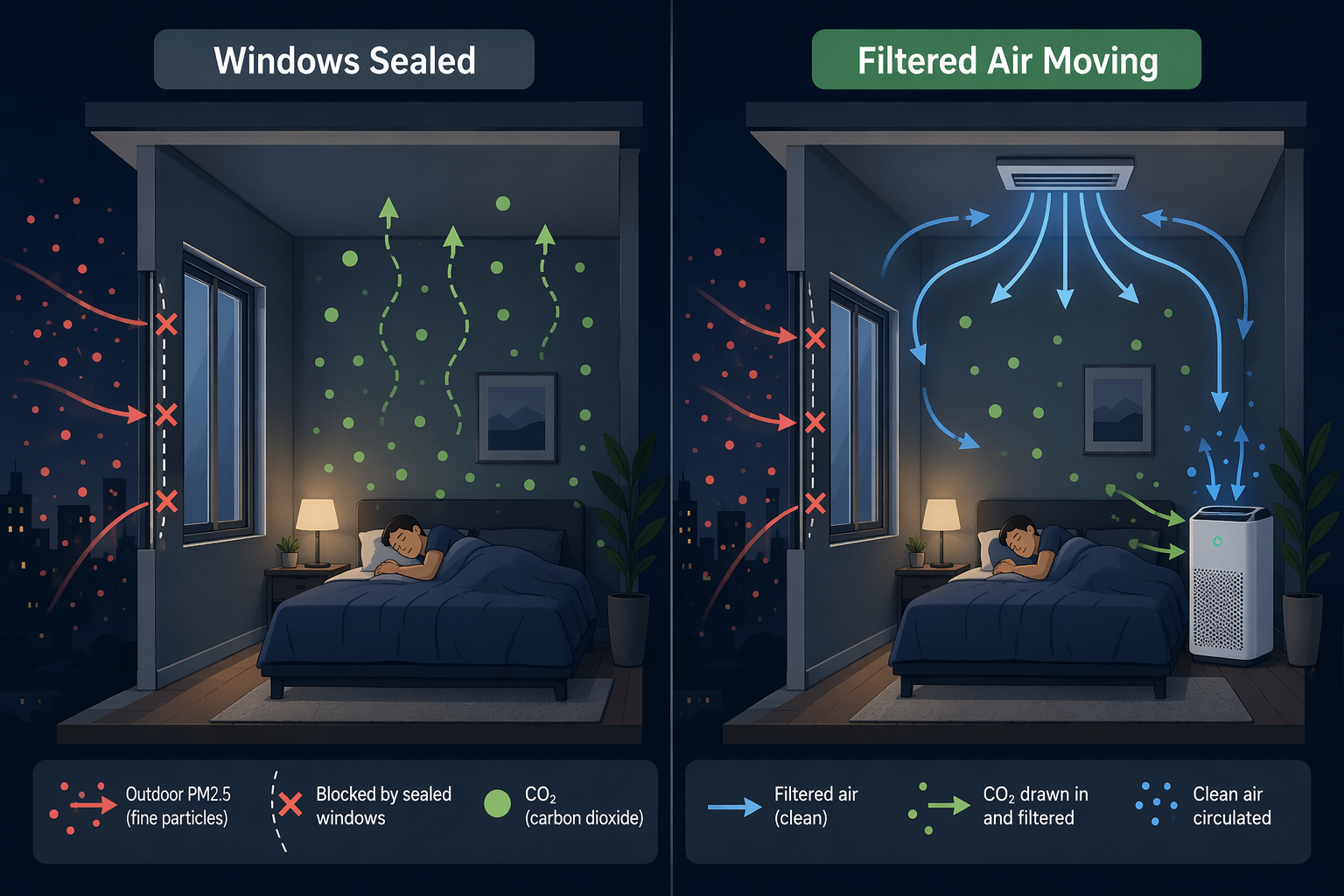
That sounds simple until the room gets warm, dinner is smoking in the kitchen, the purifier is still in the hallway, and someone says the bedroom feels stuffy. The problem is not just outdoor pollution. A sealed bedroom can keep fine particles out while allowing carbon dioxide from sleepers to build up overnight. A good bad-air bedtime routine has to solve both problems at once: less PM2.5 coming in, enough filtered air movement inside.
The Bad-Air Bedtime Protocol
Start earlier than bedtime if you can. A bedroom that has been airing out all evening is harder to rescue at 10:45 p.m., and a purifier does not instantly turn a room clean just because the light is on. Treat the advisory like a temporary household operating mode.
| When | What to do | Why it matters for sleep |
|---|---|---|
| Late afternoon or early evening | Check AirNow, your weather app, or local alerts. If AQI is above 100, choose the bedroom that will become the clean-sleep room. | You need time to close the room and let filtration work before people are under the covers. |
| Before cooking or evening chores | Close windows and exterior doors. Avoid candles, incense, smoking, frying, broiling, wood smoke, and other particle sources. | A sealed room can still be polluted from inside the house. |
| At least a few hours before sleep, if possible | Run a portable HEPA purifier in the bedroom with the door mostly closed. Keep the intake and outlet unobstructed. | Filtration lowers the particle load in the room where the longest exposure of the night happens. |
| Before the house goes quiet | Set central HVAC to recirculate or fan-on if available. Use the best compatible filter your system can handle, such as MERV-13 where appropriate. | Filtered circulation helps reduce the stale-room problem without opening the window. |
| At bedtime | Keep windows closed, keep the purifier running, manage temperature as close to your normal sleep range as the equipment allows, and avoid humid, smoky, or stuffy conditions. | The goal is not perfect air; it is a lower-exposure room that remains sleepable until morning. |
Pick the room with the fewest compromises. A bedroom with a reasonably tight window, a door that closes, an HVAC supply or return nearby, and enough space for a purifier usually beats a larger room that leaks air from every direction. If someone in the home is older, pregnant, has asthma or COPD, has obstructive sleep apnea, or is recovering from illness, give that person the better room rather than the biggest one.
Close the windows before the air gets worse, not after the smell or haze is obvious. The National Weather Service advises people to stay inside and keep windows and doors closed during air quality alerts; for sleep, that instruction needs to be narrowed to the actual bedroom where exposure will continue for hours.[2]
Run the purifier in the room, not somewhere vaguely nearby. Put it where air can move through it: not shoved behind a chair, not trapped under a desk, not pointed straight into a curtain. If the unit has an automatic mode, consider using a higher continuous setting during the advisory evening, then lowering it only if noise would keep someone awake. The quietest purifier setting is not always the useful one.
If you have central HVAC, use it as part of the sleep plan. During smoke or pollution episodes, “ventilation” cannot mean casually bringing in outdoor air. The cleaner version is recirculated, filtered movement: HVAC fan-on mode, recirculate when the system allows it, and a filter that is clean enough and efficient enough for the system. MERV-13 is often named because it captures smaller particles better than low-grade filters, but the filter has to be compatible with the equipment; a clogged or overly restrictive filter can create its own problems.
If there is no central HVAC or air conditioning, the protocol becomes more modest but still useful. Close the clean-sleep room, run a HEPA purifier continuously, reduce indoor particle sources, and use a fan only to move indoor air within the room rather than pulling outdoor air through a window. If heat makes the room unsafe or impossible to sleep in, the tradeoff changes; a cooler filtered space elsewhere, such as a community clean-air center or a better-equipped room in the home, may be the more realistic sleep intervention.
Humidity is a smaller knob, but it still matters. Baseline bedroom advice often aims for a comfortable middle range, and 50–60% can be a practical target during a short advisory event. Do not chase that number by creating damp air, steam, or condensation. A humidifier that leaves the room clammy, a shower venting into the bedroom, or wet laundry drying nearby can make the room feel harder to breathe and may create other indoor-air issues. For normal-night sleep-environment targets, see our sleep environment optimization guide.
Why Closing the Window Is Necessary but Incomplete
Fine particulate matter is the obvious enemy during many advisories. PM2.5 is small enough to travel deep into the lungs, and poor outdoor air can enter bedrooms through open windows, leaky frames, doors, vents, and the ordinary movement of people through a house. Closing the room reduces that pathway. It does not make the room automatically healthy.
A 2026 Shanghai field study followed 183 healthy young adults living in dormitories and linked bedroom PM2.5 with reduced deep sleep proportion and worse next-day endurance performance. In the study, each increase in bedroom PM2.5 was associated with a significant reduction in deep sleep proportion, reported as β = −0.19, and with lower next-day endurance performance, reported as β = −0.34.[3] That does not prove the same effect size in a 52-year-old parent in a single-family home, but it does make the bedroom itself the right unit of attention.
Deep slow-wave sleep is not just a nice extra. It is part of the night when the body does a great deal of physical restoration, and losing proportion there can make sleep feel thinner even if the clock says you were in bed long enough. This is why the advice has to be sleep-specific. A person may spend only a few minutes walking from the car to the house during an advisory, then spend seven or eight hours in the same bedroom air.
The less obvious problem is carbon dioxide. People exhale CO2 all night. In a bedroom with the door closed and little air exchange, CO2 can climb even while PM2.5 stays lower than it would with an open window. In the Shanghai dormitory study, bedroom CO2 reached up to 3,961 ppm and worsened the observed PM2.5 effects.[3] That figure comes from young dorm residents, not every bedroom, but it is high enough to make the “just seal the room” version of advice feel unfinished.
A small ASHRAE-reported intervention study makes the same practical point from the other direction. In 16 students, fan-on bedroom ventilation averaged 835 ppm CO2 compared with 2,395 ppm when the fan was off, with measurable improvements in sleep efficiency and next-day cognitive performance.[4] The sample was small, so it should not be treated as a universal household forecast. It is still useful because the intervention was boring in exactly the right way: move air through the room instead of letting it sit.
The best overnight setup during an advisory is therefore not sealed air versus fresh air. It is sealed against outdoor particles while filtered indoor air keeps moving. That distinction matters. Opening a window may improve sleep on a normal night for some people by diluting CO2 and cooling the room, but during smoke or pollution episodes it can trade one sleep disruptor for another.
What the Broader Evidence Can and Cannot Promise
The broader sleep-and-air-quality evidence points in the same direction, though it is not as tidy as a bedtime checklist. A Johns Hopkins-led metastudy reported in 2025 linked long-term exposure to PM2.5, nitrogen dioxide, and carbon dioxide with shorter, lower-quality sleep across 1.2 million participants in six countries. The Guardian’s coverage also reported the researchers’ estimate that cutting PM2.5 in half could reduce the likelihood of poor sleep by roughly 1 in 10 among middle-aged and older adults.[5]
That is not the same as proving that one purifier on one smoky Tuesday will improve one person’s sleep by a fixed amount. The large study is observational, and the most quotable figures in public coverage should be checked against the journal paper before being treated as final clinical claims. For household decisions tonight, the value is more modest: multiple lines of evidence make it reasonable to treat bedroom air as part of sleep hygiene, not as a separate public-health issue that stops at the front door.
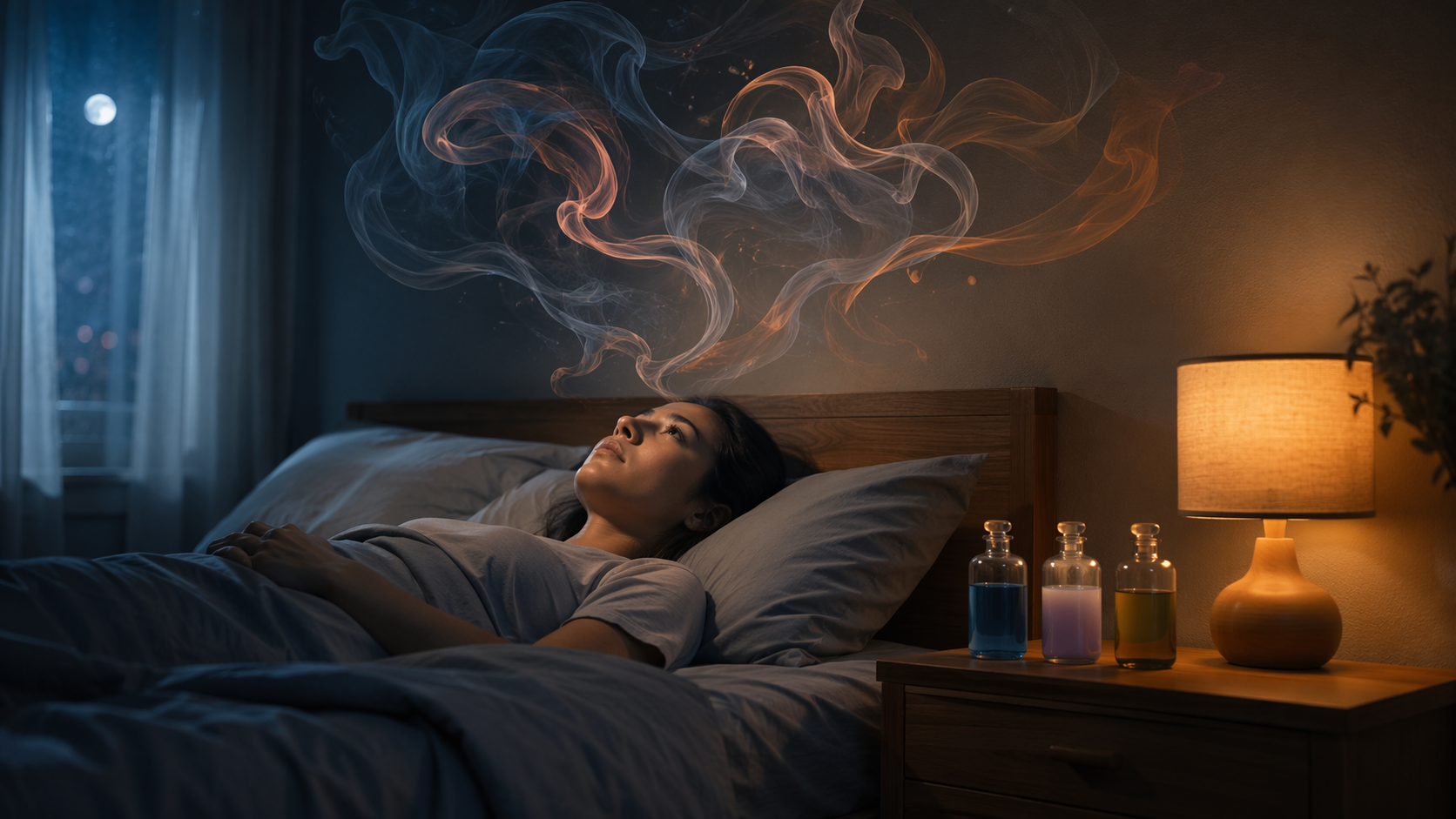
Inflammation is the third piece. Inhaled pollutants can irritate airways and contribute to inflammatory responses; Sleep Foundation’s wildfire-smoke guidance notes that smoke exposure can affect breathing and sleep, especially for people with respiratory conditions.[6] The sleep consequence may show up as coughing, congestion, more awakenings, a dry or irritated throat, or a bed partner waking because someone else is breathing noisily. None of that requires a dramatic medical event to spoil the night.
The Small Household Decisions That Usually Decide the Night
Dinner can undo the bedroom. If the advisory is active, avoid high-smoke cooking close to bedtime: frying, searing, broiling, grilling near an open door, or anything that sets off the hood fan while pulling replacement air from outdoors. If cooking is unavoidable, ventilate locally as safely as conditions allow, keep the clean-sleep room closed, and run the purifier before people go in. The person who notices the smell in the hallway at 9:30 p.m. should not have to invent a new plan then.
Candles and incense are not small details during an advisory. They add particles inside the very envelope you are trying to protect. The same goes for indoor smoking, fireplaces, scented smoke products, and hobby materials that create fumes or dust. On a normal night those may already be questionable for sleep; on a bad-air night they are working against the entire protocol.
Doors matter more than they get credit for. A bedroom door left open to a smoky kitchen or dusty hallway is a decision, even if nobody thinks of it as one. Close it once the purifier is running. If the room becomes too warm or stuffy, try filtered circulation first: HVAC fan, purifier placement, a clean indoor fan moving room air, lighter bedding, or a cooler interior room. Opening the window is the last resort during an AQI-over-100 event, not the first comfort adjustment.
Noise also has to be handled honestly. A purifier that sounds like a small aircraft may lower particles and still wake a light sleeper. If that happens, run it high before bed, then drop to the highest tolerable overnight setting. Place it far enough from the pillow that the sound is steady background noise rather than a blast across the face, while keeping airflow unobstructed. The useful setting is the one that stays on all night.
If You Are in a Sensitive Group or Use CPAP
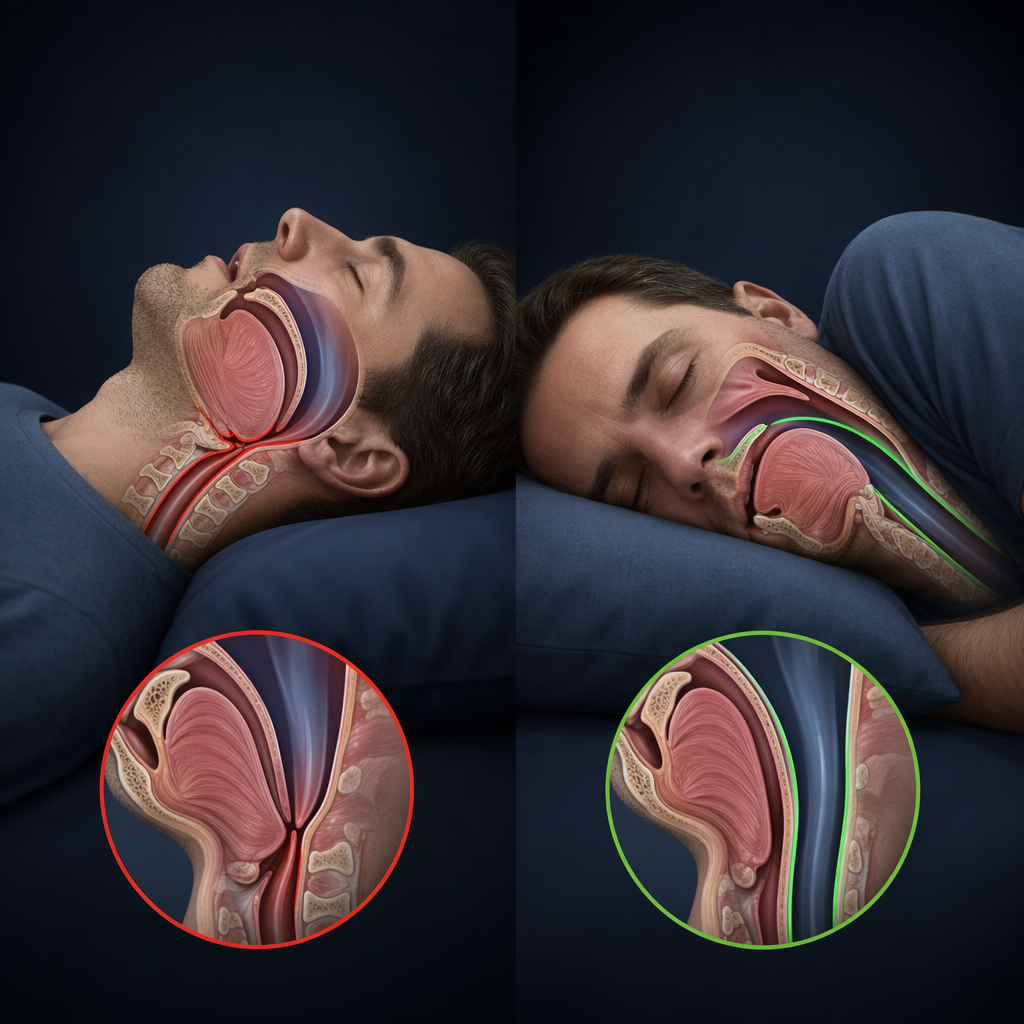
Some people should treat the protocol less casually. Older adults, pregnant people, children, and people with asthma, COPD, cardiovascular disease, or obstructive sleep apnea may have less margin when outdoor air quality drops. The National Weather Service notes that people with heart or lung disease, older adults, children, and teens are among groups at greater risk during poor air quality events.[2]
For CPAP users, the machine deserves attention before bedtime, not after the mask is on. Check that the device intake is not pulling air from a dusty floor, a smoky hallway, or a blocked corner. Replace or inspect the machine’s filter according to the manufacturer’s instructions. If you already use compatible fine filters or an inline HEPA filter recommended for your setup, make sure it is installed correctly and not overdue. Do not improvise materials over the intake; restricting airflow on a medical device is not a sleep hack.
Asthma and COPD plans belong with the clinician who wrote them. The sleep-specific part is to make nighttime triggers less likely: cleaner room, fewer particles, stable temperature, and medications available as prescribed. If poor air quality is paired with wheezing, chest tightness, shortness of breath, confusion, bluish lips, severe symptoms, or sleep disruption that does not settle after the advisory passes, use medical guidance rather than trying to solve it with another appliance. For persistent sleeplessness after the event, see the evidence-based sleep hygiene checklist for insomnia; for red flags and escalation, use our adult self-triage guide for not sleeping.
What Not to Do During an AQI-Over-100 Night
- Do not open the bedroom window to fix stuffiness unless heat or safety leaves no better option.
- Do not run a window fan that pulls outdoor air into the sleep room during the advisory.
- Do not assume a purifier in the living room protects a closed bedroom down the hall.
- Do not add indoor smoke from candles, incense, fireplaces, or late-night high-smoke cooking.
- Do not ignore a dirty HVAC filter and then rely on fan-on mode as if it were clean filtration.
- Do not make a child, older adult, pregnant person, or respiratory patient sleep in the leakier room if a cleaner one is available.
One survey-based Sleep Foundation article reported that 53.2% of U.S. adults sleep with windows closed, which means many households are already halfway to the advisory setup.[7] The missing half is filtered movement. A closed bedroom with no filtration, no HVAC fan, a smoky kitchen nearby, and two people exhaling all night is not the same as a clean-sleep room.
During an air quality health advisory, sleep protection comes from a temporary protocol rather than a permanent redesign of the house. Seal the room against outdoor PM2.5, keep filtered air moving so the room does not become stale, and stop adding particles indoors. In the morning, when the advisory changes, the house can go back to being a house instead of a small air-management project.
References
- Protecting Yourself from Poor Air Quality: Answering FAQs to help you understand AQI — American Lung Association
- During an Air Quality Alert — National Weather Service
- Association of bedroom particulate matter, sleep quality and next-day physical performance — Lin et al., Scientific Reports, 2026
- Using Indoor Air Quality Tactics To Sleep Better At Night, Perform Well The Next Day — Wargocki, ASHRAE Journal, 2017
- Air pollution can affect how well we sleep, scientists discover — The Guardian, Sep 2025
- How Wildfire Smoke Pollution Can Impact Your Sleep — Sleep Foundation
- If Opening a Window Leads to Better Sleep, Why Don't We Do It? — Sleep Foundation
Comments
Join the discussion with an anonymous comment.