
The best sleep routine for night shift workers is not a bedtime. It is a timed handoff: prepare before the shift, use light and caffeine early, protect the commute home, make daytime sleep defensible, and keep days off from becoming a weekly circadian reset. Generic advice usually fails because it starts too late. By the time a night worker is standing in the kitchen at 7:30 a.m., wired and exhausted, “keep the room dark” is only one part of the problem.
That problem is real enough to deserve a more precise routine. Shift workers may sleep 2–4 fewer hours per 24 hours than daytime workers, and drowsy driving is linked with at least 100,000 crashes each year in the United States.[1] Insomnia symptoms are also more common in shift workers than in the general population: StatPearls reports that 29–38% of shift workers meet criteria for insomnia, compared with about 6% of the general population, while shift work sleep disorder is a narrower diagnosis reported in 26.5% across some study populations.[2]
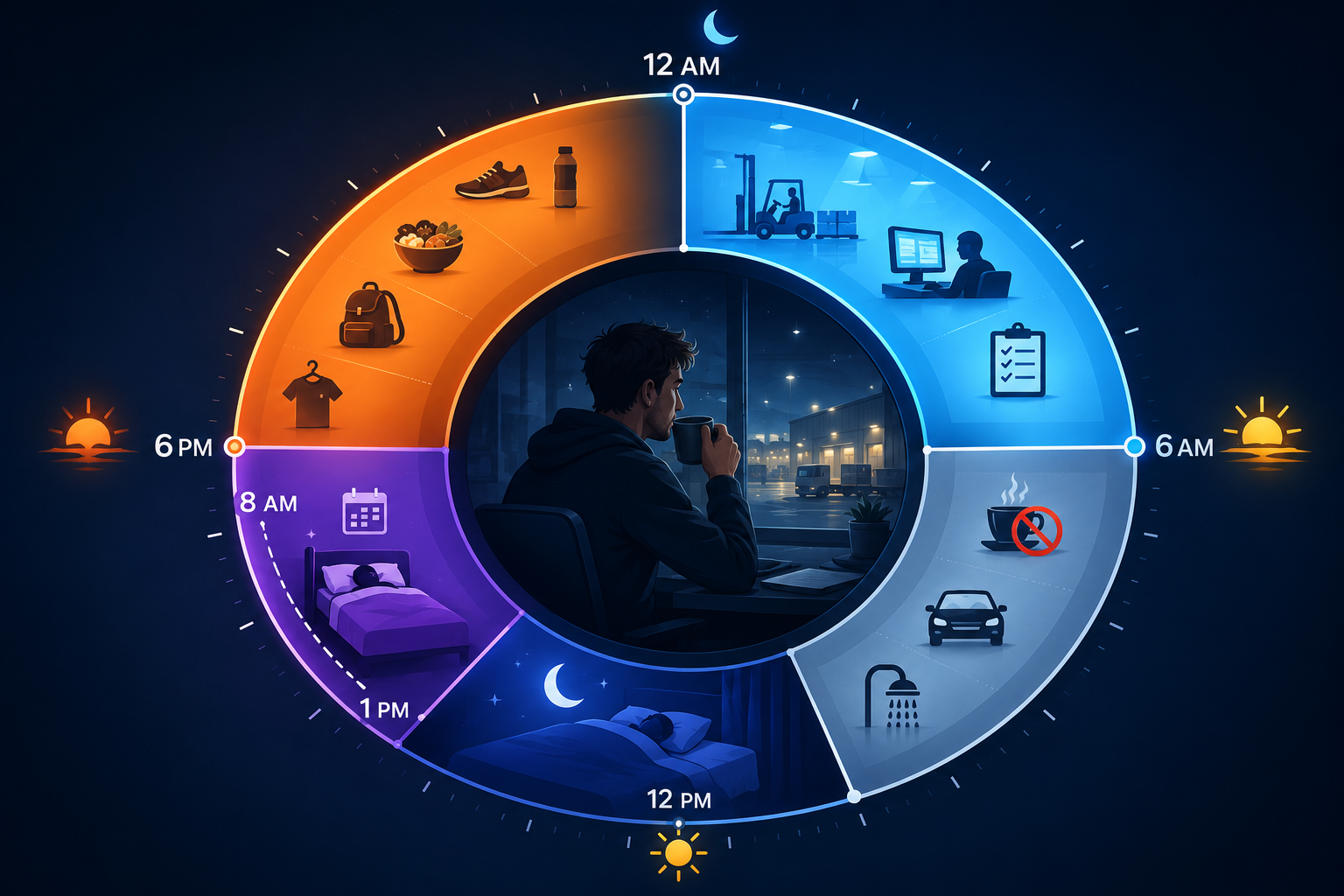
A workable routine has five moving parts. The exact clock times change with the job, commute, family needs, and whether the schedule rotates, but the order matters.
| Phase | Main job | What to do |
|---|---|---|
| Pre-shift preparation | Lower sleep pressure before work | Use a 90-minute nap if possible, or 20–30 minutes as a minimum alternative |
| First half of shift | Support alertness and delay the body clock | Use bright or blue-enriched light; place caffeine here if you use it |
| Second half through commute | Avoid being too activated for daytime sleep while staying safe | Dim light late in the shift; stop caffeine 4–6 hours before sleep; nap before driving if needed |
| Wind-down and daytime sleep | Defend the recovery window | Block light, reduce noise, cool the room, and make family or household boundaries explicit |
| Days off | Avoid weekly jet lag | Keep an anchor sleep block, often 8 a.m. to noon or 1 p.m., rather than fully flipping back |
Before the shift: nap on purpose, not by accident
The pre-shift nap is not a luxury add-on. It is the first safety decision of the shift. Cleveland Clinic describes strategic napping as one of the most effective tools for night shift workers, and the useful distinction is between a full sleep-cycle nap and a shorter emergency version.[3]
If your schedule allows it, aim for about 90 minutes before work. That gives the body a chance to move through a fuller sleep cycle instead of waking from the deepest part of sleep right as you need to drive in or clock on. If 90 minutes is impossible, a 20–30 minute nap is still worth protecting; it can reduce sleep pressure without as much sleep inertia as a longer, interrupted nap.[3]
Some workers use a caffeine nap: drink caffeine immediately before a 15–20 minute nap so the stimulant begins to take effect as the nap ends.[3] That can be useful before a demanding shift, but it belongs early enough that it does not sabotage the sleep you are trying to get the next morning. A caffeine nap at the wrong end of the shift is just delayed insomnia with better branding.
For rotating schedules, the pre-shift nap also gives you a buffer when the body has not fully adapted to the night schedule. It will not erase circadian misalignment, but it can lower the amount of wakefulness you are carrying into the hardest hours.
Early in the shift: put bright light where it can still help
Light is the strongest lever in the routine because it tells the brain what time it is. For night workers, the useful question is not simply “Was the room dark when I slept?” It is “What light did my brain receive before I tried to sleep?”
During the first half of the shift, bright light can support alertness and help push the body toward wakefulness at a time it would normally be preparing for sleep. Research summarized in a 2024 Frontiers in Sleep mini review found that workplace light interventions, including blue-enriched lighting in some studies, improved alertness, concentration, and sleep-related outcomes among shift workers.[4]
That does not mean every workplace needs to become a light lab. In practical terms, early-shift light means using the brightest appropriate work area, taking breaks in well-lit spaces if your job allows, and avoiding the habit of keeping the whole first half of the shift dim because “I need to sleep later.” The later sleep window matters, but dimming everything from the start can leave you fighting the body clock during patient checks, machine operation, dispatch decisions, stocking, charting, or the long middle hours when errors become easier.
Caffeine, if you use it, belongs in this same early-shift zone. It is better treated as a timed tool than as a beverage that follows boredom. Because caffeine has a 5–6 hour half-life, Cleveland Clinic advises stopping it 4–6 hours before planned sleep.[3] Someone who can technically fall asleep after late coffee may still get lighter, shorter, or more fragmented daytime sleep.
Late shift and commute: start landing the plane before sunrise

The second half of the shift is where many routines contradict themselves. A worker uses bright light and caffeine to survive the night, then expects the body to shut down as soon as the shift ends. The better move is to begin reducing the alerting signals before work is over, without making the workplace unsafe.
Late in the shift, use dimmer light when the job permits. That might mean avoiding unnecessary bright break-room light near the end of the shift, lowering screen brightness if it does not interfere with accuracy, or choosing a less brightly lit area for paperwork after the most safety-critical tasks are done. This is not a command to work in the dark. It is a reminder that the last light exposure of the shift can make the next sleep attempt easier or harder.
The commute needs its own rule because it is the part of the routine most likely to be waved away. Morning light after a night shift can push the body toward daytime alertness, which is exactly what a night worker does not want before daytime sleep. But dark sunglasses are not a blanket recommendation for drivers. Cleveland Clinic notes that sunglasses after work may help block morning light when someone else is driving; if you are the driver, reducing light can worsen drowsiness and driving risk.[3]
If you are too sleepy to drive safely, the routine changes. A 20–45 minute nap before driving can significantly reduce drowsy-driving risk, according to UCLA Health.[1] That may mean sleeping in a safe, permitted place before leaving, arranging a ride after especially hard shifts, or using public transportation when available. The point is not heroic toughness; the point is getting home alive.
After work: make daytime sleep a protected recovery block
Daytime sleep has to compete with sunlight, deliveries, lawn equipment, family schedules, school pickups, and the social assumption that a person at home is available. Treat the bedroom less like a cozy retreat and more like a recovery chamber: dark, cool, quiet, and boring.
Start with light. The target is not “mostly dark” if light still leaks around the curtains and lands on your face. The practical goal is blackout-level darkness, with less than 5 lux as the target cited in the night-shift sleep guidance. Blackout curtains, a well-fitted sleep mask, covered indicator lights, and a phone kept face-down or out of reach all serve the same purpose: stop the brain from receiving a daytime signal while you are trying to sleep.
Temperature is the next lever. A bedroom around 60–67°F is commonly recommended for sleep in night-shift guidance, overlapping with the cooler-room targets used in broader sleep environment advice. If you want a deeper room-by-room setup, the Sleep Environment Optimization guide covers temperature, light, noise, and humidity in more detail.
Noise control is not optional for many night workers. White noise can cover irregular household or street sounds; earplugs can help when the noise is sharper or intermittent. If you live with other people, the most useful sleep hygiene rule may be a visible boundary: a sign, a shared calendar, or a household agreement about which interruptions count as urgent. “I am asleep from 8:30 a.m. to 2:30 p.m.” is easier to defend than “I’ll try to nap after work.”
Screens matter here mainly because of timing and light. If the phone is the bridge between work and sleep, make it a short bridge: low brightness, warm display settings, and no accidental hour of scrolling in a bright room. For shift workers, vague “avoid screens” advice is less useful than a concrete shutdown path: eat if needed, shower if it helps you cool down, set the room, silence notifications, and get into bed before the neighborhood fully wakes up.
Melatonin sometimes comes up in night-shift routines, but it should be treated as a secondary aid rather than the structure itself. The stronger routine still depends on timed light, naps, caffeine cutoff, and a protected sleep window. If you use sleep aids, keep them consistent with your work schedule and medication safety, especially if you drive, operate equipment, or take other sedating medications.
Days off: keep one anchor instead of flipping the whole clock
Days off are where an otherwise decent night-shift routine often breaks. It is understandable: people want breakfast with family, daylight errands, appointments, school events, and a normal-looking weekend. The problem is that fully flipping to a day schedule and then flipping back before work can create a weekly jet-lag loop.
CDC/NIOSH offers a compromise schedule for night workers: on days off, sleep until noon or 1 p.m. and keep an anchor sleep block from about 8 a.m. to noon.[5] That block is not a moral test of consistency. It is a stabilizer. It lets you reclaim part of the day without teaching your body that every day off is a new time zone.
For a worker coming off a final night shift, that may mean sleeping after work until early afternoon, then going to bed later that night than a day worker would. For someone returning to nights, it may mean using an evening nap before the first shift back. The details change, but the anchor does the same job: it preserves a repeatable morning sleep window so the next night shift does not start from zero.
The anchor approach is also more realistic for families than insisting on perfect night-shift consistency. A parent, caregiver, student, or second-job worker may not be able to keep the same sleep schedule seven days a week. Holding one protected block is often the difference between a routine that survives contact with real life and one that looks good only on paper.
A sample routine for a 7 p.m. to 7 a.m. shift
Use this as a template, not a prescription. A nurse with a 40-minute commute, a warehouse worker with mandatory overtime, and a dispatcher rotating shifts will need different clock times.
| Time | Action |
|---|---|
| 3:30–5:00 p.m. | Take a 90-minute pre-shift nap if possible |
| 5:00–6:30 p.m. | Eat, hydrate, prepare for work, and get bright enough light to feel awake |
| 7:00 p.m.–1:00 a.m. | Use bright workplace light where appropriate; place caffeine in this early window |
| 1:00–3:00 a.m. | Stop caffeine if planned sleep is around 8:30–9:00 a.m. |
| 3:00–7:00 a.m. | Use dimmer light when safe and practical; avoid unnecessary bright break-room or screen exposure |
| Before commute | If dangerously sleepy, take a 20–45 minute nap before driving or arrange another way home |
| After arriving home | Keep the wind-down short, block morning light, and enter the sleep environment quickly |
| 8:30 a.m.–2:30 or 3:30 p.m. | Protect the main daytime sleep block as much as the job and household allow |
If the schedule is shorter, longer, or rotating, keep the sequence even when the clock times move: nap before the shift, light and caffeine early, dim late, protect the commute, then defend the daytime sleep block.
When the routine is not enough
A hard adjustment period is common when starting nights or rotating shifts. Persistent impairment is different. Shift work sleep disorder is not the same as having one rough week after a schedule change, and it should not be confused with general insomnia symptoms. UCLA Health describes diagnostic criteria that include symptoms lasting at least 3 months, with impairment present for at least 1 month.[1]
Consider professional evaluation if you regularly cannot sleep after shifts, cannot stay alert during work, feel unsafe driving, or have sleep problems that persist despite a structured routine. A clinician can look for shift work sleep disorder, chronic insomnia, sleep apnea, medication effects, mood disorders, and other contributors. If the pattern looks broader than shift timing alone, this guide to hidden causes of insomnia can help frame what else may be worth discussing.
The best routine is the one that manages the whole work cycle: alertness during the shift, safety on the way home, real recovery during the day, and enough stability on days off that the body is not starting over every week.
References
- Coping with Shift Work Sleep Disorder, UCLA Health
- Shift Work Hazards, StatPearls/NIH, 2024
- How To Sleep Better When You Work the Night Shift, Cleveland Clinic
- Current sleep interventions for shift workers: a mini review, Frontiers in Sleep, 2024
- Module 9 — Coping with the Night and Evening Shifts, CDC/NIOSH
Comments
Join the discussion with an anonymous comment.