
If your bedroom is hot and you do not have air conditioning, the useful question is not “What are all the cooling hacks?” It is “What should I do first, while I still have energy?” The best answer is a sequence: block heat before it enters, flush the room with cooler outdoor air when conditions allow, then use a fan as an exhaust tool rather than as a small wind machine pointed at your face.
The ranking matters because the biggest measured effect comes from combining passive heat control with fan-assisted ventilation. In a 2024 Nature Scientific Reports study from Aijazi and colleagues, combined passive-plus-fan strategies produced about three times the cooling effect of fan use alone; the same study notes that its measurements captured dry heat loss, so the results may be conservative for a sweating person in a real bedroom.[1]
| Rank | What to do first | Why it earns the spot |
|---|---|---|
| 1 | Block daytime heat, then use an exhaust-style window fan at night | Largest measured cooling stack; changes the room’s heat burden instead of asking your body to compensate all night |
| 2 | Take a warm shower or bath about 90 minutes before bed | Improves sleep onset by helping the body shed heat afterward, even though it does not cool the room |
| 3 | Control humidity and bedding | Makes sweating and heat release work better; especially useful when the room is warm but not dangerously hot |
| 4 | Use pulse-point cooling, damp fabric, and spread-out posture | Good short-term relief, but usually smaller and more temporary than changing the room airflow |
| 5 | Point a fan directly at yourself | Better than still air for many people, but weaker than exhaust ventilation plus passive heat blocking |
1. Block the heat before bedtime, then move air out
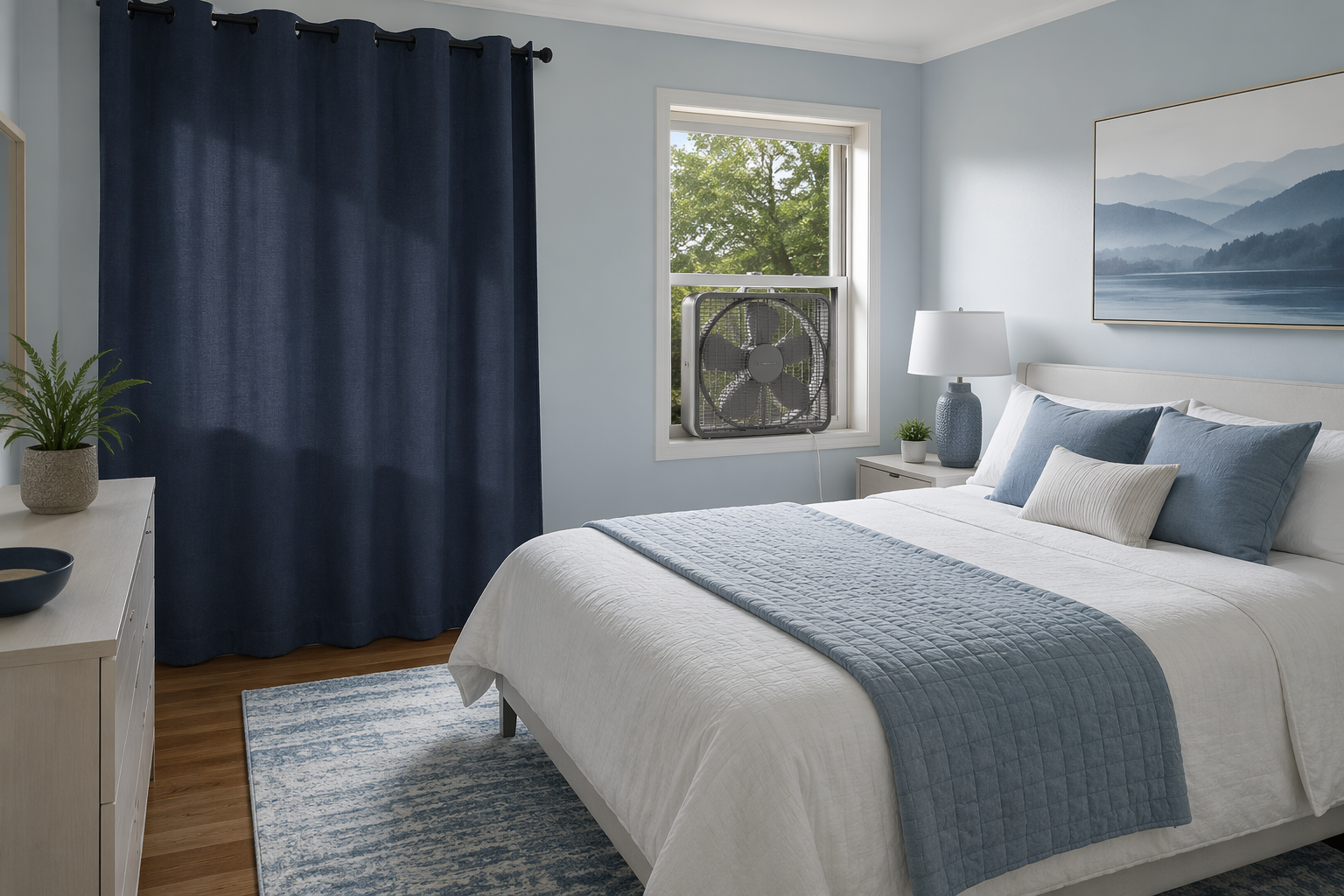
The strongest no-AC move starts hours before you lie down. A bedroom that has been absorbing sun through glass all afternoon is not the same problem as a bedroom that stayed shaded and then got ventilated after sunset. By 10:30 p.m., you can still make the room more tolerable, but the best work was probably the boring work: curtains closed, sun blocked, and unnecessary heat kept out.
Windows are the obvious weak point. The U.S. Department of Energy says up to 76% of sunlight that falls on standard double-pane windows becomes heat indoors, and that tightly installed cellular shades can reduce unwanted solar heat through windows by up to 60%; blackout curtains can reduce heat gain by up to 33%.[2] If you rent, this is where the practical version of “sleep hygiene” may look like blackout curtains, reflective window film approved by your lease, a tension rod, or even a temporary foil-backed insulation panel placed carefully during the day.
The daytime rule is simple: if the sun is hitting the window, the window is not your friend. Close curtains before the room heats up. Keep the hottest window covered even if the room feels gloomy. If one side of the home stays cooler, close off the hotter rooms so they do not donate their heat to the bedroom later.
At night, the job changes. Once the outdoor air is cooler than the bedroom, ventilation can help. This is where fan placement gets oddly important. A fan blowing inward at your bed gives you moving air on skin. A fan blowing outward through a window can pull warmer indoor air out and draw cooler outside air in from another opening, creating cross-ventilation instead of local breeze.
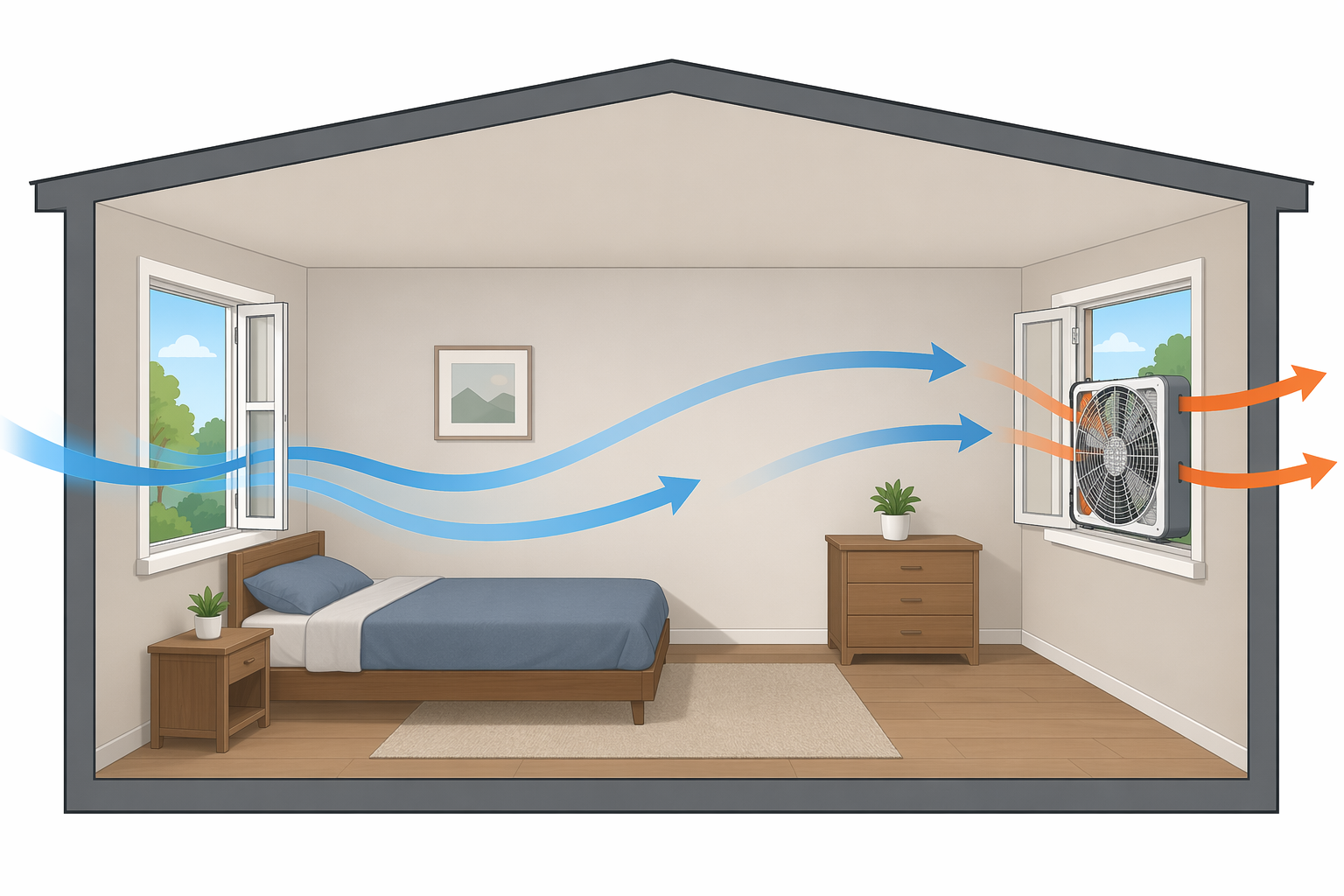
That exhaust setup is also the common recommendation from home ventilation guides: place a box fan or window fan in one window facing outward, then open another window or door on the cooler side of the home so replacement air has a path into the room.[3][4] The fan is not cooling the air like an air conditioner. It is exchanging air, which is exactly what you want if the room is holding heat after the outdoor temperature has dropped.
- During the day: close curtains, shades, or temporary window covers on sun-facing glass before the room warms.
- At sunset: check whether the outdoor air is cooler than the bedroom; if it is not, keep hot air out.
- When outside cools: open a second window or door on the cooler side of the home.
- Set the fan: point it outward in the warmer bedroom window so it exhausts indoor air.
- Before sleep: keep the intake path open only if it is safe, quiet enough, and not pulling in smoke, allergens, or humid air.
This is also where money enters the room. The Aijazi study estimated fan operation at about $0.01 per night compared with about $14.40 per night for central AC under the study’s assumptions.[1] That does not mean a fan replaces AC in dangerous heat, but it does explain why low-energy cooling deserves serious attention. In 2020 Residential Energy Consumption Survey data, the U.S. Energy Information Administration reported that 6.4 million U.S. households could not use air conditioning because of cost.[5]
What if you only have one window?
With one window, you lose the clean cross-breeze path, but you can still exhaust heat if there is another opening to a cooler hallway, stairwell, or adjacent room. Put the fan facing out, crack the door, and let replacement air come from the least-hot part of the home. If the hallway is hotter than the bedroom, skip the exchange and use the fan for direct airflow instead.
If safety, noise, wildfire smoke, outdoor humidity, or building rules make open-window ventilation impossible, the ranking changes for that night. Keep the daytime heat-blocking piece. Then move down the list to body cooling, humidity, bedding, and short-term relief. A strategy you cannot use safely is not a strategy.
2. Take a warm shower before bed, not an icy one
A cold shower feels like the obvious answer because it gives immediate relief. The sleep-specific evidence points in a different direction: a warm shower or bath about 90 minutes before bed can help people fall asleep faster. A 2019 meta-analysis in Sleep Medicine Reviews found that warm water bathing or showering at 104–108°F, timed 1 to 2 hours before bedtime with an optimal window around 90 minutes, improved sleep onset.[6]
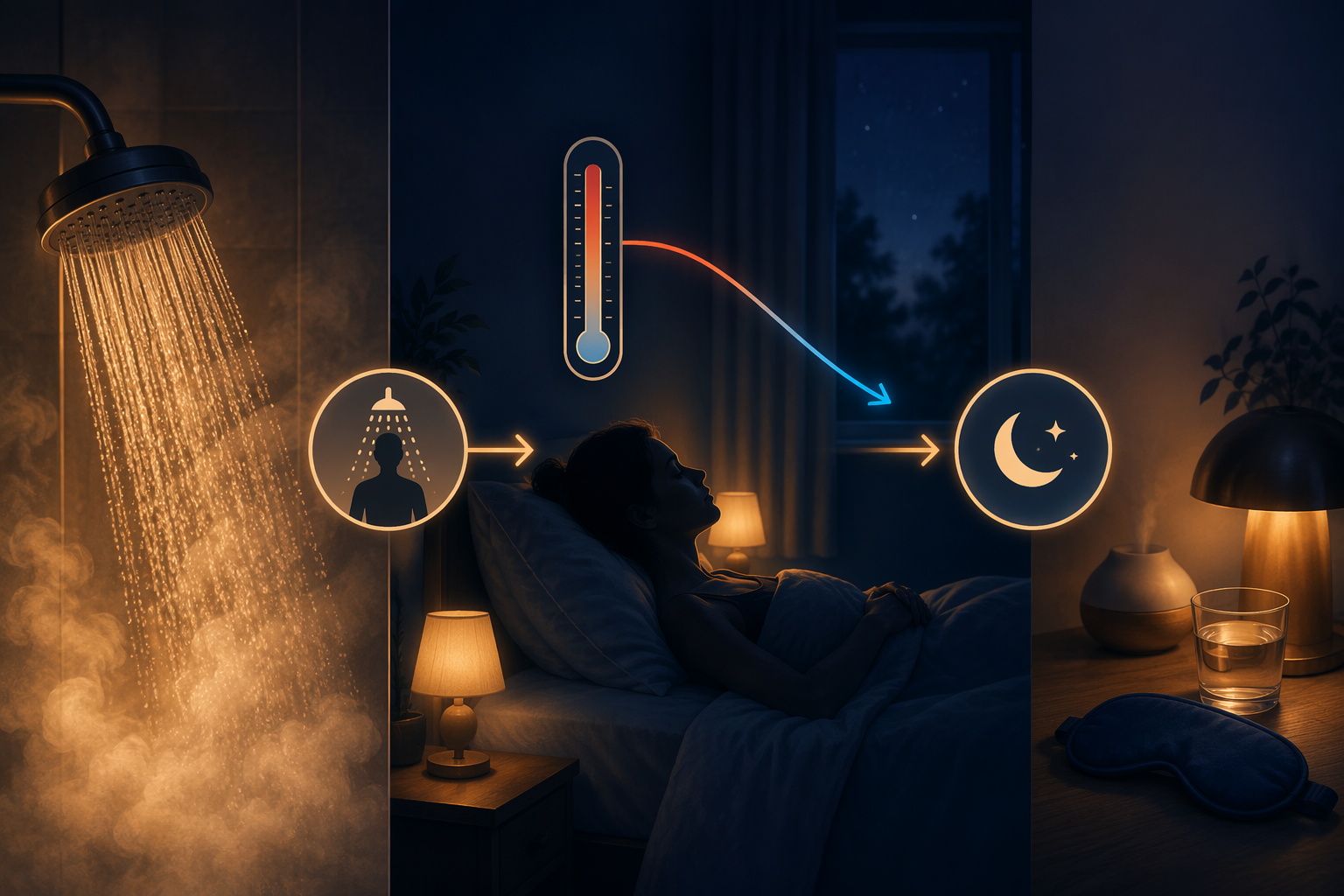
The mechanism is the useful part. Warm water brings blood flow toward the skin through vasodilation. After you step out, that skin-level heat can dissipate, helping core body temperature decline as bedtime approaches. Sleep onset normally leans on that cooling process; the shower is not magic, it is timing.
This is why the warm-shower step belongs after the room-cooling stack, not instead of it. A warm shower does not remove heat stored in the walls, mattress, or air. It helps your body meet the night in a better thermal state. If the bedroom is still stifling, you may feel good for 15 minutes and then run into the same overheated room again.
For a practical evening, the timing can look like this: block sun all afternoon, ventilate after outdoor air cools, take a warm shower roughly 90 minutes before bed, then let skin dry fully before getting under light bedding. If you shower immediately before lying down, you may still feel warm and damp when you want to sleep.
No shower available? Use a warm foot soak if that is easier, or move to short-term cooling methods like a cool cloth on the neck, wrists, or ankles. Those alternatives should be treated as relief tools, not exact substitutes for the bathing protocol studied in the meta-analysis.
3. Make sweating work: humidity, bedding, and space around the body
Once the bedroom’s heat load is handled as much as possible, the next question is whether your body can actually shed heat. Humidity is the spoiler. In dry air, sweat can evaporate and carry heat away. In humid air, sweat lingers, bedding feels clammy, and the same room temperature can feel more oppressive.
If you have a dehumidifier and can run it before bed without turning the bedroom into a noisy, hot box, it may help comfort. If you do not, avoid adding moisture to the room late at night: do not hang wet laundry in the bedroom, do not overdo damp-sheet tricks in already humid air, and be careful with evaporative coolers in climates where the air is not dry enough to support them.
Bedding is less dramatic than window control, but it still matters because it sits against the heat-exchange surface: your skin. Use the lightest cover that lets you feel settled. If you need weight to sleep, concentrate it away from the torso when possible. Keep synthetic, heat-trapping layers off the bed during heat waves, especially mattress pads or protectors that turn the bed into a warm envelope.
Posture is the cheapest adjustment. A spread-out “starfish” position exposes more skin and reduces trapped heat between limbs and torso. It is not elegant, and it may not survive contact with a partner, pet, or small mattress, but it works with the same basic physics as loose clothing: more exposed surface area, less insulation.
4. Use pulse-point cooling and damp fabric as rescue tactics
There are nights when the room strategy was late, the outdoor air never cooled, or the building simply held too much heat. That is when small body-cooling tactics earn their place. A cool cloth at the neck, wrists, elbows, groin, or ankles can feel disproportionately helpful because those areas have blood vessels close to the skin. The effect is local and temporary, but temporary is not worthless at midnight.
A lightly damp sheet can also help in dry climates if a fan moves air across it. In humid climates, it can become a sticky blanket. This is the kind of advice that gets overpromoted because it sounds resourceful; it belongs in the emergency pocket of the ranking, not at the top.
Cold packs need more caution than enthusiasm. Wrap them in cloth, avoid direct ice on skin, and do not fall asleep with intense cold pressed against one spot. The goal is to make it easier to drift off, not to trade heat stress for skin irritation.
5. A fan pointed at you is useful, just not the top move
Direct fan airflow can make a warm room more bearable by moving air across skin and helping evaporation. If it is the only tool you have, use it. Aim it across your body rather than straight into your eyes and throat. Keep cords safe, clean dust from blades or grills, and stop using the fan if it is pulling in hotter air, smoke, or irritants.
It is still ranked below the passive-plus-exhaust setup because a fan aimed at the sleeper mostly changes skin sensation. Exhaust ventilation can change the air in the room when outdoor conditions cooperate. The Aijazi study’s roughly threefold advantage for combined passive-plus-fan strategies over fan alone is the cleanest reason not to treat all fan advice as interchangeable.[1]
How cool does the room need to be?
There is no single sacred sleep temperature. Sleep Foundation describes the ideal bedroom temperature as about 65–68°F, the National Sleep Foundation gives a 60–67°F range, and HealthPartners describes 68–72°F as comfortable for many people.[7][8][9] Those ranges are useful as a target, but they can also sound absurd if your apartment is sitting at 82°F after a heat wave.
A more practical threshold is that sleep quality tends to suffer once the room gets above about 75°F, especially when humidity is high or airflow is poor.[9][10] That does not mean you have failed if your bedroom cannot hit the ideal range. It means the goal changes: reduce the heat burden enough for your body’s nighttime cooling system to do some of its job.
The climate context makes this less like a lifestyle preference and more like a resilience problem. A 2024 systematic review in Sleep Medicine Reviews concluded that warmer ambient temperatures are associated with worse sleep, and nighttime warming is a growing concern because nights are not cooling down the way many homes and bodies depend on.[11] A 2023 Casper/Gallup survey of about 4,000 U.S. adults found that 14% identified as hot sleepers, which is a survey finding rather than a clinical diagnosis, but it captures how ordinary the problem has become.[12]
The shortest workable bedtime plan
If it is already evening and you need the two actions most worth doing, do these first: set up exhaust ventilation if the outdoor air is cooler and safe to bring in, then take a warm shower about 90 minutes before bed. If you still have daylight left tomorrow, move the heat-blocking step earlier. Curtains at noon beat clever tricks at midnight.
- Before the room heats up: block sun-facing windows with curtains, shades, or temporary reflective barriers.
- After outdoor air cools: open an intake path and place a fan facing outward in another window.
- About 90 minutes before bed: take a warm shower or bath, then let your body cool down.
- At bedtime: use light bedding, spread out, and keep airflow moving across skin.
- If still too hot: use cool cloths or a lightly damp sheet only as short-term relief, especially in dry air.
None of this promises AC-like comfort. The hierarchy is more modest and more useful: stop the sun from loading the room with heat, exchange hot indoor air when the outside air finally helps, then support the body’s own cooling rhythm instead of fighting it with random last-minute hacks. To understand the physiology behind that rhythm, see our deep dive into how extreme heat hijacks your body’s sleep cooling system.
References
- Passive and low-energy strategies to improve sleep thermal comfort and energy resilience during heat waves and cold snaps, Nature Scientific Reports, 2024
- Energy Efficient Window Attachments, U.S. Department of Energy
- Should a Window Fan Face In or Out?, The Spruce
- How to Cool a Room With Fans, The Happy Sleeper
- 2020 Residential Energy Consumption Survey, U.S. Energy Information Administration, 2020
- Before-bedtime passive body heating by warm shower or bath to improve sleep: A systematic review and meta-analysis, Sleep Medicine Reviews, 2019
- The Best Temperature for Sleep, Sleep Foundation
- The Best Temperature for Sleep, National Sleep Foundation
- What’s the best temperature for sleep?, HealthPartners
- Best Temperature for Sleep, Evapolar
- The effect of ambient temperature on sleep: A systematic review, Sleep Medicine Reviews, 2024
- State of Sleep in America 2023 Report, Casper/Gallup, 2023
Comments
Join the discussion with an anonymous comment.