
Yes, coffee can interfere with sleep at night. The better question is not whether caffeine is “bad,” but how much you had, how late you had it, and how forgiving your body is at clearing it before bedtime.
That matters because caffeine is unusually good at fooling the person taking it. You may feel as if you slept normally after an afternoon latte or an after-dinner espresso. A sleep tracker, EEG recording, or next-day performance test may tell a less flattering story. The problem is not always that caffeine keeps you wide awake. Sometimes it lets you fall asleep, then quietly trims total sleep, delays sleep onset, increases wakefulness during the night, or reduces deep sleep.
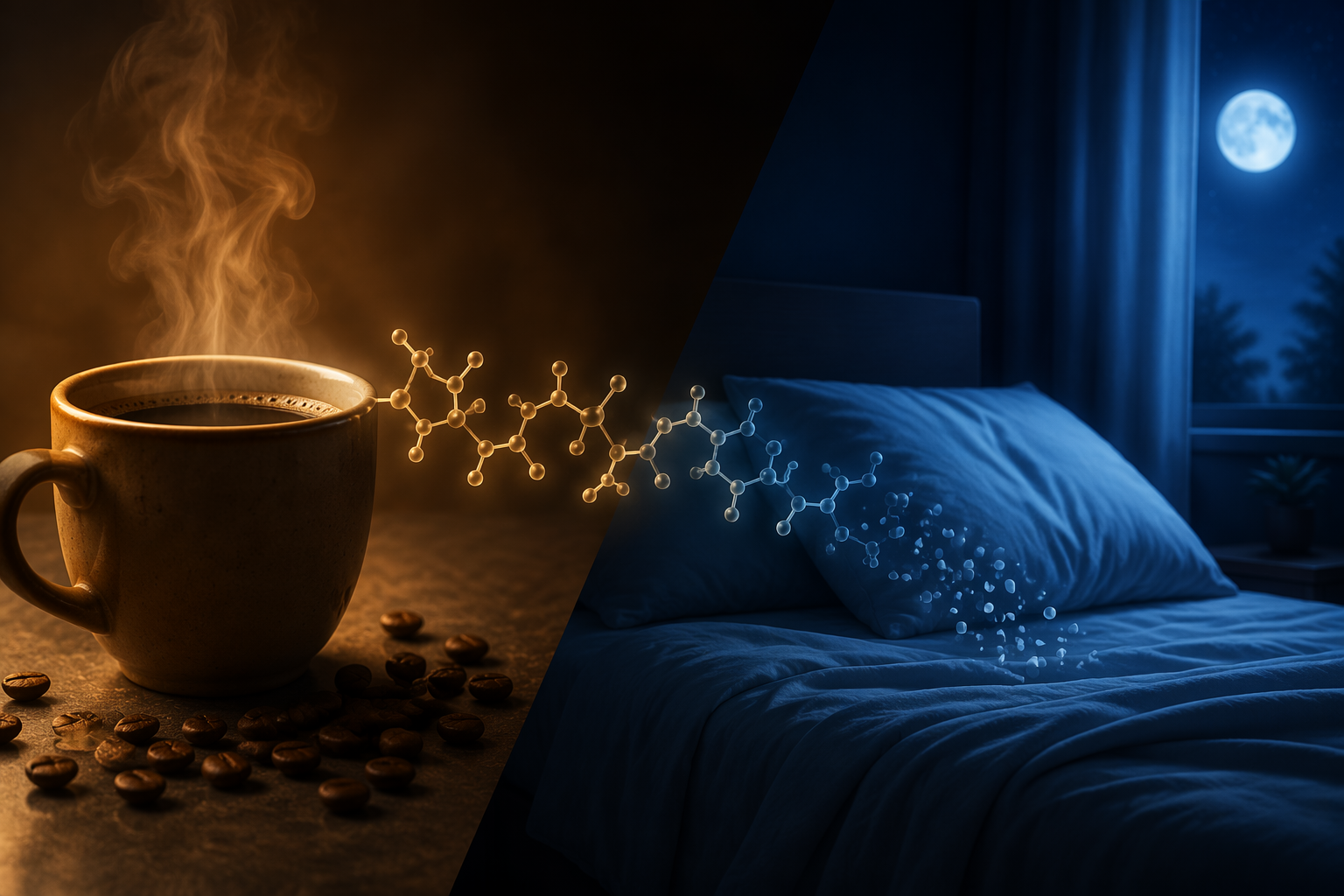
Why caffeine can make tiredness harder to feel
During the day, adenosine builds up in the brain as a byproduct of energy use. One of its jobs is to help translate time awake into sleep pressure. As adenosine binds to A1 and A2A receptors, the brain receives a stronger signal that wakefulness has been going on long enough.
Caffeine resembles adenosine closely enough to sit in those receptor sites, but it does not send the same “get sleepy” message. It blocks the signal. The useful distinction is this: caffeine does not remove the biological need for sleep. It makes that need harder to register.
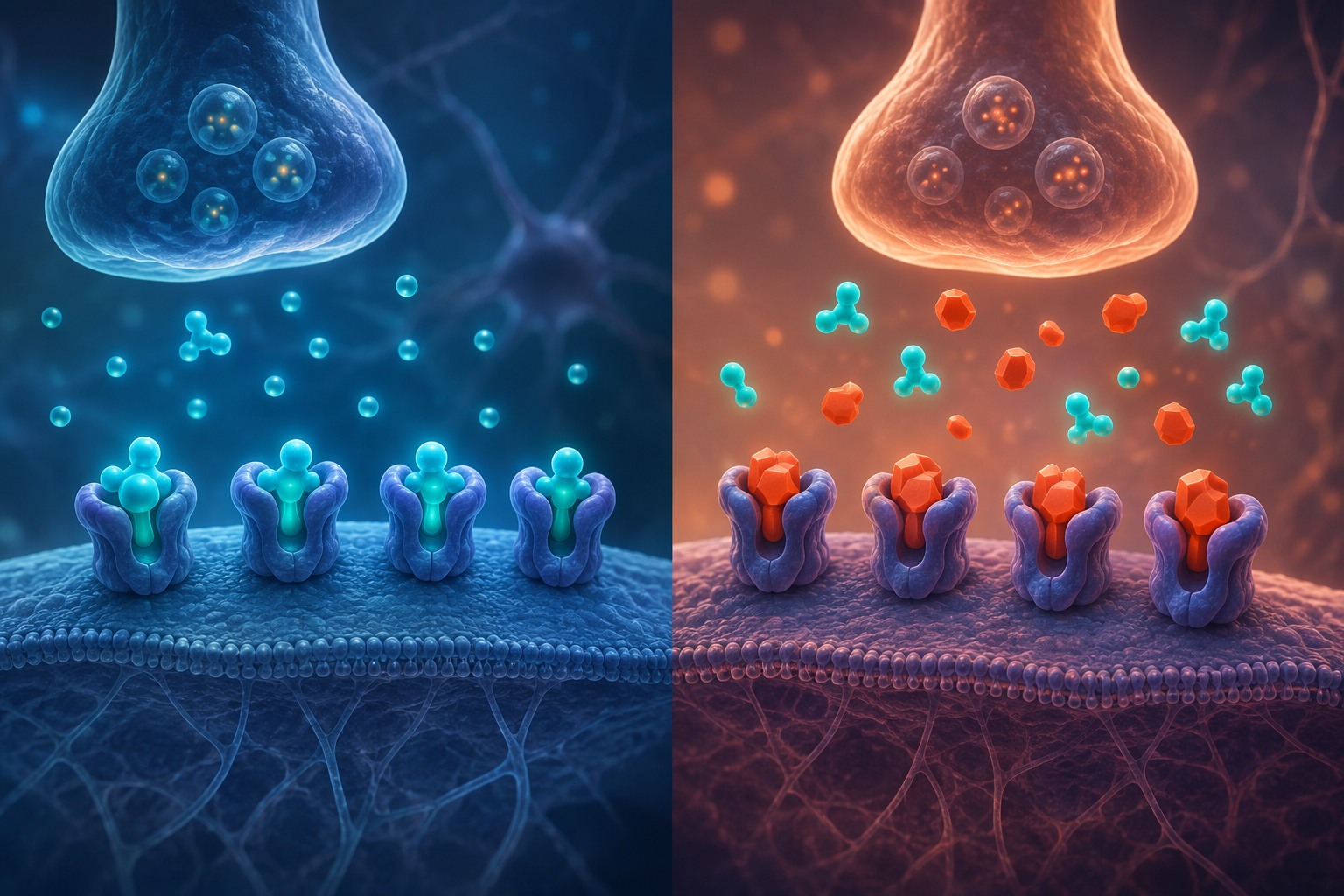
That receptor-level trick explains why caffeine can feel clean and useful. It can sharpen alertness without making you feel drugged or obviously overstimulated. But it also explains why self-perception is a weak measuring tool. If the very signal that tells you sleep pressure is rising has been muted, “I feel fine” is not strong evidence that your sleep biology is unaffected. For a deeper look at that system, see adenosine and sleep pressure.
What measured sleep studies find
The strongest single evidence block here is not a dramatic one-night anecdote. It is a 2023 systematic review and meta-analysis in Sleep Medicine Reviews that pooled findings from 24 studies on caffeine and sleep. Across the included studies, caffeine reduced total sleep time by an average of 45 minutes, lengthened sleep onset latency by 9 minutes, increased wake after sleep onset by 12 minutes, reduced N3 deep sleep by 11.4 minutes, and lowered sleep efficiency by about 7%.[1]
Those are not all the same kind of harm. Losing total sleep time is easy to understand. Taking longer to fall asleep is easy to notice. More wakefulness after sleep onset may be less obvious, especially if awakenings are brief. Reduced N3 sleep is even easier to miss, because people do not directly feel a sleep stage while it is happening. Yet N3 is part of the architecture that makes sleep restorative rather than merely unconscious.
This is where the adenosine mechanism becomes practical rather than decorative. If caffeine blocks the receptors that help the brain register accumulated sleep pressure, the expected sleep changes are exactly the ones researchers see: the brain may take longer to cross into sleep, spend more time awake after initially falling asleep, and show less consolidated deep sleep.
What study doses mean in actual drinks
Caffeine advice gets vague fast because people talk about “a coffee” as if it were a fixed dose. It is not. A small brewed coffee, a large cold brew, two espresso shots, and an energy drink can land in very different places.
| Drink | Typical caffeine amount |
|---|---|
| 8 oz brewed coffee | 100–200 mg |
| 8 oz drip coffee | About 150 mg |
| 1 espresso shot | About 63 mg |
| Energy drink | 50–300 mg per can |
| 8 oz black tea | About 50 mg |
| 12 oz soda | About 35 mg |
That table is the reason a simple cutoff time can mislead. “No coffee after 2 PM” might mean avoiding 63 mg from an espresso shot, or it might mean avoiding several hundred milligrams from a large coffee and an energy drink. The U.S. Food and Drug Administration says that, for most healthy adults, 400 mg of caffeine per day is not generally associated with dangerous negative effects, but that daily safety ceiling is not the same thing as a sleep-protective evening dose.[2]
The six-hour problem
One of the most useful caffeine-and-sleep studies tested 400 mg of caffeine at different distances from bedtime. In the condition that tends to surprise people, caffeine taken 6 hours before bed still reduced objectively measured sleep by more than 1 hour.[3]
The same study matters for another reason: participants did not reliably notice the disruption subjectively.[3] That is the office folklore problem in miniature. A person can sincerely report that they drank caffeine late and slept fine, while objective sleep data show that the night was shorter or more fragmented.
The lesson is not that 400 mg is the same as one normal cup of coffee. It often is not. The lesson is that dose and timing multiply each other. A small amount late may be less disruptive than a large amount early evening; a large amount at midafternoon may still matter for someone who clears caffeine slowly.
Why one cutoff time fails
Caffeine half-life is often summarized as if it were one number, but a useful range is closer to 2–12 hours. Half-life means the time it takes your body to clear about half of a dose. If you metabolize caffeine quickly, an early-afternoon coffee may be mostly out of the way by bedtime. If you metabolize it slowly, a meaningful amount may still be circulating when you are trying to sleep.
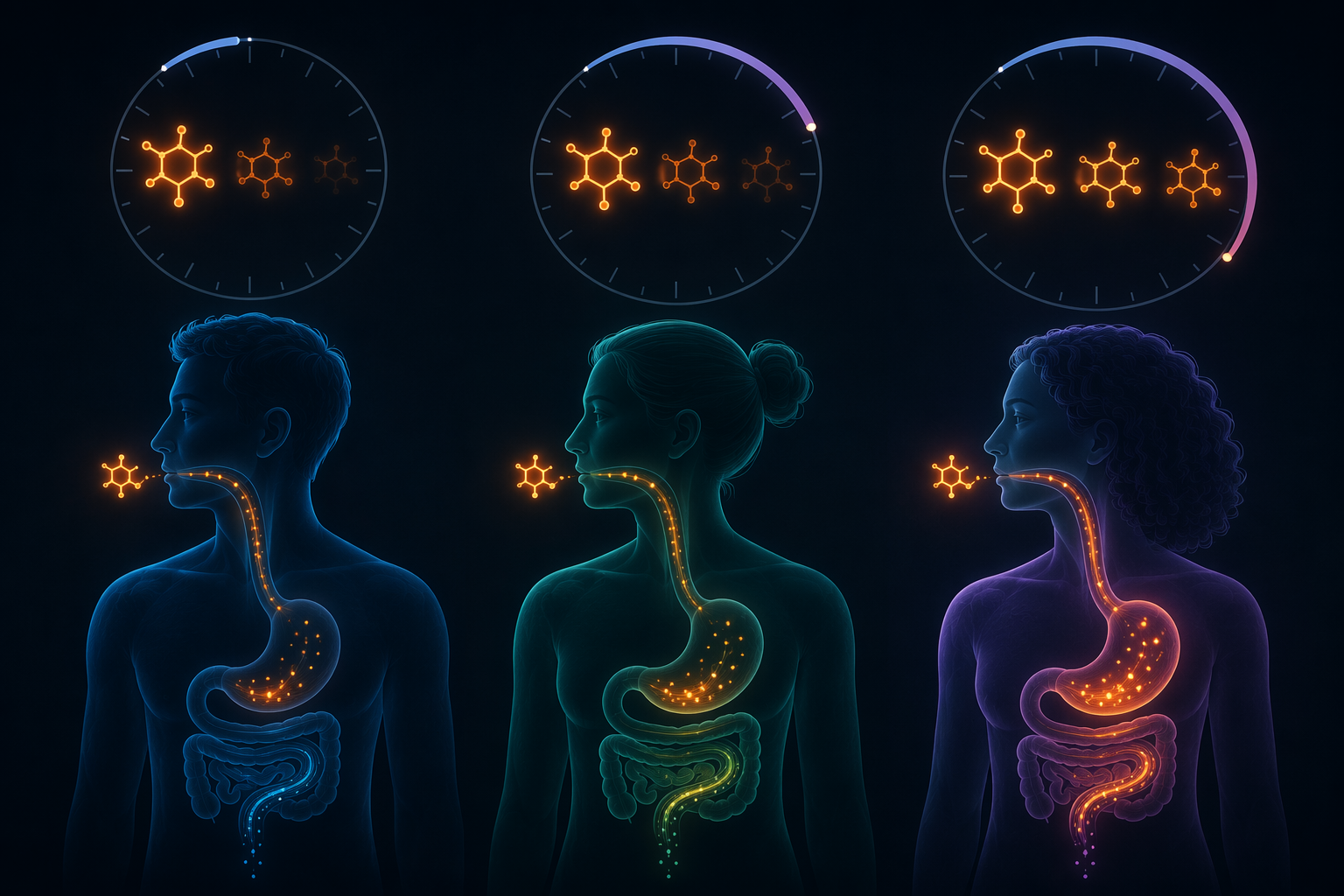
Several factors can shift that clearance window. Nicotine can speed caffeine metabolism; smokers may clear caffeine much faster than nonsmokers. Pregnancy can slow clearance substantially, especially later in pregnancy. CYP1A2 differences can make some people slower metabolizers, while ADORA2A differences may make some people more sensitive to caffeine’s sleep effects even at lower doses. Oral contraceptives, liver disease, and age can also change how well a generic cutoff applies.
This is why the popular 2 PM rule is a decent starting guess but a poor personal verdict. It ignores dose, bedtime, metabolism, pregnancy status, smoking status, medication context, and sensitivity. For someone going to bed at 9:30 PM, 2 PM leaves a different interval than it does for someone going to bed after midnight. For someone who has 300 mg at lunch, it is not the same exposure as 50 mg of black tea.
Tolerance changes the picture, but does not erase timing
Habitual caffeine use complicates the cleanest version of the story. Acute caffeine can disrupt sleep, especially when the dose is high or the timing is late. But some evidence suggests that regular daytime coffee drinkers may develop partial tolerance, with less obvious sleep disruption when caffeine is kept earlier in the day.
In a 2021 study of 20 young adult men with a mean age of 26.4 years, researchers found evidence relevant to tolerance, but the sample limits how far the result should be stretched. It does not automatically describe women, older adults, pregnant people, people using oral contraceptives, or people who know they are caffeine-sensitive.[4]
A larger 2026 PLOS ONE study with 25,381 participants also points toward an important distinction between habitual daytime coffee consumption and late, acute caffeine exposure.[5] That distinction is the humane one. Coffee as a morning ritual is not automatically incompatible with good sleep. Coffee as a late-day experiment may be asking your sleep system to absorb a pharmacological effect you cannot accurately feel.
How to find your own caffeine cutoff
A defensible cutoff starts with bedtime and dose, not with a rule copied from someone else’s schedule. If your sleep is currently short, fragmented, or slow to start, the cleanest test is to move caffeine earlier before you change five other parts of your routine at once.
- Choose a conservative test window: for one to two weeks, keep caffeine at least 8–10 hours before bedtime, especially if your usual intake is more than one small coffee.
- Reduce late-day dose first: replacing a large afternoon coffee with a smaller serving, tea, or decaf gives better information than changing your entire morning routine.
- Track sleep onset: note whether you fall asleep faster when caffeine moves earlier.
- Track awakenings and total sleep: caffeine may show up as lighter, more interrupted sleep rather than obvious insomnia.
- Use objective timing when possible: a wearable is imperfect, but consistent sleep and wake estimates can be more useful than morning mood alone.
- Reintroduce carefully: if sleep improves, test a smaller or earlier dose before deciding that all afternoon caffeine is off-limits.
The point of the experiment is to isolate the variable. If you move caffeine earlier, start a new workout plan, change alcohol intake, and go to bed an hour earlier in the same week, you may sleep better without knowing why. Keep the test boring enough that the result means something.
Shift workers need a different version of this calculation because “late” depends on the planned sleep episode, not the clock on the wall. The same principle still applies: protect the hours before your main sleep block. For more on adapting timing when work hours are irregular, see sleep hygiene for shift workers.
What to watch besides morning alertness
Morning alertness is tempting because it is easy to judge. It is also noisy. Stress, light exposure, sleep debt, exercise, alcohol, illness, and motivation can all change how you feel when you wake up. The Drake study’s subjective-objective gap is the warning: feeling normal does not prove your sleep was unchanged.[3]
Better signals are more specific: how long it takes to fall asleep, whether you wake during the night, whether your total sleep time changes, and whether deep-sleep estimates remain consistent if you use a tracker. Consumer sleep-stage data should not be treated as laboratory-grade measurement, but your own repeated pattern can still be informative when the question is behavioral timing.
If your sleep problem is already chronic insomnia, caffeine timing may be one part of the work rather than the whole answer. Approaches that deliberately build homeostatic sleep pressure, such as sleep restriction therapy in CBT-I, rely on the same broad sleep-pressure system that caffeine can blur.
Coffee does not have to be treated as a character flaw or a pleasure that serious sleepers must abandon. But nighttime sleep is the wrong place to discover that your dose, timing, metabolism, or sensitivity is less forgiving than you assumed. Move the experiment earlier, make the dose visible, and judge the result by sleep itself rather than by confidence the next morning.
References
- The effect of caffeine on subsequent sleep: A systematic review and meta-analysis. Sleep Medicine Reviews. https://pubmed.ncbi.nlm.nih.gov/36870101/
- Spilling the Beans: How Much Caffeine is Too Much? U.S. Food and Drug Administration. https://www.fda.gov/food/information-consumers-using-dietary-supplements/spilling-beans-how-much-caffeine-too-much
- Caffeine Effects on Sleep Taken 0, 3, or 6 Hours before Going to Bed. Journal of Clinical Sleep Medicine. https://pmc.ncbi.nlm.nih.gov/articles/PMC3805807/
- Regular caffeine intake delays REM sleep promotion and attenuates sleep quality in healthy men. Scientific Reports. https://www.nature.com/articles/s41598-021-84088-x
- Coffee consumption and sleep characteristics in a large population-based sample. PLOS ONE. 2026. https://journals.plos.org/plosone/
Comments
Join the discussion with an anonymous comment.