
On a normal night, sleep does not begin simply because the brain is tired. It begins because the body has started to shift heat outward. In the hours before sleep, circadian timing helps widen blood vessels in the skin, especially in the hands and feet, so heat can move from the body’s core toward the surface. As that heat leaves the core, core body temperature falls by roughly 0.5–1°C, a small-sounding drop that matters enormously for falling asleep and keeping sleep stable.[1]
That is the first useful answer to how extreme heat affects sleep quality: it interferes with a cooling sequence the body was already trying to run. Exhaustion can raise the pressure to sleep, but it does not erase the need to lose heat. A hot bedroom turns that pre-sleep drop from an automatic background process into a negotiation with the air around you.
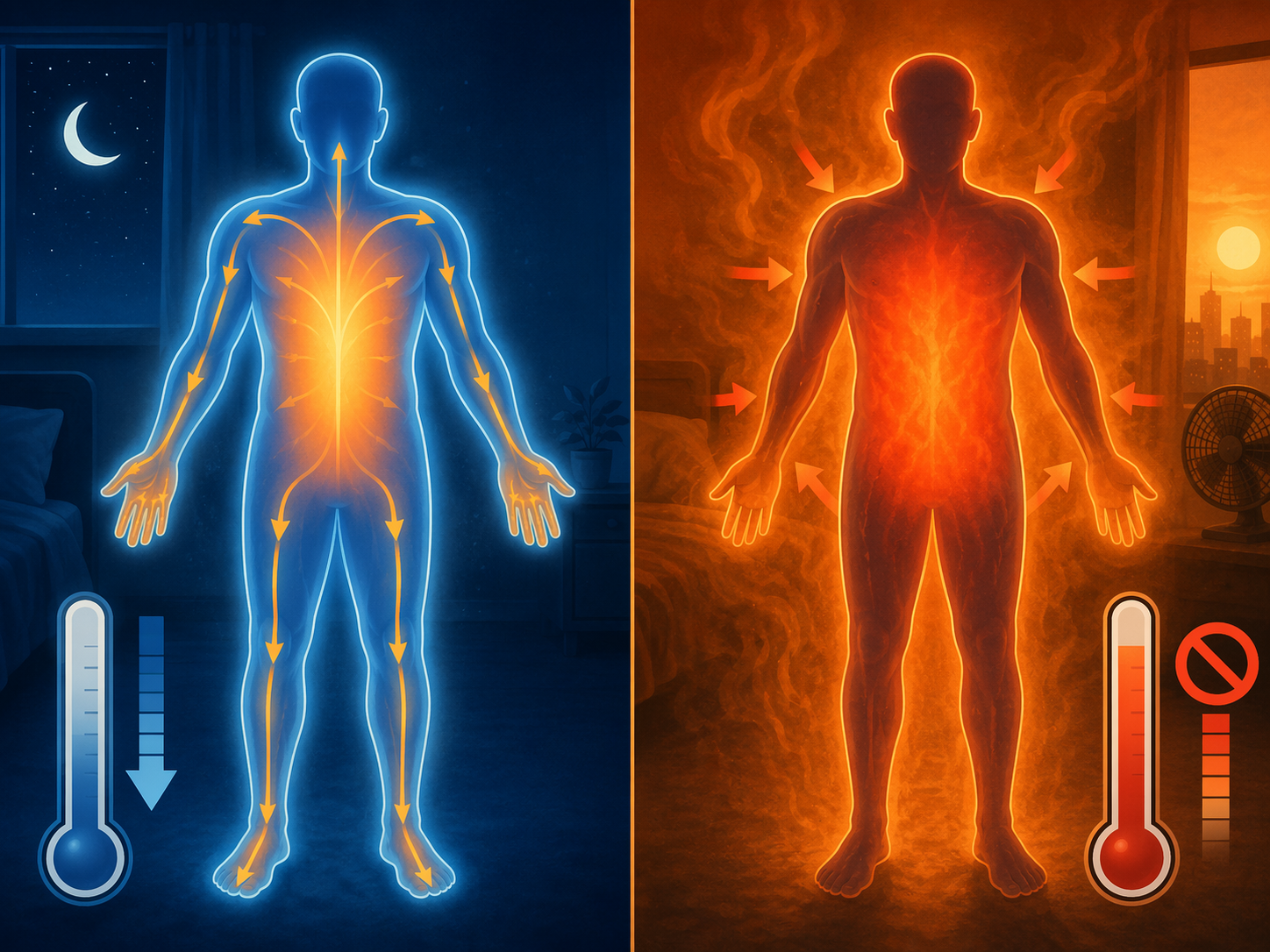
Sleep Starts With Heat Leaving the Core
The nightly cooling process is not the same as feeling cold. In fact, people often feel comfortably warm at the skin while the core is cooling. That warmth at the surface is part of the transfer: blood vessels widen, warm blood reaches the skin, and the surrounding environment accepts some of that heat. The important event is not a chilly room for its own sake, but a favorable heat gradient between the body and the bedroom.
This is why a warm bath can sometimes make people sleepy after they get out. The bath warms the skin and increases peripheral heat loss afterward, helping core temperature fall. The same principle appears in reverse on a very hot night: if the room is too warm, the skin cannot hand off heat efficiently, so the core temperature decline is delayed or blunted.[1]
The often-cited room-temperature guidance for sleep is practical shorthand, not a universal law. Cleveland Clinic, for example, places the commonly recommended sleep range around 60–67°F, or about 15.6–19.4°C.[2] But the mechanism is broader than any single thermostat number. Bedding, clothing, humidity, air movement, age, body composition, medications, housing insulation, and access to cooling all change what the body experiences at skin level.
A laboratory temperature also does not map neatly onto every bedroom. Outdoor temperatures recorded at meteorological stations can help researchers detect population-level patterns, but they do not say exactly what happened beside a reader’s bed, under a blanket, on a top floor, or in a room that stayed hot long after sunset.
What Extreme Heat Blocks
Thermal sleep research often treats temperatures above about 25°C as moving beyond the zone where the body can shed heat with ease during sleep.[1] That number is best read as a physiological guide, not a personal cutoff. Some people will struggle below it; others may tolerate higher temperatures for a time. The basic problem is the same: when the room is too warm relative to the skin, dry heat loss slows.
The body still tries. Skin blood vessels can remain dilated. Sweating can increase. A person may kick off sheets, roll over, search for a cooler patch of mattress, or wake just enough to adjust position without remembering it clearly in the morning. Those behaviors look like restlessness, but underneath them is thermoregulation competing for control of the night.
When heat loss is blocked before sleep, sleep onset can be delayed. When it is blocked after sleep begins, the night becomes easier to fragment. The sleeper may not be fully awake for long stretches, but the brain and body keep surfacing out of consolidated sleep because staying asleep now requires work from systems that are trying to defend body temperature.
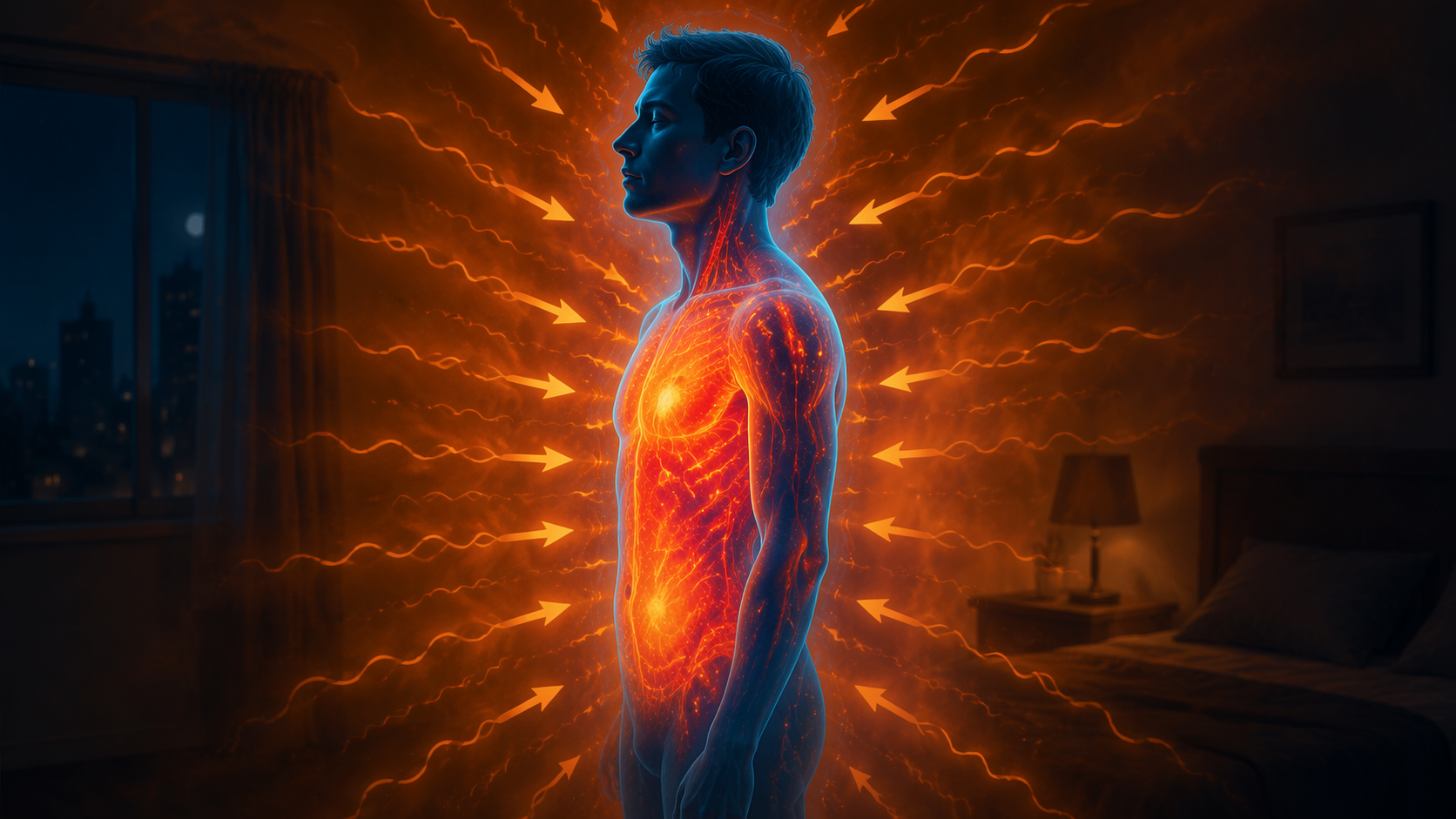
This is the part many quick sleep tips skip. A fan, lighter bedding, or an open window may help if they improve heat transfer. But the reason they may help is not mystical comfort. They are attempts to restore the body’s ability to move heat away from the core. For cooling strategies, a practical guide such as sleeping during a heat advisory belongs after the mechanism, not before it.
Why the Night Becomes Lighter and More Broken
Heat does not merely shorten sleep as if someone trimmed minutes off the beginning and end. Controlled studies summarized by Okamoto-Mizuno and Mizuno show a more specific pattern: heat exposure increases wakefulness and reduces slow-wave sleep and REM sleep, with effects often concentrated in the earlier part of the night.[1]
That selectivity matters. Slow-wave sleep is the deepest non-REM sleep, the stage many people associate with physical restoration and the feeling of having slept heavily. REM sleep is the stage most associated with vivid dreaming and important brain activity involved in emotional and cognitive processing. For readers trying to interpret wearable sleep data, the distinction between these stages is explained more fully in deep sleep vs. REM tracker meaning.
The body’s difficulty is partly that stable deep sleep and active heat defense do not fit together well. Deep sleep is not a good time for intense thermoregulatory struggle. If the bedroom keeps pushing heat back at the body, the sleeping brain has less room to settle into the stages that require physiological quiet.
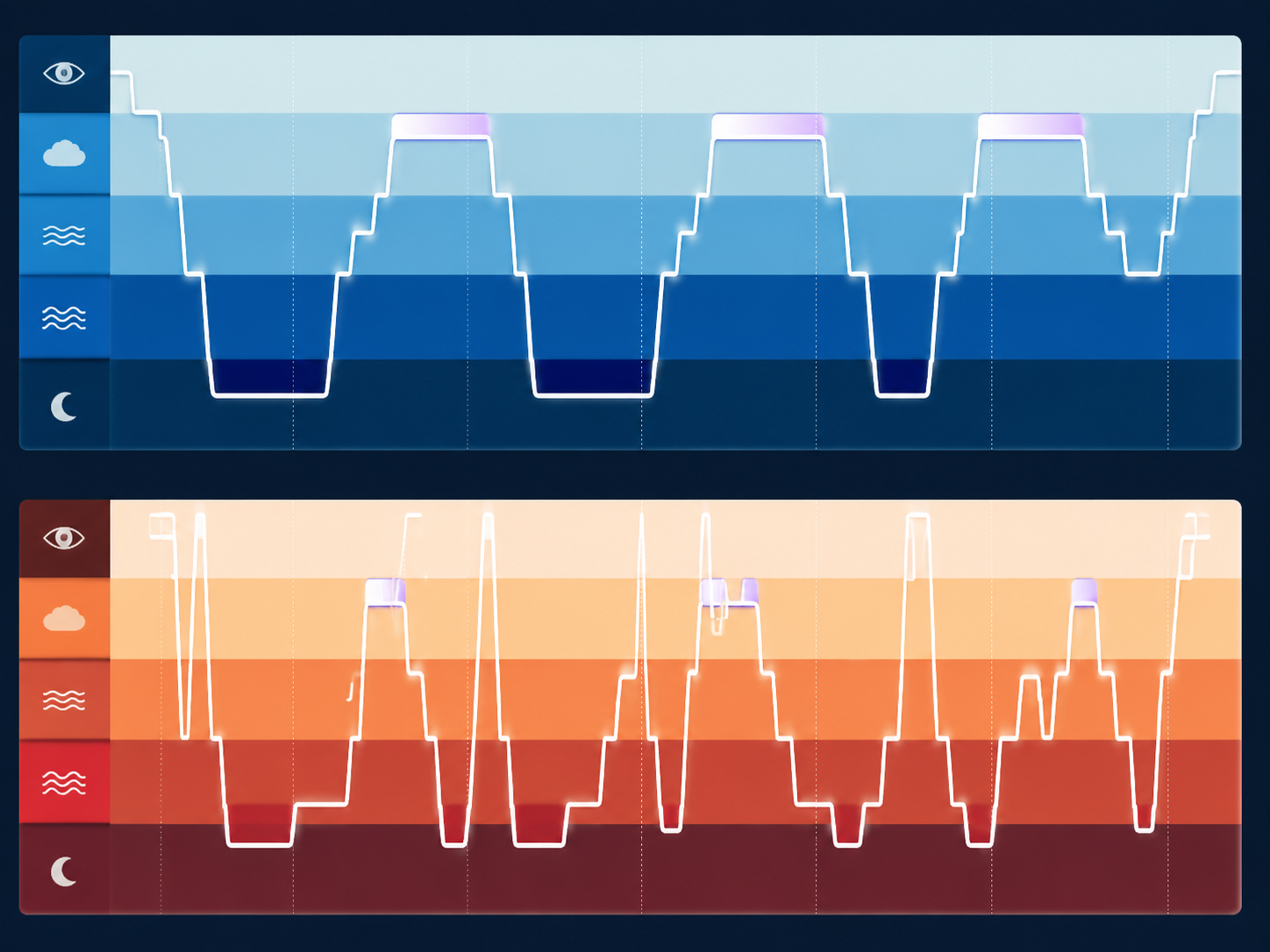
This also helps explain the familiar mismatch between time in bed and how the morning feels. Someone may spend many hours lying down during a heat wave and still wake up with the flat, unrefreshed feeling of a night that never became deep enough for long enough. The clock counted an opportunity to sleep; the heat kept interrupting the architecture of sleep.
Why the First Part of the Night Can Suffer So Much
The first part of the night normally carries a large share of slow-wave sleep. If high ambient temperature blocks the initial core-temperature decline, it collides with the window when deep sleep would ordinarily be most prominent. The result is not just more tossing at bedtime. Heat can disrupt the period when the night is supposed to become most physiologically deep.[1]
REM vulnerability has a different texture. Thermoregulation is reduced during REM sleep compared with waking and non-REM sleep, so a hot environment can make REM harder to sustain cleanly. The sleeper may cycle into lighter sleep or wakefulness instead of maintaining the normal rhythm. Over a full night, that can leave both the early deep-sleep portion and later REM-rich portions feeling disturbed.[1]
Humidity Turns the Same Problem Up
Humidity is not a separate villain from heat. It makes the same cooling problem harder to solve. When the air is already holding a lot of moisture, sweat evaporates less efficiently. Sweat sitting on the skin may feel miserable, but evaporation is the cooling step. Without it, the body pays the discomfort cost without getting as much heat loss in return.
Sleep Foundation notes that relative humidity above 60% can interfere with sleep comfort and cooling.[3] In the thermal-environment studies reviewed by Okamoto-Mizuno and Mizuno, humid heat at 32°C and 80% relative humidity suppressed the normal decline in core temperature more than dry heat at the same temperature.[1] The air temperature matched; the body’s ability to cool did not.
That distinction matters for real bedrooms. A room can feel punishing even when the number on the thermostat does not look extreme, because the skin is dealing with trapped moisture, still air, bedding, and the heat stored in walls and furniture. The relevant question is not only how hot the air is, but whether the body can dump heat into it.
Why “Getting Used to It” Is Not a Reliable Plan
The harshest finding for anyone living through consecutive hot nights is that the sleep disruption does not reliably fade after a few exposures. The Okamoto-Mizuno and Mizuno review describes studies in which people did not habituate to heat-related sleep disruption even after five consecutive nights at elevated temperature.[1]
That does not mean no one adapts to climate in any way. People change clothing, routines, bedding, window timing, hydration habits, and cooling equipment. Bodies also vary. But the narrower sleep finding is important: repeated hot nights did not simply train the sleeping system to stop being vulnerable. If a person is still waking repeatedly on the fourth or fifth oppressive night, that is not a failure of willpower.
Large observational work has also linked warmer nights with shorter sleep across populations, including a 2022 analysis reporting that rising nighttime temperatures erode human sleep globally.[4] Those studies are useful corroboration, especially because they move beyond the lab. Their limitation is just as important: many rely on outdoor temperature estimates rather than measured bedroom conditions. They show that hot nights matter at scale; they do not reveal exactly how warm an individual sleeper’s mattress, room, or skin surface was.
The Biological Bottom Line
Extreme heat hijacks sleep because it blocks the body from doing one of sleep’s quiet prerequisites: moving heat from the core to the skin and out into the environment. When that transfer stalls, core temperature does not fall as it should, sleep onset becomes harder, wakefulness increases, and the night loses some of the slow-wave and REM structure that makes sleep feel restorative.
The practical consequence is simple, even if solving it is not. Cooling the sleep environment is not cosmetic comfort. It is support for a biological process the sleeping body cannot skip.
References
- Effects of thermal environment on sleep and circadian rhythm, Journal of Physiological Anthropology, 2012.
- What’s the Best Temperature for Sleep?, Cleveland Clinic.
- Humidity and Sleep, Sleep Foundation.
- Rising temperatures erode human sleep globally, One Earth, 2022.
Comments
Join the discussion with an anonymous comment.