
“Take turns” sounds fair until the baby wakes at 2:40 a.m. and nobody knows whether “turn” means feeding, changing, burping, washing bottle parts, resettling, logging the feed, or lying awake listening for the next cry. Two loving adults can both be trying hard and still build resentment because the night was never actually assigned.
The practical answer to how to sleep when baby is born is not a prettier version of “sleep when the baby sleeps.” For partnered new parents, the first useful move is a written night-shift contract: who is on duty, where the off-duty parent sleeps, what happens at handoff, and how the feeding method changes the job.
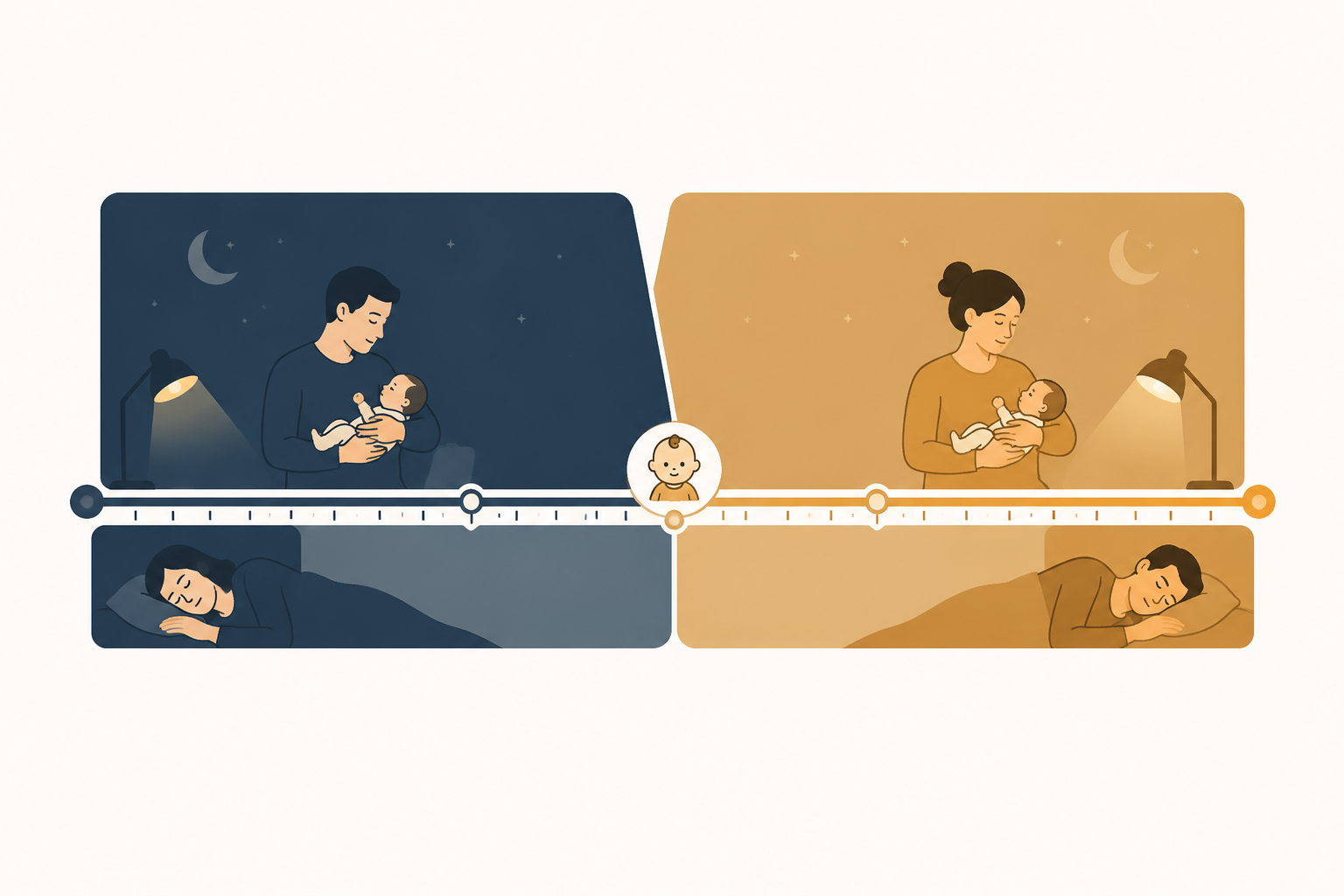
A workable base model comes from Henry Ford Health: split a roughly 10-hour night into two protected shifts, such as 8 p.m. to 1:30 a.m. and 1:30 a.m. to 7 a.m., so each parent has a chance at one uninterrupted 4- to 5-hour block rather than both parents hovering through every wake-up.[1]
Start With The Contract, Then Rebuild It Around Feeding
The base contract has three parts. First, divide the night into two named shifts. Second, the off-duty parent sleeps somewhere they are not half-monitoring the baby. Third, the handoff is clean: the on-duty parent gives the next feed time, diaper status, bottle or pump status, and anything unusual, then leaves the other parent to sleep.
| Contract Piece | What It Means At Night |
|---|---|
| Shift window | One parent owns all baby care during a defined block, such as 8 p.m.–1:30 a.m. or 1:30 a.m.–7 a.m. |
| Off-duty sleep space | The sleeping parent uses a separate room, guest bed, couch, or other safe sleep space away from routine baby noise. |
| Handoff rule | The outgoing parent gives only the needed update, then stops managing. |
| Feeding-method adjustment | The schedule changes depending on whether milk removal, bottle feeding, nursing, or formula prep has to happen. |
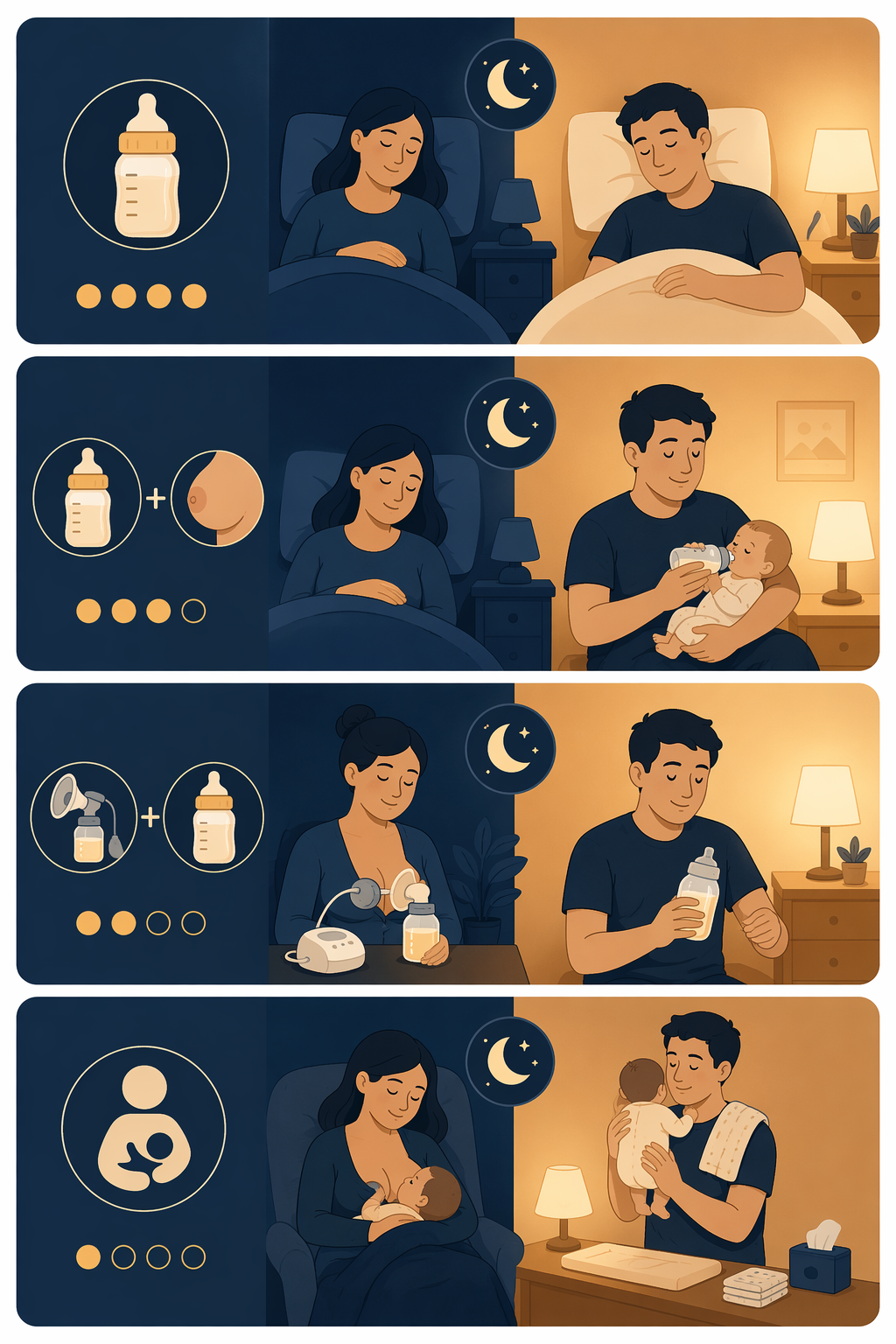
That last line is where many night plans fail. Formula feeding, combo feeding, exclusive pumping, and exclusive breastfeeding are not interchangeable scheduling problems. They place different physical demands on different bodies. A fair plan respects that instead of pretending every wake-up can be handed off in the same way.
This article focuses on partnered households with two available adults. Single parents need a different structure, not a guilty imitation of a two-parent split: a support roster, a relative or friend assigned to one early-morning bottle or settling block, a postpartum doula or night nurse if accessible, or a plan that clusters baby care to protect one 4-hour stretch when possible.
Why The Uninterrupted Block Matters
New parents are often told to count total hours. That misses the part that makes people feel unwell: sleep chopped into pieces. A SLEEP 2025 study of 41 first-time mothers using Fitbit wearable data found that new mothers slept only 4.4 hours daily in week 1. By weeks 8 to 13, total sleep had rebounded to 7.3 hours, but the longest uninterrupted block was still only 4.1 hours.[2]
That study is useful language for a real problem, not a universal measurement for every family. It was small, limited to first-time mothers ages 26 to 43, used wearable data, and was supported by trackthatsleep LLC; the lead author serves as CEO.[2] Still, the finding matches what many parents report: the number of hours can look less terrible before the body feels restored.
Sleep is also not just a comfort issue. Henry Ford Health reports that 1 in 5 birth parents experience postpartum depression or anxiety, and 1 in 10 non-birth parents do as well.[1] The Sleep Foundation likewise describes sleep deprivation and fragmented sleep as connected to postpartum depression risk, while noting that depression itself can also worsen sleep.[3]
For more on the mechanism, see why new parent sleep deprivation is not only about total hours and why sleep fragmentation matters for maternal mental health. The night-shift contract is the practical layer on top: it turns the idea of protected sleep into a specific household routine.

Formula Feeding: Use The Cleanest Split Available
Formula feeding gives the most scheduling flexibility because either parent can complete the whole wake-up: prepare the bottle, feed the baby, burp, change, settle, and reset supplies. What to Expect’s night-shift guidance treats formula-feeding families as the simplest case for alternating full responsibility by shift.[4]
A simple version looks like this: Parent A handles every wake-up from 8 p.m. to 1:30 a.m. Parent B sleeps in a separate space. At 1:30 a.m., Parent A gives a short handoff and goes off duty. Parent B handles every wake-up until 7 a.m.
- Before bed: stock clean bottles, formula, burp cloths, diapers, wipes, and a dim light in the feeding area.
- During shift: the on-duty parent handles the full wake-up without calling in the off-duty parent unless there is a safety or medical concern.
- At handoff: report the last feed amount, last diaper, next likely wake window, and any spit-up, fever, poor feeding, or unusual crying.
- After handoff: the off-duty parent stops tracking. If they are still listening from bed, the contract is not doing its job.
The point is not to make both parents equally awake. The point is to make one parent fully responsible while the other gets an actual sleep block, then switch.
Combo Feeding: Flexibility With A Body Attached
Combo feeding often looks flexible on paper: some feeds can be breast milk, some can be formula, and the non-nursing partner can take a bottle. In the middle of the night, the missing detail is breast comfort and milk removal. A nursing parent may still need to nurse or pump to avoid engorgement, protect supply, or relieve discomfort.
What to Expect describes a pump-and-sleep strategy in which the breastfeeding parent pumps before bed and the partner handles one bottle feeding during the off-shift.[4] BabyCenter also recommends using a pumped bottle so another adult can take a feeding and the breastfeeding parent can sleep longer.[5] This can work well, but it is not magic. If the nursing parent becomes engorged, develops plugged ducts, or is at risk for mastitis, the plan needs to change.
A reasonable combo-feeding night might protect the nursing parent’s first sleep block. They nurse or pump before going off duty. The partner takes the next wake-up with a prepared bottle of pumped milk or formula. If the baby wakes again inside that same block and the nursing parent is still comfortable, the partner stays responsible. If the nursing parent wakes in pain or with significant engorgement, milk removal becomes the priority.
| Decision | Choose This When | Night Consequence |
|---|---|---|
| Partner gives pumped milk | Milk is already available and the nursing parent can comfortably go the planned interval | Best chance at a protected nursing-parent sleep block |
| Partner gives formula | Formula is part of the feeding plan and breast comfort is stable | Cleaner partner-led shift, but still watch engorgement and supply needs |
| Nursing parent feeds, partner does the rest | Breast discomfort, supply concerns, or baby feeding needs make nursing the safest choice | The block is interrupted, but awake time can still be shortened |
| Nursing parent pumps, partner feeds | Milk removal is needed but the baby can take a bottle | Separates milk removal from baby care so the nursing parent can return to bed faster |
Combo-feeding couples should decide before bedtime which bottle is available, who prepares it, and what level of breast discomfort overrides the plan. Nobody should be negotiating that while one person is leaking through a shirt and the other is warming a bottle with one eye open.
Exclusive Pumping: Assign Milk Removal And Bottle Feeding Separately
Exclusive pumping is where “you sleep, I’ll take the baby” can quietly fail. There are two jobs, not one: someone has to remove milk, and someone has to feed, burp, change, settle, store milk safely, and deal with pump parts. If those jobs are blurred, the pumping parent can end up awake for the pump and awake for the baby.
What to Expect’s guidance separates the work more clearly: the pumping parent pumps during their shift, while the partner handles bottle feeding during the pumping parent’s off-shift.[4] That means the schedule is built around pump timing as much as baby timing.
One version: the pumping parent pumps around the start of their off-duty block, then goes to a separate room. The partner handles the next baby wake-up with already available milk or formula, including all bottle cleanup that cannot safely wait. When the pumping parent’s next pump is due, they wake only for milk removal, not for the full baby-care sequence, unless the couple has intentionally assigned that shift back to them.
- Write down the pump windows separately from the baby-care shifts.
- Decide who labels, stores, chills, or prepares pumped milk overnight.
- Set up pump parts before bed so the pumping parent does not lose 20 minutes to searching and washing.
- Do not count a pump session plus bottle feeding plus cleanup as “off duty.”
The protected block may be shorter for the pumping parent if milk removal has to happen at a certain time. Still, separating pump labor from baby-care labor often removes the invisible second shift: the parent pumps, then somehow also becomes the person responsible for every noise, cloth, bottle, and diaper.
Exclusive Breastfeeding: Shorten Awake Time Instead Of Pretending To Remove It
Exclusive breastfeeding is the most constrained version of the night-shift system. The non-nursing partner cannot remove the feeding wake-up. The nursing parent still wakes when the baby needs to nurse. A schedule that says otherwise is not supportive; it is inaccurate.
What the partner can do is remove everything around the feed. What to Expect recommends that, for exclusively breastfeeding families, the partner handles non-feeding tasks such as diapering, burping, and settling so the nursing parent can feed and return to sleep as quickly as possible.[4]
That can still be a serious improvement. A wake-up that becomes nursing, diapering, burping, rocking, replacing the swaddle, changing a soaked outfit, and checking the clock can turn into nursing and handing the baby back. The nursing parent may not get a fully uninterrupted block yet, but they can spend fewer minutes awake and carry less of the night management.
| Task | Nursing Parent | Partner |
|---|---|---|
| Baby wakes | Stays in bed until baby is brought over, if the setup allows | Gets baby, checks diaper, brings baby to feed |
| Feed | Nurses | Refills water, keeps light low, avoids conversation unless needed |
| After feed | Returns to sleep immediately | Burps, changes if needed, settles baby safely |
| Reset | Does not manage supplies during the off-duty portion | Handles burp cloths, diaper disposal, sleep sack, and notes |
Some exclusively breastfeeding families add one pumped bottle once feeding is established and the nursing parent’s body tolerates the interval. That may create one longer block, but it should be approached carefully. Going 4 to 5 hours without nursing or pumping can cause engorgement for some parents and may increase the risk of plugged ducts or mastitis. If the body is sending warning signs, the schedule does not get to overrule it.
The Separate Room Is Not A Luxury Detail
A night shift does not protect sleep if the off-duty parent lies beside the bassinet hearing every grunt and waiting to be useful. BabyCenter recommends sleeping in shifts and, when possible, having the off-duty parent sleep in another room to reduce disturbance.[5]
Separate does not have to mean elegant. It can be the guest room, the living room, an air mattress, or the bedroom while the on-duty parent stays near the baby’s safe sleep space. The important part is that the sleeping parent is not the backup monitor for ordinary wake-ups.
This is also where many couples discover the real default parent. If one person is supposedly off duty but still answers questions, tracks feeding intervals, reminds the other where the swaddles are, and wakes to inspect every cry, they are not off duty. They are supervising.
The Handoff Should Be Boring
A good handoff is short enough to happen while both parents are barely awake. It should not become a performance review. It should not include a full emotional debrief unless something truly needs attention. The outgoing parent gives operational information, then stops being the manager.
- Last feed: time, amount if bottle-fed, or which side if that matters to the nursing plan.
- Last diaper: wet, stool, rash cream, leak, or anything unusual.
- Next likely need: bottle ready, pump due, medication timing, or baby recently settled.
- Supply status: clean bottles, formula, pump parts, burp cloths, diapers, and spare clothes.
- Concern: fever, poor feeding, repeated vomiting, breathing concern, unusual lethargy, or anything that needs clinical advice.
If you are too tired to remember the handoff, use a shared note or a paper log. The tool does not matter. What matters is that the sleeping parent does not have to reconstruct the night from scattered clues.
What To Agree On Tonight
Do not try to solve the next three months at midnight. Build a seven-night version, use it, then revise. Feeding changes. Milk supply changes. Babies sometimes begin giving a longer first stretch, then stop. A contract that can be edited is more useful than a perfect plan nobody follows.
- Choose the shift windows: for example, 8 p.m.–1:30 a.m. and 1:30 a.m.–7 a.m.
- Name the off-duty sleep space for each parent.
- Write the feeding-method rule: formula, combo, exclusive pumping, or exclusive breastfeeding.
- Assign reset work: bottles, pump parts, diapers, burp cloths, laundry emergencies, and safe sleep setup.
- Define the handoff script and where notes will live.
- Pick the review point: after three nights if the plan is failing, or after one week if it is mostly working.
For more detail on protecting the actual block, not just the schedule around it, see how to protect uninterrupted sleep blocks for better postpartum rest. The household rule is simple: when one person is off duty, ordinary baby care does not pass through them.
When The Contract Is Not Enough
A night-shift system can reduce preventable exhaustion. It cannot treat postpartum depression, anxiety, birth trauma, severe insomnia, feeding pain, mastitis, unsafe levels of sleepiness, or a baby who is not feeding or gaining appropriately. If either parent is having intrusive thoughts, panic, hopelessness, rage that feels frightening, thoughts of self-harm, or thoughts of harming the baby, the plan needs outside help immediately, not a better spreadsheet.
Longer-term research also argues against treating early sleep debt as a tiny inconvenience. A 2019 study in Sleep found that sleep satisfaction and duration did not fully return to pre-pregnancy levels for up to 6 years after childbirth, though the study was conducted in Germany and may not translate neatly to every leave policy, childcare system, or household structure.[6]
For the first three months, the best night system is the one that protects at least one consolidated sleep block for each parent as far as the feeding method safely allows. With formula, that may be a clean shift split. With combo feeding or pumping, it has to account for milk removal. With exclusive breastfeeding, it may mean the nursing parent still wakes, but stops being responsible for every task around the wake-up. That difference matters at 2:40 a.m.
References
- A Sleep Survival Guide For Exhausted New Parents, Henry Ford Health.
- Study Quantifies Sleep Loss, Disruption Experienced by New Mothers, SLEEP Meeting.
- Sleep Deprivation and Postpartum Depression, Sleep Foundation.
- How to Create a Night Shift System When You Have a Newborn, What to Expect.
- How to cope with sleep deprivation when you have a newborn, BabyCenter.
- Long-term effects of pregnancy and childbirth on sleep satisfaction and duration of first-time and experienced mothers and fathers, Sleep, 2019.
Comments
Join the discussion with an anonymous comment.