
If you are sleeping whenever the baby sleeps and still feel wrecked, the problem may not be that you are doing the math wrong. It may be that the math is measuring the wrong thing.
Postpartum sleep quality depends less on whether scattered naps add up to a respectable total and more on whether your body ever gets a protected, uninterrupted stretch. A mother can collect sleep in pieces all day and night and still wake up unrefreshed because each piece is being cut short before sleep can consolidate.
That mismatch shows up sharply in Fitbit data from 41 first-time mothers presented at SLEEP 2025. In the first postpartum week, mothers averaged 4.4 hours of daily sleep, down from 7.8 hours before pregnancy, and 31.7% went more than 24 hours without any sleep. By weeks 8–13, total sleep had recovered to 7.3 hours, but the longest uninterrupted sleep stretch stayed around 4.1 hours, still well below the pre-pregnancy stretch of 5.6 hours.[1]
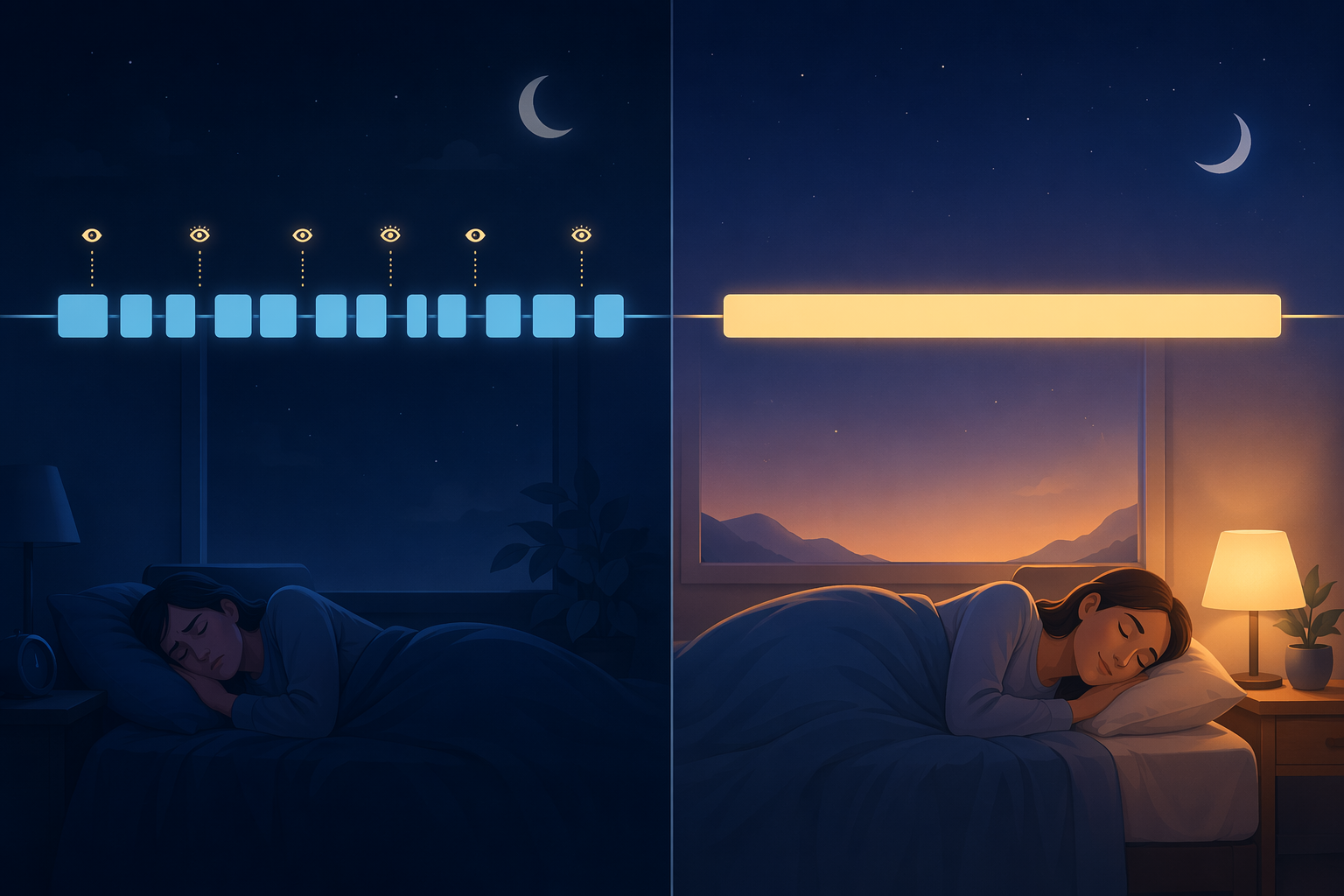
That is the part many postpartum sleep tips skip. Total sleep can look almost repaired while the nervous system is still being summoned back online every hour or two. The body does not experience seven fragmented hours the same way it experiences one protected stretch plus shorter add-ons.
Why “sleep when the baby sleeps” misses the problem
“Sleep when the baby sleeps” sounds gentle until it lands in a real house. The baby may sleep for 37 minutes. The mother may need to eat, pump, shower, manage pain, answer a message from the pediatrician, or simply lie there with her body still alert. Even when she does fall asleep, the next cry, feeding, diaper leak, monitor chirp, or anxious check can interrupt the stretch before it becomes restorative.
The advice measures opportunity. It does not measure restoration. A nap that starts with a racing heart and ends with a startled jump because the baby stirred may count toward total sleep time, but it may not give the body the deeper recovery that comes from staying asleep long enough to move through sleep stages without repeated forced awakenings.
This is why the central design goal should be more specific: protect one consolidated block, ideally around four hours, and then build the rest of the night around defending it. Not every household can do this cleanly. Some mothers are breastfeeding exclusively. Some do not have a partner at home. Some babies have medical needs, reflux, feeding difficulties, or temperaments that make any schedule look theoretical. But when help is available, it should be aimed at uninterrupted sleep, not at vague “rest.”
The night has to belong to someone else for a while
A protected sleep block is not the same as a partner saying, “Wake me if you need me.” If the mother has to wake, decide whether the baby really needs help, wake the partner, explain what to do, and then try to fall asleep again, the block has already been broken.
For a two-caregiver household, the cleanest version is a tag-team night. Pine Rest clinical guidance describes a 10 p.m.–2 a.m. and 2 a.m.–6 a.m. shift structure so each parent gets one consolidated four-hour block.[2] The exact clock times can move. The important part is that one adult is fully responsible while the other is truly off duty.
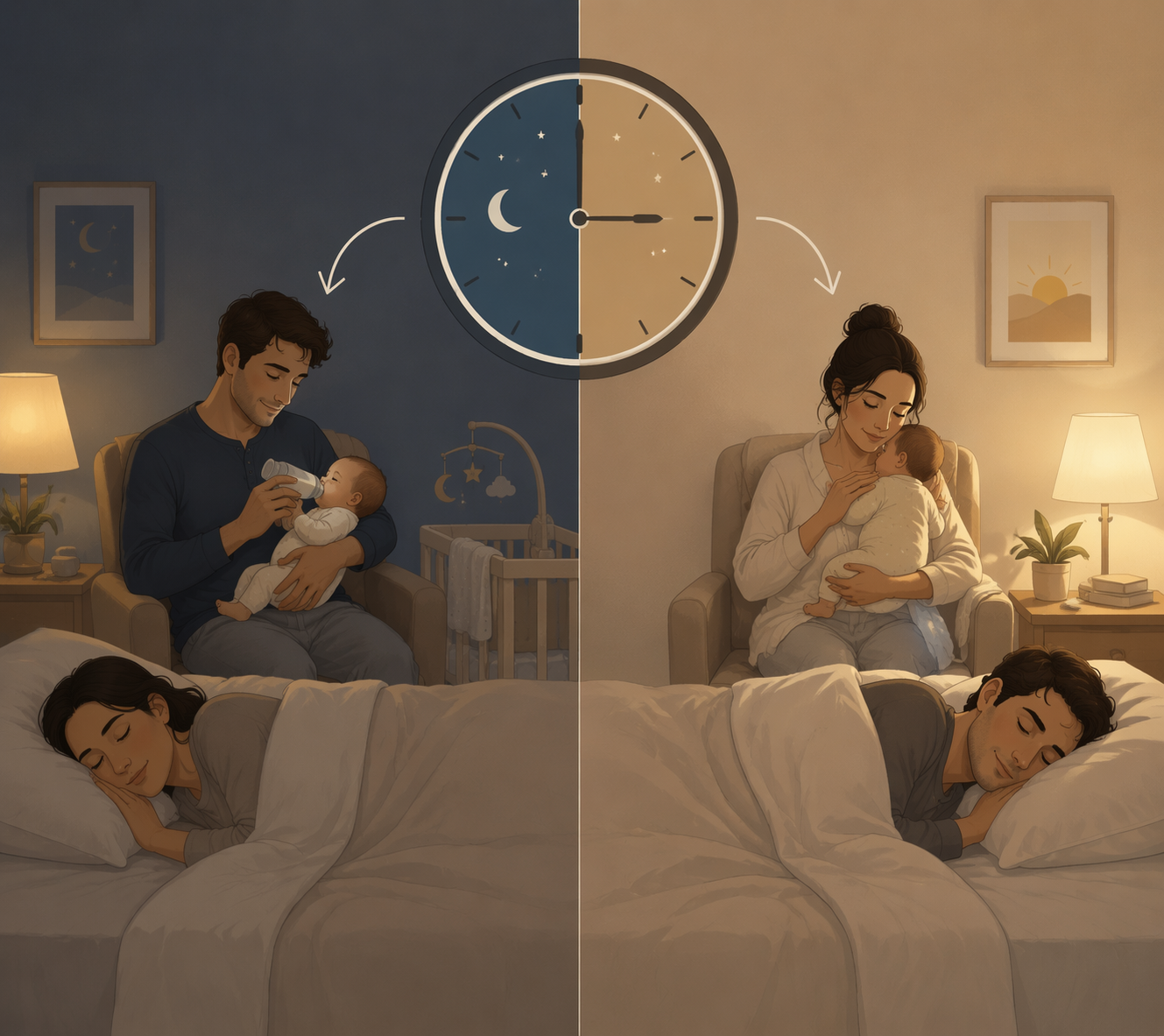
| Time | On-duty adult | Off-duty adult | What must be decided before bedtime |
|---|---|---|---|
| 10 p.m.–2 a.m. | Partner or support person | Mother sleeps | Who handles soothing, diapering, bottles or bringing baby only if nursing is unavoidable |
| 2 a.m.–6 a.m. | Mother or second adult | Partner sleeps | When the handoff happens and what information needs to be shared |
During the protected block, the on-duty adult owns the monitor, the crying, the diaper decisions, the swaddle reset, the burping, the bottle warming, the rocking, and the judgment call about whether the baby is actually hungry. The sleeping parent should not be half-listening from the next room, waiting to be useful. Half-listening is not protected sleep.
This sounds obvious until the first night someone tries it. Many households say they are taking shifts, but the mother still wakes for every noise because the monitor is on her side, the bottles are not prepared, the partner does not know where the burp cloths are, or everyone has quietly agreed that she is the final authority on whether the baby is okay. A real shift removes those tiny consultations.
- The on-duty adult keeps the monitor or sleeps closest to the baby.
- The off-duty adult uses earplugs, a white-noise machine, or distance if it is safe and workable.
- Diapers, wipes, bottles, pump parts, burp cloths, and a safe feeding space are set up before the block begins.
- The on-duty adult does not wake the sleeping parent for routine soothing, ordinary diaper changes, or non-urgent uncertainty.
- The handoff is brief: last feed, last diaper, any medication or medical instruction, and the next expected feeding window.
The point is not fairness as an abstract household value, though fairness matters. The point is biological. One parent’s body has to be allowed to stay asleep long enough for sleep to do more than briefly shut the lights off.
Feeding plans should defend the block, not decorate it
Night feeding is where many protected-block plans fail. A schedule that looks good on paper can collapse if every feed still requires the mother to wake fully. The useful question is not “How can everyone help?” but “Which feeding can happen without breaking her longest sleep stretch?”
For some families, that means pumping earlier so a partner can give one bottle during the first shift. For others, it means placing a pumped bottle in the refrigerator with clear instructions, using prepared formula when supplementation is already part of the feeding plan, or arranging one strategically timed feed before the mother goes down for her protected block. These are not moral rankings. They are logistics.
A dream feed can sometimes help if it lines up with the baby’s feeding pattern: the baby is fed while still drowsy, often before the caregiver’s own sleep block begins, in the hope of stretching the next interval. It does not work for every infant, and it should not become another elaborate ritual that keeps the mother awake longer than it helps her sleep.
Exclusive breastfeeding narrows the options, but it does not make the protected-block idea useless. The on-duty adult can still handle everything around the feed: bring the baby, manage positioning support if needed, take the baby immediately after nursing, burp, change, resettle, and keep the room quiet. If the mother must wake to nurse, the goal becomes reducing how long she is awake and preventing the feed from turning into a full household reset.
There is also a lactation reality here: pumping is not free sleep. It takes time, equipment, cleaning, and sometimes stress. A plan that asks a mother to pump at midnight so she can theoretically sleep at 1 a.m. may not protect anything. The better plan is the one that actually creates the longest unbroken stretch in that specific household.
Make the room less interested in waking her
Environmental changes cannot compensate for a night where the mother remains responsible for every sound. They can, however, protect the block once the responsibility has been transferred.
Night care should be boring on purpose. Sleep Foundation and Postpartum Support International resources describe practical measures such as using dim red light during night feeds, placing the monitor far enough away to filter non-essential sounds when another caregiver is on duty, and postponing non-urgent checks that wake the household without changing care.[4][5]
- Use the lowest safe light level for feeds and diaper changes.
- Keep phone scrolling out of night feeds when possible; bright light and alerting content make returning to sleep harder.
- Move routine supplies within reach of the on-duty caregiver before bedtime.
- Let the on-duty caregiver decide whether ordinary grunts, brief fussing, or sleep noises need action.
- Write down pediatrician-specific instructions so the sleeping parent is not awakened for questions that were already answered.
The monitor deserves special attention. It is useful when the responsible adult is the one responding. It is destructive when it turns the off-duty parent into a second, anxious listener. If another capable adult is assigned to the baby, the monitor should not sit beside the mother’s pillow just because it always has.
When the clean shift system is not available
Some postpartum sleep advice quietly assumes a second adult with predictable work hours, enough money for help, an infant who accepts bottles, and a mother who can pump comfortably. Those assumptions leave out many of the people most in need of rest.
If there is no partner available overnight, the same principle can still guide decisions: protect the longest possible uninterrupted stretch, then stop spending scarce help on tasks that do not protect it. A relative who offers to “come by sometime” may be more useful if they take the baby for a defined early-morning block after the first feed. A friend who wants to help may be more useful washing pump parts, handling laundry, or bringing food during the day so the mother can use a predictable infant nap for sleep rather than chores.
Professional night support, when accessible, fits the same logic: the value is not simply having another person in the house, but having someone competent enough to let the mother stop monitoring. For families considering any sleep arrangement out of exhaustion, especially bedsharing or couch feeding, safety guidance from a pediatric clinician matters. Exhaustion changes behavior, and improvised sleep locations can become dangerous quickly.
For exclusive breastfeeding without bottle use, a smaller target may be the starting point: one feed where everything except the actual nursing is handled by someone else, or one morning block when the baby is taken out of earshot after a feed. It may not produce a perfect four-hour stretch. It can still reduce the number of times the mother has to climb from sleep into full operational control.
What to track instead of total hours
A sleep app or wearable can be useful, but the most important number is not always the total at the top of the screen. Track the longest uninterrupted stretch for several nights. Then track what broke it.
| Question | Why it matters |
|---|---|
| What was the longest unbroken sleep stretch? | This shows whether sleep is consolidating, not just accumulating. |
| What woke the mother? | A feeding, monitor sound, pain, anxiety, pumping alarm, or partner question requires different fixes. |
| Was she responsible for deciding what happened next? | Decision-making can break the sleep block even if she never leaves the bed. |
| Could one awakening be delegated or delayed safely? | The best intervention is often removing one unnecessary arousal. |
This kind of tracking is not meant to turn the postpartum bedroom into a performance review. It is meant to stop blaming the mother for feeling exhausted when her sleep record says she technically slept. If the longest stretch is still short and every small sound requires her brain to evaluate risk, her body is receiving fragmented sleep.
When exhaustion may be more than expected fragmentation
Some disrupted sleep is expected with a newborn. That does not mean every sleep problem should be waved away as normal. In a 2017 study, mothers at 2 months postpartum reported about 6.3 hours of nighttime sleep and less than 1 hour of daytime sleep on average, with a mean Insomnia Severity Index score of 9.14, a subthreshold insomnia range.[3] In other words, insomnia symptoms can be present even when the main household problem is also obvious: the baby keeps waking.
The line becomes more concerning when a mother cannot sleep even during a protected opportunity, feels intensely wired or panicked at night, has intrusive thoughts that feel hard to manage, is afraid to sleep, or is becoming less able to function safely. Persistent low mood, hopelessness, or thoughts of self-harm need prompt clinical support. Those patterns are not solved by telling her to nap harder.
For a deeper look at that boundary, see why sleep fragmentation matters for maternal mental health. The practical distinction is simple enough to start with: expected postpartum waking usually improves when responsibility and feeding logistics protect a real sleep block. Clinical insomnia or mental-health symptoms may persist even when the baby is covered and the room is quiet.
A four-hour block will not make postpartum sleep easy. It will not make a newborn predictable, erase feeding pain, or create support where none exists. But when total sleep math stops explaining how destroyed a mother feels, consolidated sleep is the first thing worth protecting.
References
- Profound Postpartum Sleep Discontinuity in First-Time Mothers, SLEEP 2025, Vol. 48, Supplement, 2025.
- Pine Rest clinical guidance, Pine Rest.
- Sleep in the Postpartum: Characteristics of First-Time, Healthy Mothers, PMC, 2017.
- Postpartum Insomnia, Sleep Foundation.
- Sleep Resources, Postpartum Support International.




Comments
Join the discussion with an anonymous comment.