
A new mother can add up the night and still feel like something is wrong. Forty minutes after the first feed. Ninety minutes before the next one. A short nap at dawn, maybe another one in the afternoon if the household lets her lie down. On paper, the total may look less alarming than she feels. In her body, it can feel like being repeatedly pulled back from the edge of sleep before anything has had time to settle.
That mismatch is where maternal mental health and sleep quality have to start: not with the question “How many hours did you get?” but with “How long were you allowed to stay asleep without interruption?”
The cleanest illustration comes from Fitbit-based data presented at SLEEP 2025. In a study of 41 first-time mothers, the longest uninterrupted sleep stretch fell from 5.6 hours before pregnancy to 2.2 hours in the first postpartum week. By weeks 8–13, total nightly sleep had rebounded to 7.3 hours, but the longest stretch was still only 4.1 hours — better than week one, but still well below the pre-pregnancy baseline for sleep continuity.[1]
That distinction explains why a mother can be told she is “getting enough sleep” and still feel emotionally raw, anxious, slowed down, or unable to regulate. The arithmetic total is not the whole sleep experience. The nervous system is not restored by a spreadsheet.
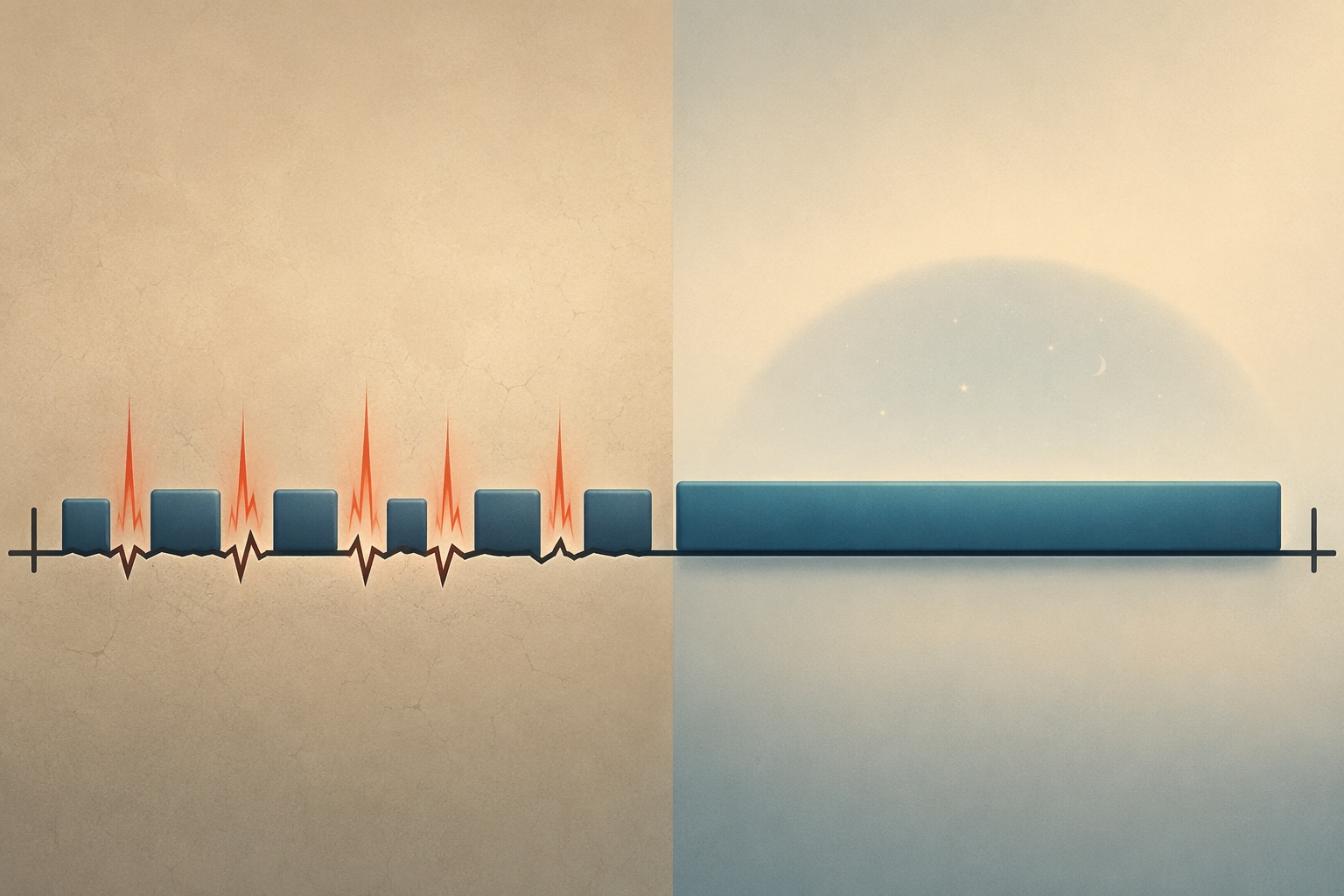
The Night Is Not Just a Total
Postpartum sleep advice often treats sleep as a bucket: keep pouring in minutes whenever you can, and eventually the bucket fills. That is the logic behind “sleep when the baby sleeps.” Sometimes it helps. A 28-minute nap is better than another half hour of dishes or scrolling in a state of collapse. But the bucket model misses the architecture problem.
Sleep has continuity. It has depth, sequencing, transitions, and recovery value that depends partly on being allowed to move through sleep without repeated alarms from the baby, the pump, pain, anxiety, household noise, or the need to listen for the next cry. A mother may collect sleep episodes across a 24-hour period and still never get one stretch long enough for her body to stop bracing.
The SLEEP 2025 numbers make that visible. The 7.3-hour total by weeks 8–13 sounds close to what many adults are told to aim for. The 4.1-hour longest stretch tells a different story. It says the night is still chopped into pieces. It says recovery is being attempted in fragments.[1]
The same study reported that 31.7% of first-time mothers went more than 24 hours without any sleep during the first postpartum week.[1] That figure is severe, and it deserves attention. But the quieter number may matter more for many families after the first shock of birth: the longest stretch remains shortened even when total sleep begins to look acceptable.
The study should not be treated as final doctrine. It included 41 first-time mothers, used Fitbit devices rather than laboratory polysomnography, and was funded by trackthatsleep LLC, whose CEO was the lead author.[1] Those limits do not make the pattern meaningless. They do mean the result is best read as a useful, concrete measurement of something postpartum households already recognize: the mother may be sleeping, but she may not be staying asleep.
Why Broken Sleep Feels So Different
Repeated awakenings ask the brain to perform a hard transition over and over. Fall asleep. Wake to assess the baby. Feed, pump, soothe, change, reposition, check the time, wonder whether the baby is breathing normally, decide whether to wake a partner, try to fall asleep again. This is not a neutral interruption. It is a cycle of activation.
That cycle is especially costly when mood is already under pressure from hormonal shifts, pain, blood loss, identity change, feeding demands, and the sheer vigilance of keeping a newborn alive. A mother who is woken six times is not simply missing minutes. She is being forced to re-enter alertness six times, often with responsibility attached.
This is why the longest uninterrupted stretch deserves more clinical respect than it usually gets. It is not a luxury metric for people with perfect routines. It captures whether the mother’s sleep contains any protected span long enough to become restorative.
Research on postpartum mood supports taking fragmentation seriously. Goyal, Gay, and Lee found that fragmented maternal sleep correlated more strongly with depressive symptoms than infant temperament did.[2] That does not prove that fragmented sleep alone causes depression, and it does not mean infant temperament is irrelevant. It does suggest that when a mother is struggling, the household should not look only at whether the baby is “easy” or “difficult.” The mother’s sleep structure may be the more important place to look.
Objective sleep measurement points in the same direction. The MGH Center for Women’s Mental Health describes Posmontier’s actigraphy work as linking sleep discontinuity specifically, rather than total sleep time, with postpartum depression severity.[3] Again, this is not a simple one-way causal story. Depression can worsen sleep, and poor sleep can worsen mood. But the relationship is strong enough that fragmented sleep should not be waved away as ordinary newborn inconvenience when mood symptoms are also appearing.
When “Sleep When the Baby Sleeps” Falls Apart
The phrase sounds kind until it reaches a real room. The baby may sleep only while held. The mother may need to pump after feeding. The toddler may be awake. The incision may hurt. Milk may leak. Anxiety may surge exactly when the house gets quiet. Someone may tell her to nap while also expecting her to manage the appointment schedule, the laundry, the visitors, the feeding log, and the emotional weather of everyone who “just wants to help.”
Even when she does sleep whenever the baby sleeps, she may only be increasing total sleep time. That can matter, but it may not solve the deeper problem if every sleep episode is short and interruptible. A mother can accumulate enough fragments to make the total look acceptable and still never receive the kind of continuous sleep that helps stabilize attention, impulse control, stress response, and emotional range.
This is where a household often makes the wrong calculation. It asks, “How can we help her get more sleep?” The better first question is narrower: “How can we protect one stretch?”
The Practical Target: One Protected Stretch
Anchor sleep is the name often given to that protected stretch: one consolidated block of roughly 4–5 hours when the mother is not responsible for listening, deciding, feeding, soothing, or troubleshooting unless there is a true emergency. The point is not to make postpartum sleep perfect. The point is to stop making every sleep opportunity fragile.
The 4–5 hour target is clinically grounded and pragmatic, not proven by a dedicated randomized trial. It comes from reproductive psychiatry practice and expert guidance, including Dr. Nicole Leistikow’s description of sleep as “the most potent antidepressant with no side effects” in a discussion of protecting maternal sleep.[4] The quote is memorable, but the useful part is operational: the mother needs a stretch other people actively defend.

Protecting that stretch can look different depending on feeding, recovery, work schedules, finances, and support. In one household, a partner takes the first part of the night with a bottle or previously expressed milk while the mother sleeps behind a closed door. In another, a doula or relative covers a predictable block. In another, the care plan changes so the mother is not the default responder for every sound between two feeds. The important feature is not the exact schedule. It is that someone other than the mother owns the interruptions during the protected window.
This is also where feeding conversations need to become honest rather than moralized. If exclusive breastfeeding means the mother is awake every 90 minutes and her mood is deteriorating, the plan is not working simply because it is biologically normal. A lactation goal, a mental health goal, and an infant feeding goal may need to be held in the same room. The question is not whether one ideal wins. The question is what plan keeps both baby and mother safe enough to continue.
For partners and support people, anchor sleep is not “helping out.” It is taking possession of a defined risk point. During that block, the mother should not be the household’s backup alarm. If she has to listen for whether help is needed, judge whether the baby’s cry is escalating, or wait to see whether someone else wakes up, the stretch is not truly protected.
What to Protect Before Optimizing Anything Else
- A predictable 4–5 hour window when the mother is off duty unless there is a genuine emergency.
- A clear responder who handles baby care, household noise, and decisions during that window.
- A feeding plan that does not require the mother to fully wake for every infant need.
- A room, phone setting, or handoff routine that removes the expectation that she will monitor from bed.
- A willingness to revise the plan if mood symptoms, panic, rage, or intrusive thoughts intensify.
Nursery routines, light exposure, caffeine timing, and bedtime rituals can all have a place. They are just not the center of the problem when a mother’s night is being repeatedly broken by care duties. Sleep hygiene cannot compensate for a household structure that keeps assigning every interruption to the same recovering body.
The Clinical Boundary Matters
Some postpartum sleep disruption is expected, especially in the newborn period. Expected does not mean harmless in unlimited doses. It also does not mean every exhausted mother has a disorder. The line becomes more concerning when sleep loss is paired with persistent low mood, escalating anxiety, emotional numbness, panic, rage, hopelessness, intrusive thoughts, or the inability to sleep even when another adult is safely caring for the baby.
Postpartum Support International describes sleep as closely connected with perinatal mood and anxiety disorders, and that connection runs in both directions: sleep disruption can worsen symptoms, and PMAD symptoms can make sleep harder to obtain even when the opportunity exists.[5] That bidirectional loop is one reason mothers should not be told to solve the problem by willpower or better gratitude.
If the pattern has crossed into insomnia — trouble falling asleep, staying asleep, or returning to sleep despite opportunity — professional treatment is available. The MGH Center for Women’s Mental Health identifies cognitive behavioral therapy for insomnia, or CBT-I, as a first-line treatment in the perinatal period.[3] That matters because postpartum insomnia is not a character flaw. It is a treatable clinical problem, and it can coexist with depression or anxiety.
Pregnancy-related sleep problems belong in the same broader conversation, but the postpartum period has its own architecture. A pregnant person may be waking from discomfort, reflux, restless legs, urinary frequency, or anxiety. A postpartum mother may be waking because another human’s survival has been routed through her body and attention. The sleep may be broken in both periods, but the household obligations around it are different.
A Better Metric for a Real Household
The mother who is counting total hours and still feeling unwell is not failing to appreciate her sleep. She may be measuring the wrong thing. Total sleep time can hide the cost of repeated awakenings. Longest uninterrupted stretch brings the problem into focus.
That metric also changes what she can ask for. “I need more sleep” is easy for a household to agree with and still not protect. “I need one uninterrupted 4–5 hour stretch, and I need someone else to be responsible during it” is harder to blur. It names the task. It names the protection. It names the person who should not be listening from bed.
Protecting sleep continuity is not a promise that postpartum depression or anxiety will be prevented. The evidence does not support that kind of guarantee, and mothers do not need another promise that becomes their fault if it fails. What the evidence and clinical reasoning do support is more precise: when maternal mood is fraying, one consolidated stretch is a more actionable mental-health target than chasing total hours through broken naps.
References
- Study quantifies sleep loss, disruption experienced by new mothers, SLEEP Meeting, 2025.
- Fragmented maternal sleep is more strongly correlated with depressive symptoms than infant temperament at three months postpartum, Journal of Behavioral Medicine, 2009.
- Postpartum Depression and Poor Sleep Quality Occur Together, MGH Center for Women’s Mental Health.
- Protecting Maternal Sleep, Momwell.
- The Connection Between Sleep and Perinatal Mood and Anxiety Disorders, Postpartum Support International.


Comments
Join the discussion with an anonymous comment.