
Mechanism explainer
How daylight saving time disrupts children's sleep schedules
A one-hour clock change is a real, multi-day circadian disruption for many children, and spring forward costs more sleep than fall back. This guide explains the body-clock mechanism, what the evidence shows by age, how long re-adjustment takes, and when to involve a pediatric sleep specialist.
Evidence note: This explainer uses observational studies and pediatric sleep-medicine consensus guidance, not randomized trials. Last reviewed: August 1, 2026. It is informational only and is not a substitute for care from your child’s clinician.
The hard part of daylight saving time is not that the clock moves by one hour. It is that a child’s body clock is moved by light while school, daycare, buses, meals, alarms, and parent work schedules usually stay firm. On the Monday after spring forward, a wake-up that says 6:30 a.m. on the kitchen clock may still feel like 5:30 a.m. to the child’s circadian system.
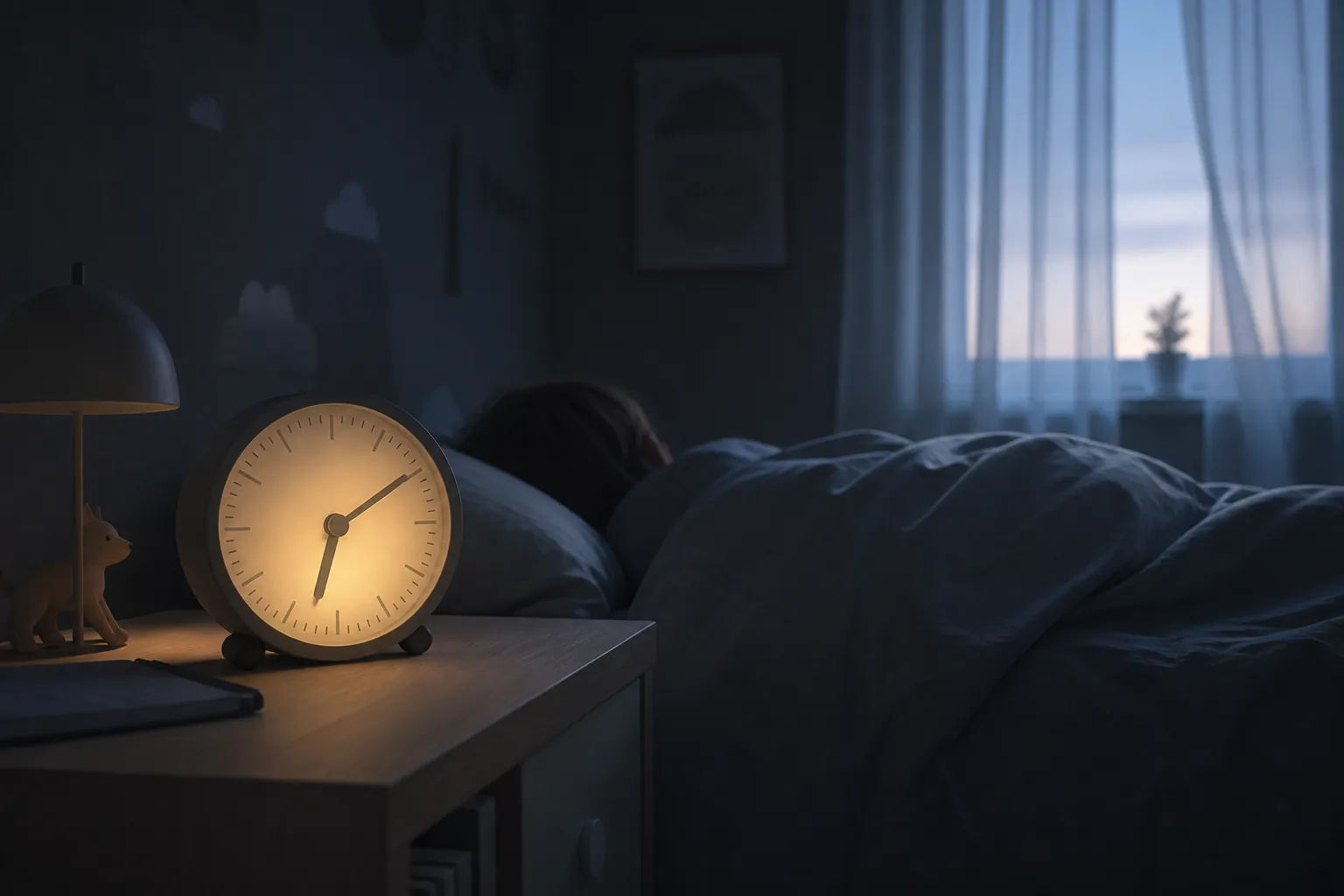
That mismatch is why “just one hour” can create several days of groggy mornings, earlier meltdowns, nap resistance, or a teenager who looks less awake even after getting to bed at a reasonable-looking time. The change is small on paper. It lands on a sleep system that is timed by morning light, evening light, routine, and developmental stage.
The body clock follows light, not the school calendar
Daylight saving time changes the relationship between social time and solar light. The spring shift produces darker mornings and brighter later evenings. For a child who must wake at the same clock time, that is an awkward combination: less morning light to pull the circadian clock earlier, and more evening light to push sleep timing later. The American Academy of Sleep Medicine describes daylight saving time as a source of circadian misalignment and argues that permanent standard time better matches human circadian biology [1][2].
AASM’s public sleep-education guidance makes the same practical point: light exposure, sleep timing, and consistent schedules are the levers that help the body adjust after the time change [3]. Seattle Children’s sleep physician Maida Lynn Chen has called the spring shift “jet lag for an entire nation,” a useful phrase because it points to the real mechanism without pretending the event is exotic [4]. Nobody put the child on a plane. The child’s clock was still asked to move.

Spring forward is usually the more costly direction because it asks children to wake earlier by their internal time while evening light makes earlier sleep harder. Fall back is different. It can look easier for older children because the clock gives them an apparent extra hour, but younger early risers may wake very early by the clock and become sleepy earlier in the evening. The problem changes shape; it does not vanish.
What has actually been measured in children
The evidence in children is not enormous, and it should not be inflated. There are no randomized trials assigning young children to daylight saving time disruption. The best child-specific data are observational: one stronger natural-experiment study in adolescents, plus more limited findings in infants and toddlers. That is still enough to stop treating the sleep loss as imaginary.
Adolescents: less sleep, slower vigilance
The clearest child-specific study is the 2015 Journal of Clinical Sleep Medicine paper “Adverse Effects of Daylight Saving Time on Adolescents’ Sleep and Vigilance.” Researchers followed 35 high-school students with actigraphy before and after the spring transition. In the school week after daylight saving time began, the teens lost an average of 32 minutes of sleep per night, adding up to 2 hours and 42 minutes across the week [5].
That study matters because it did not stop at “they seemed tired.” The adolescents also showed slower reaction times, more attention lapses, and higher daytime sleepiness after the clock change [5]. For parents of teens, this is the point worth sitting with: a half-hour nightly loss can sound modest until it is repeated across a school week and measured in vigilance, not just bedtime frustration.
The sample was small, so it should not be presented as a national average for every teenager. It is still stronger than the usual household anecdote because the students’ sleep was monitored objectively and the outcome included daytime performance. It also fits what sleep clinicians already worry about in adolescents: biological sleep timing tends to run later during the teen years, while many school start times demand early wake-ups.
Infants and toddlers: a smaller number, with a larger caveat
For infants and toddlers, the often-cited child-specific estimate is roughly 15 to 20 minutes less nighttime sleep per night in the week after spring forward. That figure comes from a SLEEP 2019 conference abstract, “Start of Daylight Saving Time and Sleep in Young Children,” and has been summarized in later parent-facing coverage [6]. It should be treated as an abstract-level finding, not as a settled population estimate.
Still, the size of the number is easy to misread. Fifteen minutes is not much if it happens once. Fifteen to 20 minutes across several nights can collide with daycare naps, feeding schedules, sibling noise, and a bedtime routine that already has no spare room. For babies and toddlers, the consequence may show up less as a verbal complaint and more as nap timing that drifts, a shorter night, or an early-evening crash.
Some children show little or no measurable disruption. That does not weaken the case; it keeps it honest. A child who sleeps flexibly, has a later wake time, or gets strong morning light may adjust quickly. A child with short sleep, early school start times, neurodevelopmental sensitivity, anxiety, or an already fragile nap schedule may have much less margin.
| Age band | What the evidence supports | How to read it |
|---|---|---|
| Infants and toddlers | About 15–20 minutes less nighttime sleep per night in the week after spring forward, reported from a SLEEP 2019 conference abstract [6]. | A useful signal, not a universal rule. Watch naps, bedtime resistance, and early-evening sleepiness. |
| School-age children | Direct measured evidence is thinner; pediatric guidance treats the clock change as a short-term circadian and routine disruption [3][7]. | Look at the child’s actual adjustment: waking, mood, school functioning, and whether sleep recovers within the expected window. |
| Adolescents | In one actigraphy study of 35 high-school students, average sleep fell by 32 minutes per night and 2 hours 42 minutes across the school week, with worse vigilance [5]. | The strongest child-specific case that small nightly losses can matter, especially with fixed early school wake times. |
How long adjustment usually takes
For most children, pediatric sources describe adjustment as a matter of several days to about a week. The American Academy of Pediatrics’ HealthyChildren guidance says most children adjust within about a week and notes that teens can have a harder time when early school schedules collide with the spring shift [7].
Other pediatric sleep guidance allows a longer tail. Children’s Hospital of Philadelphia says it may take up to about two weeks for some children to adjust [8]. Cook Children’s describes some children taking up to about three weeks [9]. Those ranges are not contradictions so much as reminders that the same one-hour clock change lands differently depending on age, light exposure, schedule rigidity, and baseline sleep.
There is also a broader circadian point that should not be confused with the household timeline. AASM has stated that the body clock may not fully re-entrain to daylight saving time even after months [1][2]. That does not mean every child will be visibly impaired for months. It means the policy keeps social time out of step with the light-dark cycle, while most families experience the sharpest practical disruption in the days to weeks around the change.
What helps because it targets the mechanism
The useful advice is not magic; it is circadian mechanics. If morning darkness and evening light are pushing the body clock the wrong way, the response is to strengthen the morning signal, soften the evening signal, and avoid asking the child to absorb the entire shift at once.

A gradual shift is the least dramatic and often the most sensible move. Stanford Medicine Children’s Health and AAP guidance both emphasize easing children toward the new schedule rather than relying on a single abrupt correction, often in 15-minute steps [7][10]. Sources differ on how far ahead to begin; some families use a few days, while others start closer to a week before the change. The principle is more important than the exact calendar: move wake time, meals, naps when possible, and bedtime in small increments so the body gets repeated timing cues.
| Lever | What it changes | How to use it without overcomplicating the week |
|---|---|---|
| Morning light | Helps cue the circadian clock toward the new morning. | Open curtains, eat breakfast near daylight, or get outside early when feasible. This is especially useful after spring forward [3][10]. |
| Dimmer evenings | Reduces the late-light signal that pushes sleep later. | Lower household lights in the last part of the evening and keep the routine visually quieter. |
| Screen limits | Cuts down on bright, engaging evening light and bedtime delay. | Treat screens as part of the light environment, not just a discipline issue. For more on this, see the site’s guide to kids’ sleep in a screen-heavy world. |
| Small schedule shifts | Avoids making the child absorb a full hour at once. | Move bedtime, wake time, naps, and meals by about 15 minutes when the family schedule allows [7][10]. |
| Routine anchors | Gives the brain repeated cues that sleep is approaching. | Keep the order predictable. CHOP describes a 20–30 minute bedtime routine, or about 40 minutes when a bath is included [8]. |
Evening screens deserve a little restraint, not a moral lecture. The issue during the time change is that screens combine light, alerting content, and time creep. If the household already needs a screen plan, the practical place to start is the last hour before bedtime. The related guides on kids’ sleep in a screen-heavy world and a computer-free evening routine go deeper on the same light-and-arousal problem.
For infants and toddlers, the same levers apply, but the work is mostly done through the environment. A baby cannot decide to “adjust.” Parents adjust light, nap timing, feeding rhythm, and the order of the evening. For teens, the limiting factor is often not knowledge; it is the collision between delayed biology, homework, devices, activities, and early school start times.
When it is more than normal adjustment
A rough few mornings after the clock change is expected. A preschooler may wake grumpy. A school-age child may need more help moving through the morning. A teen may look painfully slow for several days. The first question is not whether the time change had an effect; for many children, it did. The better question is whether sleep starts moving back toward the child’s usual pattern.
Daylight saving time is not a family catastrophe. It is also not nothing. Spring forward is harder than fall back for many children because it moves the social clock against the light cues their bodies use. The measured losses can be small per night and still matter across a week, especially for children who were already sleeping close to the edge.
If sleep problems continue beyond about two to three weeks, or if the change is accompanied by marked mood or behavior changes, it is time to involve the child’s pediatrician or a pediatric sleep specialist rather than keep recycling clock-change fixes [8][9][10]. The same applies sooner if the child already has a diagnosed sleep disorder, significant anxiety, complex medical needs, or safety concerns from daytime sleepiness.
References
- Daylight saving time: an American Academy of Sleep Medicine position statement, American Academy of Sleep Medicine, 2020.
- Permanent standard time is the optimal choice for health and safety: an American Academy of Sleep Medicine position statement, American Academy of Sleep Medicine, 2024.
- Daylight Saving Time, Sleep Education, American Academy of Sleep Medicine.
- Daylight Savings Time, Seattle Children’s, March 2026.
- Adverse Effects of Daylight Saving Time on Adolescents’ Sleep and Vigilance, Journal of Clinical Sleep Medicine, 2015.
- Daylight Saving Time and Children’s Sleep: Why the Clock Change Hits Families Hard, North State Parent, March 2026.
- Daylight Saving Time: Don’t Lose Sleep Over It, HealthyChildren.org, American Academy of Pediatrics, updated October 2025.
- 5 Ways to Help Kids Adjust to Daylight Saving Time, Children’s Hospital of Philadelphia.
- Daylight Saving Time: A Small Clock Change With Big Effects on Kids’ Sleep, Cook Children’s Checkup Newsroom, March 2026.
- How to Navigate Daylight Saving Time as a Family, Stanford Medicine Children’s Health.
Supports these guides
Spot an error or have clinical feedback?
Because this article covers clinical, medication, or safety information, we use a moderated correction channel instead of open public comments. Let us know if something about “How daylight saving time disrupts children's sleep schedules” needs a closer look.
Send feedback on this article