
Mechanism explainer
Permanent Daylight Saving Time Sleep Health: A Claim-by-Claim Comparison
This evidence scorecard tests each popular argument for permanent daylight saving time against the research, from activity and energy to safety and mood, showing why most claims fail—and where genuine uncertainty remains.
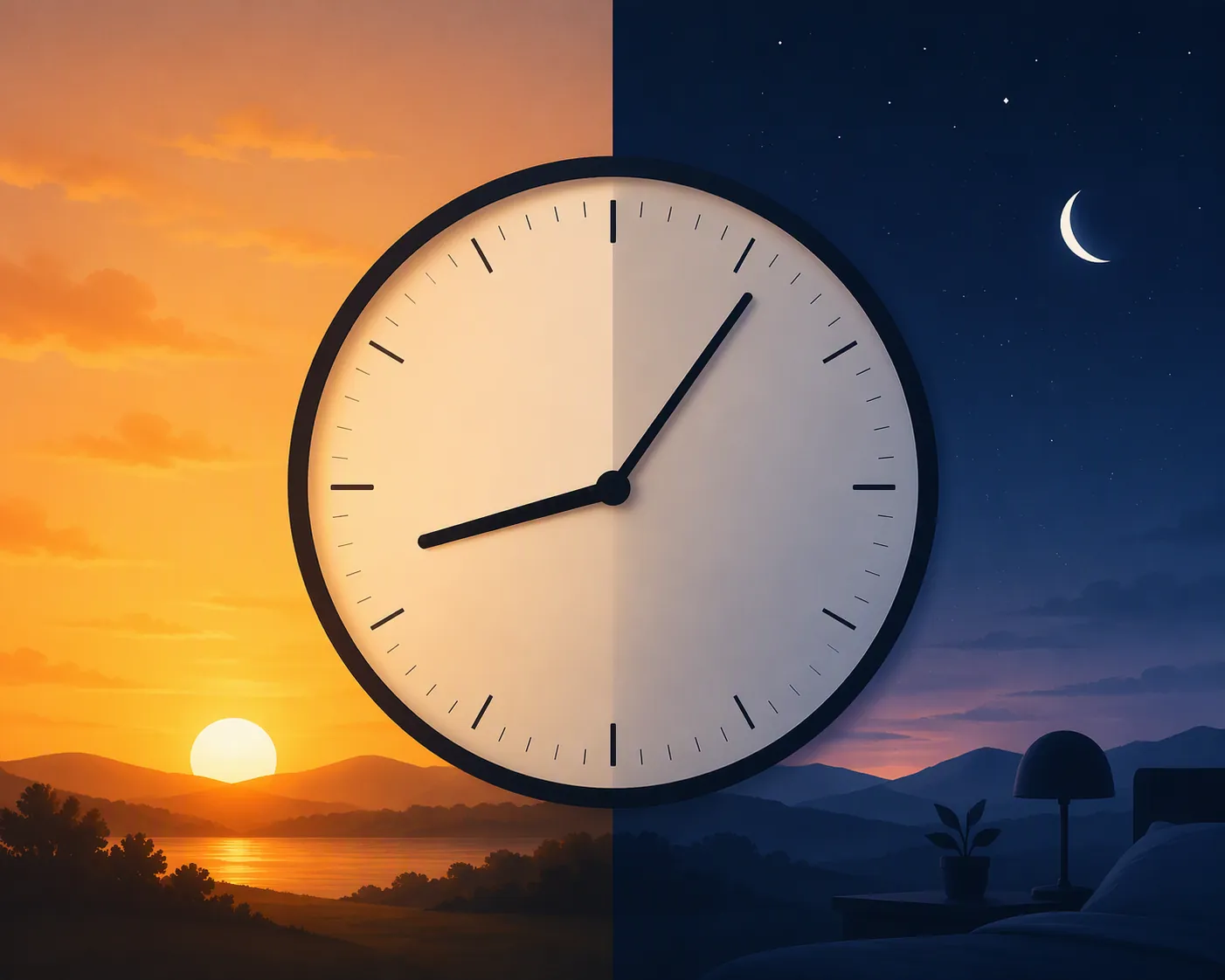
The permanent daylight saving time sleep health question is really a three-way comparison. The country can keep seasonal clock changes, adopt permanent daylight saving time, or adopt permanent standard time. “Sunshine” language makes one of those choices sound like it manufactures light. It does not. It moves civil time later against the solar day, giving many people more usable light after work while making morning light arrive later by the clock.
That trade can feel benign in June and punishing in January, especially for anyone whose day starts before sunrise because school buses, caregiving, warehouse shifts, medication timing, or a child’s wake-up schedule says so. The evidence scorecard below treats evening light as a real benefit where it is one, but asks whether it is strong enough to outweigh sleep timing, morning safety, seasonal mood, and clinical consensus.
The current policy debate is often presented as a choice between “changing the clocks” and “more sunshine.” That leaves out the most important comparison for sleep health: if the goal is to stop changing clocks, permanent standard time removes the transitions without locking the population into later sunrises.
The claim-by-claim scorecard
Evidence tiers matter here. Formal medical-society positions and replicated natural experiments should carry more weight than intuitive lifestyle arguments. A model estimate can be important without being settled fact. A poll can explain political pressure without proving a health effect.
| Claim for permanent DST | Best supporting argument | Counter-evidence | Evidence tier | Bottom line |
|---|---|---|---|---|
| It will be better for sleep because we stop changing clocks. | Ending seasonal clock changes avoids the spring and fall disruptions. | Permanent DST also keeps evening light later year-round. In a time-zone-border analysis, an extra hour of evening light was associated with about 19 minutes less sleep, with the largest effects among early-morning workers. Major sleep and medical societies endorse permanent standard time, not permanent DST, as the healthier fixed-clock option. [1][2][3] | High: circadian plausibility, observational sleep-duration evidence, formal society consensus | Strongly favors permanent standard time. |
| People will be more physically active. | More evening light may make after-work walks, sports, errands, and outdoor play easier. | A Duke/All of Us wearable preprint found no net increase in total daily steps across 1,157 Fitbit users; steps shifted from morning to evening. The study is useful but preliminary, female-skewed and higher-SES, and it did not measure sleep outcomes. [4] | Moderate-to-preliminary: wearable difference-in-differences preprint | Permanent DST may shift activity later; it has not shown a net activity gain. |
| Roads will be safer because evenings are brighter. | Some travel happens in the evening, and light can improve visibility. | Crash risk depends on local solar timing. Locations with sunrises and sunsets at least 30 minutes later than the time-zone meridian had 21.8% higher motor vehicle crash fatality rates in cited analyses. Evening benefits can be offset by darker mornings and geography. [1] | Moderate: geographic observational evidence, not a simple national yes/no | No blanket safety win for permanent DST; morning alignment matters. |
| It will save energy. | Less evening darkness could mean less lighting use. | The 1976 National Bureau of Standards report to Congress found no significant energy savings, and the Indiana natural experiment found DST increased residential energy demand. [1] | Moderate: government report plus natural experiment | Energy savings are too weak or negative to justify a sleep-health trade. |
| It will reduce crime. | More evening light may reduce some crimes that occur after work or school. | The crime argument is narrower than the sleep-health argument and depends on timing, location, and crime type. It does not establish a broad health advantage for permanent DST over permanent standard time. [1] | Low-to-moderate: context-dependent observational evidence | Possible local benefits are not decisive for national clock policy. |
| It will help winter mood because evenings will feel less dark. | Evening light after work can feel psychologically and socially valuable. | Permanent DST makes winter mornings darker. A 7-year Russian study cited in the sleep-medicine literature found adolescent seasonal depression highest under permanent DST and lowest under permanent standard time. [1] | Moderate: natural-experiment-style seasonal observation, with population limits | Winter mood is not a clean pro-DST argument; the available evidence favors standard time. |
| It will prevent heart attacks by ending clock transitions. | The spring transition has been linked to acute cardiovascular stress in some studies. | A systematic review reported about a 4% elevated acute myocardial infarction risk in the first week after the spring transition across 17 studies, but a 2025 JAMA Network Open study of 168,870 patients reported a null finding. This is a transition question, not proof that permanent DST is the right fixed clock. [5][6] | Contested: transition meta-analysis signal plus large null study | Supports ending clock changes cautiously; does not rescue permanent DST. |
| Long-term disease burden would be lower under DST. | Large models can estimate how clock policy might affect population risk through circadian timing. | Stanford Medicine reported a PNAS county-level model estimating about 300,000 fewer strokes and 2.6 million fewer obesity cases under permanent standard time. Those figures are model estimates and have been publicly challenged by University of Seville physicists, so they should not be treated as settled counts. [7] | Contested modeling | Potentially important, but not the main reason permanent standard time wins the scorecard. |
| Most people want permanent DST. | Evening light is popular, and policy names that promise sunshine poll well. | Polling changes with wording: Gallup reported 48% preferred year-round standard time versus 24% year-round DST, while AP-NORC reported 56% preferred year-round DST versus 42% standard time. [8][9] | Political-context evidence, not health evidence | Public preference warns us to frame the choice honestly; it does not determine sleep-health effects. |
The sleep row carries the most weight
The strongest case against permanent daylight saving time is not that people feel groggy for a few days after a clock change. It is that later evening light can chronically delay sleep timing while fixed morning obligations remain fixed. The Giuntella and Mazzonna time-zone-border estimate, summarized in the clinical sleep literature, connected an extra hour of evening light with roughly 19 minutes less sleep, and the reduction was largest among people with early work schedules. [1]
That finding is especially relevant for households that do not control their morning start time. A later sunset may make dinner-hour life easier, but it does not move the first school bell, the medication schedule, the warehouse shift, or the child who needs help getting dressed. The person paying the sleep cost is often the person least able to reallocate the morning.
The society positions line up with that mechanism. The American Academy of Sleep Medicine’s 2020 position statement supported permanent standard time over seasonal changes, and its 2024 statement again described permanent standard time as the optimal choice for health and safety. [2][3] The 2024 statement is notable because it is not just one professional group talking to itself; the permanent-standard-time preference is shared across major sleep, neurology, and medical organizations. [2]
For the biological pathway—light timing, melatonin, circadian phase, and social clock pressure—see Restful Ground’s deeper explanation of permanent DST sleep health risks. This scorecard does not need to re-prove every mechanism; the point here is that the sleep-duration and consensus evidence is stronger than the lifestyle claims usually offered for permanent DST.
Activity looks persuasive until total movement is measured
The activity argument has a humane core. People like walking after work without feeling as if the day has already closed. Parents see a brighter playground. Older adults may feel safer taking a short evening walk. None of that is imaginary.
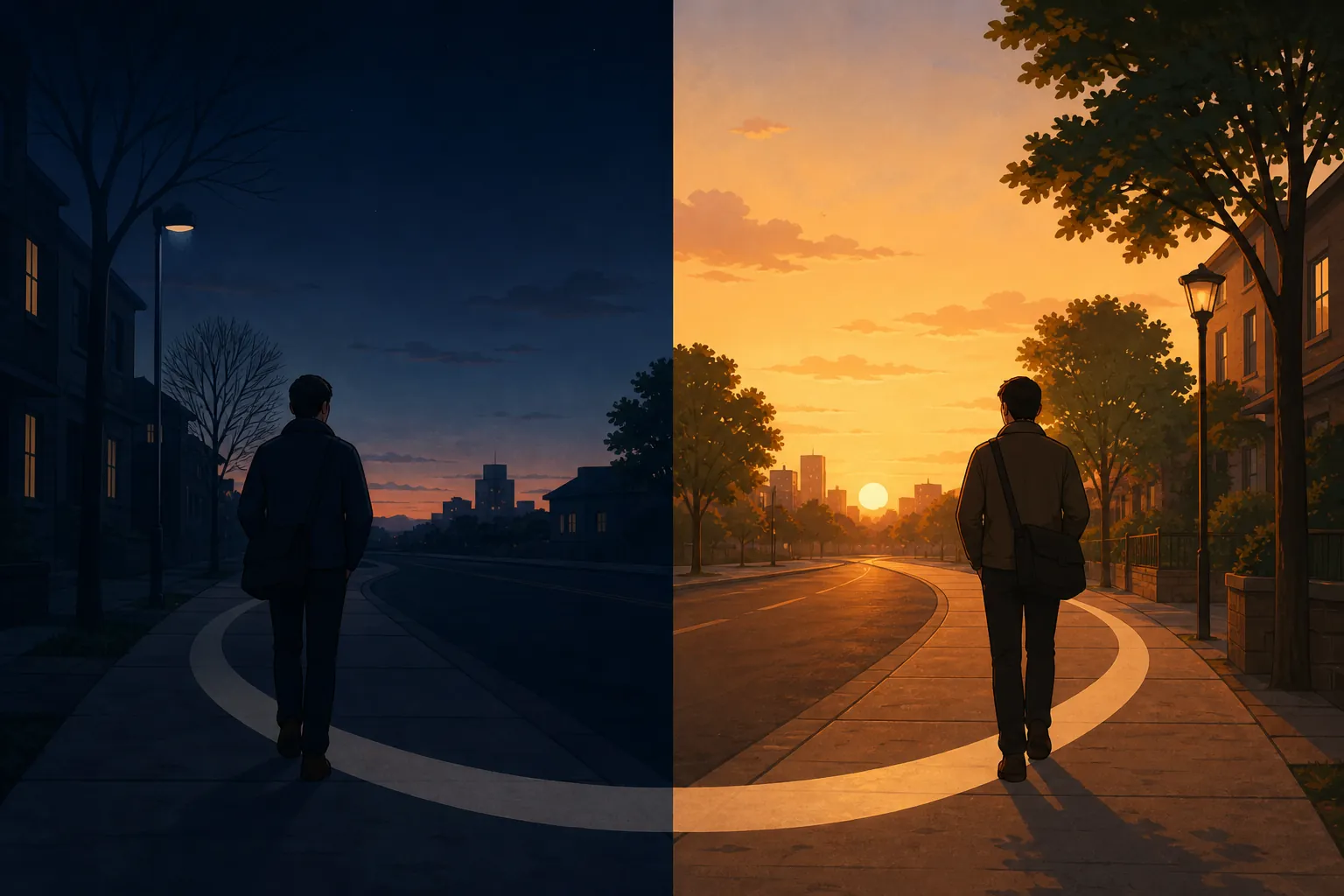
The harder question is whether permanent DST creates more activity or simply moves it. The Duke/All of Us wearable analysis used a difference-in-differences design and Fitbit step data from 1,157 users. It found that DST shifted steps from morning to evening, without changing total daily steps. [4]
That is a useful finding, but it should be kept in its lane. The study is a medRxiv preprint; its sample was not a perfect mirror of the U.S. population; and it deliberately excluded sleep outcomes. [4] It can weaken the claim that DST increases total physical activity. It cannot tell us whether later evening steps came at the cost of shorter sleep, worse morning alertness, or different effects in children, shift workers, or older adults.
Road safety is a geography problem, not a slogan
“Brighter evenings are safer” sounds obvious until the map gets involved. A clock policy does not brighten every commute; it changes which commute gets the light. Western edges of time zones and places already living late relative to solar noon are not in the same position as eastern-edge communities.
The clinical sleep-medicine review summarizes analyses finding 21.8% higher motor vehicle crash fatality rates in locations whose sunrises and sunsets occur at least 30 minutes later than the time-zone meridian. [1] That does not mean every DST day is a crash disaster, and it does not mean evening visibility has no benefit. It means national permanent-DST arguments that count evening light while ignoring darker mornings are incomplete.
This is where the burden becomes unequal. A person who can choose a later start may absorb a darker sunrise differently from a high-school student waiting outside, an early-shift worker driving sleepy roads, or a caregiver coordinating another person’s morning routine. Restful Ground’s related FAQ on the unequal burden of permanent daylight saving time is the better place for that population-by-population discussion.
Energy savings and crime are smaller claims than they sound
Energy savings keep returning to the debate even though the evidence has been weak for decades. The National Bureau of Standards report to Congress in 1976 found no significant energy savings, and the Indiana natural experiment found DST increased residential energy demand. [1] Modern energy use is not only about when people turn on lights; it also includes heating, cooling, household routines, and regional climate.
Crime deserves a similarly narrow treatment. Extra evening light may plausibly affect some outdoor or evening crimes. But that is not the same as proving a broad population-health advantage for permanent DST over permanent standard time. When the question is sleep health, morning light, and year-round circadian alignment, the crime claim is not strong enough to carry the policy.
Winter mood cuts against the “more evening light” story
The winter-mood argument may be the easiest one to feel and the hardest one to evaluate casually. Late-afternoon darkness can make a workday feel sealed off from ordinary life. A little more light after work sounds like mercy.
But permanent DST buys that evening light by spending morning light. In winter, that can mean more people waking, commuting, learning, and taking medication before sunrise. The 7-year Russian study cited by Krishnan and Johnson found adolescent seasonal depression highest under permanent DST and lowest under permanent standard time. [1] It is one study in a specific population, not a universal law, but it is enough to puncture the idea that permanent DST is obviously better for seasonal mood.
For readers with delayed sleep phase tendencies, ADHD-related eveningness, perimenopausal sleep disruption, or children who are already hard to wake, the practical issue is not only mood. Later light can make the whole household’s sleep window slide later while the morning alarm stays immovable. Restful Ground’s circadian-hygiene guide to aligning daily habits with your biological clock explains why morning light is not interchangeable with evening light.
The contested rows should stay contested
Acute myocardial infarction
The heart-attack literature is often used as a blunt anti-DST talking point. It is better read more carefully. A systematic review reported an approximately 4% elevated acute myocardial infarction risk in the first week after the spring transition across 17 studies. [6] That supports concern about abrupt clock changes.
But the counter-evidence is real. Rymer and colleagues’ 2025 JAMA Network Open study, with 168,870 patients, reported no significant association between daylight saving time transitions and acute myocardial infarction outcomes. [5] That null result does not prove spring transitions are harmless for every group, and access limitations around the article’s full text mean it should not be over-interpreted here. It does mean the AMI row should remain in the contested column.
More importantly, even a strong transition signal would not choose permanent DST. Permanent standard time also removes the clock change. The AMI debate can argue against seasonal switching without deciding which fixed time is healthier.
Long-term stroke and obesity modeling
The Stanford Medicine report on Weed and Zeitzer’s PNAS model is attention-worthy because it tries to estimate long-term disease burden rather than only transition-week effects. Stanford reported that the model estimated about 300,000 fewer strokes and 2.6 million fewer obesity cases under permanent standard time. [7]
Those are not observed case counts from a national policy trial. They are model estimates. The model has also been challenged by University of Seville physicists, according to April 2026 reporting, so the figures should be treated as contested rather than settled. [7] If the model is eventually strengthened by independent replication, it would add weight to the standard-time side. The current scorecard does not need it to reach that conclusion.
Public opinion tells us about framing, not physiology
Polls are useful because they show how easily the issue changes when the words change. Gallup reported that 48% preferred year-round standard time and 24% preferred year-round daylight saving time. [8] AP-NORC, using different framing, reported 56% preferred year-round daylight saving time and 42% preferred standard time. [9]
That split should make editors, legislators, and clinicians more careful, not more dismissive. People are not foolish for wanting brighter evenings. They are often answering the question they were asked: whether they would like usable light after work. A sleep-health policy has to ask the less cheerful follow-up: who loses morning light, who cannot shift their start time, and what happens when the loss repeats all winter?
Where the comparison lands
Seasonal clock changes have real drawbacks, and the spring transition may carry acute risks for some outcomes. But removing the transition does not require permanent daylight saving time. It can be done with permanent standard time, which aligns better with morning light and the clinical consensus.
On the strongest rows—sleep duration, circadian alignment, society positions, crash geography, activity reallocation, energy, and winter mood—the preponderance of evidence favors permanent standard time. The heart-attack and long-term modeling rows remain genuinely contested, but they do not overturn the central comparison. Permanent DST offers some appealing evening-light benefits. It does not offer the stronger sleep-health case.
References
- Debunking myths about daylight saving time: ten things everyone should know about the benefits of permanent standard time. Journal of Clinical Sleep Medicine, 2023.
- Permanent standard time is the optimal choice for health and safety: an American Academy of Sleep Medicine position statement. Journal of Clinical Sleep Medicine, 2024.
- Daylight saving time: an American Academy of Sleep Medicine position statement. Journal of Clinical Sleep Medicine, 2020.
- Should We Keep Changing the Clock? Characterizing Causal Effects of Daylight Saving Time on Behavior and Physiology. medRxiv.
- Daylight Savings Time and Acute Myocardial Infarction. JAMA Network Open, 2025.
- Daylight-Saving Time & Health: A Systematic Review of Beneficial & Adverse Effects. European Journal of Epidemiology, 2026.
- Study suggests most Americans would be healthier without daylight saving time. Stanford Medicine, September 2025.
- More Than Half in U.S. Want Daylight Saving Time Sunsetted. Gallup, 2025.
- AP-NORC October 2025 poll on daylight saving time. AP-NORC, October 2025.
Supports these guides
Spot an error or have clinical feedback?
Because this article covers clinical, medication, or safety information, we use a moderated correction channel instead of open public comments. Let us know if something about “Permanent Daylight Saving Time Sleep Health: A Claim-by-Claim Comparison” needs a closer look.
Send feedback on this article