
Three Pathways That Explain How Wildfire Smoke Disrupts Sleep
Wildfire smoke disrupts sleep through more than just coughing—learn about the three distinct pathways: inflammation, autonomic dysregulation, and trauma-activated insomnia, and what the research says about each.
The most frustrating wildfire-smoke nights are not always the dramatic ones. Sometimes the room looks normal, the coughing is mild, the windows are shut, and sleep still comes apart in pieces. That is the part worth taking seriously: wildfire smoke can disrupt sleep even when the problem does not feel like a simple airway complaint.
The clearest human signal comes from Liu et al. 2021, which linked wildfire PM2.5 exposure with a 7.2% reduction in sleep efficiency and more nighttime awakenings across more than 6,000 participants in the Western US and Canada, with the sleep effect increasing in a dose-dependent pattern.[1] Sleep efficiency is not a mood rating. It is the share of time in bed actually spent asleep. A drop there means the night is being mechanically interrupted, not merely remembered as unpleasant.
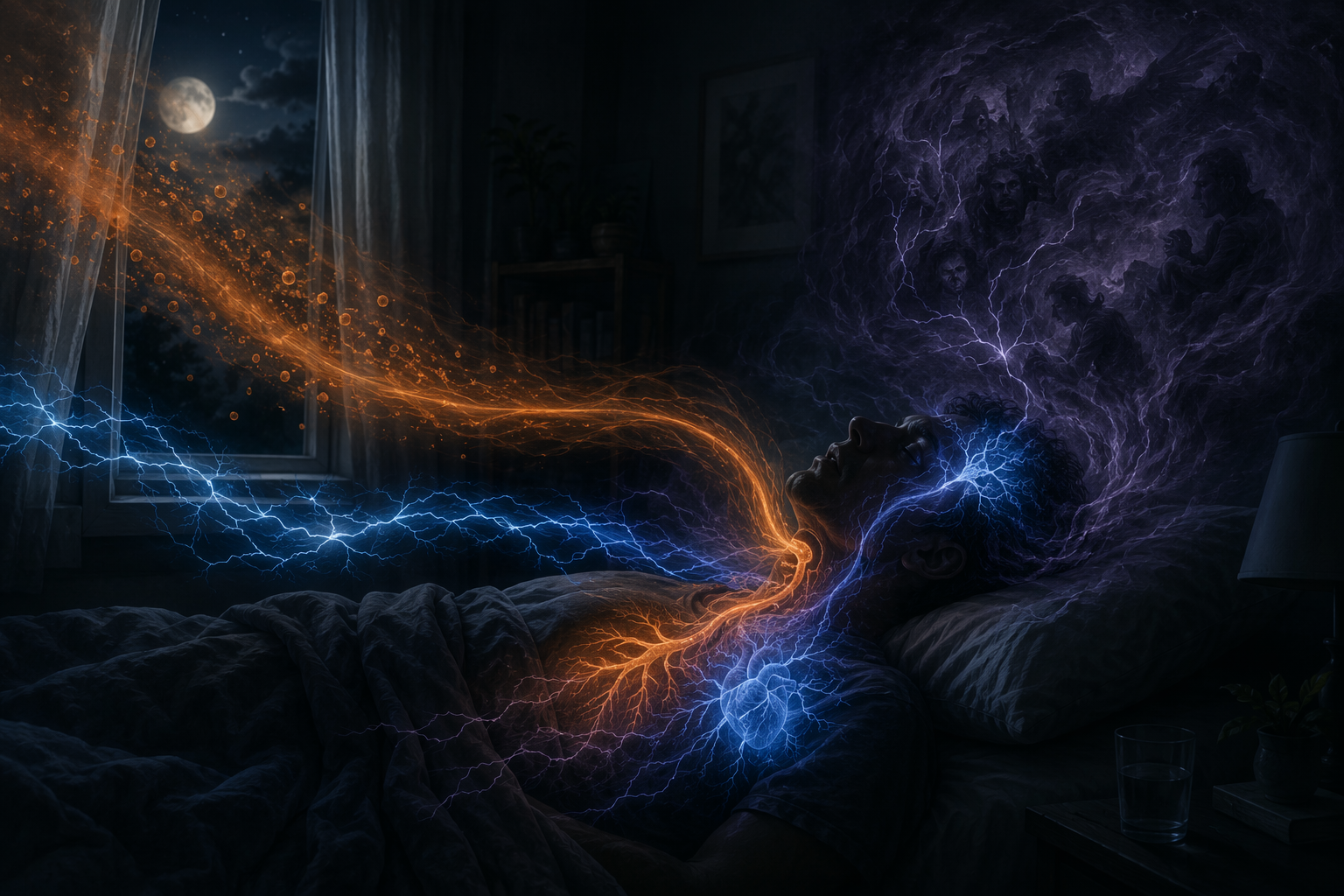
That finding does not prove every mechanism by itself. It does, however, make the question sharper. If smoke exposure measurably reduces sleep efficiency, the body is doing more than objecting to a bad smell. The evidence points to three overlapping routes: airway irritation and systemic inflammation, autonomic nervous system dysregulation, and trauma-activated insomnia.
The First Pathway Starts in the Airways, Then Stops Being Local
The airway pathway is the easiest to recognize because it has obvious sensations attached to it: throat scratchiness, chest tightness, nasal congestion, coughing, and the kind of mouth-breathing that makes sleep lighter before a person is fully awake. Fine particulate matter, especially PM2.5, is small enough to move deep into the lungs. Once there, it can irritate tissue and trigger inflammatory signaling rather than staying confined to the nose or throat.
This matters because sleep is not just a passive state that happens after the lights go out. Deeper, more restorative sleep depends on stable breathing, stable physiology, and a nervous system that is not repeatedly being nudged back toward alertness. When airway irritation causes coughing or congestion, the interruption is direct. When smoke exposure contributes to broader inflammatory activity, the interruption can be less obvious: the sleeper may not wake with a dramatic symptom, but sleep can become more fragmented and less efficient.
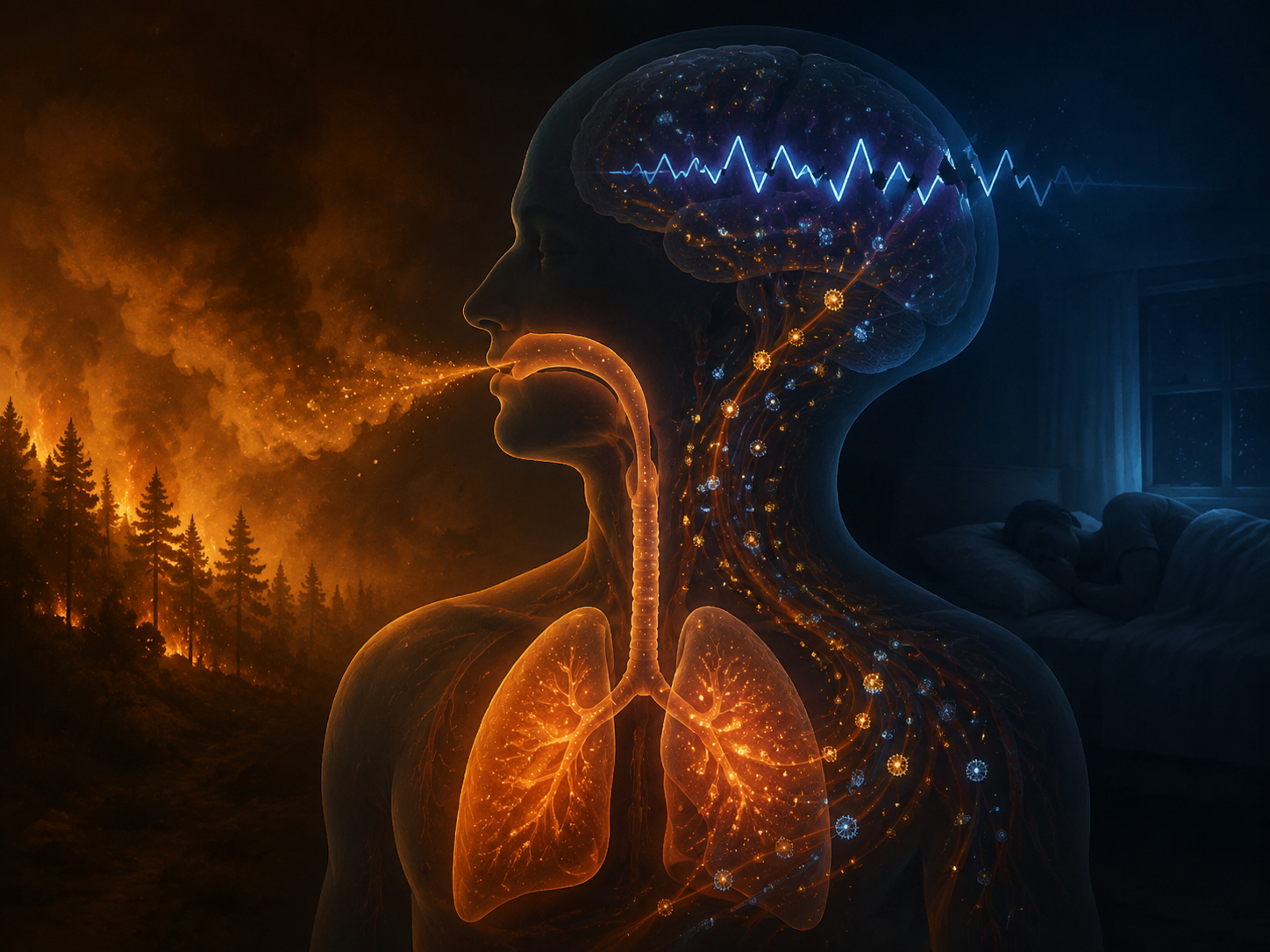
Markers such as IL-6 and CRP are useful here as signposts, not as a complete explanation. They represent the kind of systemic inflammatory response that can make sleep feel strangely unrefreshing. The point is not that a person can diagnose cytokine activity from a bad night. It is that smoke inhalation gives the body a biological reason to remain unsettled after the visible haze has thinned.
Sleep-disordered breathing may sit at the edge of this pathway. In the Isaac et al. systematic review, one included study of Cerro Grande fire evacuees reported obstructive sleep apnea in 41% of participants and presumptive sleep-disordered breathing in 94.8%.[2] Those numbers should not be treated as community prevalence: the sample involved treatment-seeking evacuees, which likely inflated the rates. Still, the finding is a reminder that airway vulnerability and wildfire exposure can collide in people who already have collapsible airways, snoring, asthma, chronic congestion, or undiagnosed sleep apnea.
Closed windows reduce exposure, but they do not erase it. Canadian research reported that indoor PM2.5 during wildfire events can reach 50–80% of outdoor levels in homes without active filtration, although the fraction varies with building age, construction, HVAC setup, weather, and filtration.[3] That variability is important. One apartment may behave almost like a leaky outdoor extension; another may hold a much cleaner bedroom air zone. The sleeper only feels the result.
The Autonomic Pathway: A Body Trying to Sleep While Acting on Alert
The autonomic pathway is less visible than coughing, but it may explain why some smoke-exposed nights feel so paradoxical: the body is exhausted, yet it will not fully power down.
Healthy sleep leans heavily toward parasympathetic dominance. Heart rate falls. Blood pressure tends to dip. Breathing becomes more regular. The body shifts away from daytime readiness and toward repair. Smoke exposure can push in the opposite direction, activating sympathetic physiology—the same broad system that prepares the body to respond to threat, exertion, or stress.
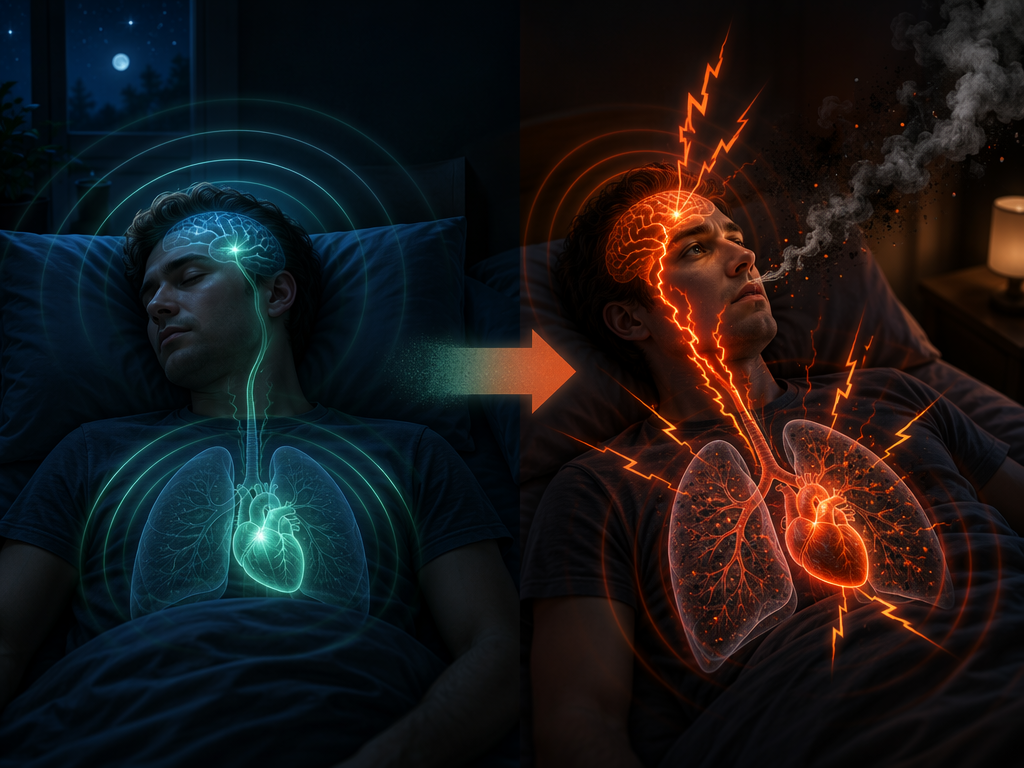
Rentschler et al. 2025 is useful because it measured the kind of sleep-architecture and cardiovascular changes that people often sense but cannot easily name. In Sprague Dawley rats, a single 1-hour exposure to eucalyptus biomass smoke significantly decreased both NREM and REM sleep duration while increasing heart rate, blood pressure, and heart-rate-variability markers associated with sympathetic tone.[4] In other words, the animals did not merely breathe dirtier air. Their sleep stages and cardiovascular state shifted in a direction that looks incompatible with deep restoration.
That is a mechanistic window, not a human clinical verdict. Rats are not adults lying awake in Sacramento, Kelowna, or Canberra with an AQI app open. The study does not prove that the same magnitude or architecture pattern occurs in human sleepers during a wildfire event. What it does support is a plausible pathway: biomass-smoke inhalation can alter autonomic tone in ways that directly oppose the physiology of sleep.
This distinction matters because poor sleep after smoke exposure is often explained too narrowly. If the only model is airway irritation, then a night without much coughing can feel mysterious or even psychosomatic. The autonomic model gives a different explanation: the lungs, blood vessels, heart, and brain may be participating in a stress response that keeps sleep shallow. The person may wake repeatedly not because they are thinking about smoke, but because the body is failing to sustain the low-arousal state that sleep requires.
It also helps explain why sleep can remain poor after the worst outdoor readings pass. The visible plume may move on faster than the body’s regulatory systems settle. That does not mean every bad night after a smoke day is caused by wildfire exposure. It means the timing of symptoms can lag behind what the sky looks like.
The Trauma Pathway Is Not Secondary for People Who Have Lived Through Fire
Smoke is an exposure. Wildfire is also an event. For some sleepers, the bedroom air is only one part of the problem. The smell of smoke can mean evacuation routes, lost homes, waiting for alerts, checking on relatives, or remembering the last time the horizon turned orange.
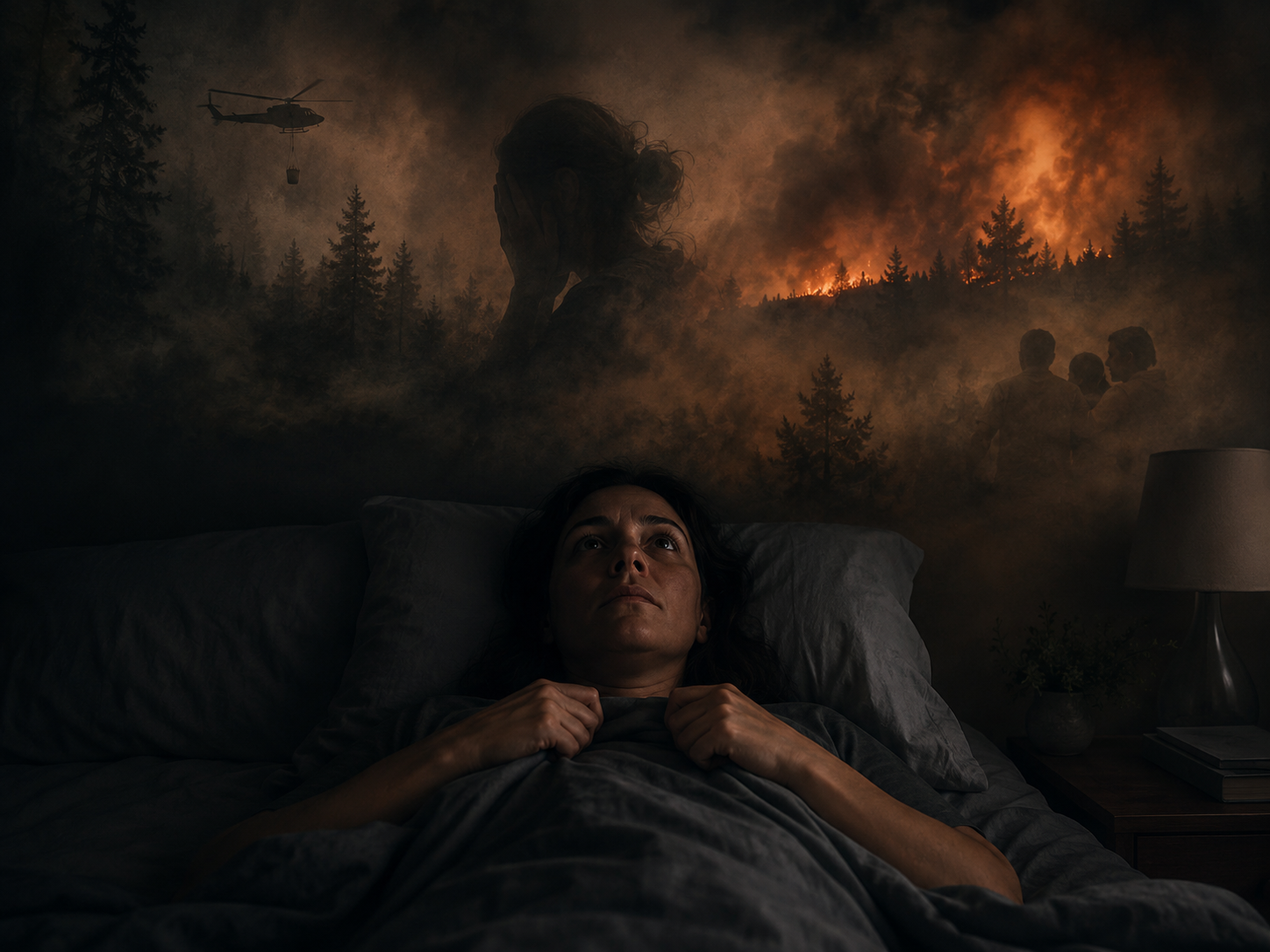
The sleep numbers in wildfire survivors are stark. Isaac et al. 2021 reviewed five studies and found insomnia prevalence of 63–72.5% and nightmares in 33.3–46.5% of wildfire survivors assessed 1–10 months after the fire.[2] The review also noted that these sleep-disturbance rates exceeded those reported after other natural disasters.[2] The caveat is real: five studies are not a vast literature, and survivor samples do not represent everyone who smells smoke during a regional event. But the signal is too large to file under ordinary discomfort.
Trauma-activated insomnia has a different logic from particle irritation. The sleeping brain is supposed to loosen its grip on monitoring the environment. After threat, it may do the opposite. Small sounds become meaningful. A change in wind matters. The phone on the bedside table becomes part of the sleep system because it might carry an alert. In that state, awakenings are not random interruptions; they are the behavior of a brain trained to keep watch.
Recent mental-health evidence connects wildfire smoke exposure with acute psychological strain, without proving that every smoke-exposed person develops trauma insomnia. Jung et al. 2025 reported that a 10 μg/m³ increase in wildfire-specific PM2.5 was associated with increased emergency department visits for depression, anxiety, and mood disorders for up to 7 days after exposure.[5] That is an association measured at the population level, not a diagnosis attached to an individual bedroom. It still fits what many people notice: smoke days can change mood, vigilance, and the threshold for waking.
This pathway is developed more fully in why wildfire smoke keeps your brain on high alert at night, but the essential point belongs here: smoke can disturb sleep even when the air-quality mechanism and the threat-memory mechanism are tangled together. A person can be inflamed, sympathetically activated, and psychologically vigilant in the same night.
Why the Three Pathways Compound Instead of Staying Separate
The clean diagram has three pathways. The lived night usually does not.
Airway irritation can cause micro-awakenings, and each awakening gives the brain a chance to notice the smell, the heat, the alert, or the worry. Systemic inflammation can feed autonomic arousal. Sympathetic activation can make it harder to return to stable NREM sleep after a brief interruption. Anxiety can tighten breathing and raise heart rate, making the body’s stress physiology more active even if the particle exposure is declining.
This is why the question “Is it just coughing?” is too small. Coughing may be the visible part. The sleep loss may also be carried by cardiovascular activation, inflammatory signaling, and threat monitoring. The Liu et al. sleep-efficiency finding gives the human anchor; the Rentschler rodent work gives a plausible autonomic mechanism; the Isaac review shows that post-fire insomnia and nightmares can be widespread among survivors.[1][2][4]
| Pathway | What changes during the night | What the evidence supports |
|---|---|---|
| Airway irritation and systemic inflammation | Coughing, congestion, unstable breathing, inflammatory signaling that can fragment sleep | Human wildfire PM2.5 is linked with lower sleep efficiency; treatment-seeking evacuee data suggest sleep-disordered breathing may be common in vulnerable groups |
| Autonomic dysregulation | Higher sympathetic tone, heart rate, and blood pressure opposing the parasympathetic state of restorative sleep | Direct sleep-architecture evidence comes from a rat biomass-smoke model, not human trials |
| Trauma-activated insomnia | Hypervigilance, nightmares, repeated awakenings, difficulty surrendering to sleep | Wildfire survivor studies report high insomnia and nightmare prevalence, though the review base is small |
What This Explanation Changes About Protection
The mechanisms do not make basic smoke precautions obsolete. They make them more urgent and more specific. If exposure can persist indoors and sleep disruption can run through inflammatory and autonomic routes, then the bedroom matters as a physiological recovery space, not just as a comfort zone.
For the practical side, the most useful next layer is a clean-room protocol for sleeping when air quality is hazardous, including how to choose the room, seal obvious leaks, and reduce indoor particle load. That step-by-step guidance is covered in how to sleep when air quality is hazardous. Filtration choices—especially portable HEPA units and HVAC filters—are handled in more detail in protecting sleep during wildfire smoke.
Monitoring also needs to be earlier than bedtime. If smoke exposure can alter the night’s physiology, waiting until the bedroom smells smoky is late. AQI forecasts and smoke maps are most useful when they trigger preparation before particles have built up indoors; the mechanics of that are covered in the air-quality forecast sleep guide. For a broader overview of smoke and sleep beyond mechanisms, see why wildfire smoke disrupts your sleep.
The calibrated conclusion is not that wildfire smoke explains every restless night during fire season. It is that the evidence supports more than a nuisance model. Human data show a meaningful sleep-efficiency signal during wildfire PM2.5 exposure. Survivor studies show striking insomnia and nightmare burdens after fires. Animal data show a plausible autonomic route through which biomass smoke can reduce NREM and REM sleep while raising cardiovascular arousal. The pieces are not equally mature, but they point in the same direction: wildfire smoke disrupts sleep through converging physiological and psychological pathways, and the body may keep registering the event after the sky looks calmer.
References
- Wildfire smoke PM2.5 reduces sleep efficiency — Sleep journal, 2021
- A Systematic Review of the Impact of Wildfires on Sleep Disturbances — Int J Environ Res Public Health, 2021
- Indoor air quality during wildfire events — Indoor Air journal, 2021
- Sleep disruption from inhalation of biomass smoke: a basis for coincident hypertension? — Particle and Fibre Toxicology, 2025
- Exposure to wildfire smoke linked with worsening mental health conditions — Harvard Chan School, 2025
Explore the mechanism
Next step
Spot an error or have clinical feedback?
Because this article covers clinical, medication, or safety information, we use a moderated correction channel instead of open public comments. Let us know if something about “Three Pathways That Explain How Wildfire Smoke Disrupts Sleep” needs a closer look.
Send feedback on this article