
The renewed push for the Sunshine Protection Act in July 2026 has put a familiar promise back in front of Americans: keep the later sunsets, stop changing the clocks, and be done with the nuisance. The bill’s appeal is easy to understand. A bright evening after work feels like a gift, and almost nobody defends the twice-yearly clock change as a humane ritual. But the health question is narrower and less forgiving: permanent daylight saving time would not simply remove clock changes. It would move the social day later against the sun, especially in winter, while many alarms, bus routes, school starts, and work shifts would stay fixed. That is where the health risks of permanent daylight saving time sleep disruption begin. [1]
Daylight saving time gives people more evening light by shifting civil time one hour ahead of solar time. Evening light is not neutral to the brain. It tells the circadian system that the biological day is still underway, which can delay sleep onset. The next morning, the clock still orders people up for work, school, caregiving, or a commute. The lost sleep does not come from weak discipline; it comes from putting light and obligation on opposite sides of the body’s timing system.
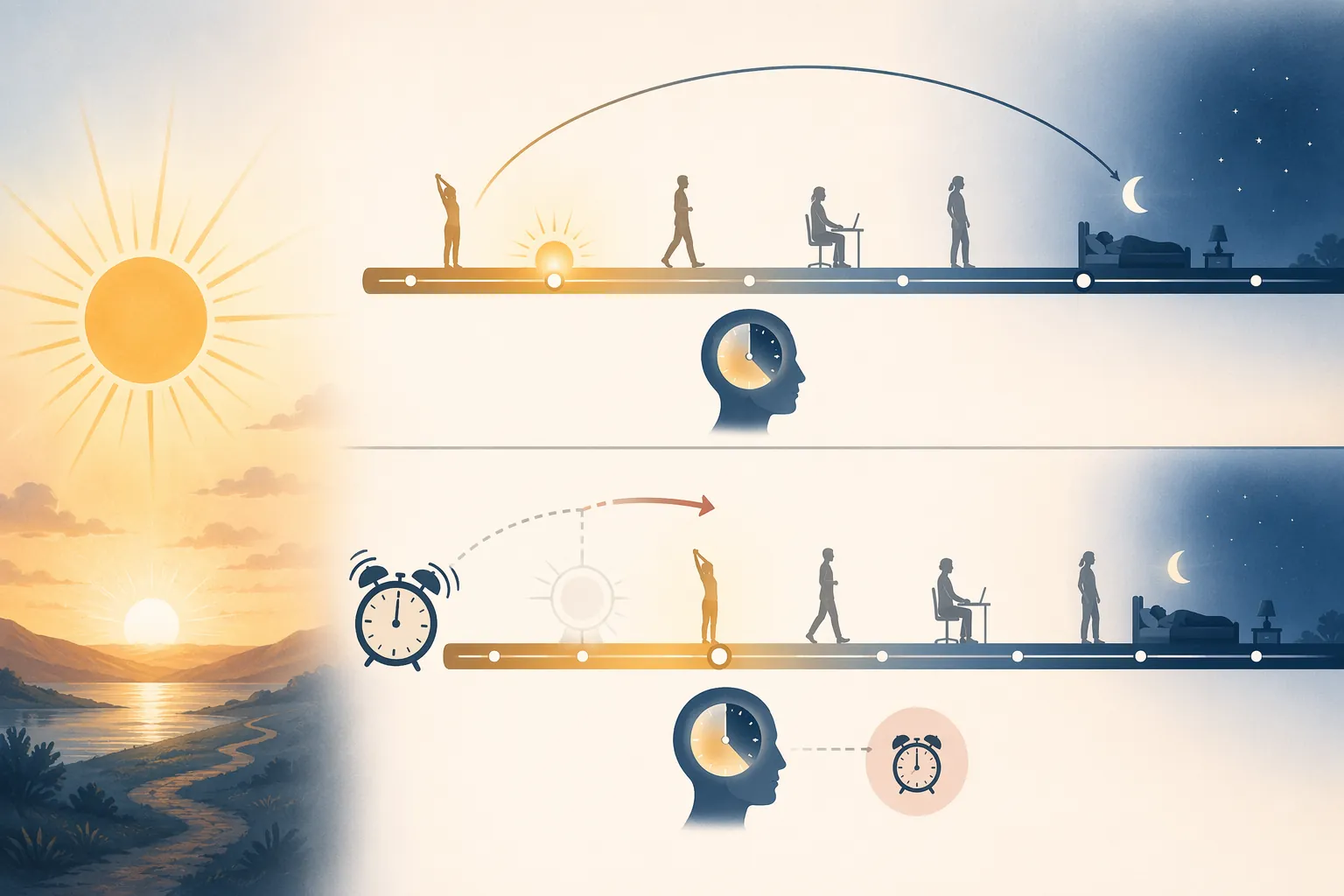
That distinction matters because several sleep and medical organizations do not merely object to changing clocks. The American Academy of Sleep Medicine has argued that permanent standard time is the optimal choice for health and safety because it better aligns human activity with the sun-driven circadian system. Its 2024 position statement also summarizes the larger health context: short sleep, defined there as less than six hours, is associated with a 12% increased mortality risk, 38% higher obesity rates, 37% higher diabetes rates, and 26% higher coronary heart disease. [2]
The sleep loss is small enough to dismiss, and large enough to matter
One of the more useful findings in this debate is not dramatic. Under DST-like conditions, people slept an average of 19 minutes less per night. For workers who started before 7 a.m., the loss reached 36 minutes per night. [3] Those numbers are easier to underestimate than a one-night crisis, but that is exactly why they matter. A half hour shaved from sleep night after night is not experienced as a public-health event. It is experienced as a rougher morning, another coffee, a shorter temper, a body gradually asked to run on less.
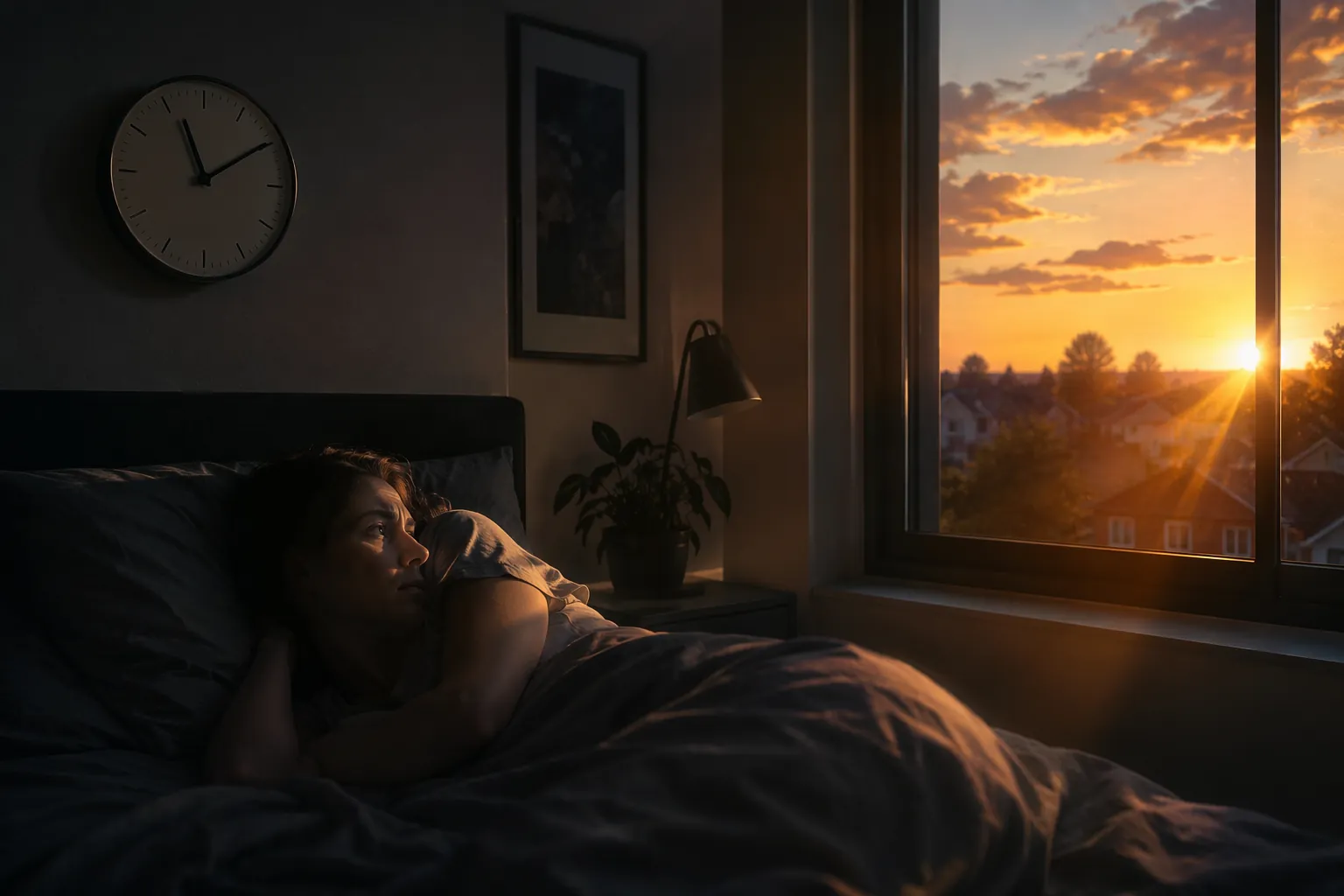
The early-start worker is the clearest case because the usual advice fails. Sleep later is not an option when the shift begins before dawn. Turn off the lights is useful inside the home, but it does not erase outdoor evening light arriving later by the clock. Permanent DST would make that mismatch a winter condition as well as a summer one in many places: darker mornings, later biological night, and the same social start time.
For readers who want the broader policy comparison, the tradeoff between permanent daylight saving time and permanent standard time is covered separately in Permanent DST vs standard time: which is better for sleep?. The key point here is more specific: a policy can remove clock-changing annoyance while still preserving, or worsening, a daily timing problem.
The body does not simply adapt to the clock
The most common objection is reasonable: if daylight saving time became permanent, wouldn’t people get used to it? Some habits would shift. Bedtime routines might move. Employers or schools could adjust, though many would not. But the circadian system is not a wall clock. It takes its strongest timing cues from light, especially the relationship between light exposure and the solar day.
The cortisol evidence is blunt. In a 2014 study of season, daylight saving time, and sunrise timing, the cortisol rhythm advanced by only 2 minutes despite a 60-minute clock change. [4] Cortisol is not the whole circadian system, but this result answers the casual adaptation claim in the right biological language. The social clock moved by an hour; a measurable body rhythm barely moved at all.
That does not mean every person is equally trapped by the same schedule. Chronotype matters, and a strong morning-lark pattern can make some people less burdened by permanent DST. But for people whose natural timing is later, and for anyone whose morning cannot move, adaptation has a ceiling. The body keeps checking the sun while the calendar insists the hour has changed.
This is also why the adolescent version of the problem is especially hard. Teenagers naturally tend toward later sleep timing, and early school starts leave little room for recovery. That narrower issue is addressed in Why permanent daylight saving time harms student sleep. The adult version is less often named because adults are expected to cope, but fixed obligations do not become biologically lighter because the person is older.
From delayed sleep to cardiovascular risk
The cardiovascular evidence comes in two different forms, and they should not be blended carelessly. The sharpest numbers come from the spring transition into daylight saving time, not from permanent DST itself. Reviews of cardiovascular outcomes have reported a 24% to 50% increase in heart attack risk on the Monday after the spring transition, continued elevation of 5% to 15% during DST weeks, and a 10% to 21% decrease when clocks return to standard time. Stroke incidence has been reported to rise 9% after the spring transition. [5]
Those transition studies are not a perfect simulation of permanent DST. A one-hour shock after a weekend is not the same as living year-round under a later civil clock. Still, they show that the cardiovascular system notices abrupt sleep and circadian disruption. Heart attack and stroke risk do not rise because people are annoyed by resetting a microwave. They rise in the setting of sleep loss, altered morning timing, and stress on systems that regulate blood pressure, inflammation, clotting, glucose, and autonomic balance.
Permanent DST would remove the acute spring jolt, which is a real benefit. But it would also preserve a DST-like timing relationship every day. That is why the discussion cannot stop with transition studies. The more relevant question is whether chronic social time pushed away from solar time points in the same direction as the transition data. The evidence is not randomized, but it is not empty.
The chronic burden shows up in obesity, stroke, diabetes, and cancer signals
Chronic sleep loss is a plausible bridge between permanent DST and metabolic disease because the affected systems are the ones sleep helps regulate. Short sleep is associated with higher rates of obesity and diabetes, and with higher coronary heart disease, in the AASM summary of the evidence. [2] Association is not destiny for an individual person, but at population scale it is enough to take repeated sleep loss seriously.
The Stanford Medicine report on a 2025 PNAS modeling study gives the population-level version of that argument. The researchers compared permanent standard time, permanent daylight saving time, and the current switching system. Their model estimated that permanent standard time would mean 2.6 million fewer people with obesity and 300,000 fewer stroke cases compared with the current system. Permanent DST still performed better than the current switching system in the model, achieving about two-thirds of the health benefit of permanent standard time, but it was inferior to permanent standard time for roughly 85% of the population. [6]
That result is easy to misread in both directions. It does not prove that one federal clock law would instantly prevent millions of diagnoses; it is a model, and it does not account for all real-world variation in weather, geography, buildings, or individual light exposure. But it is also not a decorative statistic. It translates the mechanism into expected population burden: when social time aligns better with solar time, fewer people are modeled to carry obesity and stroke risk.
Other proxy evidence points the same way. Position-within-time-zone studies have found cancer risk rising by 5% per degree of westward displacement within a time zone for breast, prostate, and colorectal cancers. [2] Westward location is not the same as a daylight saving law, and these studies are not randomized trials. But they capture the same underlying exposure: the clock says morning before the sun fully agrees, and the mismatch is lived repeatedly.
For readers who want the underlying circadian mechanics rather than the policy frame, The Science of Daylight Saving Time Sleep Disruption goes deeper into light timing, melatonin, and sleep pressure. The short version is enough for the health judgment here: later evening light delays the biological night, while many morning demands remain immovable.
The 1974 lesson is political, not biological proof
The United States has tried a version of permanent daylight saving time before. In 1974, during the energy crisis, public support was initially high, then fell sharply as dark winter mornings arrived; reported support dropped from 79% to 42% in about two months. The often-repeated child-safety story should be handled carefully, because later discussion of the episode notes that fatality changes could not be attributed solely to daylight saving time amid other confounding factors. [1]
The energy argument is also thinner than its political durability suggests. A review aimed at daylight saving time myths cites the 1974 experiment’s electricity savings at only 0.03% of annual U.S. consumption. [7] That figure does not settle every modern energy question, but it does keep the claim in proportion. A sleep and circadian tradeoff should not be sold as a major energy policy unless the savings are actually major.
Who might fare better under permanent DST
The honest case against permanent DST is not that every person would be harmed in the same way. The Stanford model found that about 15% of the population, described as strong morning larks, may experience less circadian burden under permanent DST. [6] That makes intuitive sense. If someone naturally wakes early and becomes sleepy early, later evening light may not push sleep as far into the night as it does for a later chronotype.
Chronotype is not a personality virtue, and it is not fully chosen. A morning person, an evening person, and someone in the middle can live under the same clock law and pay different biological costs. Readers trying to place themselves can start with the Chronotype Guide: Are You a Morning Person or Evening Person?. For policy, though, the minority exception does not erase the population finding. A clock law has to be judged by the distribution of burden, not only by the people whose biology is best matched to it.
The healthier default is the one closer to solar time
Permanent standard time is not glamorous. It does not promise a bright dinner hour in December. Its health advantage is quieter: it places the social morning closer to the solar morning and reduces the need to wake while the circadian system is still being pulled toward biological night. That alignment is why sleep-medicine groups favor it, and why the Stanford model estimated larger health gains under permanent standard time than permanent daylight saving time. [2][6]
The best argument for permanent DST is experiential: people like evening light. That preference deserves to be admitted plainly. But liking evening light does not make sleep a lifestyle accessory, especially for people who cannot move their mornings. The body does not vote on federal time policy; it responds to light, darkness, and repeated sleep opportunity.
For most people, the healthier permanent clock is standard time. Permanent daylight saving time may ease the burden for a minority of strong morning larks, but for the population as a whole it shifts cost onto sleep timing, chronic sleep debt, and the cardiovascular and metabolic systems that have to absorb the loss.
References
- The US Tried Permanent DST in 1974 and People Hated It. Newsweek, 2026.
- Permanent standard time is the optimal choice for health and safety: an American Academy of Sleep Medicine position statement. American Academy of Sleep Medicine, 2024.
- Sunset time and the economic effects of social jetlag: Evidence from US time zone borders. ScienceDirect, 2019.
- The effects of season, daylight saving and time of sunrise on serum cortisol in a large population. PubMed, 2014.
- Daylight saving time, circadian rhythms, and cardiovascular health. PMC.
- Study suggests most Americans would be healthier without daylight saving time. Stanford Medicine, 2025.
- Debunking myths about daylight saving time: ten things everyone should know. PMC, 2023.
Comments
Join the discussion with an anonymous comment.