
On a hot night, the problem can feel strangely specific. You are tired. Your mind is not racing. You did not drink coffee at 5 p.m. The room is simply too warm for your body to do the quiet physical work that usually lets sleep begin.
That distinction matters for understanding climate change sleep loss effects. Heat-related insomnia is not just ordinary restlessness with a higher thermostat setting. Sleep onset depends on thermoregulation: before stable sleep takes hold, core body temperature normally falls by roughly 0.3–0.5°C, helped by blood vessels widening in the hands and feet so the body can shed heat to the surrounding air.[1] When the air around you stays warm, that heat gradient shrinks. The body has less room to dump heat, and sleep becomes harder to enter and easier to disturb.

Why a warm room can block sleep onset
The body is not passive at bedtime. In the evening, circadian signals, skin blood flow, and heat exchange with the environment work together to lower core temperature. Warm hands and feet at night are not a trivial comfort detail; they are part of the mechanism. Distal vasodilation moves heat toward the skin surface, where it can leave the body.
That is why a hot bedroom can feel different from racing-mind insomnia or a delayed body clock. In those cases, the barrier may be cognitive arousal or mistimed circadian signaling. In a hot room, the barrier may be more literal: the body is trying to cool itself into sleep, and the room is pushing back. For some readers, the problem may still be mixed; a warm night can coexist with worry or circadian delay. But the thermal pathway is strong enough to deserve its own explanation.
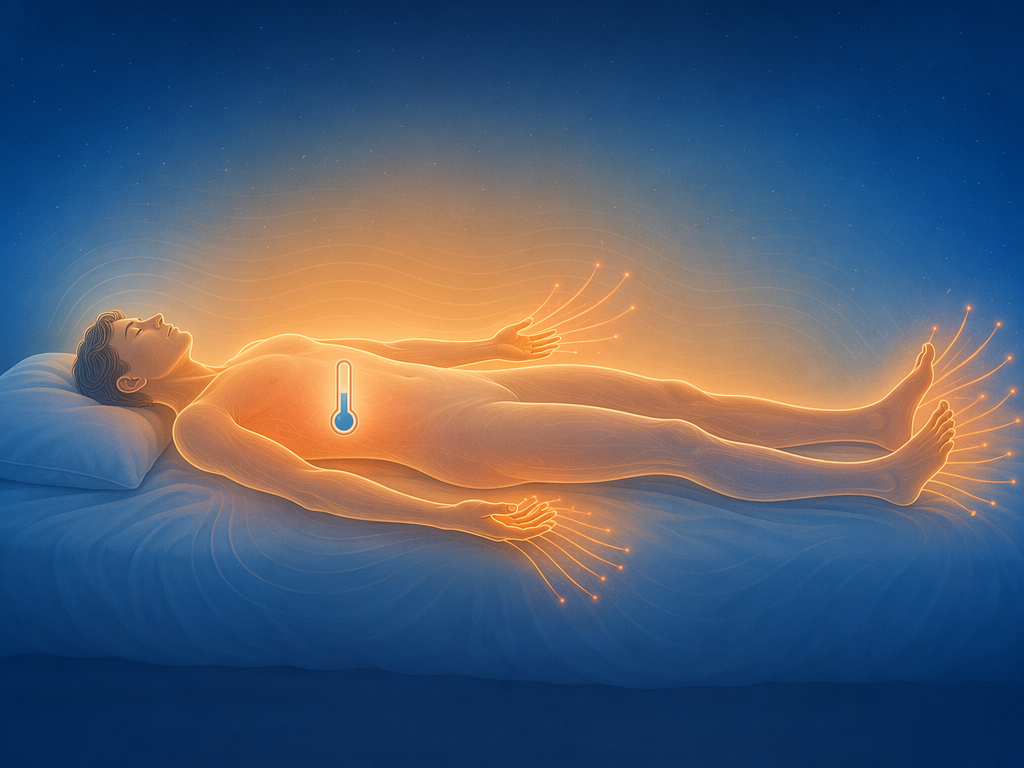
Once that physiology is in view, population findings become easier to interpret. A warmer night is not merely correlated with bad sleep because people happen to be in worse moods during summer. It alters one of the basic conditions the sleeping body is trying to create.
The first population bridge: one warmer degree, more insufficient sleep
A widely cited 2017 study in Science Advances connected nighttime temperature anomalies with self-reported sleep loss in the United States. Using CDC Behavioral Risk Factor Surveillance System data from about 765,000 respondents, Obradovich and colleagues estimated that a +1°C nighttime temperature anomaly increased insufficient sleep by about 3 nights per 100 people per month.[2]
That number is useful because it is small enough to be believable and large enough to matter. It does not mean every person loses sleep every time the night is 1°C warmer than usual. It means that, across a population, the probability of reporting insufficient sleep rises in a measurable way. A few extra bad nights spread across many people becomes a public-health signal.
The same study also has an important limitation: the sleep measure was self-reported “insufficient sleep,” not laboratory polysomnography or direct sleep tracking.[2] That means the result may capture fatigue, perceived sleep quality, or other heat-related discomfort in addition to actual minutes lost. Still, the finding fits the physiology: warmer-than-usual nights are exactly when heat dissipation should become harder.
What 23 million sleep records add
The strongest modern evidence chain comes from Li and colleagues’ 2025 Nature Communications study, which analyzed 23 million sleep records from Huawei smart device users in mainland China.[3] Wearables are not sleep laboratories, and Huawei users are not a random sample of the world. But the scale lets the researchers examine repeated nights across many people and compare sleep against ambient temperature patterns with unusual resolution.
| Temperature association in Li et al. 2025 | Sleep outcome |
|---|---|
| Each 10°C rise in daily mean temperature | About 9.7 fewer minutes of total sleep |
| Each 10°C rise in daily mean temperature | 20.1% higher odds of insufficient sleep |
| Each 10°C rise in daily mean temperature | 2.82% decline in deep sleep |
| High-emissions projection by 2099 | 33.3 hours of annual sleep loss per person |
| Moderate-mitigation projection by 2099 | About 16 hours of annual sleep loss per person |
The headline result is straightforward: each 10°C rise in daily mean temperature was associated with about 9.7 fewer minutes of total sleep and 20.1% higher odds of insufficient sleep.[3] Those are not catastrophic numbers for a single night. Their significance is cumulative. A heat wave does not need to erase half the night to affect mood, attention, metabolic regulation, or recovery across a week.
The more interesting finding is about sleep architecture. Li and colleagues reported that deep sleep declined by 2.82% per 10°C rise, with deep sleep appearing more thermosensitive than light or REM sleep.[3] That is not a decorative detail. Deep sleep is the stage most associated with high sleep pressure and slow-wave activity, and its vulnerability makes sense in a sleep system organized around a nightly drop in core temperature.
This gives the heat-sleep link a sharper shape. Warm nights may not only shorten sleep; they may change what kind of sleep a person gets. If the body struggles to reach or maintain the temperature conditions that favor consolidated deep sleep, the loss is not captured fully by bedtime and wake time. Two people may spend the same number of hours in bed, while the warmer night leaves one with lighter, more fragmented sleep.
There is a caution here. Consumer wearables estimate sleep stages from signals such as movement and heart-rate patterns; they do not measure brain waves the way polysomnography does. So the exact percentage should not be treated as a clinical staging verdict for any one person. The study is still valuable because the direction of the finding lines up with the body-level mechanism: deep sleep appears especially vulnerable when ambient heat opposes the normal nighttime temperature drop.[3]
A projection is not a prophecy, but it shows the scale
Li and colleagues projected future sleep loss under different warming scenarios. Under the high-emissions SSP5-8.5 pathway, annual sleep loss reached 33.3 hours per person by 2099; under the moderate-mitigation SSP2-4.5 pathway, the estimate was about 16 hours per person per year.[3]
The proper response to those numbers is neither panic nor dismissal. A 33.3-hour annual estimate turns scattered hot-night discomfort into a population burden: multiplied across millions of people, small nightly losses become large totals. But the projection assumes no adaptation, meaning it does not model future changes in air-conditioning access, building design, behavior, or physiological acclimatization.[3] Those omissions matter. Better housing, cooling access, and urban heat management could reduce the realized loss; continued warming with unequal adaptation could push the burden toward the higher end.
The geographic boundary also matters. The 23 million records came from Huawei smart device users in mainland China.[3] Housing stock, air-conditioning prevalence, baseline climate, work schedules, and wearable-user demographics differ across countries. The study strengthens the evidence that heat can degrade sleep at scale. It does not license a careless copy-and-paste of every numerical estimate onto every city or household.
The same warm night does not land evenly
Average effects can hide the people with the least room to adapt. In the 2017 U.S. study, older adults were more affected by temperature anomalies, with adults 65 and older losing nearly twice as much sleep as younger adults.[2] That finding is plausible: aging changes thermoregulation, sleep architecture, health status, medication use, and the ability to recover from fragmented nights. For readers trying to understand why standard advice often falls short later in life, the issue overlaps with broader limits of older-adult sleep hygiene.
Income also changes exposure. Research linking rising temperatures to reduced sleep in U.S. adults reported that people with annual household income below $50,000 experienced more than three times the sleep loss from temperature anomalies compared with higher-income individuals, partly because cooling access is not evenly distributed.[4] A warmer night in a well-insulated, cooled bedroom is not the same physiological challenge as a warmer night in a poorly cooled apartment.
Body composition may matter too. The same research direction has found greater sleep fragmentation at higher temperatures among people with obesity.[4] That does not mean heat-related sleep loss is reducible to weight, or that every person with obesity will respond the same way. It means that thermal load, breathing, metabolic health, and sleep continuity can interact. The population average is a starting point, not a substitute for vulnerability.
Other climate-related sleep pathways exist, but heat is the main chain
Climate change can disturb sleep through more than bedroom temperature. Air pollution, including PM2.5 and ozone, has been linked with sleep disruption through pathways such as systemic inflammation, nasal irritation, and breathing disturbance.[5] Wildfires, hurricanes, displacement, and property loss can produce trauma-related insomnia; one synthesis reported that up to 66% of wildfire survivors had insomnia persisting 10 months after the event.[1]
Obstructive sleep apnea may also worsen under hotter conditions. The American Thoracic Society reported research finding that climate change increases the severity of obstructive sleep apnea, a reminder that heat can interact with existing sleep-disordered breathing rather than merely delaying sleep onset.[6]
Climate anxiety belongs in the picture, but it is a different picture. Ogunbode and colleagues found that negative emotions about climate change were related to insomnia symptoms across data from 25 countries, with a modest cross-sectional association accounting for about 3–6% shared variance.[7] That supports climate worry as a real secondary pathway, especially for people whose nights are dominated by threat monitoring or rumination. It does not replace the direct thermal mechanism. If the main experience is lying awake because the room and body will not cool, the problem is not adequately described as anxiety.
This distinction is practical even in an article that is not a cooling checklist. A person with heat-driven sleep onset problems may need a different explanation than someone whose main issue is cognitive hyperarousal, and a different explanation again from someone whose sleep timing is drifting later for circadian reasons. The symptom “I can’t fall asleep” is not a diagnosis; temperature is one possible driver among several.
What the evidence can and cannot say
The best-supported conclusion is narrower, and stronger, than the usual slogan. Rising temperatures are already measurable in sleep data. The mechanism is biologically plausible and well established: sleep onset depends on losing heat, and warm nights make heat loss harder. Population studies now find associations at scales large enough to take seriously, from hundreds of thousands of self-reports in the United States to tens of millions of wearable sleep records in China.[2][3]
The evidence is not perfect. Self-reported insufficient sleep can blur sleep loss with fatigue. Wearable sleep staging is not the same as brain-wave measurement. Projections to 2099 depend on emissions pathways and adaptation assumptions. Vulnerable groups are not interchangeable across regions. These caveats do not erase the signal; they keep it honest.
A hot night feels different from ordinary restlessness because the sleeping body is negotiating with physics. It needs to move heat outward, lower core temperature, and settle into deeper stages of sleep. Climate change raises the baseline against which that negotiation happens. The exact number of hours lost by 2099 is conditional. The direction of the burden is already visible.
References
- Why can't I sleep? 4 ways climate change could be keeping you up at night — The Conversation — 2025
- Nighttime temperature and human sleep loss in a changing climate — Science Advances — 2017
- Climate warming may undermine sleep duration and quality in repeated-measure study of 23 million records — Nature Communications — 2025
- Study links rising temperatures to reduced sleep in U.S. adults — USC Keck Medicine / Environment International — 2025
- Air pollution and sleep review — PMC
- Climate Change Increases Severity of Obstructive Sleep Apnea — American Thoracic Society
- Negative emotions about climate change are related to insomnia symptoms — Current Psychology — 2023
Comments
Join the discussion with an anonymous comment.