
You can be exhausted all evening, barely keeping your eyes open, and then feel strangely awake the moment you get into bed. The room goes quiet. Your body is still. Then your mind starts reviewing tomorrow, replaying yesterday, checking the time, calculating how much sleep is left, and quietly accusing you of failing at something that should be automatic.
If this is why you are searching “i can t sleep at night,” the most useful starting point is not blame and not another generic reminder to relax. A racing mind at night often works like a learned alarm response. After enough nights of worrying in bed, the bed itself can become a cue for wakefulness. Cleveland Clinic sleep psychologist Michelle Drerup describes this as conditioned arousal: the brain starts associating bed with being awake, frustrated, and mentally active rather than with sleep.[1]

That distinction matters. It means the problem is not that you lack discipline, gratitude, toughness, or the correct bedtime tea. Your nervous system has learned a pattern. Patterns can be reinforced, but they can also be retrained.
Stress and anxiety are also a very common reason people report trouble falling asleep. Sleep Foundation reports that 54% of adults name stress or anxiety as the top reason they have difficulty falling asleep.[2] That number does not prove every racing-mind night is an anxiety disorder. It does make one thing clear: lying in the dark with an overactive mind is not rare, and it is not evidence that you are uniquely bad at sleep.
First, Make Sure It Is Your Mind and Not Your Clock
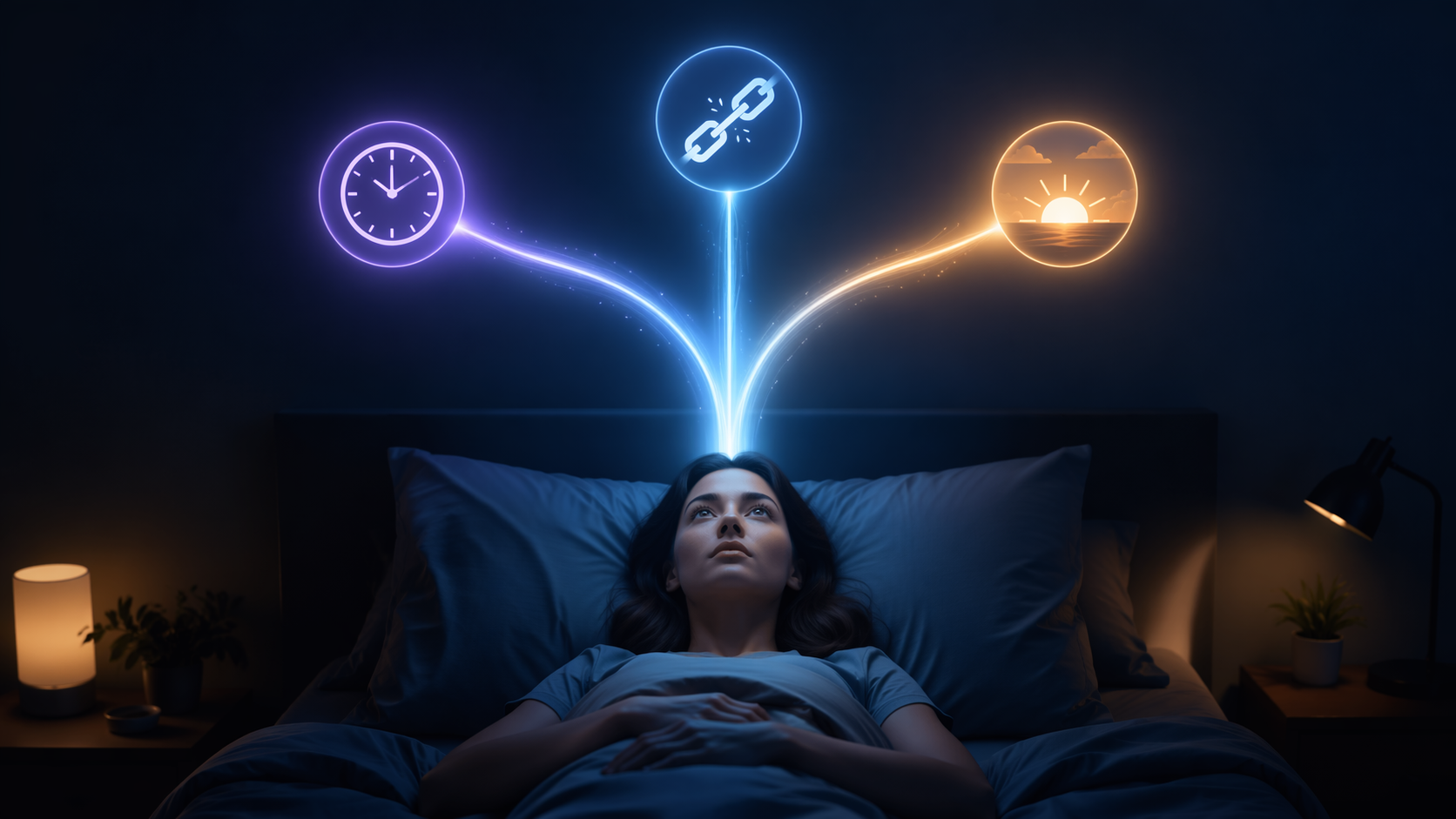
Two different problems can feel like “I can’t sleep at night.” One is cognitive hyperarousal: you feel tired, you want sleep, but your thoughts and body rev up in bed. The other is circadian delay: your internal clock may simply not be ready for sleep at the time you are trying to force it.
A rough clue: if you fall asleep more easily when your schedule shifts later, or if you consistently feel more alert at night and sleepy in the morning, the clock deserves attention. If the pattern is “sleepy before bed, suddenly wired in bed,” the bed-worry association is more likely to be the main target. If you are unsure, start with Can’t fall asleep? Check if it’s your mind or your clock before treating every hard night as anxiety.
Why Trying Harder Keeps You Awake
Sleep is unusually sensitive to effort. You can decide to stand up, send an email, or wash a cup. You cannot decide, by force, to become unconscious. The harder you monitor whether sleep is arriving, the more your brain receives evidence that something important is happening and should be watched.
This is how the bed becomes a performance test. At first, worry happens in bed because that is the first quiet moment of the day. Then the clock-checking starts. Then the dread starts earlier: brushing your teeth, turning off the lamp, feeling your heart beat against the pillow. Eventually the bedroom itself can carry the emotional tone of “here we go again.”
Low stimulation makes the effect sharper. During the day, tasks, conversations, screens, traffic, and decisions compete with your thoughts. At night, there is less to interrupt them. A worry that was background noise at 3 p.m. can sound enormous at 1:40 a.m. That does not mean the thought became more true. It means the conditions around it changed.
For readers who want the physiology behind this alert state, the deeper pathway is covered in Why Your Body Stays on Alert When You Try to Sleep and Why Anxiety Gets Worse at Night. For tonight, the more important point is practical: if staying in bed awake teaches your brain that bed is a place for thinking, then the first job is to stop rehearsing wakefulness there.
What to Do Tonight When Your Mind Is Already Racing
Tonight’s goal is modest on purpose. You are not trying to guarantee eight perfect hours. You are trying to lower arousal and avoid strengthening the bed-awake connection. That is a smaller target, and it is a better one.
| If this is happening | Do this | Why it helps |
|---|---|---|
| You have been awake for about 20 minutes | Get out of bed and go somewhere dim and quiet | It prevents more awake time from being paired with the bed |
| Your body feels keyed up | Use paced breathing or progressive muscle relaxation | It gives the nervous system a lower-arousal rhythm to follow |
| Your mind keeps listing problems | Write worries and next actions on paper | It moves planning out of the bed and into a contained place |
| You are checking the clock | Turn the clock away or cover it | It removes the countdown that fuels performance anxiety |
| You get sleepy again | Return to bed without trying to evaluate the night | The bed gets another chance to be linked with sleepiness |
Use the 20-Minute Rule Without Turning It Into Another Test
The common instruction is: if you are not asleep after about 20 minutes, get out of bed. The “about” is important. Do not stare at the clock waiting for minute 20. If you are clearly awake, frustrated, rehearsing arguments, or trying to force sleep, the rule has already done its job: it tells you to leave the stage.
Go to a chair, couch, or another quiet place. Keep the light low. Do something dull and non-demanding: read a familiar book, listen to quiet audio, fold a small amount of laundry, sit with a blanket. Avoid making this a second evening. The goal is not entertainment; it is to wait for sleepiness to return somewhere other than the bed.
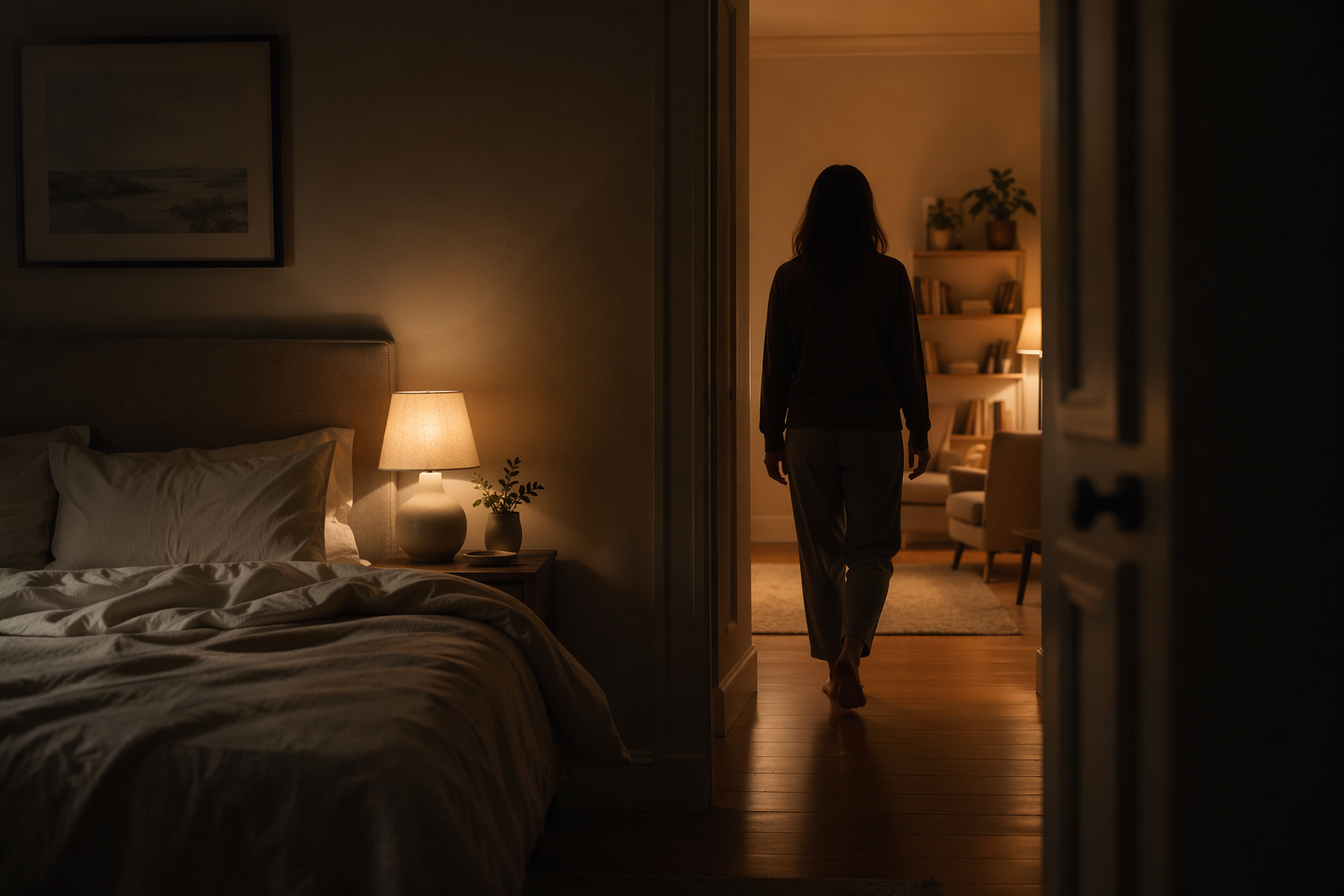
This can feel unfair the first few nights. You are tired, and now someone is telling you to get up. But staying in bed for hours while angry, alert, and mentally busy is not rest in the way your brain needs. It is practice. Unfortunately, it is practice being awake in bed.
Give the Body a Boring Signal
Paced breathing is not a thought eraser. That expectation makes people abandon it too quickly. Its job is narrower: to give your attention and body a slower rhythm than the worry loop.
- Box breathing: inhale for 4, hold for 4, exhale for 4, hold for 4; repeat gently.
- 4-7-8 breathing: inhale for 4, hold for 7, exhale for 8; shorten the counts if that feels strained.
- Long-exhale breathing: inhale comfortably, then make the exhale slightly longer than the inhale.
If counting makes you more vigilant, drop the numbers. Breathe in a way that feels slow, quiet, and easy enough to continue. If you want a broader look at relaxation methods and where the evidence is stronger or weaker, use Home Remedies for Sleep: An Evidence-Tiered Guide as a side path rather than trying five new techniques in one night.
Put Worry Somewhere It Can Wait
Worry journaling works best before bed, not after you are already deep in the spiral. Give yourself a short, plain format: “What is on my mind?” and “What is the next reasonable action?” The next action can be tiny: send the email after breakfast, check the bill tomorrow afternoon, ask for clarification at work, schedule time to think about it.
The point is not to solve your life at bedtime. It is to stop the brain from using the pillow as a planning desk. If a thought returns in bed, the response is not an argument. It is a reminder: this has been captured; the next step has a place.
Try Progressive Muscle Relaxation If Your Mind Follows Body Tension
Progressive muscle relaxation gives some people a more concrete anchor than breath. Start at your feet or face. Gently tense one muscle group for a few seconds, then release. Move through the body slowly. Keep it mild; this is not a workout. The contrast between tension and release can help you notice when you are gripping the night as if effort will make sleep happen.
If you become more alert while doing it, stop. A useful sleep tool should lower arousal. It should not become another assignment you can fail.
The Longer Retraining Plan: Teach the Bed What It Means Again
The overnight tactics protect you from making the loop stronger. The longer plan is what changes the loop. This is where CBT-I, or cognitive behavioral therapy for insomnia, matters. In a 2015 meta-analysis of 20 randomized controlled trials, CBT-I was associated with an average 19-minute reduction in sleep latency and a 26-minute reduction in wake after sleep onset.[3] Those numbers are not a promise about your first night. They are a realistic reason to take repetition seriously.
CBT-I is not one trick. It usually combines behavioral rules, sleep scheduling, and work with the thoughts that keep insomnia active. The behavioral part deserves first attention because it changes what your brain repeatedly experiences in bed.
Stimulus Control Comes First
Stimulus control sounds clinical, but the idea is simple: protect the bed as a cue for sleep. If the bed has become a place for scrolling, worrying, arguing with thoughts, checking the time, doing work, and waiting miserably for sleep, the cue is muddy. The brain cannot tell whether bed means rest or vigilance.
- Use the bed for sleep and sex, not planning, working, scrolling, or problem-solving.
- Go to bed when sleepy, not simply when you are tired of being awake.
- If you are awake and activated, leave the bed and return when sleepy.
- Wake at a consistent time most days, even after a rough night.
- Avoid long, late naps that reduce sleep pressure before bedtime.
The uncomfortable part is also the therapeutic part. Leaving bed interrupts the old lesson. Returning only when sleepy repeats a new one. Night after night, the bed gets fewer minutes of anger and mental rehearsal, and more minutes of sleepiness followed by sleep.
This is why “resting in bed for hours” can be misleading. If you are calm and drifting, fine. If you are furious, calculating, and trying to win sleep by force, the bed is absorbing the wrong lesson. The mattress is not the problem; the pairing is.
Sleep Restriction Can Help, but It Is Not a DIY Contest
Sleep restriction therapy is another CBT-I component. It limits time in bed to better match the amount of sleep you are actually getting, then gradually expands the sleep window as sleep becomes more consolidated. The name sounds harsh because, in the beginning, it can be. It may temporarily increase sleepiness before sleep improves.
This is best done with a clinician or a structured CBT-I program, especially if your insomnia is chronic, your daytime sleepiness is dangerous, or you have medical or psychiatric conditions that make sleep loss riskier. Sleep restriction is not appropriate to improvise if you have bipolar disorder concerns, a seizure disorder, or another condition where sleep deprivation may destabilize health.
Cognitive Restructuring Is Not Positive Thinking
The thoughts that keep insomnia alive often sound factual at night: “Tomorrow is ruined,” “I will never sleep,” “I can’t function unless I fall asleep right now.” Cognitive restructuring does not ask you to pretend those fears are silly. It asks you to test whether they are complete.
A more useful replacement is specific and believable: “I have had bad nights before and still gotten through the day,” or “Resting quietly is not the same as sleep, but it is better than fighting.” The sentence should lower threat, not decorate it.
CBT-I is widely treated as a first-line approach for chronic insomnia; the American Medical Association notes that CBT-I is recommended first line and reports that about 70% to 80% of patients respond to it.[4] Response does not mean every night becomes perfect. It means the insomnia pattern becomes more workable and less self-reinforcing.
What Often Makes the Racing-Mind Loop Worse
Some habits are discussed so often that people stop hearing them. They still matter, but not as moral rules. They matter when they feed the same arousal loop you are trying to weaken.
- Clock-checking turns the night into a countdown and gives worry new data every few minutes.
- Stimulating screen content can keep the mind socially, emotionally, or cognitively engaged when you need less engagement.
- Alcohol may make sleepiness arrive faster for some people, but it can disrupt sleep later in the night.
- Trying to compensate with long naps can reduce the sleep pressure that helps you fall asleep the next night.
- Using the bed as a place to solve problems keeps teaching the brain that bedtime is thinking time.
Sleeping pills and supplements are sometimes part of care, but they are not the cleanest first answer to a conditioned bed-worry pattern. If you are considering over-the-counter options, treat that as a separate risk-benefit decision rather than a shortcut around behavioral retraining. A secondary overview is available in GABA-Targeting OTC Sleep Aids for Anxiety.
When a Racing Mind Needs More Than Sleep Tactics
Bedtime rumination is common, but it is not always harmless. Mayo Clinic lists stress, mental health disorders, medications, medical conditions, sleep-related disorders, caffeine, nicotine, and alcohol among factors that can contribute to insomnia.[5] If insomnia is persistent, worsening, or affecting safety, it deserves medical attention rather than more self-blame.
Seek professional help if you have chronic insomnia, severe anxiety, panic, depression symptoms, thoughts of self-harm, possible bipolar disorder, substance use concerns, seizure disorders, or daytime sleepiness that makes driving or work unsafe. Also get help if you are considering sleep restriction and have any condition where sleep loss could be risky.
Insomnia and mental health can also overlap. A review article on CBT-I notes that about 40% of people with insomnia may have a diagnosable mental health condition, while also emphasizing that sleep-focused behavioral treatment can improve insomnia and sometimes related symptoms.[3] That is a reason to take the pattern seriously, not a reason to panic at every bad night.
What Progress Usually Looks Like
Progress is often uneven. The first win may not be falling asleep instantly. It may be leaving the bed after 25 minutes instead of lying there for two hours. It may be checking the clock once instead of ten times. It may be writing the worry down before bed and noticing that it still returns, but with less force.
That still counts because the target is the association. If the problem was learned through repetition, it usually changes through repetition too: less awake struggle in bed, more returning to bed when sleepy, fewer nights where the pillow becomes a courtroom for the whole day.
If you want to match sleep interventions to the specific biology you suspect is driving your nights, Mechanistic Sleep Improvement can help sort arousal, circadian timing, sleep pressure, and habit loops.
Tonight, that may mean getting up, dimming the lights somewhere else, breathing without demanding silence from your mind, and returning only when sleepiness comes back. Over the next weeks, it means repeating the lesson until the bed becomes less of a test and more of a cue again.
References
- How To Stop Your Mind From Racing and Get To Sleep, Cleveland Clinic
- 126 Sleep Statistics, Sleep Foundation
- Cognitive-Behavioral Therapy for Insomnia: An Effective and Underutilized Treatment, PMC
- What doctors want patients to know about insomnia, AMA
- Insomnia Symptoms and Causes, Mayo Clinic



Comments
Join the discussion with an anonymous comment.