
The awkward part of apple watch sleep tracking is that it greets you before you have fully become a person again. You open the Sleep app, see deep, core, REM, awake time, and now a Sleep Score, and one small number can start rewriting the whole night. Thirty-seven minutes of deep sleep looks less like an estimate and more like a verdict.
The first useful move is not to panic, and not to pretend the chart is meaningless either. In opt-in Apple Watch data analyzed by Empirical Health, users averaged about 49 minutes of deep sleep, about 13% deep sleep, 20% REM, and roughly 6.5 hours of total sleep per night; 80% of users fell between 15% and 25% REM sleep.[1] That is not a clinical norm for every age, body, schedule, or medical situation. It is still a helpful reality check for the common morning question: “Is my number wildly unusual?”
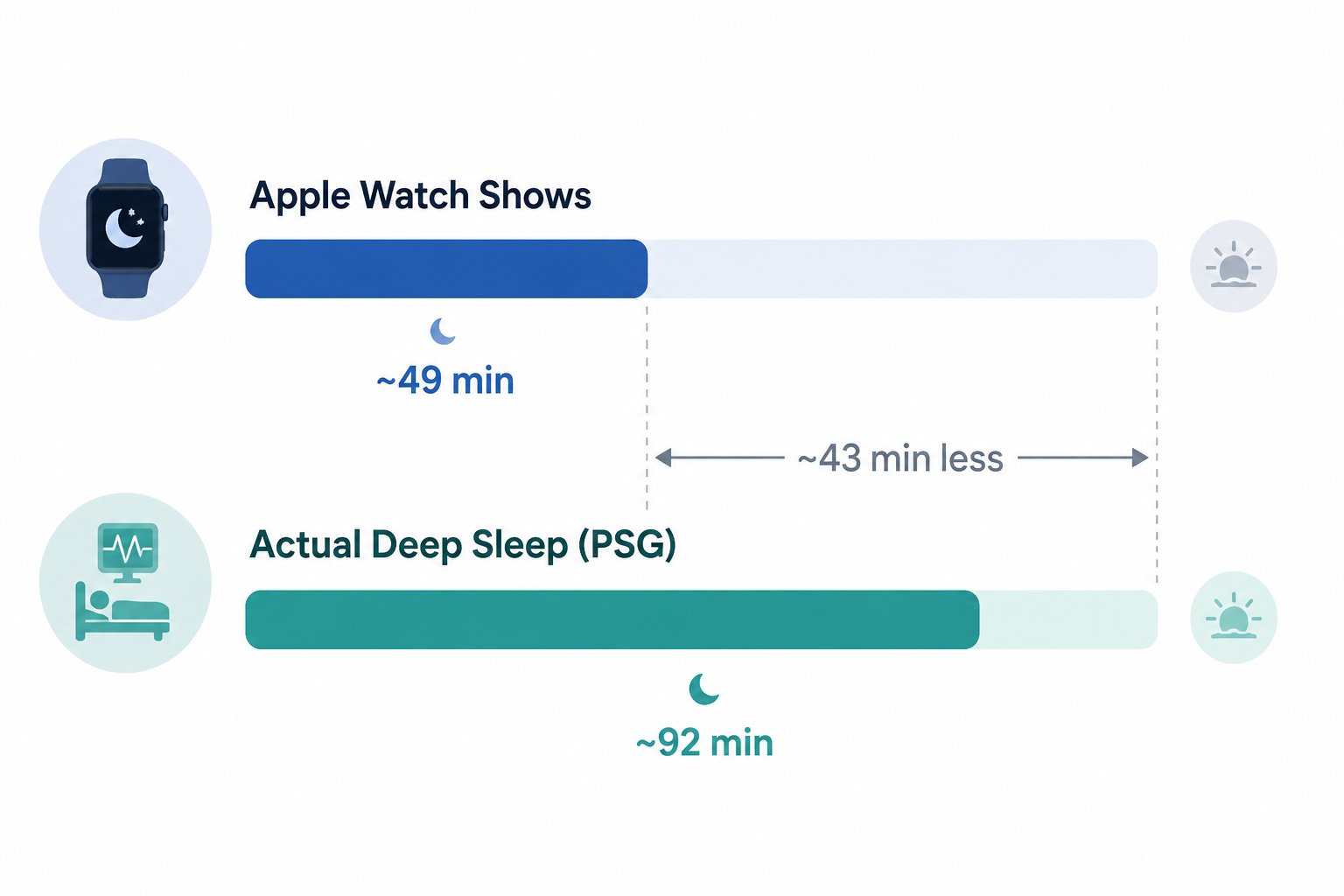
The second move is more important: treat the stage minutes as directional. In a 2024 validation study from Brigham and Women’s Hospital and Harvard researchers, Apple Watch underestimated deep sleep by about 43 minutes per night and overestimated light sleep by about 45 minutes compared with polysomnography, the sleep-lab standard.[2] That finding changes how a low deep-sleep number should feel. It may be saying something about your night, but it may also be showing the watch’s known blind spot.
What Apple Watch Means by Deep, Core, and REM
Apple groups your night into awake time, REM sleep, core sleep, and deep sleep. Core sleep is Apple’s consumer-facing name for lighter non-REM sleep. Deep sleep refers to the slow-wave portion of non-REM sleep that people often associate with physical restoration. REM is the stage most associated with vivid dreaming and certain kinds of memory and emotional processing.
Those labels are useful shorthand, but the watch is not reading brain waves from your wrist. It estimates stages from signals such as movement and heart-rate patterns. That distinction matters because sleep staging is genuinely hard. Even trained human scorers looking at polysomnography do not agree perfectly; stage classification has inherent gray areas, not just consumer-device error.[2]
| Apple Watch label | What it roughly represents | How to read it |
|---|---|---|
| Deep | Slow-wave non-REM sleep | Useful as a trend, but the most panic-prone and one of the least reliable nightly numbers |
| Core | Lighter non-REM sleep | Often takes up the largest share of the night and may absorb time the watch misses from deep sleep |
| REM | Rapid eye movement sleep | More useful over weeks than as a single-night target |
| Awake | Detected awakenings or restless periods | Worth watching when it repeatedly rises or matches how disrupted you feel |
If you want a fuller accuracy caveat beyond stages, the companion guide What Your Apple Watch Sleep Data Actually Means is a useful next stop. For interpreting the morning stage chart, though, the practical rule is simpler: one night is noisy; a repeated pattern is more informative.
Why Your Deep Sleep Number May Look Too Low
Deep sleep gets too much emotional power because it looks like the “good” sleep. If the chart says you spent only a small slice of the night there, it is easy to assume your body failed to repair itself. The evidence does not support reading the number that harshly.
In the 2024 validation study, Apple Watch deep-sleep sensitivity was about 50.5%, compared with 86.1% for light sleep and 82.6% for REM.[2] Sensitivity here means how often the device correctly identified that stage when the sleep-lab recording showed it was happening. For deep sleep, that is close enough to coin-flip territory that a precise-looking nightly minute count deserves extra humility.
This does not mean Apple Watch deep sleep is useless. It means the number is better at raising a soft signal than making a hard claim. If your deep sleep estimate is lower than usual for several weeks and your total sleep is shorter, your wake time is higher, or you feel worse during the day, that combination is worth noticing. If one Tuesday says 37 minutes after a stressful evening, the watch has not delivered a neurological report card.
The funding note matters here. The 2024 study was funded by Oura Ring Inc., and several authors disclosed Oura-related conflicts.[2] That does not erase the Apple Watch findings, especially because other research also shows that consumer wearables struggle with stage-level precision. It does mean the study should be read as strong calibration evidence rather than as a reason to crown or dismiss any one brand.
A Better Way to Read Deep Sleep
- Compare your deep sleep with your own multi-week baseline, not with a single ideal number.
- Look at the percentage and the minutes together; a short night can make deep sleep minutes look low even if the share is ordinary.
- Do not treat one low estimate as proof that recovery failed.
- Give more weight to patterns that match daytime sleepiness, repeated awakenings, or consistently short total sleep.
REM Is Easier to Use as a Range Than a Target
REM has a slightly calmer interpretation problem. The Empirical Health Apple Watch data showed an average of about 20% REM, with most users falling between 15% and 25%.[1] That range is a better guide than a nightly mission. A night with less REM after a late bedtime, an alarm-shortened morning, or more awakenings is not surprising; REM often clusters more heavily in the later part of sleep.
The 2024 validation study found Apple Watch REM sensitivity at 82.6%, much better than its deep-sleep sensitivity in that dataset.[2] That still does not make REM minutes a clinical measure. It makes them more reasonable to follow as a trend, especially when paired with total sleep time and consistency.
Core Sleep Is Often Where the Watch Parks Uncertainty
Core sleep can look disappointing because the word sounds ordinary. In practice, it is where much of the night naturally sits. It also appears to be the category Apple Watch handles more confidently than deep sleep: in the 2024 study, light sleep sensitivity was 86.1%.[2] The same study’s bias pattern is the catch. If Apple Watch underestimates deep sleep and overestimates light sleep, then some of what appears as “core” may be sleep the watch failed to label as deep.[2]
So a night heavy in core sleep is not automatically a bad night. It may be a normal architecture, a device-estimation artifact, or both. The more useful question is whether the night was long enough, whether it was repeatedly interrupted, and whether similar patterns continue.
What the Sleep Score Is Actually Scoring
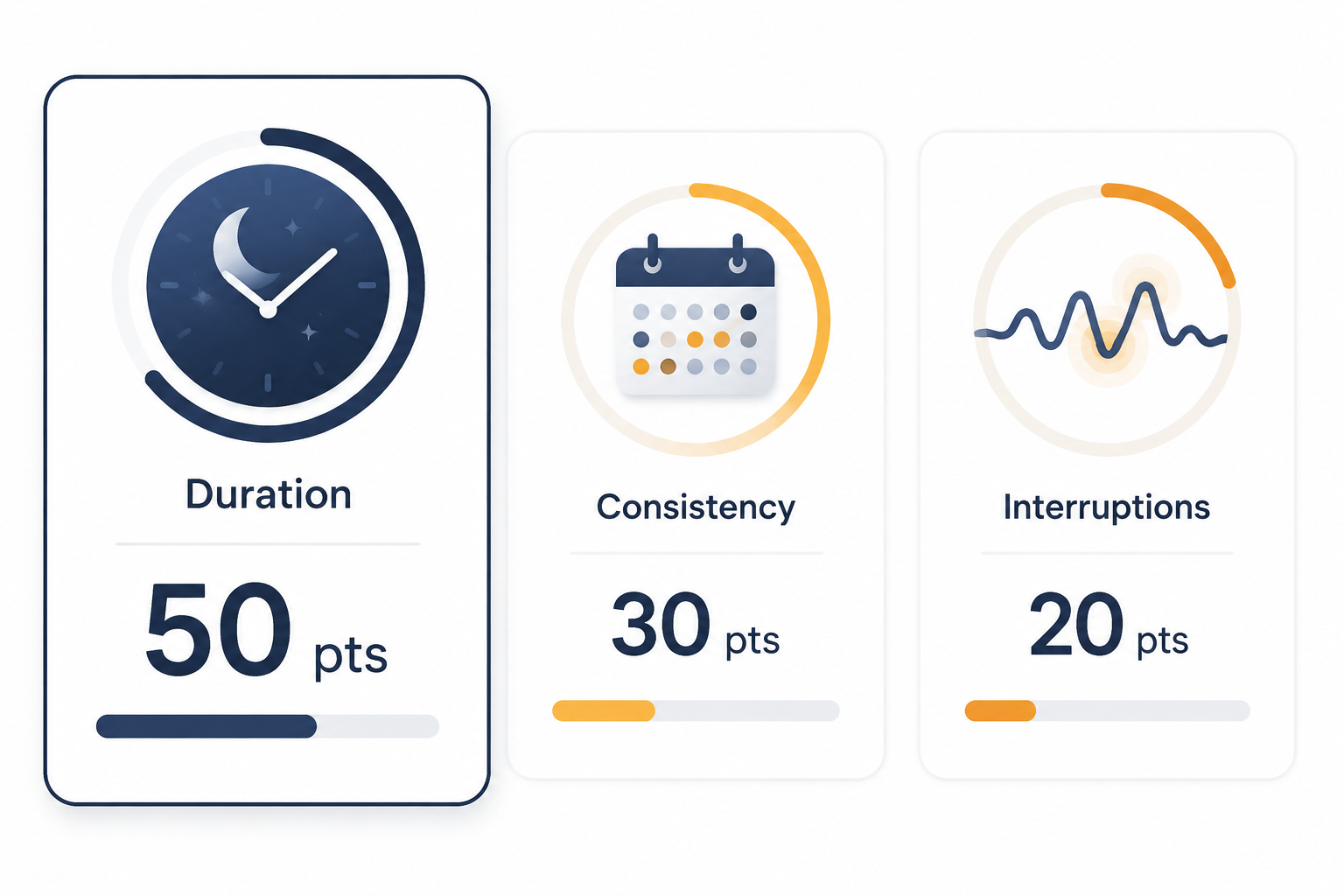
The Sleep Score is Apple’s most helpful sleep feature when it stays in its lane. In watchOS 26, the score is built from duration worth 50 points, consistency worth 30 points, and interruptions worth 20 points.[1] That weighting is a useful design choice: it nudges attention away from stage micromanagement and toward the parts of sleep most people can actually change.
| Sleep Score component | Points | What it rewards | How useful it is day to day |
|---|---|---|---|
| Duration | 50 | Getting enough total sleep | High value, but sometimes constrained by work, caregiving, illness, or schedule |
| Consistency | 30 | Sleeping and waking on a regular rhythm | Usually the most actionable sub-score |
| Interruptions | 20 | Fewer detected disruptions during the night | Useful when it matches lived experience or repeats over time |
Duration gets the largest share, as it should. A beautiful stage chart cannot rescue a chronically short night. But consistency is the sub-score many users should watch most closely because it is often more controllable than squeezing an exact amount of REM or deep sleep out of a particular night. A steady wake time, a predictable sleep window, and fewer extreme weekend shifts tend to produce cleaner data and, more importantly, a less chaotic sleep life.
Interruptions deserve a slightly different reading. If your watch shows many awakenings and you remember being awake, that is useful. If it shows a restless night but you feel fine and the pattern does not repeat, it is not worth turning into a case file. As with stages, the score is strongest when it helps you see a pattern you can act on.
What Validation Studies Can and Cannot Tell You
Validation studies are not all saying the same thing, but they point in the same practical direction: Apple Watch can be useful for sleep tracking, while stage-by-stage interpretation needs caution. A 2023 multicenter JMIR study of 75 participants and 11 devices found the Apple Watch 8 had a macro F1 score of 0.491 and fair agreement with polysomnography, with κ=0.30; it performed best among the tested wearables for light sleep sensitivity.[3]
That study also has boundaries. It was conducted with Korean participants, and Apple Watch performance varied by institution, with a macro F1 score of 0.544 at SNUBH and 0.420 at CLC.[3] Those details are not trivia. They are reminders that wearable accuracy is not one fixed property of a device; it can vary by population, protocol, and scoring conditions.
Apple’s 2025 validation claims, as reported by secondary sources, suggest newer foundation-model approaches trained on Apple Heart and Movement Study data and a peer-reviewed comparison in which Apple Watch had the highest agreement among six wearables tested, with κ=0.53.[1] Because the primary Apple document could not be directly verified here, that should sit in the background rather than carry the argument. It is encouraging context, not a license to treat every stage minute as exact.
When Tracking Starts Making Sleep Worse
There is a name for the trap where sleep tracking turns into sleep anxiety: orthosomnia. A 2024 cross-sectional study estimated that 3% to 14% of regular sleep-tracker users may experience it.[4] That range should not be used as a scare tactic. Most people who wear a watch to bed are not doomed to become anxious about it. But if your morning chart regularly changes your mood, makes you dread bedtime, or sends you into repeated “fix my sleep stages” searches, the distress is real enough to take seriously.
A good sleep tracker should reduce guesswork. It should not make you negotiate with a graph before breakfast. If the score helps you notice that late alcohol, late caffeine, or a drifting bedtime tends to produce shorter or more interrupted sleep, keep using it. If the stage chart makes you feel defective after otherwise normal nights, hide the detail view for a while and follow the broader trends.
The Changes Worth Making From Apple Watch Sleep Data
The most useful actions are boring in the best way. They do not require reverse-engineering your REM cycles. They use the watch as a feedback tool for habits that are visible across many nights.
- Protect total sleep first; stage percentages are less meaningful when the night is simply too short.
- Keep wake time and bedtime reasonably consistent, especially if your consistency sub-score is dragging down the Sleep Score.
- Watch interruptions over several weeks, not just after one restless night.
- Treat deep sleep minutes as a rough trend with a known underestimation problem.
- Notice alcohol and caffeine timing; real-world data identifies alcohol and caffeine within four hours of bedtime as the second modifiable factor after sleep disorders associated with reduced sleep quality.[1]
That last point is where wearable data can be genuinely helpful. If three late coffees or a drink close to bed are followed by shorter sleep, more wake time, or a worse score, you have a practical experiment. The watch does not need to diagnose the cause to help you test the pattern.
The cleanest rule is this: use Apple Watch sleep stages as directional trend signals, use deep sleep minutes with extra caution, and put most of your attention on a regular schedule, enough total sleep, fewer interruptions, and whether tracking is making sleep easier rather than more anxious.
References
- Apple Watch Deep Sleep Meaning, Empirical Health
- Performance of seven consumer sleep-tracking devices compared with polysomnography, PMC
- Evaluating the Performance of Consumer Sleep Trackers, JMIR, PMC
- Orthosomnia prevalence in regular sleep-tracker users, 2024 cross-sectional study
Comments
Join the discussion with an anonymous comment.