
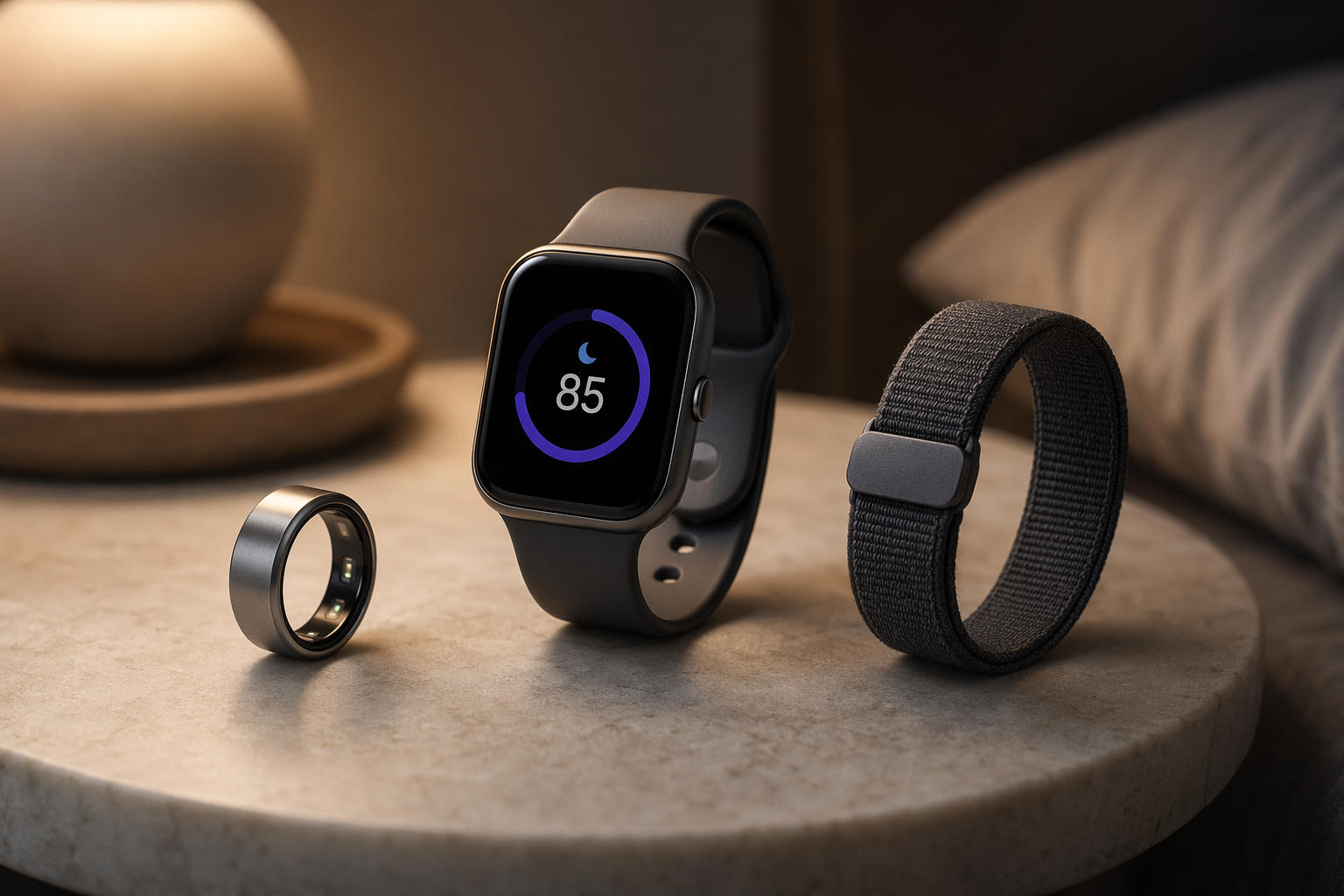
Search for the best device for sleep tracking and the first thing you’ll find is disagreement from people who spend a lot of time testing this stuff. Sleep Foundation gives the Oura Ring 4 a 9.1/10 and places it at the top of its list; Wirecutter also names Oura its top pick; Wareable does the same. CNET, meanwhile, crowns Whoop 5.0 its best overall sleep tracker.[1][2][3][4]
That contradiction is not a sign that one reviewer is obviously wrong. It is a sign that “best” is doing too much work. A ring that disappears on one person’s hand may be intolerable to someone whose fingers swell at night. A recovery band can be excellent if you want coaching and maddening if you dislike subscriptions. A smartwatch can be the smartest purchase in the right ecosystem and the wrong one if you hate charging it before bed.
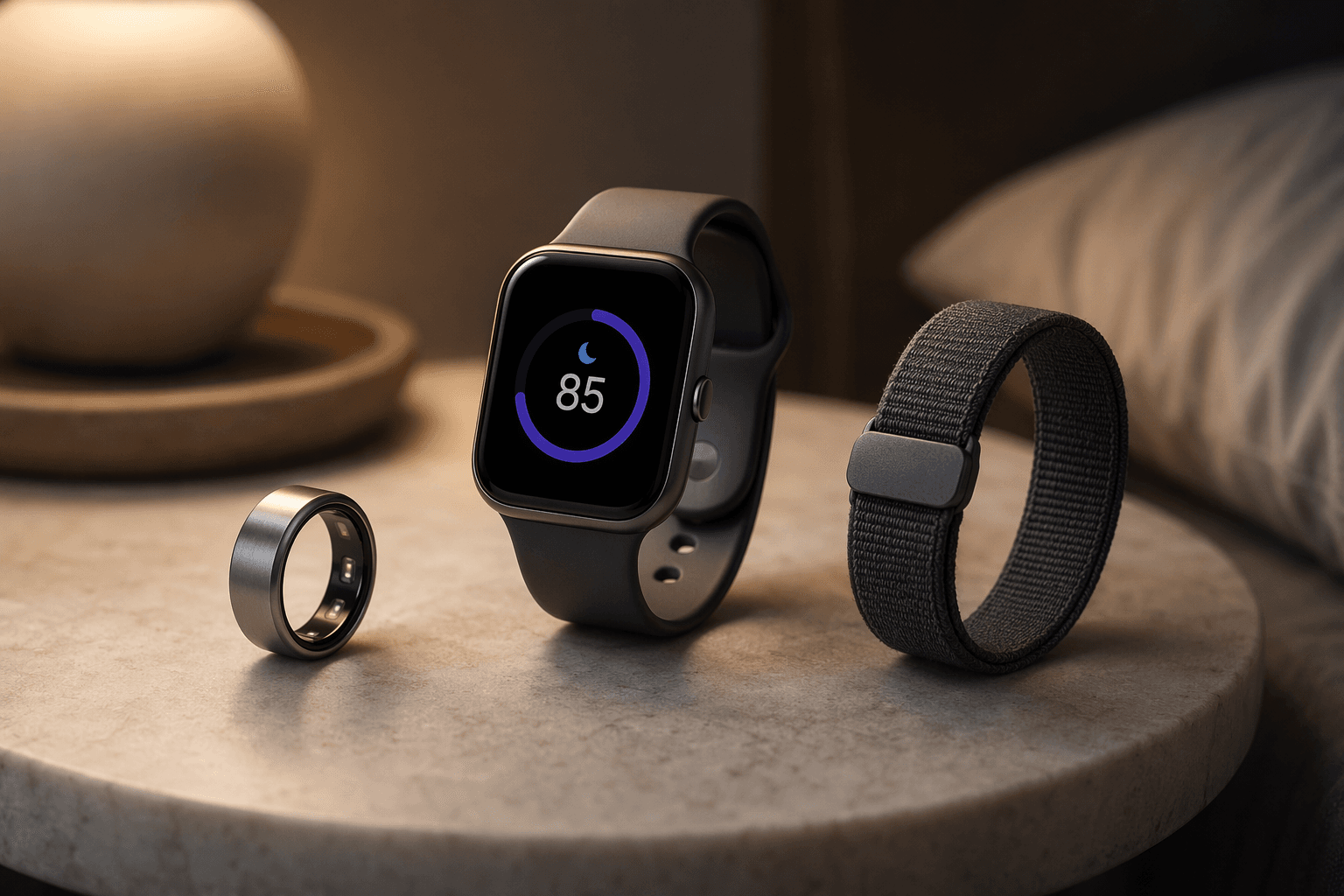
So the better question is not “Which sleep tracker wins?” It is: which constraint gets to veto the others? For most people, the choice sorts itself out once five priorities are put in the right order.
Start with the five priorities that actually change the answer
| Priority | What it decides | Likely fit if this is your top priority |
|---|---|---|
| Form-factor comfort | Whether you will wear the tracker consistently enough to collect useful sleep trends | Oura if you want a ring; Apple Watch, Samsung, or Withings if you prefer a watch; Eight Sleep if you want no wearable |
| Accuracy needs | Whether you care mostly about sleep/wake trends, sleep stages, respiratory signals, or apnea-related alerts | Apple or Samsung for FDA-cleared sleep apnea detection within the right ecosystem; Oura or Whoop for broader sleep and recovery trend tracking |
| Subscription tolerance | Whether the long-term cost and app access model will annoy you after the first month | Withings, Apple Watch, or Samsung if you want no required subscription; Oura or Whoop only if the ongoing fee feels acceptable |
| Ecosystem compatibility | Whether the device works naturally with your phone, health app, notifications, and daily routine | Apple Watch for iPhone users; Samsung devices for Android users who want Samsung’s sleep apnea feature |
| Data style | Whether you want coaching and readiness-style interpretation or more direct access to signals and trends | Whoop if recovery coaching is the point; Oura if you want a calmer ring-based dashboard; smartwatch or Withings options if you want sleep tracking as one feature among others |
Comfort belongs first because it has veto power. A tracker you remove at 2 a.m., forget on the charger, or stop wearing because it catches on bedding is not quietly collecting better data in a drawer. Accuracy matters, but it only matters after the device survives the boring human test: can you sleep with it often enough for the trends to mean anything?

Why Oura shows up so often at the top
Oura is the easiest recommendation to understand, even if it is not the easiest recommendation to make universally. It is a ring, not a watch or band, so it avoids the bedtime-screen-on-wrist feeling that turns some people away from smartwatches. It is also the point of convergence across several major review lists: Sleep Foundation, Wirecutter, and Wareable all place Oura at or near the top of their sleep-tracker recommendations.[1][2][3]
That makes Oura a sensible starting point for comfort-first shoppers, especially those who want sleep tracking to be the device’s main job. It does not make a ring shape magically universal. Rings can feel great until fingers swell, sizing is slightly off, weight becomes noticeable, or the wearer simply dislikes sleeping with jewelry. If you already know rings bother you, Oura’s consensus status should not overrule that information.
The other Oura catch is cost. The Ring 4 is listed in the research materials as a $350 device with a $70/year subscription, which puts a three-year ownership estimate around $560 before taxes, discounts, replacement chargers, or plan changes.[1][3] If you want a deeper explanation of how its sleep score is built, use the Oura sleep score guide rather than treating the single score as self-explanatory.
Whoop is a different kind of “best”
Whoop 5.0 makes sense if your sleep question is tied to training, strain, recovery, and behavior change. CNET names Whoop 5.0 its top overall sleep tracker, and that choice is easier to parse when you see Whoop less as a neutral sleep monitor and more as a coaching system built around recovery.[4]
The model is also unusually clear: there is no separate device purchase in the figures provided here, but there is an ongoing membership. The research brief lists Whoop at $199–$359 per year, with the three-year comparison using $239/year for an estimated $717 total.[4] That can be perfectly reasonable for someone who wants the recovery dashboard, but it is the wrong kind of product for someone who already knows they will resent paying to keep using the system.
Validation should be read with the same care. A 2022 six-device validation study reported about 86% sleep/wake accuracy for Whoop, but that study used Whoop 3.0, not Whoop 5.0.[5] That does not make the finding useless; it makes it generation-specific. If Whoop is on your shortlist, the more useful next step is to look at the kind of metrics it tends to handle well and where sleep-stage precision is more limited. The Whoop sleep-tracking accuracy guide is a better place for that narrower question.
If your phone ecosystem is the deciding factor
For iPhone users, the Apple Watch Series 11 belongs in the conversation less because it is a pure sleep tracker and more because it is already the center of many Apple health setups. The cited review materials describe it as a strong sleep/wake tracker, with FDA-cleared sleep apnea detection and no subscription requirement.[2][3][4] The tradeoff is familiar: it is a smartwatch that needs regular, often daily, charging. That sounds minor until the watch is at 8% when you are ready for bed.
For Android users, Samsung’s Galaxy Ring and Watch Ultra are more relevant than an abstract comparison with Apple Watch because the ecosystem decides what features are practical. The research materials identify Samsung as the Android-side option with FDA-cleared sleep apnea detection and no subscription requirement.[3][4] That makes Samsung especially important for Android users who care about apnea-related screening features but do not want to move into Apple’s ecosystem.
The wording matters here: FDA-cleared sleep apnea detection is not the same thing as a clinical diagnosis. It can be a useful prompt to discuss symptoms or patterns with a clinician. It should not be treated as a final answer about whether someone has, or does not have, sleep apnea.
If you are mainly choosing among Apple Watch, Oura, and Whoop, the Apple Watch vs. Oura vs. Whoop comparison can carry the device-by-device detail. The point here is simpler: ecosystem is not a cosmetic preference. It changes friction, features, charging habits, and how often you actually look at the data.
The subscription math changes the shortlist
A low-friction first month is not the same as a good three-year purchase. Subscriptions matter because they change the emotional cost of the device. Some people like an app that keeps interpreting their data and nudging them. Others open the dashboard, see another recurring fee attached to their sleep, and quietly stop caring.
| Device | Up-front cost model | Required subscription in research brief | Approximate 3-year cost |
|---|---|---|---|
| Withings ScanWatch 2 | Device purchase | No required subscription | ~$350 |
| Oura Ring 4 | $350 ring | $70/year | ~$560 |
| Whoop 5.0 | Subscription-only model in cited pricing | $199–$359/year; comparison uses $239/year | ~$717 |
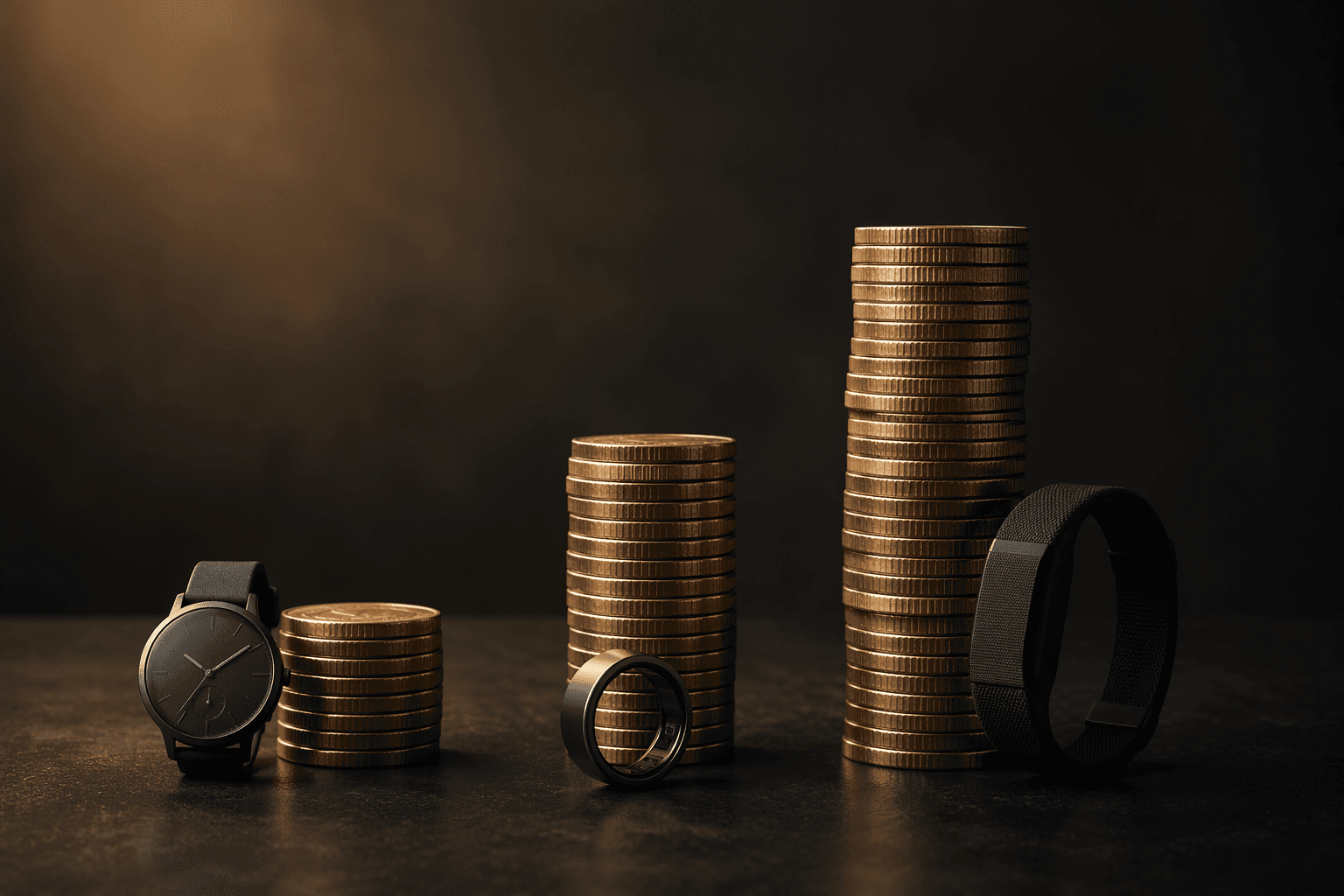
This is where Withings ScanWatch 2 becomes more interesting than it looks in a feature checklist. It has a 30-day battery estimate, no required subscription, and an approximate three-year cost of $350 in the comparison used here.[3][4] The compromise is that it omits REM-stage data.[3] For someone who wants a low-maintenance watch that tracks sleep without turning into another monthly bill, that tradeoff may be acceptable.
For another reader, the REM omission is enough to remove it from the list. That is the point of doing the cost comparison before falling in love with a score. Withings looks better when subscription avoidance and battery life rank high. It looks weaker if detailed sleep-stage reporting is one of your non-negotiables.
Accuracy is not one thing
Consumer sleep-tracker accuracy usually means several different questions that get flattened into one claim. Can it tell sleep from wake? Can it estimate sleep stages? Can it detect breathing irregularities? Can it produce useful trends over weeks? Those are related, but they are not interchangeable.
The strongest consumer devices are often most useful for trend tracking: bedtime regularity, total sleep estimate, wake patterns, resting heart rate, heart-rate variability, temperature shifts, respiratory rate, and recovery direction. Sleep-stage labels are more fragile. If a device tells you that REM was lower last night, that may be worth watching over time, but it should not be treated like a lab-grade measurement from a single night.
The published validation studies also lag the products on sale. The 2022 six-device validation study used Oura Gen 2, Whoop 3.0, and Apple Watch Series 6, among other devices, so its findings should not be pasted directly onto today’s models as if the hardware and algorithms never changed.[5] A 2025 Nature study used Oura Ring Gen 3, not Oura Ring 4 or a later model.[6] These studies are still useful calibration points. They are not courtroom verdicts on every current device.
If accuracy by metric is the deciding issue, use a narrower comparison rather than a general ranking. Restful Ground has separate guides for smart-ring sleep-tracking accuracy, Fitbit sleep-tracker accuracy, and metric-specific sleep and fitness tracking accuracy. That is more useful than asking one overall score to answer every accuracy question at once.
What about non-wearable sleep tracking?
Eight Sleep Pod belongs in the discussion for a specific reader: someone who dislikes wearing anything to bed and cares about temperature control. Its appeal is not just tracking; it is the bed environment. But the non-wearable form factor introduces a different limitation. CNET found that Eight Sleep overestimated sleep time by logging awake-but-still periods as sleep.[4]
That does not make it irrelevant. It means the buyer should be honest about the main job. If temperature control is the reason you are buying, Eight Sleep may still be worth evaluating. If precise sleep/wake detection is the reason, the awake-still issue should carry more weight.
Map your priority to a likely starting point
- If comfort and a dedicated sleep-tracking form factor lead, start with Oura, then decide whether the ring fit and $70/year subscription still work for you.
- If recovery coaching is the reason you are buying, consider Whoop first, with the understanding that the subscription is the product model, not a side detail.
- If you are an iPhone user who wants strong smartwatch value, no required sleep subscription, and FDA-cleared sleep apnea detection, Apple Watch Series 11 is the ecosystem-first candidate.
- If you are in Android and apnea-related detection is a priority, Samsung’s Galaxy Ring or Watch Ultra deserves a look because the cited materials identify Samsung as the Android-side FDA-cleared option.
- If subscription avoidance and long battery life matter more than complete sleep-stage detail, Withings ScanWatch 2 is the practical counterweight to Oura and Whoop.
- If you want no wearable and care about temperature control, evaluate Eight Sleep Pod, but keep the possible sleep-time overestimation in mind.
Garmin and Fitbit shoppers may need a slightly different frame because activity tracking, training load, battery life, and sleep scoring all start competing with each other. For those paths, use the Garmin sleep score guide, the best sleep-tracking smartwatch guide, or the combined sleep and activity tracker guide. If your main uncertainty is physical comfort rather than brand, the form-factor comparison is the better detour.
A few caveats before treating any list as final
The prices and subscription totals here reflect a Q2 2026 snapshot from the research materials and may change. Device makers alter plans, retailers discount hardware, and bundled memberships can shift the real checkout number.
The major review sources cited here, including Sleep Foundation, CNET, and Wirecutter, disclose affiliate or commerce relationships.[1][2][4] That does not make their testing worthless. It does mean their recommendations should be read alongside the actual constraints that affect your use: fit, charging, subscription access, phone compatibility, and what kind of data you will bother reading after the novelty fades.
If you want the shortest honest answer: start with Oura when comfort and ring-based sleep tracking lead; consider Whoop when recovery coaching leads; look at Apple Watch or Samsung when ecosystem fit and no required subscription lead; choose Withings when subscription avoidance and battery life matter most; evaluate Eight Sleep when non-wearable temperature control is the point. The best device is the one whose compromises you will still tolerate after the first month.
References
- Best Sleep Trackers, Sleep Foundation.
- Best Sleep Trackers, Wirecutter.
- Best sleep trackers and monitors, Wareable.
- Best Sleep Tracker, CNET.
- Performance of Consumer Sleep Tracking Devices Compared with Polysomnography, PMC, 2022.
- Validation of Oura Ring Gen 3 against polysomnography, Nature, 2025.

Comments
Join the discussion with an anonymous comment.