Mechanism explainer
Apple Watch Sleep Tracking Accuracy: What the 2024–2026 Peer-Reviewed Studies Actually Show
This article provides an evidence-verification deep dive for Apple Watch owners and prospective buyers. It examines the specific quantitative accuracy data from the 2024 Brigham & Women's Hospital PSG study, the 2025 University of Salzburg multi-device comparison, and Apple's own validation data, covering sleep/wake detection, deep sleep limitations, and the new watchOS 26 Sleep Score.
Why Accuracy Questions Dominate Apple Watch Sleep Discussions
If you own an Apple Watch or are considering buying one for sleep tracking, you have likely encountered a confusing mix of claims. Some sources call it a game-changer for sleep health. Others dismiss wearable sleep staging as a gimmick. The truth, as usual, sits somewhere in the middle — and it requires looking at the actual peer-reviewed data rather than marketing language.
This article is written for the evidence-verification stage of your research. We are not here to sell you a device or tell you that your sleep score is the most important number in your life. We are here to answer a specific question with specific numbers: how accurate is Apple Watch sleep tracking, where does it fall short, and what does the 2024–2026 research actually show?
How Apple Watch Measures Sleep: Accelerometer, PPG, and Respiratory Rate
Before diving into accuracy numbers, it helps to understand what the Apple Watch is actually measuring — and, just as importantly, what it is not measuring.
Polysomnography (PSG), the clinical gold standard for sleep staging, uses electroencephalography (EEG) to measure brain wave activity directly. It can distinguish between wakefulness, light (NREM) sleep, deep (N3) sleep, and REM sleep by analyzing the electrical patterns of the brain. The Apple Watch cannot do this. It has no EEG electrodes.
Instead, the Apple Watch relies on three indirect signals:
- An accelerometer that detects gross body movement and micro-movements associated with breathing. When you are still for a prolonged period, the watch infers that you are asleep.
- A photoplethysmography (PPG) sensor that uses green and infrared LEDs to measure heart rate and heart rate variability (HRV). Different sleep stages produce characteristic HRV patterns, which the algorithm uses to estimate stage transitions.
- A respiratory rate measurement derived from the accelerometer's detection of chest wall movements. Breathing patterns also shift across sleep stages.
The watchOS operating system feeds these signals into a machine-learning model that classifies each 30-second epoch as awake, core (light) sleep, deep sleep, or REM. The model is trained on large datasets of PSG-scored sleep, but it is fundamentally making an inference from indirect data. This is the root of both its strengths and its limitations.
Key Accuracy Numbers from the Brigham & Women's Hospital PSG Study (2024)
The most rigorous independent assessment of Apple Watch sleep tracking accuracy to date comes from a 2024 study published in Sensors by researchers at Brigham & Women's Hospital (Robbins et al., 2024). The study enrolled 35 healthy adults and compared the Apple Watch Series 8 against simultaneous PSG recording in a controlled laboratory setting.
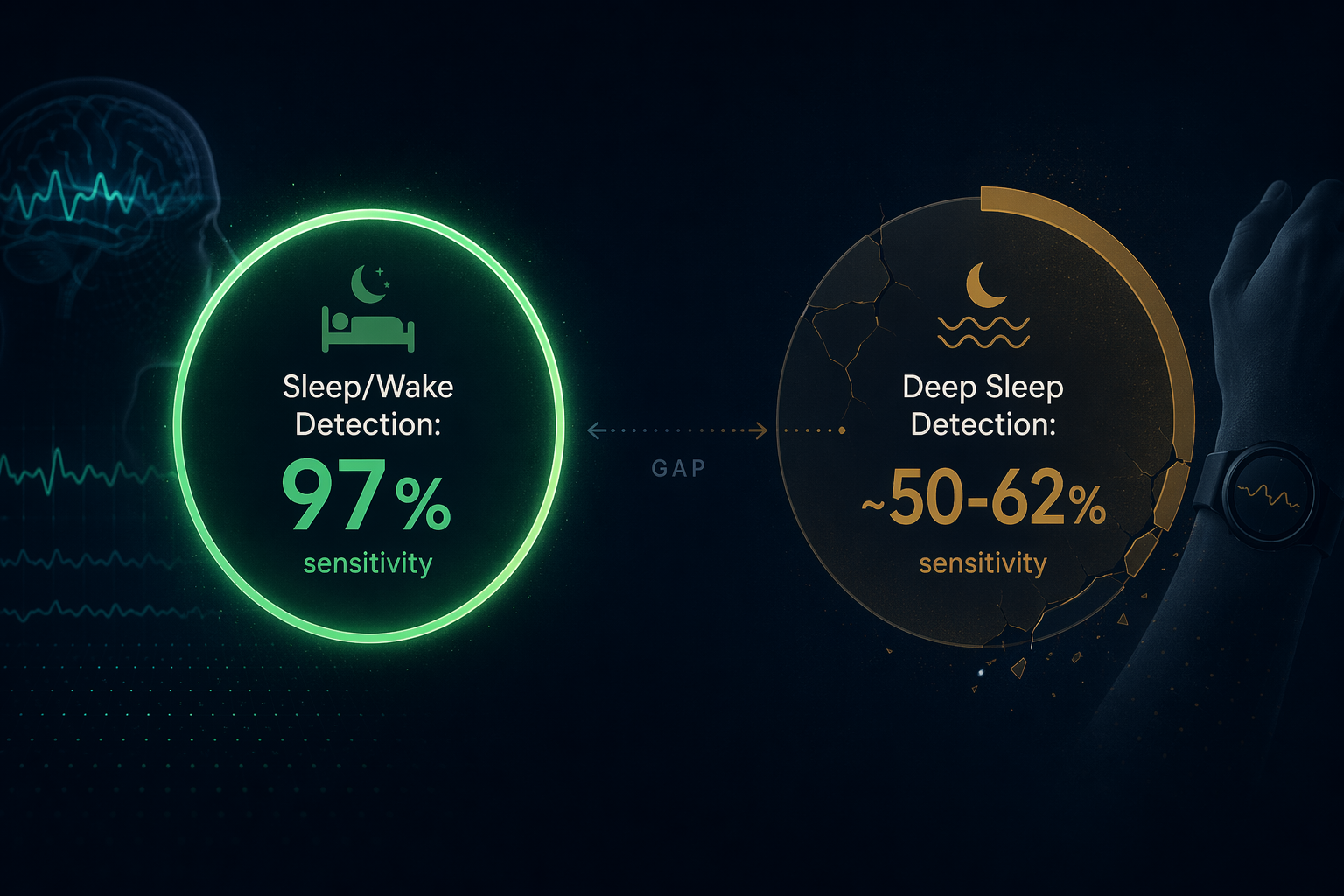
The headline finding: Apple Watch is excellent at detecting whether you are asleep or awake. Its sleep/wake sensitivity was 97% (SD 2%), meaning it correctly identified sleep epochs 97% of the time. The epoch-by-epoch agreement with PSG was 93%, with a Cohen's kappa of 0.60 — a moderate-to-substantial agreement level. The intraclass correlation coefficient (ICC) for total sleep time was 0.85, which is classified as excellent.
However, when the analysis moved to four-stage classification (awake, light, deep, REM), the picture changed significantly.
| Metric | Apple Watch vs. PSG | Interpretation |
|---|---|---|
| Sleep/wake sensitivity | 97% (SD 2%) | Excellent — rarely misses sleep epochs |
| Sleep/wake epoch agreement | 93% (Kappa = 0.60) | Moderate-to-substantial agreement |
| Total sleep time ICC | 0.85 | Excellent correlation with PSG |
| Deep sleep sensitivity | 50.5% (SD 20.6%) | Misses roughly half of PSG-identified deep sleep |
| Deep sleep precision | 87.8% (SD 19.7%) | When it says deep sleep, it is usually correct |
| Light (core) sleep sensitivity | 86.1% (SD 6.2%) | Good detection of light sleep |
| REM sensitivity | 82.6% (SD 14.8%) | Good detection of REM |
| Deep sleep ICC | 0.13 | Poor — unreliable for individual deep sleep measurement |
The most striking finding is the systematic bias in deep sleep estimation. The Apple Watch significantly underestimated deep sleep by an average of 43 minutes per night (p < 0.001) and overestimated light sleep by an average of 45 minutes per night (p < 0.001). This means that if your Apple Watch reports 30 minutes of deep sleep, the PSG likely recorded closer to 73 minutes. Conversely, if it reports 4 hours of light sleep, the true value is probably closer to 3 hours and 15 minutes.
The 2025 University of Salzburg Multi-Device Comparison: Apple Watch in Context
A second major data point comes from a 2025 study conducted by researchers at the University of Salzburg in collaboration with The Quantified Scientist. This preprint tested 15 consumer wearables against PSG in a single protocol, providing a rare head-to-head comparison across devices.
The Apple Watch achieved the highest overall agreement of any device tested, with a Cohen's kappa of 0.53 (moderate agreement). Stage-specific accuracy was: core/light sleep 83%, REM 69%, and deep sleep 51%. These numbers are broadly consistent with the Brigham & Women's Hospital findings, reinforcing the pattern: strong overall performance, but deep sleep remains the weakest link.
The Salzburg study also confirmed that the Apple Watch was the best device for awake detection — a critical feature for users who want to understand sleep fragmentation and nighttime wakefulness.
| Device | Overall Agreement (Kappa) | Deep Sleep Accuracy | Awake Detection |
|---|---|---|---|
| Apple Watch | 0.53 (highest) | 51% | Best in class |
| Oura Ring (Gen 3) | ~0.50 | ~55% | Good |
| Fitbit Sense 2 | ~0.45 | ~45% | Moderate |
| WHOOP 4.0 | ~0.42 | ~48% | Moderate |
Apple's Own Validation Data: The Foundation Model and Confusion Matrix
Apple has also published its own validation data, most recently in an October 2025 white paper that describes the foundation-model-based sleep staging algorithm introduced in watchOS 26. While the full PDF was not accessible for direct analysis, data from it has been summarized by the independent health analytics platform Empirical Health.
According to that analysis, Apple's internal testing (n=166) found that the watch was approximately 62% accurate in detecting deep sleep. The confusion matrix reveals a specific pattern: when the Apple Watch misclassifies deep sleep, it most often labels it as core (light) sleep — 38% of the time. This is consistent with the systematic underestimation of deep sleep seen in the Brigham & Women's Hospital study.
| PSG Label | Apple Watch Label | Accuracy | Primary Confusion |
|---|---|---|---|
| Deep sleep | Deep sleep | ~62% | Confused with core sleep 38% of the time |
| Core (light) sleep | Core sleep | ~86% | Occasionally confused with deep or REM |
| REM | REM | ~82% | Occasionally confused with light sleep |
| Wake | Wake | ~97% | Rarely misclassified |
The watchOS 26 foundation-model update represents a meaningful algorithmic improvement. Earlier versions of Apple's sleep staging relied on a simpler decision-tree model. The new approach uses a deep-learning architecture trained on over 5 million nights of sleep data from the Apple Heart & Movement Study, in partnership with the American Academy of Sleep Medicine, the National Sleep Foundation, and the World Sleep Society. This larger and more diverse training dataset should improve trend tracking and reduce night-to-night variability.
What This Means in Practice: Trends vs. Absolute Deep Sleep Minutes
The practical takeaway from all this data is nuanced but clear: the Apple Watch is excellent for tracking sleep/wake trends and reasonably good for REM and light sleep patterns, but its deep sleep numbers should be interpreted with significant caution.
Consider what the average Apple Watch user actually sees. According to Empirical Health's analysis of user data, the average Apple Watch wearer gets about 49 minutes of deep sleep per night, which represents roughly 13% of total sleep time. The 10th percentile is 7% and the 90th percentile is 18%. Average REM is around 20%, and core (light) sleep makes up about 67%.
If your watch consistently reports deep sleep in the single-digit percentage range, it is worth paying attention to the trend — especially if it is declining over weeks or months. But fixating on whether you got 45 minutes versus 55 minutes of deep sleep on a given night is not productive, because the measurement error (±43 minutes of systematic bias plus random night-to-night variation) is larger than the difference you are trying to detect.
- Use Apple Watch for: tracking sleep/wake timing, total sleep time trends, bedtime consistency, and REM patterns over weeks.
- Do not use Apple Watch for: diagnosing sleep disorders, measuring absolute deep sleep minutes, or making medical decisions based on a single night's sleep stage breakdown.
- Watch for: sustained downward trends in deep sleep percentage or total sleep time over 2–4 weeks, which may warrant a conversation with a healthcare provider.
watchOS 26 Sleep Score: How It's Calculated and What It Adds
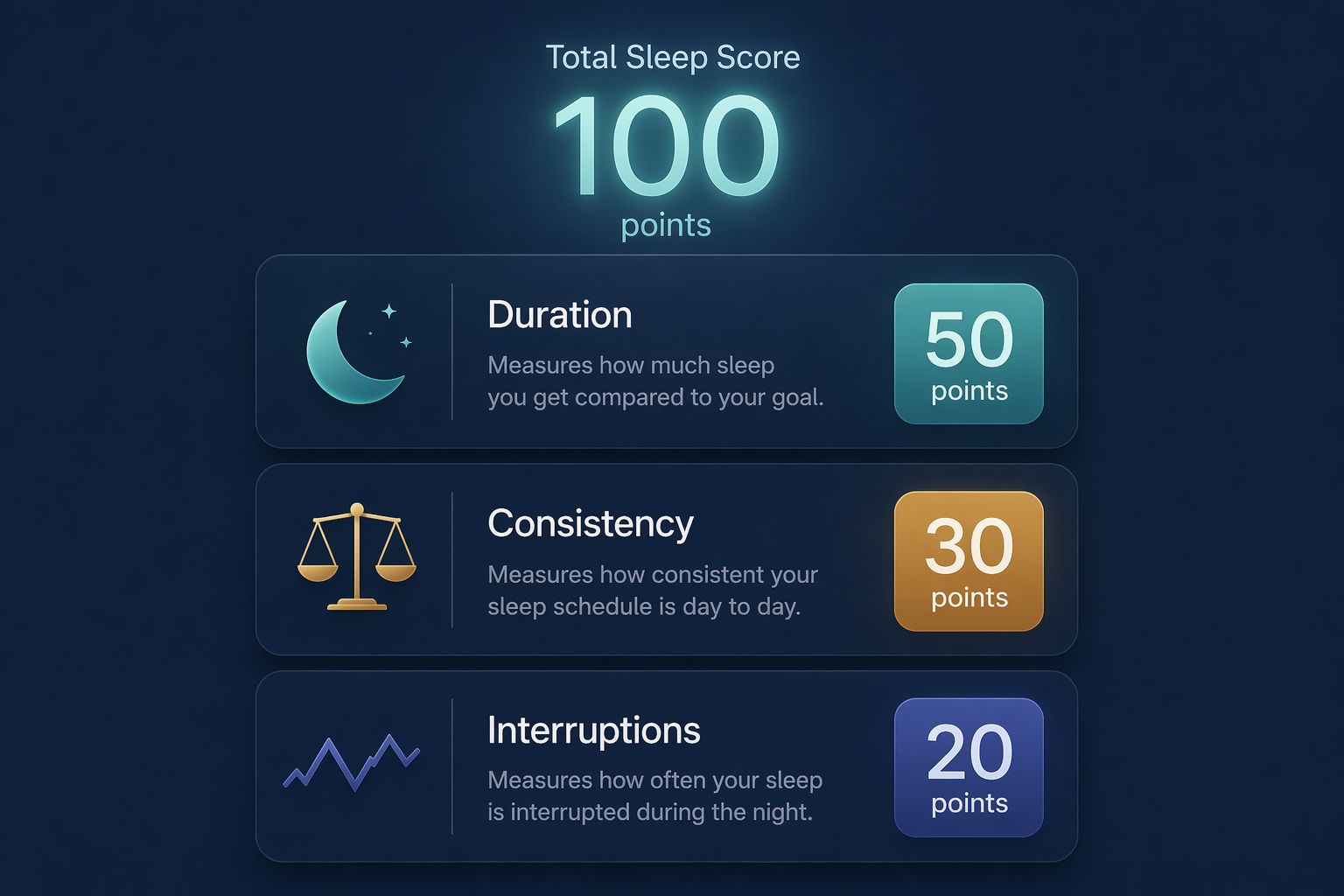
With watchOS 26, Apple introduced a Sleep Score that distills multiple sleep metrics into a single 0–100 number. This is not a clinical diagnostic tool — it is a trend-tracking composite designed to give you a quick sense of whether your sleep quality is improving or declining.
The Sleep Score has three components:
- Sleep duration (50 points): How many hours you actually slept, compared to your personalized sleep goal.
- Bedtime consistency (30 points): How regular your bedtime and wake time are, evaluated over the last 13 nights. This is the only component that looks backward across multiple nights.
- Interruptions (20 points): How fragmented your sleep is — more wake episodes reduce this score.
The score ranges are: Very Low (0–40), Low (41–60), OK (61–80), High (81–95), and Very High (96–100). The feature is available on Apple Watch Series 6 and later, SE (2nd generation) and later, and all Ultra models.
Notably, the Sleep Score does not directly incorporate sleep stage percentages. It focuses on the three dimensions that the Apple Watch measures most reliably: total sleep time, regularity, and fragmentation. This is a smart design choice — it leans into the device's strengths rather than trying to summarize its weakest measurement (deep sleep) into the same score.
For a broader explanation of how sleep scores work across different devices, see our Sleep Score Explained guide.
Practical Advice for Improving Apple Watch Sleep Tracking Accuracy
While no amount of user behavior can make the Apple Watch measure brain waves, there are several steps you can take to ensure you are getting the most reliable data the device is capable of producing.
- Wear the band snugly but not tight. The PPG sensor needs consistent skin contact to measure heart rate and HRV accurately. A loose band introduces motion artifact that degrades sleep stage classification.
- Enable Sleep Focus mode. This tells the watch you intend to sleep, which activates the sleep tracking algorithm and prevents notifications from disturbing your rest (and your data).
- Charge strategically. The Apple Watch needs at least 30% battery before bed to track sleep through the night. If you charge during your morning routine, you should have enough battery for overnight tracking.
- Be consistent with your sleep schedule. The watchOS 26 Sleep Score's consistency component rewards regularity, and the algorithm itself performs better when it has a stable baseline to compare against.
- Understand that no algorithm can fully compensate for the lack of EEG data. Even with the foundation-model improvements, the Apple Watch is making an educated guess about your sleep stages based on movement and heart rate. Treat the data as a general guide, not a precise measurement.
For users with an Apple Watch Series 9 or later, Ultra 2, or SE (3rd generation), the watch also offers a sleep apnea breathing disturbance feature that uses the accelerometer to detect breathing disruptions over a 30-day period. This is not a diagnostic tool — it is intended for undiagnosed individuals 18 and older who may need to discuss their results with a healthcare provider.
Bottom Line: Use Apple Watch for Trends, Not Clinical Diagnostics
The evidence from the 2024 Brigham & Women's Hospital study, the 2025 University of Salzburg multi-device comparison, and Apple's own validation data converges on a consistent conclusion: the Apple Watch is one of the most accurate consumer wearables for sleep tracking, but its deep sleep measurement has fundamental limitations that no algorithm update can fully resolve.
If you use the Apple Watch to track whether you are getting enough total sleep, whether your bedtime is consistent, and whether your sleep is becoming more or less fragmented over time, you are using it exactly as intended. The 97% sleep/wake sensitivity and 0.85 ICC for total sleep time mean you can trust those trends.
But if you find yourself obsessing over whether you got 45 minutes or 55 minutes of deep sleep, or if you are considering changing your sleep habits based on a single night's stage breakdown, you are asking the device to do something it cannot reliably do. The 50.5% deep sleep sensitivity and 0.13 ICC for deep sleep make that clear.
Supports these guides
Spot an error or have clinical feedback?
Because this article covers clinical, medication, or safety information, we use a moderated correction channel instead of open public comments. Let us know if something about “Apple Watch Sleep Tracking Accuracy: What the 2024–2026 Peer-Reviewed Studies Actually Show” needs a closer look.
Send feedback on this article