
Why There Is No Single Best Fitness Tracker for Sleep
If you search for "best fitness tracker for sleep" you will find dozens of articles that crown a single winner. The problem is that they rarely agree on which device that is, because the answer depends entirely on what you prioritize. Do you want the most accurate sleep-stage data, or do you need a device you can wear every night without irritation? Is battery life more important than app features? Do you also need GPS for running, or is sleep the only metric that matters?
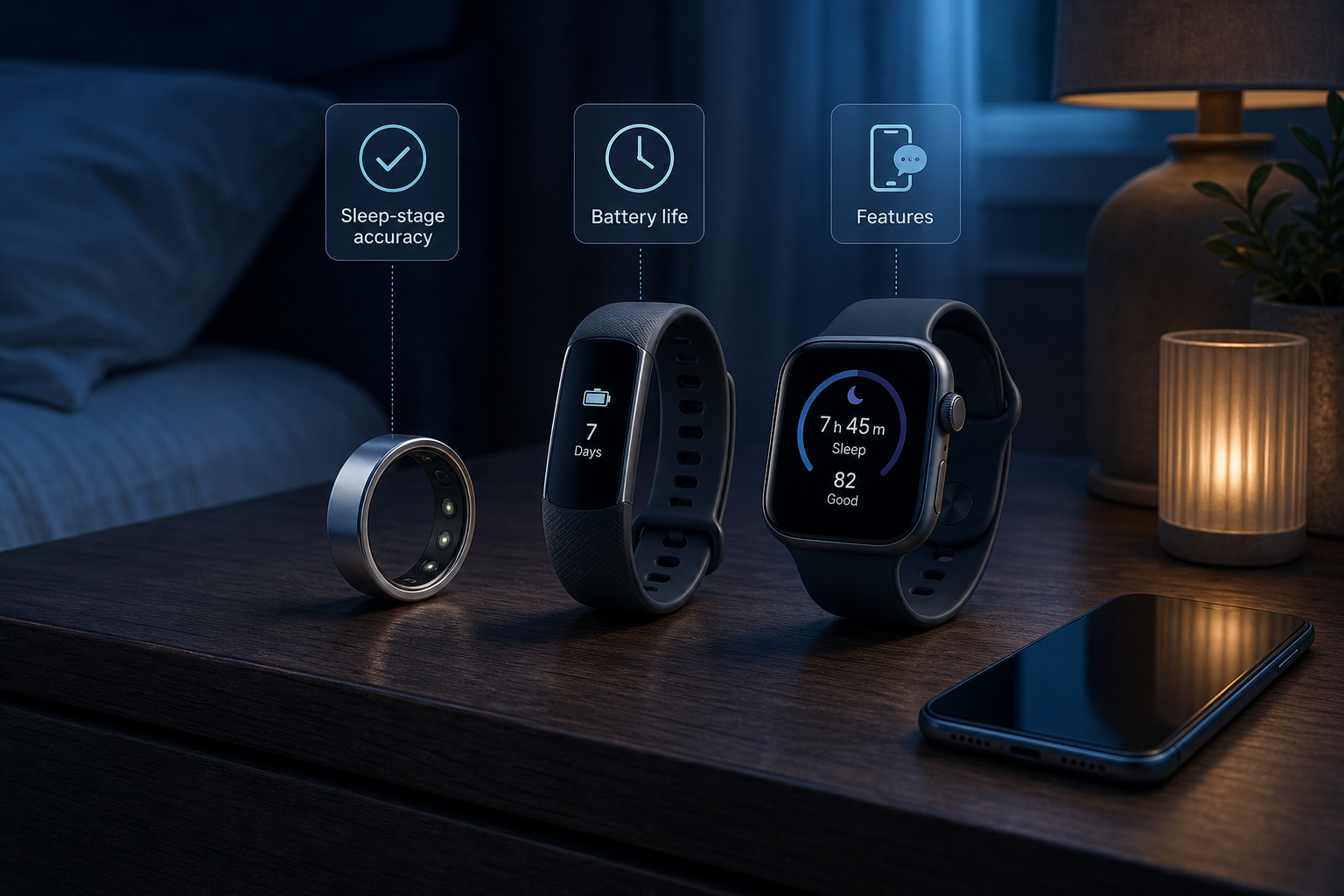
This guide takes a different approach. Instead of ranking brands, it organizes the decision by form factor — smart rings, fitness bands, smartwatches, and non-wearable mats — because the physical design of a tracker determines its accuracy ceiling, its overnight compliance rate, and its battery life more than any single brand feature. The table below summarizes the core tradeoffs across the four categories.
| Form Factor | Sleep-Stage Accuracy (Macro F1 vs. PSG) | Overnight Wear Compliance | Typical Battery Life | Exercise Tracking Depth |
|---|---|---|---|---|
| Smart Ring | 0.52 (Oura Ring 3, 2023 study); 92–95% overall (manufacturer data) | ~98% | 4–7 days | Basic (steps, HR); no built-in GPS |
| Fitness Band | 0.58 (Fitbit Sense 2, 2023 study); 88–91% overall (manufacturer data) | ~85–90% | 14–21 days | Moderate (steps, HR, some GPS) |
| Smartwatch | 0.57–0.58 (Pixel Watch, Galaxy Watch 5, 2023 study); 84–88% overall (manufacturer data) | ~67% | 18–36 hours | Full (GPS, workout tracking, app ecosystem) |
| Non-Wearable Mat | Limited stage data; moderate sleep/wake detection | 100% (no wear required) | Plugged in | None |
How Consumer Sleep Trackers Measure Sleep — and Where They Fall Short
Every consumer sleep tracker on the market uses a technology called photoplethysmography (PPG). An optical sensor shines light into the skin and measures changes in blood volume to estimate heart rate and heart rate variability. From those signals, the device's algorithm infers whether you are awake, in light sleep, deep sleep, or REM sleep.
This is fundamentally different from polysomnography (PSG), the gold-standard clinical sleep test, which uses electroencephalography (EEG) to measure brain wave activity directly. PPG-based trackers do not measure brain activity — they measure proxies for it. As Johns Hopkins Medicine explains, most devices make a "guesstimate" of how much you are actually sleeping.
The 2023 prospective multicenter validation study by Lee et al., published in JMIR mHealth and uHealth, provides the most comprehensive independent benchmark to date. The study tested 11 consumer sleep trackers against in-lab PSG across 75 participants and 3,890 hours of sleep recording. The results reveal a consistent pattern: even the best wearables achieve only moderate agreement with PSG.
- Macro F1 scores — a combined measure of precision and recall across all sleep stages — ranged from 0.26 (Pillow app) to 0.69 (SleepRoutine app). Among wearables, the best performers scored between 0.57 and 0.58.
- Wearables systematically misclassify quiet wake as light sleep. The Google Pixel Watch, for example, identified only 23% of wake epochs correctly (sensitivity 0.23), despite 98% specificity for sleep.
- A sleep scientist from CQUniversity Australia, Dean J. Miller, reports that in a 2022 study, most popular trackers correctly identified more than 90% of sleep epochs but struggled with wake detection (26–73% correct). For sleep stage classification, wearables correctly identify between 53% and 60% of sleep stage epochs.
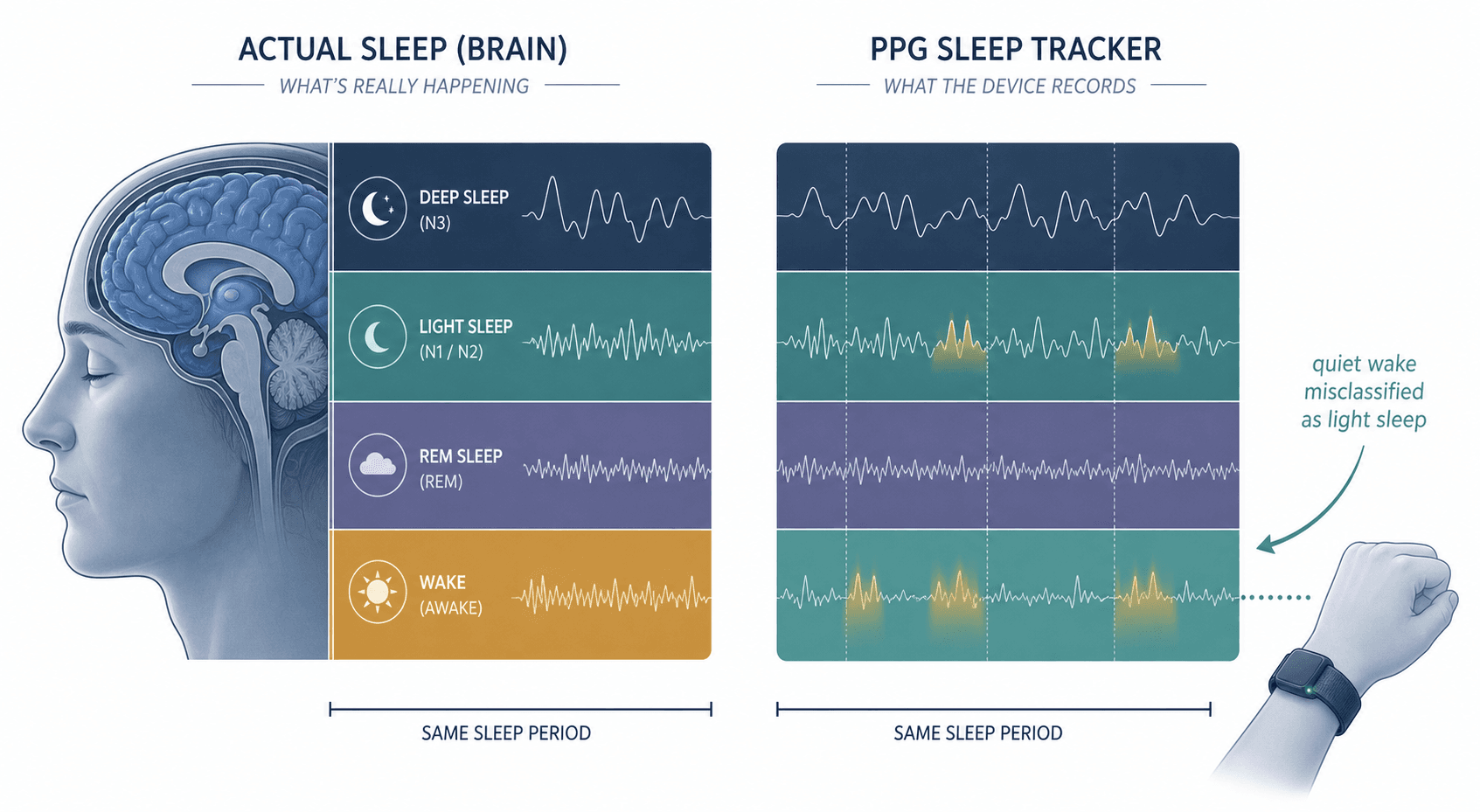
These limitations are not dealbreakers — consumer trackers are designed for trend analysis, not clinical diagnosis. But they matter enormously when you are choosing a device. A tracker that misses 77% of wake periods will paint a falsely rosy picture of your sleep quality, which can be particularly misleading if you have insomnia or sleep fragmentation.
Smart Rings: Best Sleep-Stage Accuracy and Overnight Compliance
Smart rings — led by the Oura Ring (Gen 3 and Gen 4) and the Samsung Galaxy Ring — have emerged as the form factor of choice for sleep-focused trackers. Their primary advantage is anatomical: the finger has a denser network of blood vessels and less motion artifact than the wrist, which can produce cleaner PPG signals.
The 2023 multicenter study found that Oura Ring 3 achieved a macro F1 score of 0.52 (Cohen κ 0.35), placing it in the "fair agreement" range. While this is lower than the top-scoring wearables (Fitbit Sense 2 and Galaxy Watch 5 both scored 0.58), the Oura Ring showed an important statistical advantage: it demonstrated no proportional bias for any sleep measure. In plain language, this means its errors were consistent across different sleep durations and qualities, making its data more reliable for tracking trends over time.
A more recent 2024 validation study, cited by Wirecutter, found that the Oura Ring "did not significantly differ from PSG" for total sleep time, sleep onset latency, wake after sleep onset, and time spent in light and deep sleep. Dean J. Miller, the sleep scientist from CQUniversity Australia, also notes that a recent validation study of a latest-generation ring-shaped wearable showed it "did not differ from PSG for estimating light sleep and slow wave sleep."
The second major advantage of smart rings is overnight wear compliance. According to Jointcorp's analysis, rings achieve approximately 98% overnight wear compliance, compared to 67% for smartwatches. The logic is straightforward: a ring is less bulky, does not interfere with sleep posture, and does not need to be removed for charging as frequently as a smartwatch. A device that stays on your finger every night generates more data, and more consistent data, than a device you take off three nights a week.
| Metric | Smart Ring (Oura Ring 3/4) |
|---|---|
| Macro F1 Score (2023 Study) | 0.52 |
| Wake Detection Sensitivity | Not separately reported; ring showed no proportional bias |
| Overnight Wear Compliance | ~98% |
| Battery Life | 4–7 days |
| Subscription Required | Yes ($5.99/month or $69.99/year) |
| Exercise Tracking | Basic (steps, HR); no built-in GPS |
The tradeoffs are real. Smart rings offer limited exercise tracking — they count steps and measure heart rate, but they lack built-in GPS for outdoor runs and cannot match the workout-specific features of a Garmin or Apple Watch. They also require a monthly subscription (Oura charges $5.99/month or $69.99/year after the first month), which adds to the total cost of ownership.
Fitness Bands: Strong Total Sleep Time Accuracy with Long Battery Life
Fitness bands — represented by devices like the Fitbit Inspire 3 and the Whoop 4.0 — occupy the middle ground between rings and smartwatches. They are less bulky than a full smartwatch but more feature-rich than a ring, and they offer the longest battery life of any wrist-worn form factor.
In the 2023 multicenter study, the Fitbit Sense 2 (a band-style device) achieved a macro F1 score of 0.58 (κ 0.42), tying with the Galaxy Watch 5 for the highest score among wearables. Jointcorp's analysis estimates overall sleep tracking accuracy for fitness bands at 88–91% compared to PSG, though this figure should be treated as a manufacturer estimate rather than a validated benchmark.
The standout advantage of fitness bands is battery life. Most models last between 14 and 21 days on a single charge, compared to 4–7 days for rings and 18–36 hours for smartwatches. This has a direct impact on data quality: a device that needs to be charged every night is a device that will miss sleep data. A device that can go two to three weeks between charges stays on your wrist consistently, producing a more complete sleep record.
| Metric | Fitness Band (Fitbit Sense 2 / Whoop 4.0) |
|---|---|
| Macro F1 Score (2023 Study) | 0.58 (Fitbit Sense 2) |
| Overall Accuracy (Manufacturer Estimate) | 88–91% |
| Overnight Wear Compliance | ~85–90% |
| Battery Life | 14–21 days |
| Subscription Required | Fitbit: optional ($9.99/month); Whoop: required ($30/month) |
| Exercise Tracking | Moderate (steps, HR, some GPS models) |
Fitness bands are a strong choice if you want reliable total sleep time and sleep/wake detection without the bulk of a smartwatch. They are less accurate for sleep stage classification than the best rings, but their superior battery life means you are more likely to wear them every night — and consistent data is often more useful than slightly more accurate data with gaps.
Smartwatches: Feature-Rich but Compromised by Overnight Compliance
Smartwatches — the Apple Watch Series 8/9, Samsung Galaxy Watch 5/6, Google Pixel Watch, and Garmin Fenix series — are the most popular form factor for general fitness tracking, but they face a fundamental challenge as sleep trackers: people do not like wearing them to bed.
The 2023 multicenter study showed that smartwatches can achieve competitive sleep-stage accuracy. The Google Pixel Watch scored a macro F1 of 0.57 (κ 0.40), the Galaxy Watch 5 scored 0.58 (κ 0.42), and the Apple Watch 8 scored 0.49 (κ 0.30). The Galaxy Watch 5 also achieved the smallest bias for sleep efficiency among all tested devices: just -0.4 percentage points compared to PSG.
But accuracy in a lab setting does not translate to accuracy in real-world use if the device is not on your wrist. Jointcorp reports that smartwatch overnight wear compliance is approximately 67%, meaning one in three nights goes untracked. The reasons are well-documented: smartwatches are bulkier than rings or bands, they can interfere with sleep posture, and their short battery life (typically 18–36 hours) means many users charge them overnight.
| Metric | Smartwatch (Pixel Watch / Galaxy Watch 5 / Apple Watch 8) |
|---|---|
| Macro F1 Score (2023 Study) | 0.57 (Pixel Watch), 0.58 (Galaxy Watch 5), 0.49 (Apple Watch 8) |
| Sleep Efficiency Bias | -0.4 percentage points (Galaxy Watch 5, best in study) |
| Wake Detection Sensitivity | 0.23 (Pixel Watch, worst in study) |
| Overnight Wear Compliance | ~67% |
| Battery Life | 18–36 hours |
| Subscription Required | No (Apple, Samsung, Google); Optional (Garmin) |
| Exercise Tracking | Full (GPS, workout tracking, app ecosystem) |
Smartwatches make the most sense if you want a single device for all-day fitness tracking, notifications, and sleep monitoring — and you are willing to accept that your sleep data will have gaps. If you are primarily interested in sleep quality and can tolerate wearing a separate device at night, a ring or band will likely give you more complete and consistent data.
Non-Wearable Options: Convenience with Sensor Limitations
For people who cannot or will not wear a device to bed — due to skin sensitivity, personal preference, or medical devices like CPAP masks — non-wearable sleep trackers offer an alternative. These include under-mattress sensors (Withings Sleep Mat), smart bed platforms (Eight Sleep Pod), and bedside devices that use radiofrequency or sound analysis.
The main advantage is obvious: 100% compliance, because there is nothing to remember to put on. The tradeoff is sensor accuracy. Non-wearable devices measure movement and respiratory patterns through the mattress, which is a less direct proxy for sleep than PPG. They cannot track sleep stages with the same granularity as a finger- or wrist-worn device, and they are susceptible to interference from bed partners and pets.
- Under-mattress sensors (Withings Sleep Mat): Track sleep/wake patterns, heart rate, and respiratory rate. Limited sleep stage data. Can be confused by a partner's movements.
- Smart beds (Eight Sleep Pod): Integrate temperature regulation with sleep tracking. Track sleep stages using ballistocardiography, but accuracy data is limited and mostly manufacturer-provided.
- Bedside devices: Use radiofrequency or sound to estimate sleep. Generally the least accurate category, with limited validation data.
Non-wearable trackers are a reasonable choice if you absolutely cannot wear a device, but they are not a substitute for a wearable if sleep-stage accuracy matters to you. They are best suited for tracking long-term trends in sleep duration and consistency rather than detailed stage analysis.
Key Limitations All Sleep Trackers Share
Regardless of which form factor you choose, every consumer sleep tracker shares a set of fundamental limitations that are important to understand before you rely on the data.
- PPG is not EEG. Consumer trackers measure proxies for sleep — heart rate, movement, and temperature — not brain activity. They cannot diagnose sleep disorders like sleep apnea, narcolepsy, or periodic limb movement disorder.
- All trackers overestimate sleep in people with insomnia. Because they misclassify quiet wake as light sleep, they systematically inflate total sleep time and sleep efficiency for people who spend significant time awake in bed. This can create a misleading picture that contradicts how the user actually feels.
- Consumer sleep trackers are not FDA-regulated as medical devices. As Johns Hopkins Medicine states, for exact data, a medical sleep study monitoring brain waves is required.
- Tracker data can cause or worsen sleep anxiety. The Sleep Foundation reports that approximately 30% of American adults use wearable health trackers, and a subset develop orthosomnia — an unhealthy preoccupation with optimizing sleep data. People with orthosomnia may stay in bed longer to improve their scores, which can paradoxically worsen insomnia.
How to Choose: A Decision Framework Based on Your Priorities
The right fitness tracker for sleep depends on your answers to three questions: How much do you care about sleep-stage accuracy? Will you actually wear it every night? And what else do you need the device to do?
| Your Priority | Best Form Factor | Why |
|---|---|---|
| Maximum sleep-stage accuracy and overnight comfort | Smart Ring | Finger-based PPG produces cleaner signals; 98% overnight wear compliance means more complete data. Accept limited exercise tracking and a subscription fee. |
| Long battery life and consistent sleep tracking with moderate exercise features | Fitness Band | 14–21 day battery eliminates charging gaps; 88–91% accuracy is sufficient for trend analysis. Good for step counting and basic HR tracking. |
| All-in-one device for fitness, notifications, and sleep | Smartwatch | Full feature set but lower overnight compliance (~67%). Best if you are willing to charge nightly and accept data gaps. |
| Cannot or will not wear a device to bed | Non-Wearable Mat | 100% compliance but limited sleep stage data. Best for tracking sleep duration and consistency, not stage analysis. |
No consumer sleep tracker — regardless of form factor, price, or brand — is a substitute for a clinical sleep evaluation. If you suspect you have a sleep disorder such as insomnia, sleep apnea, or restless legs syndrome, the right tool is not a wearable but a referral to a sleep specialist for polysomnography or home sleep apnea testing. Use trackers to spot trends and motivate consistency, not to diagnose or treat medical conditions.


Comments
Join the discussion with an anonymous comment.