
The Original Vision: What Were Bose Sleepbuds II Designed to Do?
When Bose introduced the Sleepbuds II in October 2020, the company was attempting something genuinely novel: a wearable designed exclusively for sleep, not for fitness tracking or phone calls. The core insight was that many people who struggle to fall or stay asleep are not dealing with a clinical sleep disorder — they are dealing with environmental noise. A snoring partner, a barking dog, traffic, or a neighbor's television can fragment sleep architecture without the sleeper even being fully aware of the disruption.
Bose's approach to this problem was not active noise cancellation (ANC), which requires a seal against the ear canal and can feel claustrophobic for all-night wear. Instead, the company used noise masking — a library of preloaded sounds (35 in total, across three categories called Noise Making, Naturescapes, and Tranquilities) designed to cover up disruptive noises by playing calibrated audio that the brain finds non-alarming. The technology is closer to a white noise machine than a pair of noise-canceling headphones, but miniaturized into a package that fits entirely inside the ear.
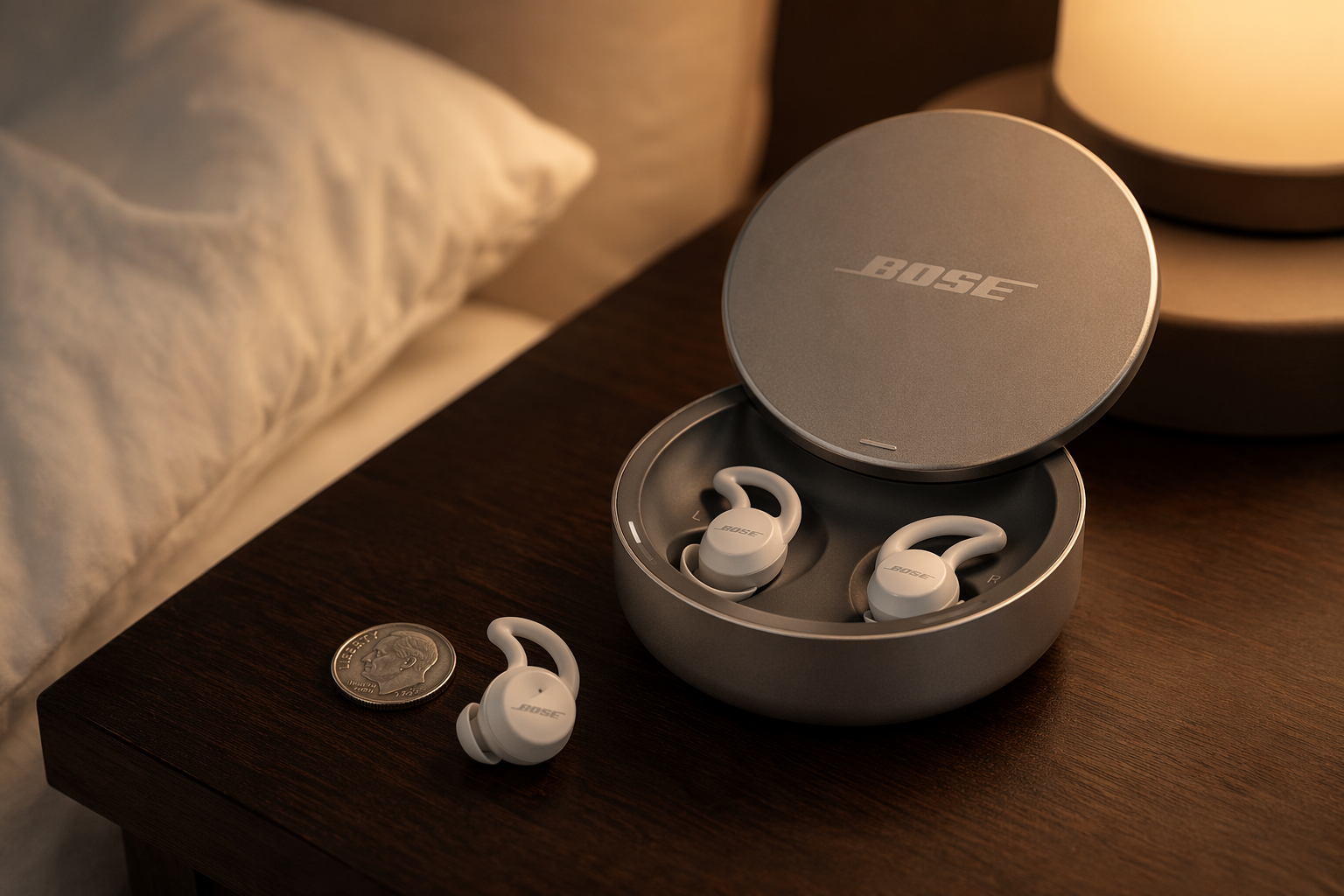
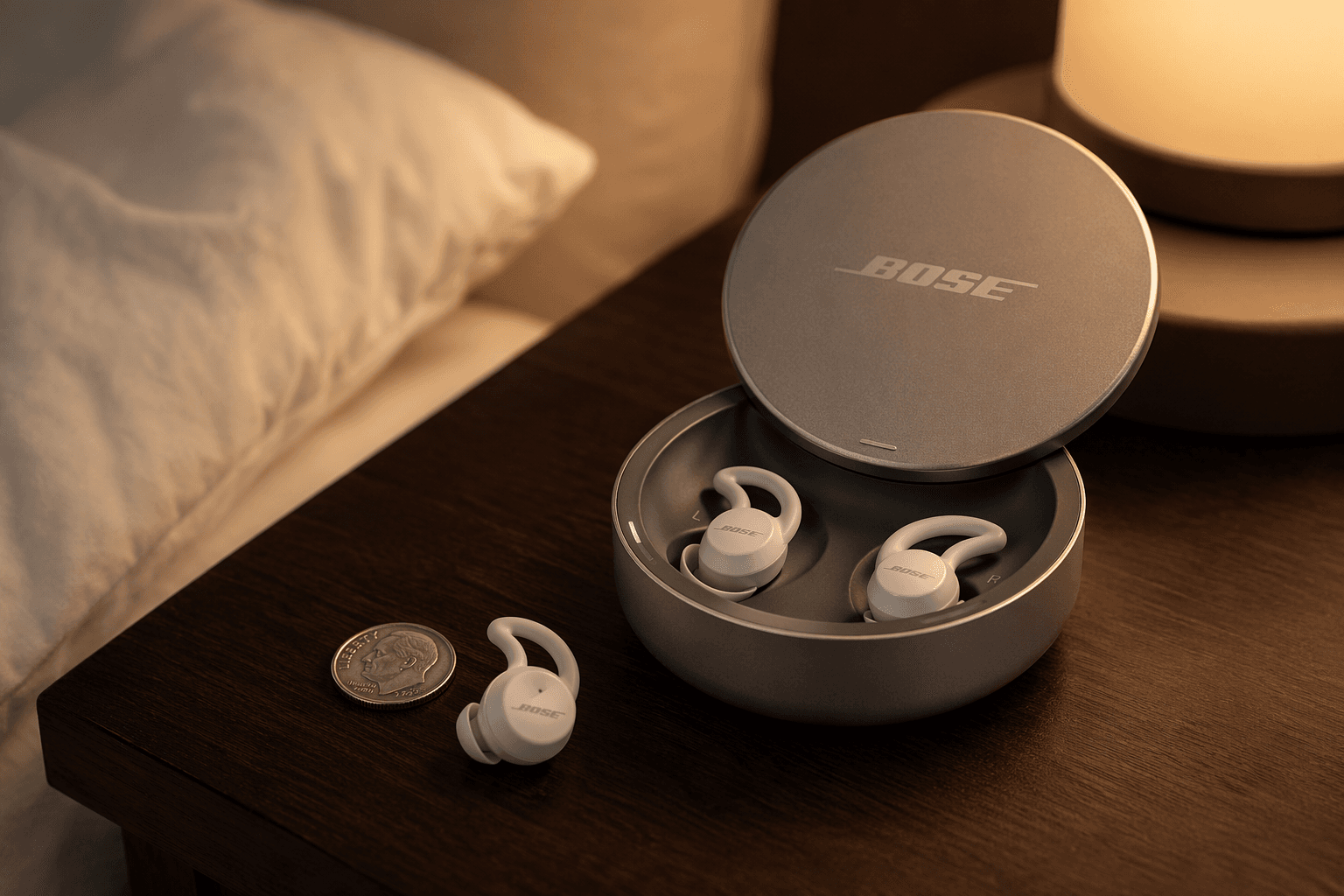
The engineering challenge was extreme. Each bud weighs just 1.35 grams and measures 6.35 mm deep — roughly the depth of a pencil eraser. The form factor had to be small enough and flat enough that a side sleeper could press their head into a pillow without feeling a hard plastic lump pressing into their ear. The battery had to last a full night's sleep (10 hours) while powering the audio playback and the onboard storage. And the entire system had to function without Bluetooth streaming, because Bluetooth radios consume too much power for all-night use in such a tiny enclosure.
The result was a product that solved a real problem for a specific group of people — noise-sensitive sleepers who could not tolerate earplugs and found white noise machines too bulky or disruptive for a bed partner. But the same design constraint that made the Sleepbuds II remarkable also limited their appeal, as we will explore in the sections that follow.
The Clinical Evidence: Did They Actually Work?
Bose commissioned a clinical study with the University of Colorado Anschutz Medical Campus and UCHealth CARE Innovation Center to evaluate whether the Sleepbuds II actually improved sleep outcomes. The results, published in Bose's own press materials, reported striking numbers:
- 100% of participants confirmed that Bose noise masking worked against common sleep disturbances
- 86% said the product helped them fall asleep easier
- 76% said it helped them stay asleep
- 80% reported improved overall sleep quality
Dr. Aaron Weiner, a licensed clinical psychologist who reviewed the Sleepbuds II from a clinical perspective, noted that the 76% improvement in staying asleep and 80% improvement in sleep quality "isn't surprising" given the product's design. He confirmed that the earbuds "absolutely accomplish what they were designed to do" — namely, mask environmental noise that would otherwise trigger micro-arousals throughout the night.
The clinical utility is straightforward: if your sleep disruption is driven by external noise, a device that reliably masks that noise should improve your sleep continuity. The Sleepbuds II appear to have delivered on that promise. The question was never whether the technology worked — it was whether enough people would pay $249.95 for a single-purpose device that could not also stream music, take calls, or track sleep stages.
The First-Gen Disaster: Battery Defects and Full Refunds
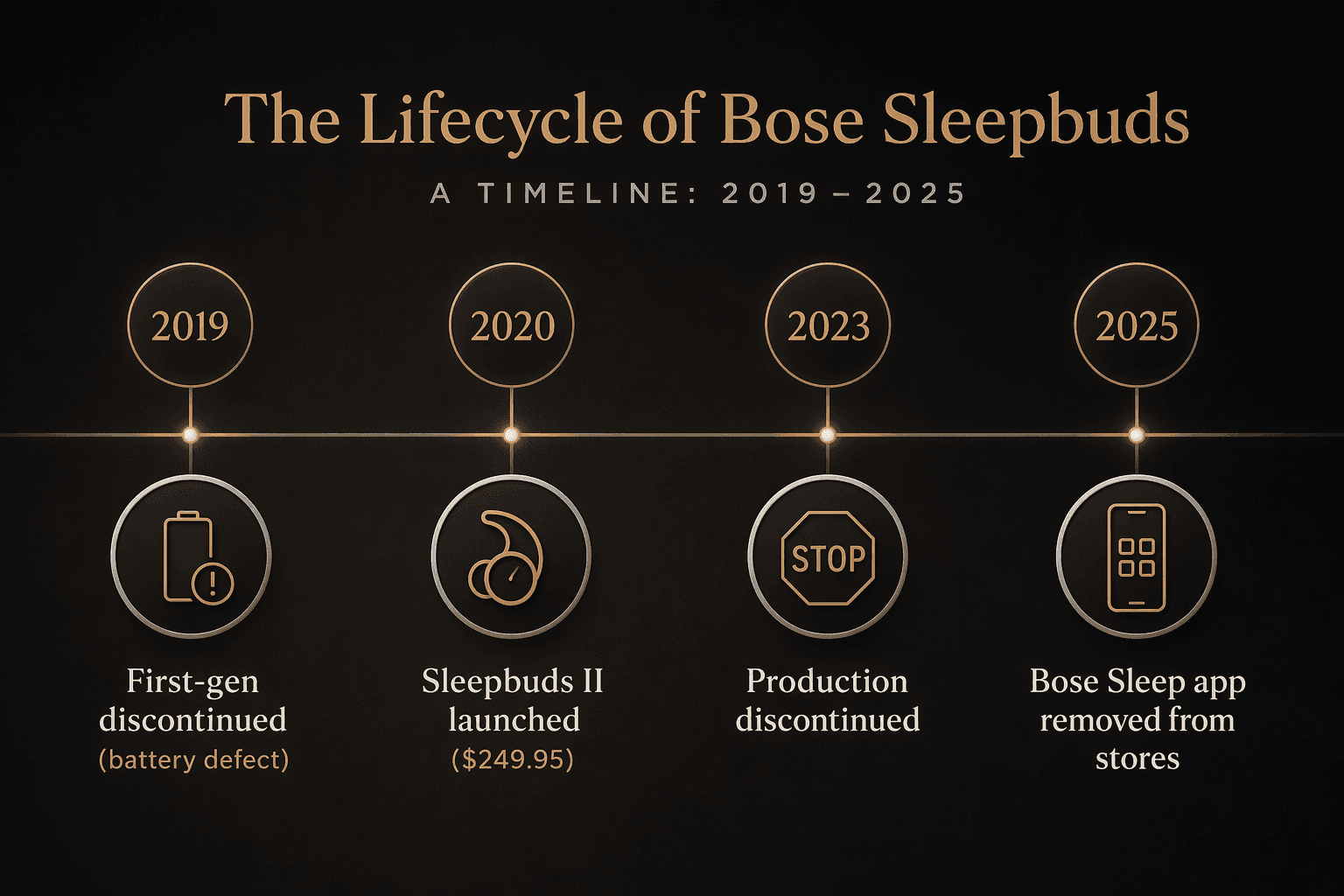
Before the Sleepbuds II could prove themselves in the market, Bose had to survive the fallout from the original Sleepbuds. In October 2019, Bose fully discontinued the first-generation Sleepbuds due to a hardware battery defect. The batteries in the original buds suffered from inconsistent performance, premature failure, and charging malfunctions. Bose general manager John Roselli issued a public apology, stating that the battery "functions safely" but "doesn't work as consistently or predictably as it should."
Bose's response was unusually generous for a hardware recall: the company promised full refunds to all customers, with returns accepted through December 31, 2019. Replacement units were offered into early 2020. This was not a safety recall — the batteries were not a fire risk — but Bose recognized that the product had failed its core promise of reliable all-night operation.
The first-gen failure had two lasting consequences. First, it burned consumer trust at a critical moment — the Sleepbuds were a new product category, and early adopters who received refunds were unlikely to give Bose a second chance. Second, it forced Bose to redesign the battery system from scratch, delaying the second generation and adding engineering cost that made the product line harder to justify commercially.
The Second-Gen Recovery: What Sleepbuds II Fixed (and What They Didn't)
The Sleepbuds II, announced on September 22, 2020 and released on October 6, 2020 at $249.95, addressed the first generation's most critical failure. The battery was switched to a NiMH chemistry that provided a reliable 10-hour runtime. The buds received an IPX4 sweat- and water-resistance rating, and the charging case was upgraded to anodized aluminum, providing 30 additional hours of charge. The form factor remained essentially identical — 1.35 grams per bud, 6.35 mm deep — because the original design was already well-executed.
Here is what the Sleepbuds II offered — and what they deliberately did not:
- Fixed: Reliable NiMH battery with 10-hour all-night runtime
- Fixed: IPX4 sweat and water resistance for overnight wear
- Fixed: Anodized aluminum case with 30 hours of additional charge
- Not included: Bluetooth music or podcast streaming
- Not included: Active noise cancellation
- Not included: Sleep tracking or biometric sensors
- Not included: Phone call support
The missing features were not oversights — they were engineering tradeoffs. Bluetooth streaming consumes significantly more power than playing preloaded audio from onboard storage. Adding Bluetooth would have required a larger battery, which would have made the buds too large for comfortable side sleeping. ANC requires a tight ear seal that many sleepers find uncomfortable for eight hours. Bose made a deliberate choice to prioritize the sleep experience over feature breadth.
But that choice came with a commercial cost. A $249.95 device that cannot stream music, track your sleep, or take calls is a hard sell in a market where consumers expect multi-function wearables. The Sleepbuds II were a brilliant solution to a narrow problem — and narrow problems rarely generate the sales volume needed to sustain a product line at a company Bose's size.
Why It Ultimately Failed: Low Adoption and Bose's Strategic Retreat
Bose discontinued the Sleepbuds II in 2023, roughly three years after launch. The company did not issue a dramatic press release — the product simply stopped being manufactured and quietly disappeared from store shelves. According to Ozlo, a company founded by three former Bose engineers who worked on the Sleepbuds project, the discontinuation was driven by low consumer adoption and Bose's decision to refocus on its core audio product categories.
The low adoption is not difficult to explain. The Sleepbuds II occupied an awkward position in the market: too expensive for impulse buyers, too limited for feature-conscious tech shoppers, and too specialized for the average person who just wants to sleep better. The people who needed them — noise-sensitive sleepers who could not tolerate earplugs — were a genuine but small demographic. Bose, a company accustomed to selling millions of speakers and headphones, could not justify the engineering and supply chain overhead for a niche product.
There is also a broader lesson here about the sleep-tech market. Consumers have repeatedly shown that they prefer multi-function devices (smartwatches, fitness trackers, smart rings) over single-purpose sleep gadgets. The Sleepbuds II were a pure-play sleep product in an era when the market was moving toward platforms. Even products with stronger clinical evidence, like CBT-I digital therapeutics, have struggled with consumer adoption for similar reasons.
The App Problem: What the July 2025 Removal Means for Users
This is the most urgent and time-sensitive part of the story for anyone considering a used pair of Sleepbuds II in 2026. On July 21, 2025, Bose removed the Bose Sleep app from both the iOS App Store and Google Play Store. The app was the only way to set up the Sleepbuds II, transfer sounds to the buds, adjust volume, and configure alarm settings.
For existing owners who have the app installed and working, the Sleepbuds II will continue to function as long as they do not need to re-pair or reset the buds. But the situation is fragile: if the app crashes, if the phone is replaced, or if the buds need to be factory-reset for any reason, there is no recovery path. Bose has not released a desktop utility or alternative setup method.
This is a stark reminder of the risks of buying discontinued hardware that depends on a proprietary app. The physical product may be in perfect condition, but the software ecosystem that makes it functional has been shut down. For sleep-tech shoppers in 2026, the Bose Sleepbuds II are effectively a bricked product for anyone who does not already have a working setup.
Current Alternatives: What Should You Buy in 2026?
If you are a noise-sensitive sleeper looking for an in-ear sleep solution in 2026, two products stand out as the primary alternatives to the discontinued Bose Sleepbuds II. Each takes a different approach to the core problem.
| Feature | Bose Sleepbuds II (Discontinued) | Ozlo Sleepbuds | Soundcore Sleep A20 |
|---|---|---|---|
| Price (approx.) | $249.95 (original) | ~$179 | ~$99–$149 |
| Noise approach | Noise masking (preloaded sounds) | Noise masking + audio streaming | Passive isolation + audio streaming |
| Bluetooth streaming | No | Yes (any audio) | Yes (any audio) |
| Active noise cancellation | No | No | No (A30 model adds mild ANC) |
| Battery life (buds) | 10 hours | Up to 10 hours | Up to 14 hours (preloaded) / 10 hours (streaming) |
| Battery life (case) | 30 additional hours | Smart Case with extra charges | Not specified |
| Sleep tracking | No | Yes (biometric + environmental sensors) | No |
| Side-sleeping comfort | Excellent (1.35g, 6.35mm deep) | Ultra-soft silicone with anchor wings | Tiny flat profile with stability wings |
| App status | Removed from stores (July 2025) | Active | Active |
| Warranty | N/A (discontinued) | Not specified | 18 months |
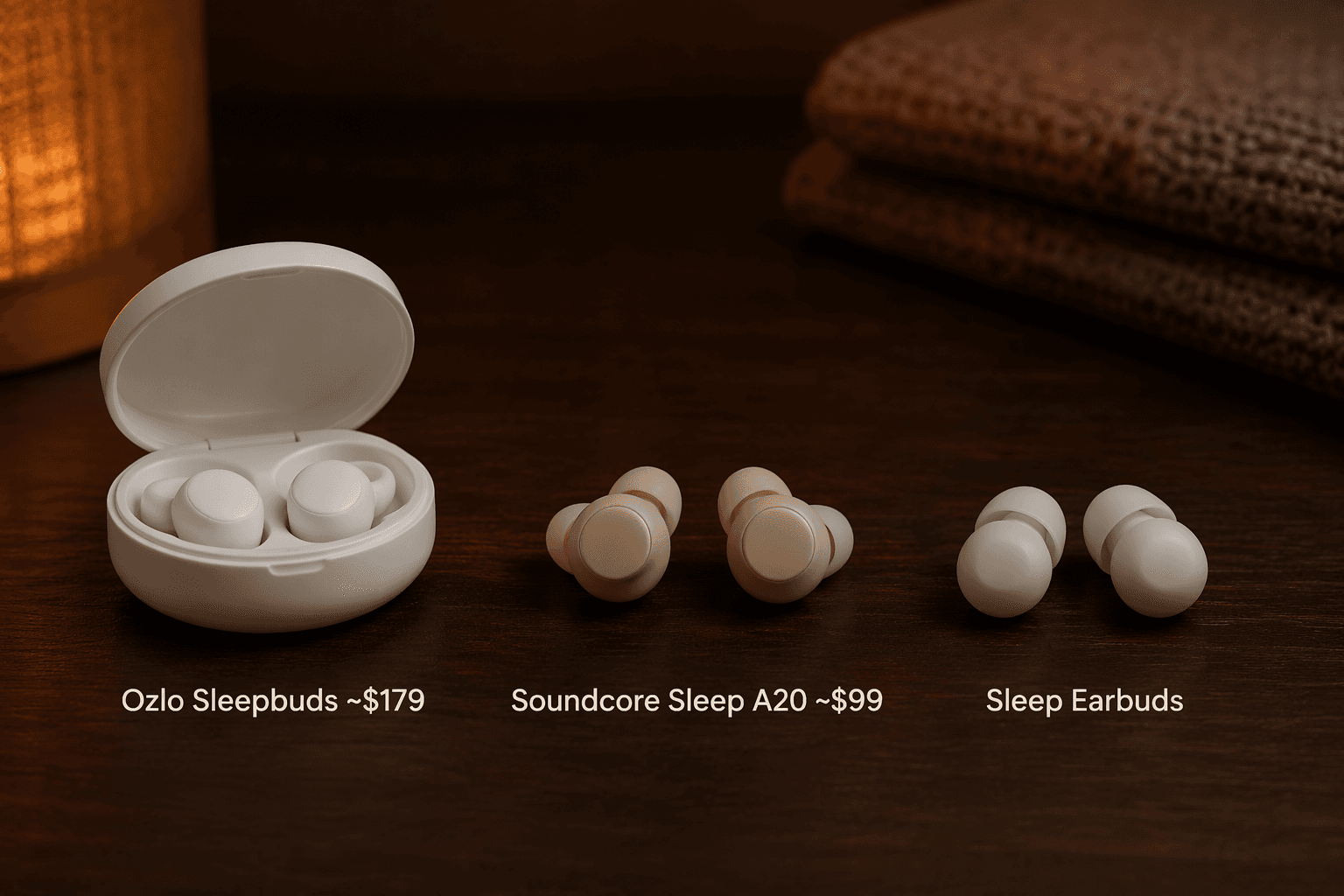
The Ozlo Sleepbuds are the most direct spiritual successor to the Bose Sleepbuds II. The company was founded by three former Bose engineers who worked on the original Sleepbuds project. They have addressed the key limitation of the Bose product by adding Bluetooth audio streaming — you can listen to audiobooks, podcasts, or YouTube through the buds in addition to the preloaded noise-masking tracks. The buds also include built-in biometric and environmental sensors for sleep reports, something the Bose product never offered. At approximately $179, they are priced below the Bose original.
The Soundcore Sleep A20 (owned by Anker) is the Wirecutter top pick for blocking and masking loud noises. It uses passive isolation (a physical seal) combined with preloaded and streamed audio, rather than active noise cancellation. The buds have a tiny flat profile designed for side sleepers, with puffy stability wings to keep them in place. Battery life reaches up to 14 hours with preloaded sounds and 10 hours with Bluetooth streaming. The A20 is IPX4 rated and comes with an 18-month warranty. The newer A30 model adds mild ANC and dynamic snore masking but has a shorter 9-hour battery life and costs approximately $50 more.
Verdict: Should You Buy Used Bose Sleepbuds II in 2026?
For most readers, the answer is a clear no. The app removal in July 2025 makes used Sleepbuds II a high-risk purchase. Unless you are buying from someone who can demonstrate that the buds are already paired and working with their phone, and unless you are willing to keep that specific phone and app installation intact indefinitely, you are buying a product that may become unusable at any moment.
If you already own a working pair and have the Bose Sleep app installed, you can continue using them. But treat the setup as fragile: avoid factory-resetting the buds, avoid switching phones without careful planning, and do not assume the app will continue to work indefinitely on future OS updates.
For noise-sensitive sleepers who need a reliable solution today, the Ozlo Sleepbuds or Soundcore Sleep A20 are better choices. They offer the same core benefit — comfortable all-night wear with noise masking — plus the flexibility of Bluetooth streaming and active software support.
The Bose Sleepbuds II were a remarkable piece of engineering — a genuinely innovative solution to a real problem, executed with the miniaturization and industrial design skill that Bose is known for. But they were also a case study in the gap between technical excellence and commercial viability. The product was too specialized, too expensive, and too dependent on a proprietary software ecosystem to survive in a market that rewards versatility and platform longevity. For the people who bought them and got them working, they were life-changing. For everyone else, they are a cautionary tale about the risks of falling in love with a niche product.

Comments
Join the discussion with an anonymous comment.