
If you want one device for sleep and daytime activity, the hard part is not finding a tracker that can measure both. It is finding one you will keep on overnight, keep charged, and keep paying for after the free trial ends.
The three form factors solve different problems
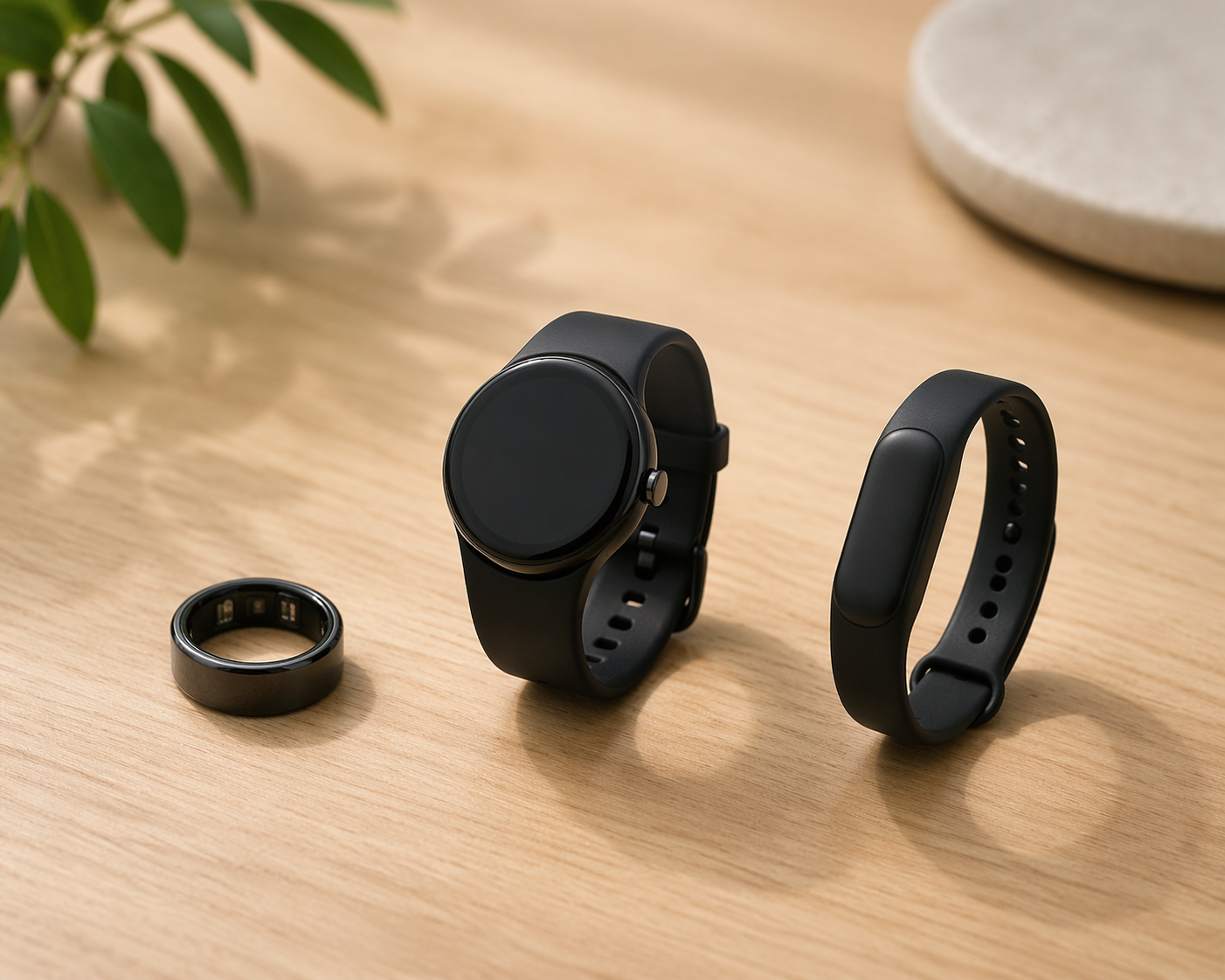
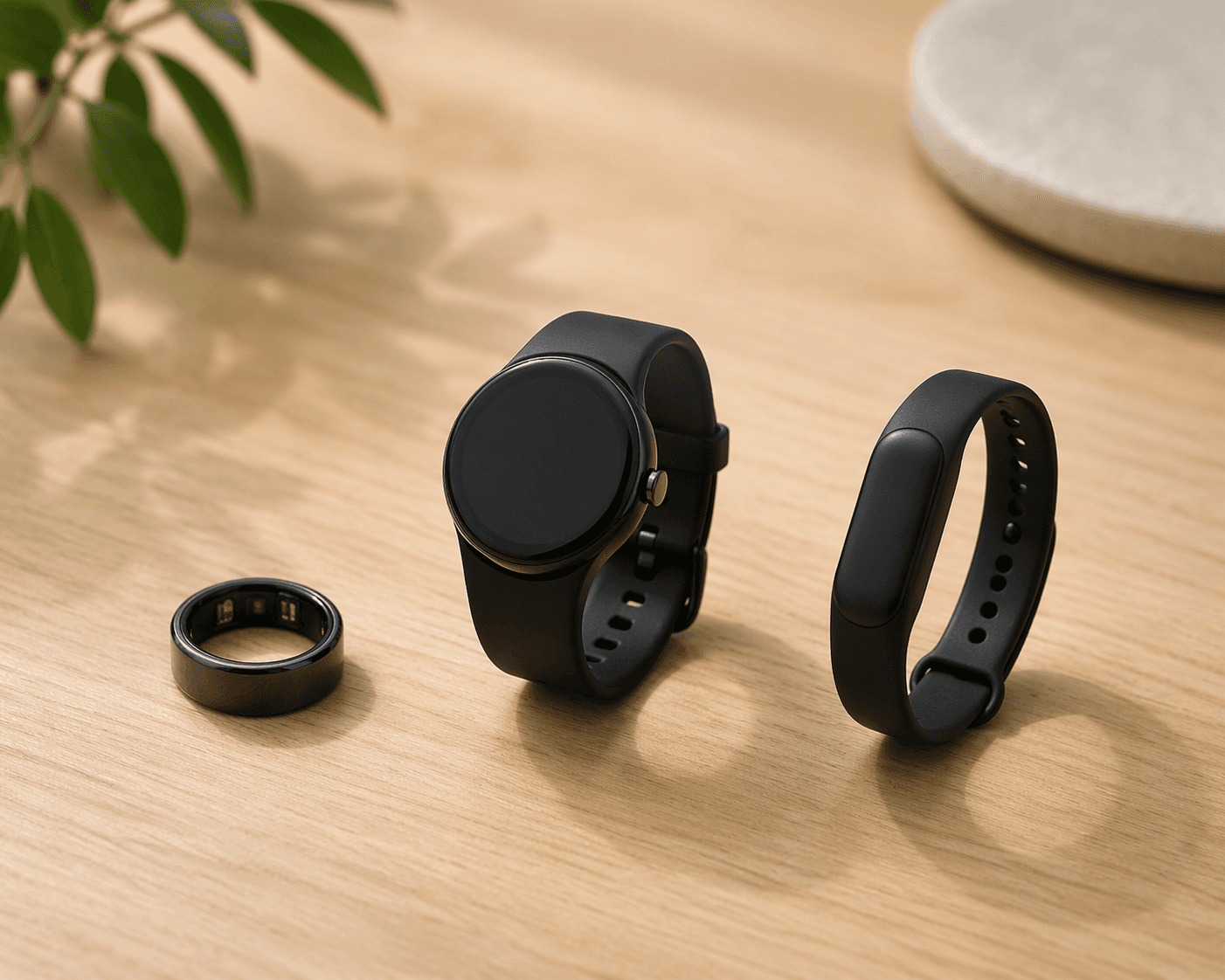
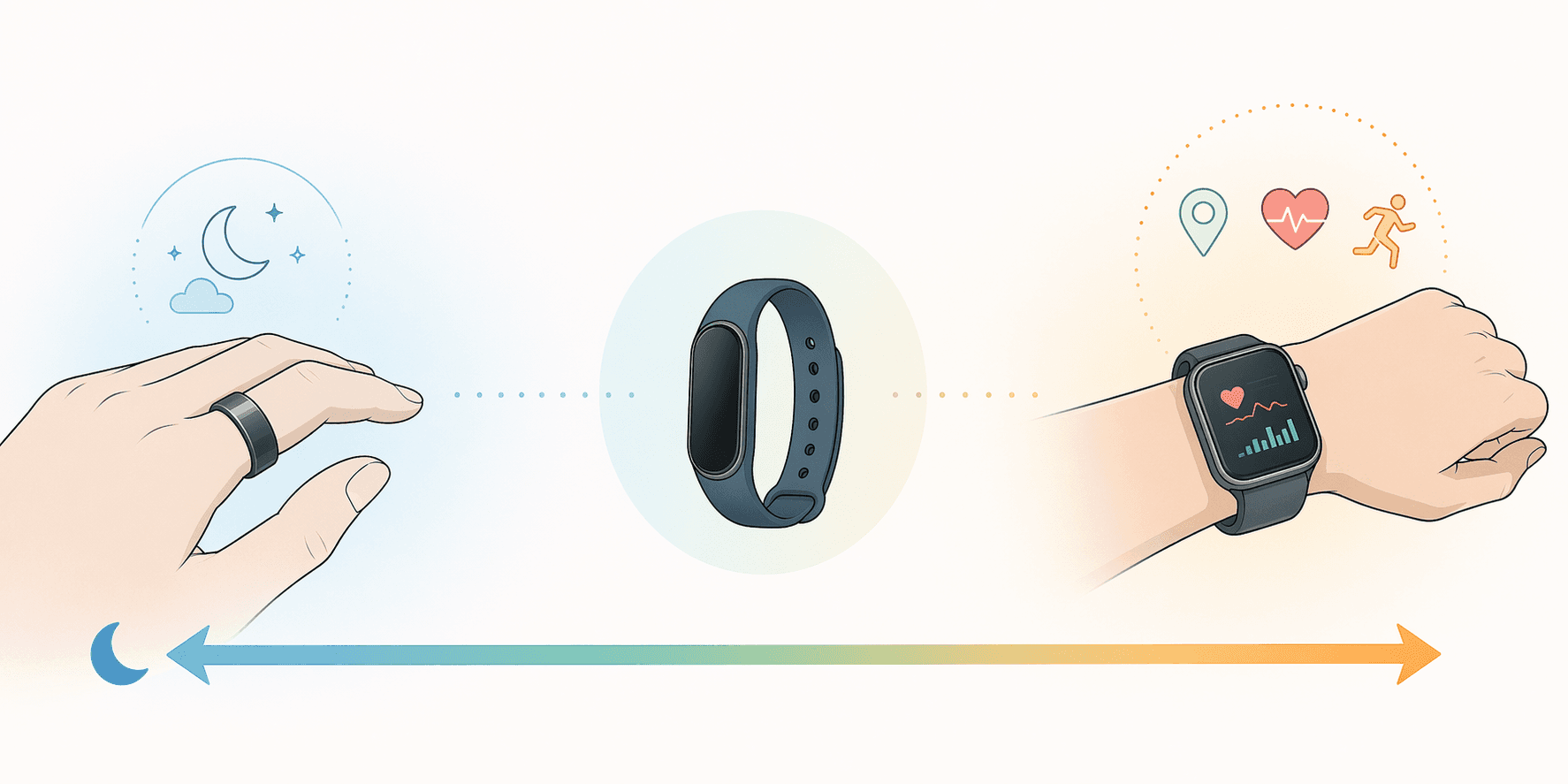
Smart rings, smartwatches, and screenless bands sit in different parts of the same tradeoff. Rings usually disappear on the hand, which is why hands-on reviews keep finding stronger overnight wear consistency. Smartwatches collect more daytime context and training data, but bulk and charging routine make sleep tracking easier to skip. Screenless bands remove the distraction of a display, which helps bedtime consistency, but they often replace that simplicity with a recurring fee.[1][2][3][4][5]
- Smart ring: best if sleep is the priority and you want the least intrusive overnight wear.
- Smartwatch or hybrid watch: best if you care about live workout data, pace, GPS, notifications, and a fuller daytime interface.
- Screenless band: best if you want a sleep-friendly device with fewer distractions and can accept a more expensive ongoing model.
The subscription question comes before the feature list
The money question is not an afterthought. AASM cites a consumer sleep-tracking market estimate of about $30 billion in 2024, and recurring fees are now common enough that they shape the purchase itself.[3] That matters because the device you keep paying for is also the device you have to keep tolerating.
RingConn Gen 2 is the clearest no-subscription example here: $299 upfront with no ongoing fee. Whoop’s screenless model removes display clutter, but PCMag’s testing puts its subscription in the $239 to $359 per year range depending on commitment. Fitbit Charge 6 starts at $99.95, yet some of its more detailed sleep data sits behind an $80 annual Premium plan. Those are not just pricing details; they are part of whether the tracker feels easy to keep in your life or easy to cancel.[4][5][6]
Sleep-first, fitness-first, or both
If sleep is the main reason you are buying, the safest bet is the device you forget you are wearing. That usually means a ring or a slim band, not a watch that asks for a charge right before bed. If fitness matters just as much as sleep, a smartwatch becomes more defensible because it gives you live pace, GPS, and broader workout context that rings usually do not. For hybrid users, the right answer is often the least dramatic one: the tracker that stays on all night and still gives you enough daytime data that you never feel under-equipped.[1][2][3][5]
That is also why Apple Watch-style devices can struggle in real life even when their daytime tracking is strong. A 1- to 2-day battery life makes overnight charging a recurring temptation, and a lot of people simply take the watch off to make that easier.[2][3][4]
- Choose a ring if your main goal is to wear something overnight without noticing it.
- Choose a smartwatch or hybrid watch if you actually use training tools during the day and can live with the charging routine.
- Choose a screenless band if you want a less distracting sleep experience and are comfortable paying a subscription for it.
Accuracy still matters, but it comes after fit and cost
The lab data is useful as a warning label, not as the only score that counts. One independent Sleep Advances comparison of six consumer devices reported weak sleep-staging performance for the Garmin device it tested, while the Oura-funded Brigham study reported better agreement for Oura; because the studies used different hardware and different sponsor relationships, neither should be treated as the final word on every current model.[7][8] If you still want the metric-by-metric version after ruling out the form factor question, the companion accuracy comparison goes deeper.
The broader pattern is less flattering to all consumer wearables. They tend to overestimate total sleep time, call wakefulness light sleep too often, and underestimate wake after sleep onset by roughly 12 to 48 minutes.[7][8] The studies behind those findings are also small, often involving 13 to 75 participants, and they do not fully solve the hardware-generation or skin-tone-bias problem either.[7][8]
The best sleep and activity tracker is the one that stays on your body overnight and does not leave you resenting the bill. For many people, that will be a ring or a slim band. For others, it will be a smartwatch because daytime fitness matters more. The useful choice is the one you can wear consistently and keep paying for without irritation.
References
- Best Sleep Trackers of 2026 — Sleep Foundation — https://www.sleepfoundation.org/best-sleep-trackers
- The 2 Best Sleep Trackers of 2026 — Wirecutter/NYT — https://www.nytimes.com/wirecutter/reviews/best-sleep-trackers/
- Comparing Sleep Features of Popular Smartwatches — AASM — https://aasm.org/comparing-sleep-features-of-popular-smartwatches/
- The 7 Best Sleep Trackers of 2026 — CNET — https://www.cnet.com/health/sleep/best-sleep-tracker/
- The Best Fitness Trackers We've Tested for 2026 — PCMag — https://www.pcmag.com/picks/the-best-fitness-trackers
- Best Sleep Tracker Without Subscription (2026 Buyer's Guide) — RingConn — https://ringconn.com/blogs/guides/best-sleep-tracker-without-subscription-2026
- Schyvens et al. 2025 — Sleep Advances — 2025 — https://academic.oup.com/sleepadvances/article/6/2/zpaf021/8090472
- Robbins et al. 2024 — MDPI Sensors — 2024 — https://www.mdpi.com/1424-8220/24/20/6532

Comments
Join the discussion with an anonymous comment.