
If Garmin Cirqa and Whoop are both screenless bands built around sleep, recovery, and readiness, the obvious question is why one keeps charging you. The short answer: Whoop has the stronger published sleep-stage evidence, while Cirqa has the much cleaner long-term cost. That does not make Whoop automatically “better,” and it does not make Cirqa a bargain version of the same sleep science. It means the two bands ask for different compromises.
For a buyer searching for a Garmin Cirqa vs Whoop sleep tracking comparison, the most important distinction is not whether either band can draw a plausible sleep chart. Most modern wearables can. The real question is whether the chart is trustworthy enough for the decision you plan to make from it: going easier after “low deep sleep,” believing a recovery score, or treating a REM estimate as if it came from a sleep lab.
| Category | Garmin Cirqa | Whoop 5.0 |
|---|---|---|
| Device type | Screenless Garmin smart band, released in July 2026 | Screenless recovery and strain band |
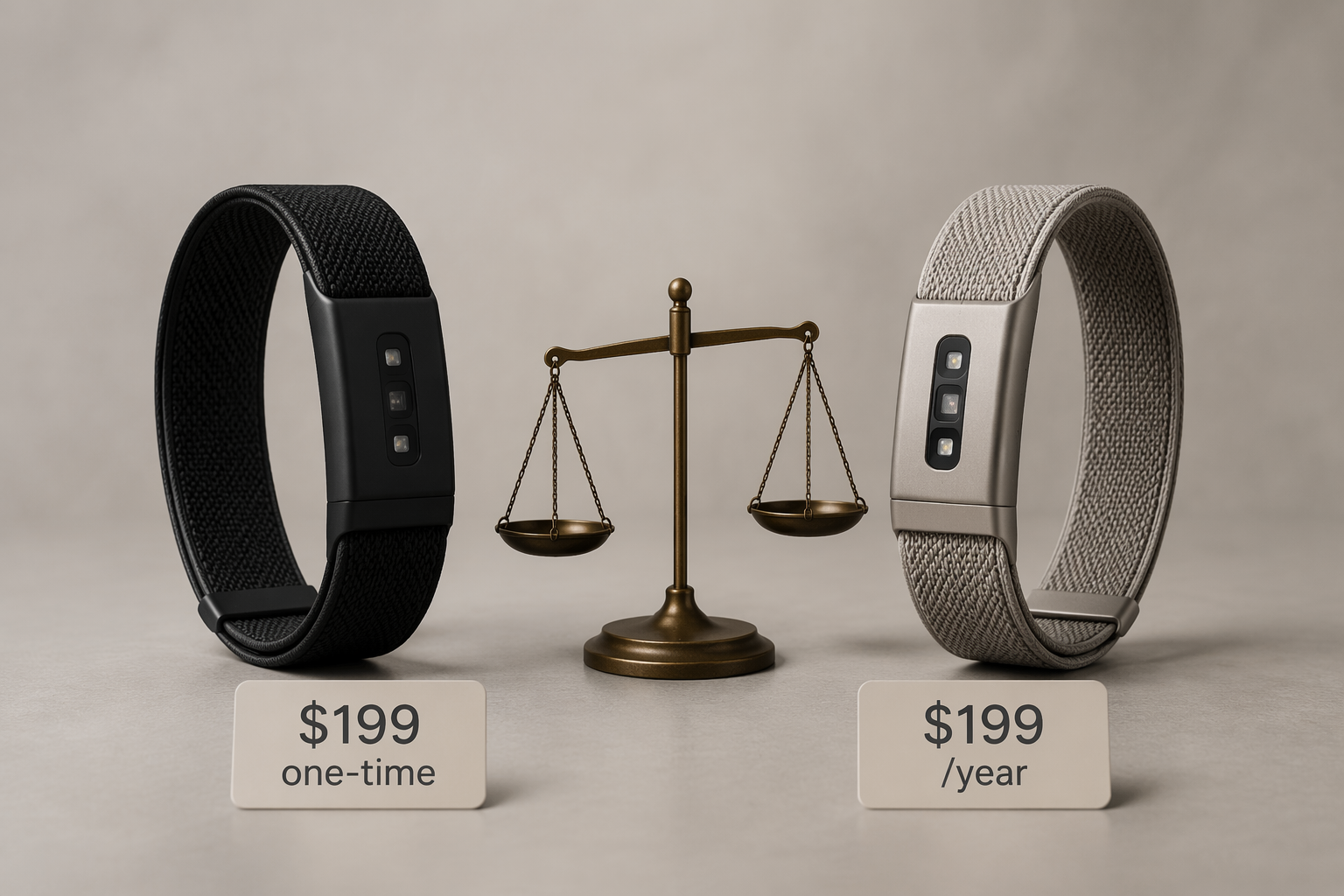
| Price structure | $199 one-time purchase | Whoop One starts at $199 per year |
| Subscription requirement | No required subscription | Subscription required |
| Main sleep metrics | Sleep duration, sleep stages, Sleep Score, HRV-based recovery context, Training Readiness | Sleep duration, sleep stages, HRV, recovery, strain, sleep need |
| Strongest available sleep evidence | No independent Cirqa-specific validation yet; closest Garmin evidence is from older Garmin wearables using related sleep systems | Peer-reviewed Whoop 3.0 data showed better multi-stage sleep agreement than Garmin Forerunner 245 in the same study |
| Biggest uncertainty | Cirqa uses Garmin's Elevate Gen4 optical HR sensor, but published Garmin sleep studies tested watch-form devices, not Cirqa's fabric-band form factor [2] | Whoop 5.0 is newer than the peer-reviewed Whoop 3.0 studies, and its claimed sleep-stage improvement has not been independently validated |
That table is already enough to rule out one lazy conclusion: this is not a simple feature checklist. Cirqa and Whoop both report sleep stages, HRV, and recovery-style signals. The evidence does not support treating those outputs as equally reliable just because the labels match.
Accuracy Depends On Which Sleep Metric You Mean
“Sleep tracking accuracy” is too blunt a phrase. A wearable can be acceptable at estimating when you fell asleep and woke up, weaker at total sleep time, and much weaker at classifying light, deep, and REM sleep. Those are not minor distinctions. They change what the data is safe to use for.
For bedtime, wake time, and broad sleep-duration trends, both Garmin and Whoop can be useful. If your question is whether your weekday sleep window is shrinking, whether late training pushes your bedtime later, or whether travel disrupts your routine, a wrist band does not need to be a miniature sleep lab to be useful.
Sleep stages are different. Deep sleep and REM are exactly the numbers people tend to overread, because they feel physiological and corrective: more deep sleep sounds like more repair; more REM sounds like better cognition or emotional processing. That is where the published evidence starts to matter much more.
If you need a refresher on what Garmin is combining into its nightly score, the site’s Garmin Sleep Score explainer is the better place for scoring mechanics. Here, the question is narrower: when Garmin-style sleep staging is compared with polysomnography, and when Whoop is tested in the same neighborhood, which signal deserves more confidence?
The Closest Garmin-Vs-Whoop Study Favors Whoop
The most useful evidence is Miller et al. 2022, a CQUniversity validation study of six wearable devices in 53 healthy adults. It compared devices including Whoop 3.0 and Garmin Forerunner 245 against polysomnography for sleep, heart rate, and HRV metrics [1]. It is not a Cirqa test, and it is not a Whoop 5.0 test. Still, it is the closest published Garmin-versus-Whoop sleep-stage comparison available in the research brief, and its pattern is too large to wave away.
| Metric in Miller et al. 2022 | Whoop 3.0 | Garmin Forerunner 245 | Why it matters |
|---|---|---|---|
| Multi-state sleep-stage agreement vs PSG | 60% | 50% | Overall stage classification was meaningfully better for Whoop |
| Cohen's kappa | 0.44, moderate agreement | 0.25, fair agreement | Kappa accounts for agreement occurring by chance |
| Deep sleep sensitivity | 62% | 28% | Garmin detected less than one-third of PSG-scored deep sleep |
| REM sensitivity | 66% | Not the decisive Garmin weakness reported here | Whoop's REM detection was substantially more usable than its deep-sleep-challenged Garmin comparison |
| Garmin deep-sleep error pattern | Not the main issue | 61% of PSG-scored deep sleep was misclassified as light sleep | This directly distorts a recovery story built around deep sleep |
The deep-sleep result is the one to sit with. Garmin Forerunner 245 detected only 28% of PSG-scored deep sleep, while 61% of PSG-scored deep sleep was labeled as light sleep [1]. That is not a harmless color-chart disagreement. If a device repeatedly turns deep sleep into light sleep, a user may believe they are recovering poorly when the lab-scored night says something else.
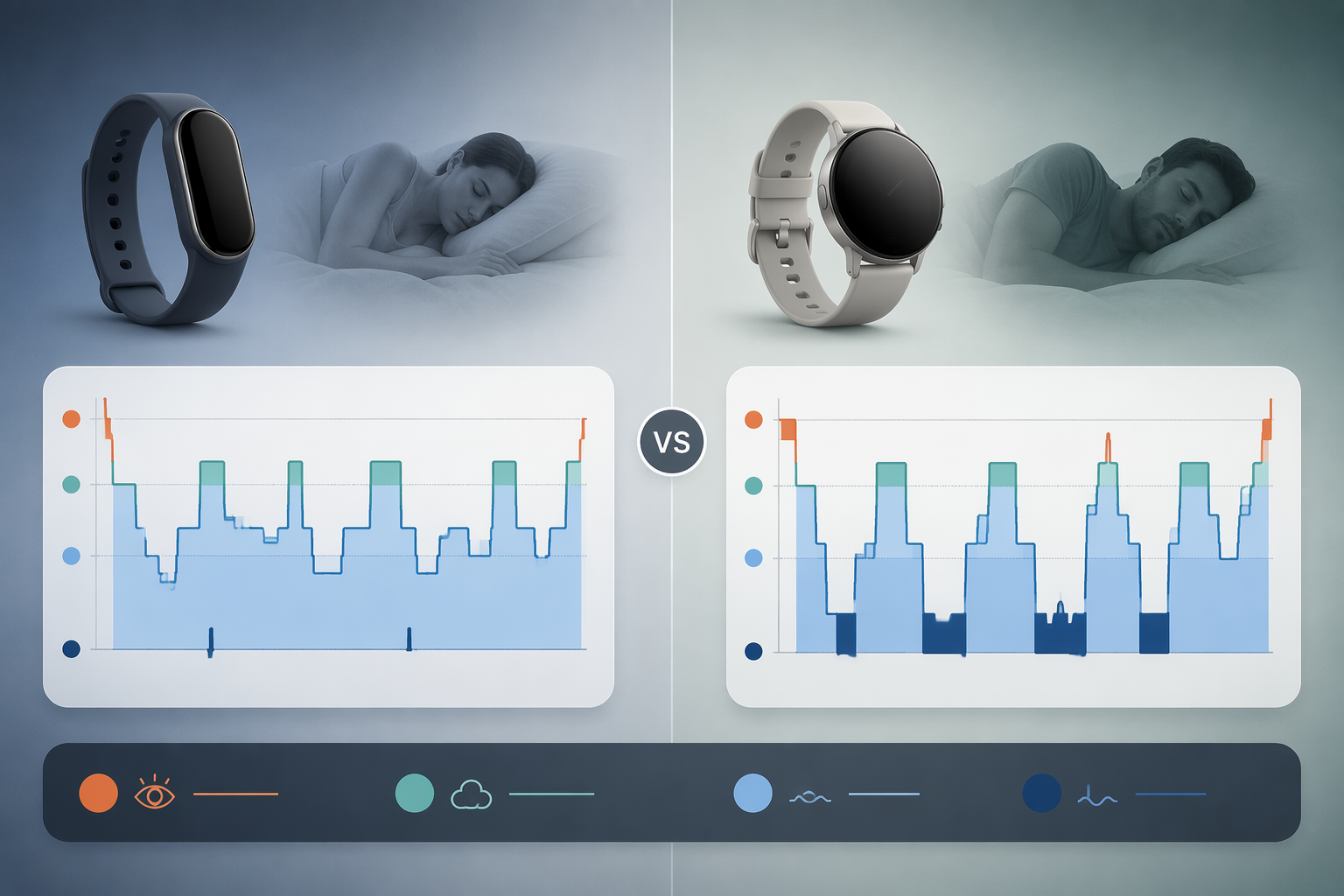
This is why a bland “wearables are not medical devices” disclaimer is not enough. The practical problem is behavioral. Someone sees a low deep-sleep estimate, changes training, blames alcohol, adjusts supplements, or decides they are not recovering. If the device is systematically weak at identifying deep sleep, the downstream choices become noisier than the app interface admits.
Whoop was not perfect in the study. A 60% multi-state agreement with PSG is not a sleep-lab replacement, and κ=0.44 is moderate rather than excellent [1]. But in this comparison, Whoop’s sleep-stage data sits on firmer ground than Garmin’s. That difference is especially relevant because Whoop’s product is built around recovery interpretation, not just passive logging.
HRV Is Another Place Where Whoop Has Useful Evidence
HRV matters here because both devices lean on it for recovery context. In Miller et al. 2022, Whoop showed excellent HRV agreement against ECG, with ICC 0.99 and a bias of 4.7 ms [1]. That does not automatically validate every recovery score or coaching prompt. It does mean one of the core inputs behind Whoop’s recovery story has unusually strong agreement in the available peer-reviewed evidence.
That distinction is often lost in product debates. A device can have a good HRV measurement and still produce an overconfident readiness narrative. But if HRV is one of the metrics you are buying the band for, Whoop has a stronger published case than a generic “trust the algorithm” pitch.
Garmin's Total Sleep Time Evidence Is More Mixed Than Its Stage Evidence
A separate 2024 study by Kainec et al. included Garmin Vivosmart 4 PSG data. For Garmin Vivosmart 4, the study found total sleep time was overestimated by 41.7 minutes, with ICC=0.38, categorized as poor agreement [3]. This is not a direct Cirqa test and not a direct Garmin Cirqa vs Whoop 5.0 comparison, but it adds a second caution: Garmin’s sleep-duration estimates can also drift meaningfully depending on device and context.
Garmin’s own 2019 sleep study reported 69.7% overall accuracy, while also noting significant individual variation; the worst reported case was 49.9% accuracy in a participant with a sleep disorder [4]. Vendor-run research should not be treated the same way as an independent head-to-head PSG validation, but the individual-variation point is worth keeping. Wearable sleep accuracy is not only a brand average. It is also whether the device works acceptably on your wrist, with your sleep patterns.
For a deeper Garmin-only evidence pass, see Garmin Sleep Tracking Accuracy: What the 2026 Research Actually Says. The short version for this comparison is simple enough: Garmin may be useful for broad sleep habits, but its published evidence is weaker for the specific stage outputs that make recovery dashboards feel persuasive.
What We Can And Cannot Infer About Cirqa Specifically
Cirqa is the awkward part of this comparison because it is new. The device was released in July 2026, and there is no independent Cirqa-specific sleep validation yet in the research brief. That matters. It would be cleaner to say “Cirqa scored X against PSG,” but that study does not exist here.
What we do know is that Cirqa uses Garmin’s Elevate Gen4 optical HR sensor, as reported in DC Rainmaker’s July 2026 hands-on coverage [2]. That places Cirqa on previous-generation Garmin sensor hardware rather than the newer Gen5 sensor found on devices such as Fenix 8. It also means the best published Garmin sleep-stage evidence remains relevant, even though it cannot be treated as a direct Cirqa lab result.
The form factor also complicates the inference. The published Garmin sleep studies cited here used watch-form devices, not Cirqa’s fabric-band design. Wrist placement, strap tension, and nighttime movement can affect optical signals. A band could theoretically improve comfort and consistency for some sleepers; it could also sit differently enough that old watch data does not transfer perfectly. The honest conclusion is narrower: the evidence points against Garmin for sleep staging, but it does not prove exactly how Cirqa performs until Cirqa itself is tested.
If you need the device basics before judging the sleep data, start with What Sleep Features Does the Garmin CIRQA Smart Band Offer?. This comparison is intentionally narrower than a general feature tour.
The Cost Difference Is Not A Footnote
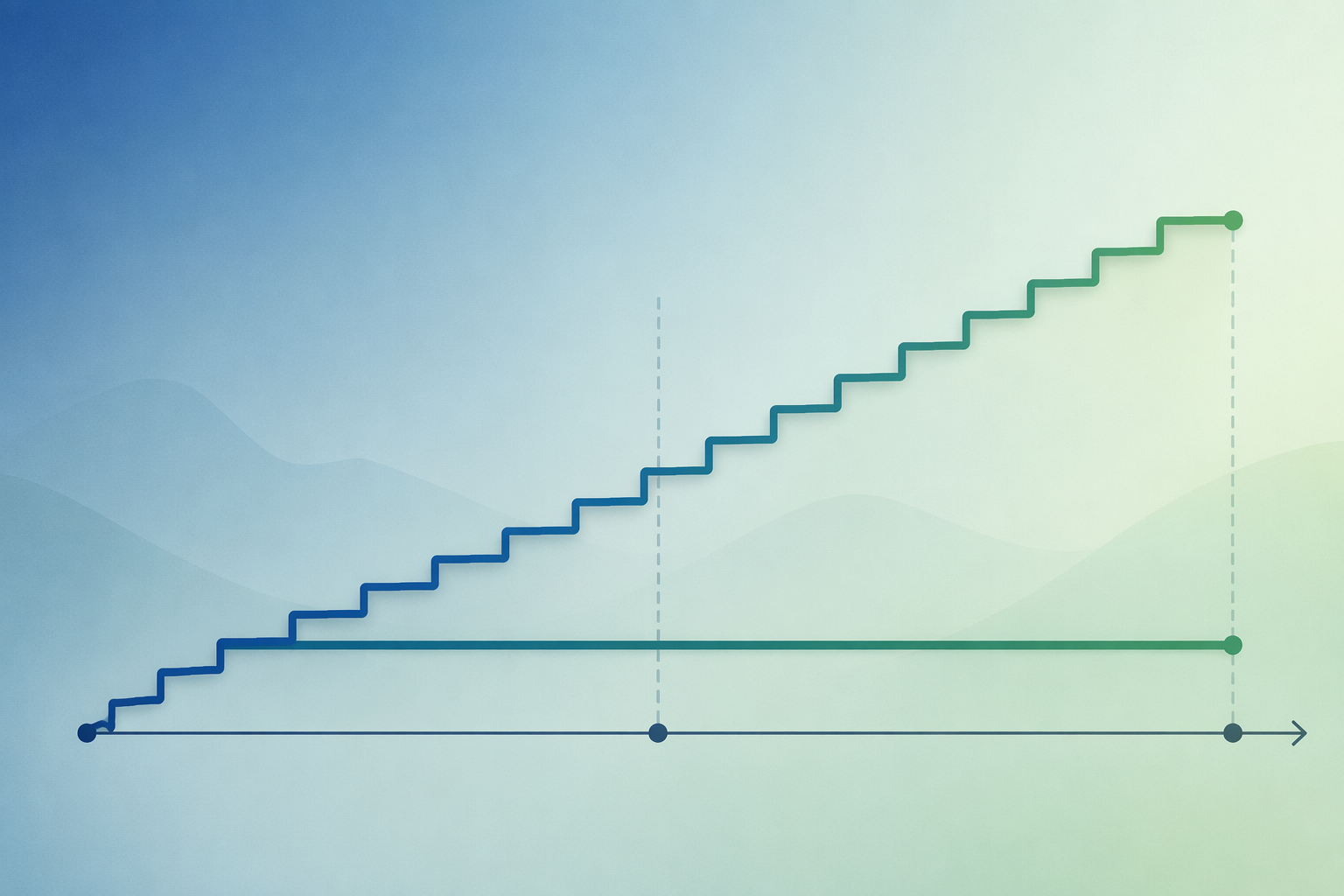
Accuracy carries the main evidence load, but cost changes the recommendation. Cirqa costs $199 once. Whoop One starts at $199 per year. That makes the break-even point blunt: after the first year, you have paid the same amount; after two years, Cirqa remains $199 while Whoop One reaches $398.
| Time owned | Garmin Cirqa cumulative cost | Whoop One cumulative cost | Difference |
|---|---|---|---|
| At purchase | $199 | $199 for first year | Effectively tied |
| After 12 months | $199 | $199 | Break-even point |
| After 24 months | $199 | $398 | Whoop costs $199 more |
That does not make Cirqa the better sleep tracker. It does make Cirqa the less financially annoying ownership model. If you mainly want a screenless Garmin band that feeds sleep, HRV, Body Battery-style context, and Training Readiness into the Garmin ecosystem, the one-time price is a real advantage. DC Rainmaker also highlighted Training Readiness as a meaningful Garmin leg-up over Whoop in the Cirqa context [2].
The trap is pretending the cheaper device buys the same confidence. If your actual use is checking bedtime consistency, looking at rough sleep duration, and keeping everything inside Garmin Connect, Cirqa’s cost structure is hard to dismiss. If your actual use is trusting deep sleep, REM, HRV, and recovery guidance enough to adjust training, Whoop has the stronger evidence case.
Which One Should You Choose For Sleep Tracking?
Choose Whoop 5.0 if sleep-stage confidence and HRV-based recovery are the reason you are buying the device. The best available head-to-head evidence comes from older models, but it favors Whoop by a meaningful margin: 60% multi-state sleep-stage agreement versus 50% for Garmin Forerunner 245, κ=0.44 versus κ=0.25, and much better deep-sleep sensitivity in the same PSG comparison [1]. Whoop 5.0 still needs independent validation, but the published direction is favorable.
Choose Garmin Cirqa if you mainly want screenless Garmin sleep trends without recurring fees, and you can tolerate weaker evidence for sleep-stage classification. Cirqa is especially sensible if you already live in Garmin Connect, care about Training Readiness, and are not planning to treat nightly deep-sleep or REM numbers as high-confidence physiological facts.
If neither tradeoff feels right, broaden the field before buying. The site’s data-driven sleep tracking watch comparison, study-based guide to which sleep tracker is best, and metric-by-metric wearable sleep accuracy comparison are better next reads than forcing this into a brand-loyal decision.
For this specific comparison, there is no need to crown a universal winner. Whoop is the better-supported sleep-stage and HRV choice. Cirqa is the cleaner long-term value choice. The right band depends on whether you are buying sleep data to act on it, or buying a low-friction Garmin sleep trend line that will not bill you again next year.
References
- A Validation of Six Wearable Devices for Estimating Sleep, Heart Rate and Heart Rate Variability in Healthy Adults, PMC
- Garmin CIRQA: Everything You Need to Know, DC Rainmaker, July 2026
- Accuracy of Fitbit Charge 4, Garmin Vivosmart 4, and WHOOP 3.0 vs PSG, PMC
- Garmin Health Announces Sleep Study Results, Garmin Blog, 2019

Comments
Join the discussion with an anonymous comment.