
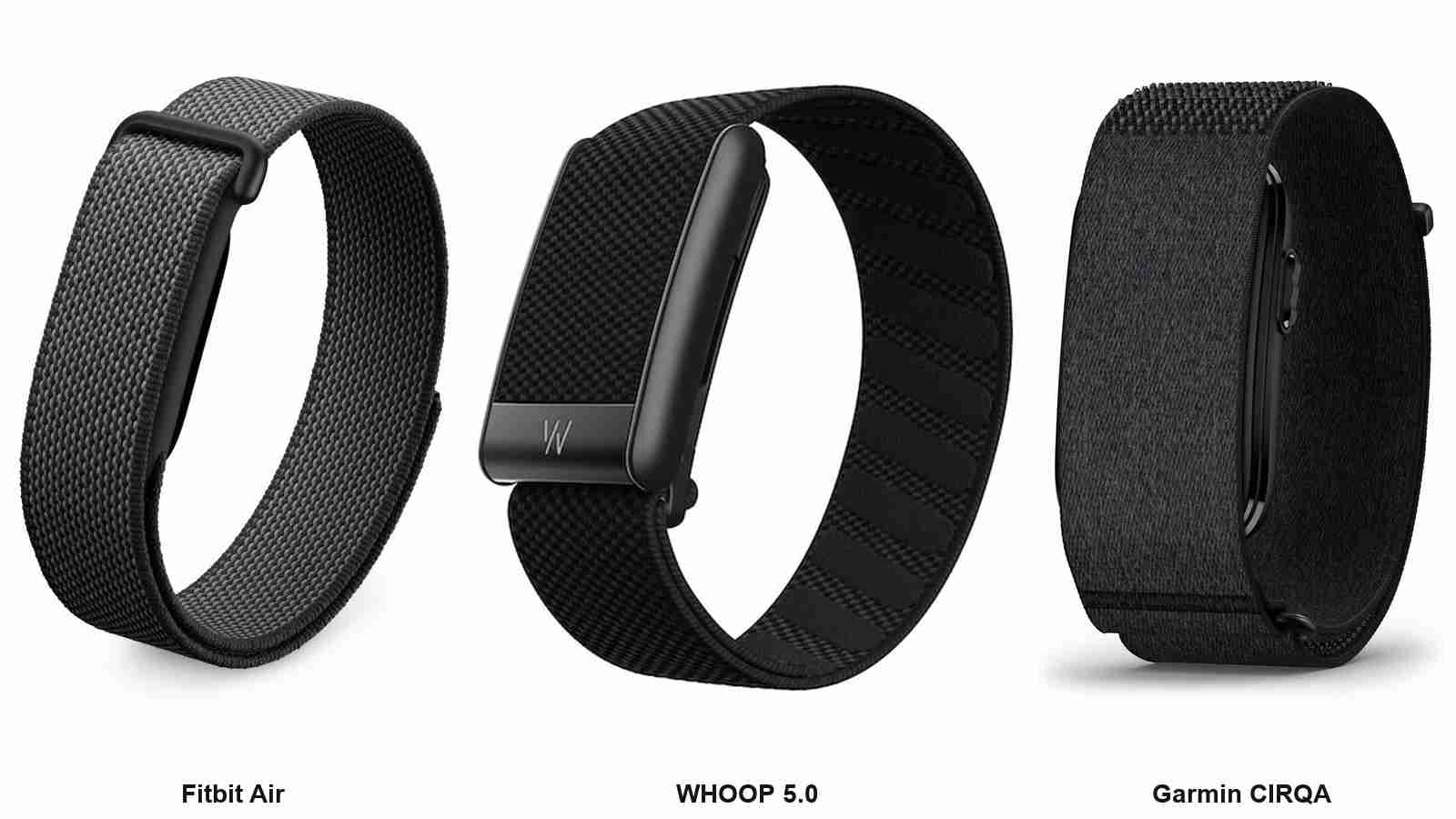
If you are shopping for a screenless sleep tracker in Q3 2026, the Garmin Cirqa price is the first thing that changes the comparison. Cirqa costs $199.99 once and does not require a subscription; Whoop 5.0 starts at $199 per year and can run to $359 per year depending on plan; Fitbit Air starts at $99.99, with Google Health Premium optional at $99.99 per year.[1][2] That makes Cirqa the best long-term value if you want deeper sleep and recovery data without another annual bill, Whoop the most polished recovery-first experience if you are willing to keep paying, and Fitbit Air the cheapest and lightest choice if basic sleep scoring is enough.
The Price Comparison Is Not Just a Checkout Detail
A low launch price can be misleading with sleep trackers because the useful part is often not the module; it is the interpretation layer that keeps arriving in the app. Over two years, Cirqa is about $200, Whoop One is about $400, and Fitbit Air can land anywhere from about $100 to $300 depending on whether the buyer uses the optional premium tier.[2] That range matters more than it would for a step counter, because sleep tracking lives or dies by the quality of its explanations over time.
| Device | Upfront or Annual Price | Estimated Two-Year Cost | Subscription Required? |
|---|---|---|---|
| Garmin Cirqa | $199.99 one-time | About $200 | No |
| Whoop 5.0 | $199–$359 per year | About $400 and up, depending on plan | Yes |
| Fitbit Air | $99.99 device + optional $99.99/year Google Health Premium | About $100–$300 | No, but premium features may matter |
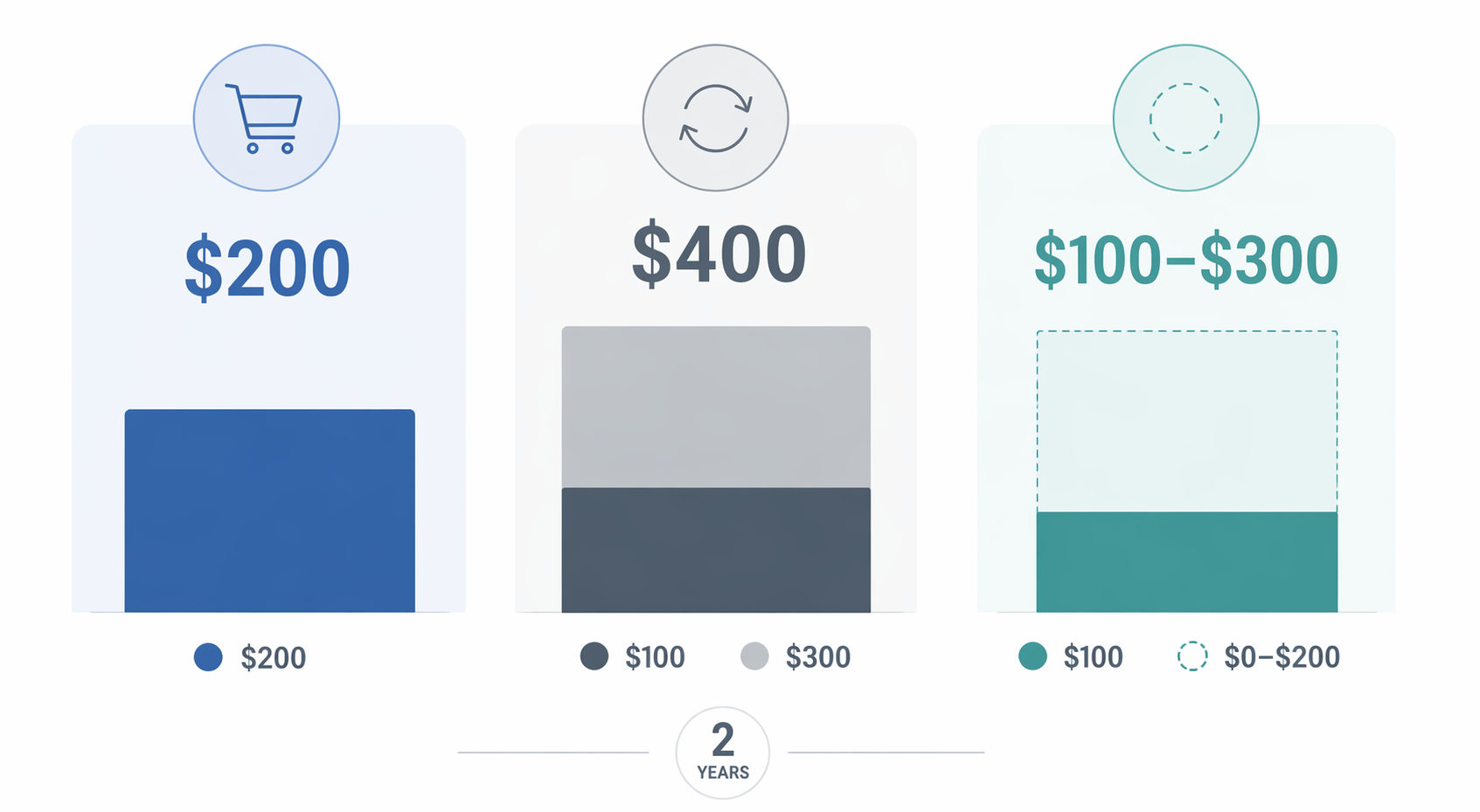
The fairest way to read that table is not “cheap wins.” Fitbit Air is the least expensive entry point, but a buyer who wants more interpretation may end up evaluating Google Health Premium as part of the real cost. Whoop is not pretending to be a one-time purchase, so the recurring price has to be judged against the daily app experience and recovery coaching. Cirqa’s advantage is simpler: the sleep and recovery feature set is included in the purchase price.
Where Cirqa Pulls Ahead: Sleep Data That Keeps Updating
Cirqa has the broadest sleep-and-recovery stack of the three at its price. Garmin lists sleep stages, a 0–100 sleep score, Sleep Coach, Sleep Alignment, nap detection, Smart Wake, HRV status, overnight SpO2, skin temperature, respiration, Body Battery, and Training Readiness.[1] That is a lot of language to wake up to, but the important distinction is not the count of metrics. It is whether the device explains what changed and whether the signal remains useful after breakfast.
Training Readiness is the main reason Cirqa is stronger than its price suggests. It updates through the day based on sleep, HRV, stress, and activity, rather than acting only as a morning verdict.[1][2] If a tracker says you recovered poorly at 7 a.m. and then never changes its mind after a quiet morning, a nap, or an unusually stressful afternoon, it is less helpful than it looks. Cirqa’s approach gives the recovery metric a chance to behave like a current status rather than a permanent grade.
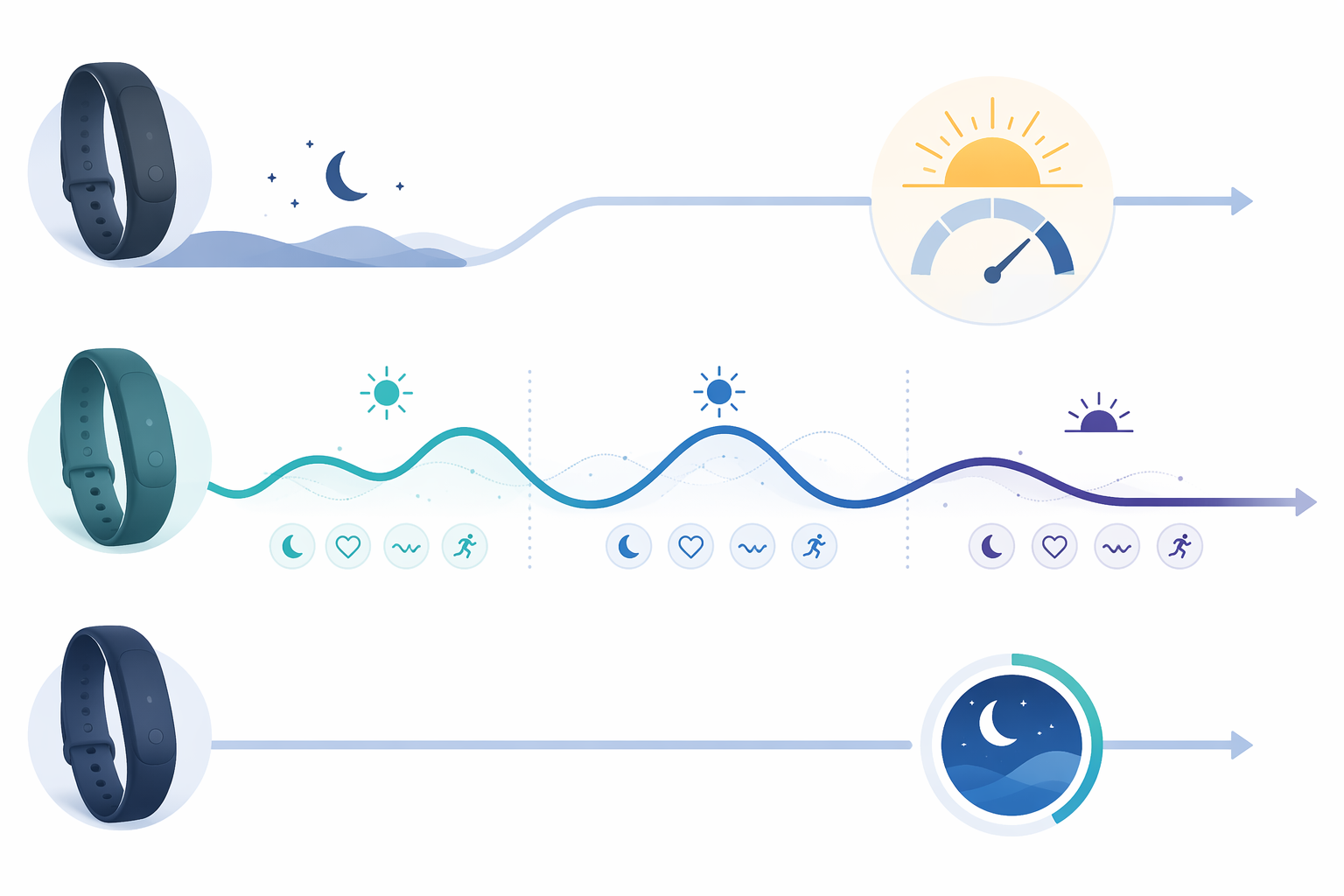
That matters for ordinary sleepers, not only athletes. A rough night followed by a low-stress day should not be interpreted the same way as a rough night followed by travel, hard training, and elevated stress. Cirqa has more context to work with because it connects sleep, HRV, stress, activity, and Garmin’s Body Battery model in the same ecosystem.[1] The tradeoff is that Garmin Connect can feel more like a dashboard than a sleep-first coach, especially for people who want one clean explanation instead of several related metrics.
The risk with this much data is familiar: a device can make the user feel behind before the day starts. Cirqa is still a screenless band, which helps because there is no display inviting a midnight check, but Garmin’s sleep dashboard is not immune to over-reading. For readers prone to chasing perfect recovery numbers, the better question is not whether Cirqa provides enough data; it is whether you can use that data without turning it into another sleep stressor. We have covered that tension separately in Garmin sleep tracking and insomnia.
Whoop 5.0 Is the Strongest Counterargument
Whoop 5.0 is expensive in a different way: it keeps asking to be worth it. Its subscription includes sleep stages, Recovery score, HRV, and SpO2 on the 5.0 hardware.[2] The Recovery score is overnight-first rather than continuously updating through the day like Cirqa’s Training Readiness, but Whoop’s app flow is easier to live with for many people because the product is built around recovery from the first screen, not around a broader fitness dashboard.
That smoothness is not a minor feature. Sleep data is only useful if the user keeps wearing the tracker and understands what the app is asking them to notice. Launch coverage from Tom’s Guide emphasized Cirqa’s sleep features while also noting the broader app-experience question around how Garmin presents them.[3] Wareable’s coverage likewise placed Cirqa in a competitive sleep-first context rather than treating the hardware alone as the whole story.[4] Whoop benefits from years of making recovery feel like the center of the product.
Whoop also has the broader accessory ecosystem. That can sound cosmetic until you try to sleep with a band in the same place every night and discover that your preferred position, bedding, skin sensitivity, or training schedule makes one location annoying. If you already like Whoop’s clothing and band options, the annual cost may feel less like a penalty and more like rent on a mature recovery system.
The limit is that the subscription has to prove itself repeatedly. At roughly twice Cirqa’s two-year cost even on the lower annual plan, Whoop needs to win on behavior: clearer decisions, better adherence, better comfort routines, or a recovery workflow you actually trust enough to follow.[2] If it merely gives you a score you glance at and ignore, the price gap becomes hard to defend.
Fitbit Air Wins When Lightness and Low Entry Cost Matter Most
Fitbit Air is the easiest device here to recommend to someone who says, “I just want to know how I slept, and I do not want a bulky band.” It starts at $99.99, offers sleep stages, sleep score, Daily Readiness, and SpO2, and its module is much lighter than the other two.[2] That makes it the least intimidating purchase and the least physically demanding option for sleep.
The module measurements explain the comfort advantage. Cirqa is 47×27×9mm and about 21g; Whoop is 34.7×24×10.6mm and about 26.5g; Fitbit Air is 34.9×17×8.3mm and about 12g.[2][5] Fitbit Air is not just slightly lighter. It is close to half the weight of Cirqa and less than half the weight of Whoop. For a restless sleeper, that may matter more than another readiness graph.
Fitbit’s weakness is interpretation depth. Sleep stages and a sleep score are enough for many people, especially if they mainly want trends in bedtime consistency, wakefulness, and rough sleep quality. But compared with Cirqa’s larger recovery stack, Fitbit Air is the simpler read. Buyers should also decide up front whether the optional Google Health Premium tier matters to them, because a $99.99 device and a $99.99-per-year habit are two different purchases.[2] For a deeper look at what Fitbit’s score can and cannot tell you, see our guide to how Fitbit Sleep Score is calculated.
Comfort: Fitbit Is Lightest, Cirqa Has the Useful Band Option
For sleep tracking, comfort is not a side category. A tracker that comes off at 2 a.m. has no clever algorithm. Fitbit Air has the clearest physical comfort win because it is the smallest and lightest module in this comparison.[2][5] Whoop is more compact than Cirqa in footprint but heavier, while Cirqa is the largest device overall.[2][5]
Cirqa’s practical counter is the official upper-arm band, available at launch for $59.99.[5] That matters for side-sleepers who dislike pressure at the wrist or who find wrist placement inconsistent overnight. It also fits Garmin’s broader pitch: the device is screenless, sleep-capable, and meant to disappear into routine. The upper-arm option adds cost, but it may make the difference between wearing the tracker every night and quietly abandoning it in a drawer.
Accuracy Needs a Calibration Pause
None of these bands should be treated as a clinical sleep instrument. The useful question is narrower: how much confidence should you place in the patterns they show, especially sleep stages and recovery trends? As of launch in July 2026, there is no controlled Cirqa vs. Whoop 5.0 vs. Fitbit Air polysomnography head-to-head study. Any accuracy comparison across the three depends on separate studies, different hardware, and different methods.
Garmin has published sleep-stage validation data, but it is not Cirqa-specific. A 2019 Garmin Health study using vivosmart 3 hardware reported 69.7% overall sleep-stage accuracy, 95.8% sleep sensitivity, 73.4% wake specificity, and Cohen’s kappa of 0.54 in a sample of 55 participants.[6] That is useful context for Garmin’s sleep work, but it used older hardware with an Elevate Gen 3 sensor, while Cirqa uses Elevate Gen 4 optical heart-rate hardware.[5][6] The algorithm may have evolved; the published number still should not be copied onto Cirqa as if it were a Cirqa validation result.
Whoop has validation data from separate studies, which helps its credibility but still does not create a direct comparison against Cirqa or Fitbit Air. Fitbit Air is newer, and independent PSG validation for this specific device is not yet available; expectations have to lean on Fitbit’s broader sleep-tracking record rather than device-specific evidence. Readers who want the methodology behind these claims should start with our overview of wearable sleep accuracy validation studies and our separate analysis of Fitbit sleep monitor accuracy.
Cirqa also should not be mistaken for a medical wearable. It uses Garmin’s Elevate Gen 4 optical heart-rate sensor and does not offer medical-grade ECG or AFib detection.[5] That does not weaken it as a sleep tracker at $199.99; it just keeps the claim in the right lane.
How the Sleep Features Stack Up
| Category | Garmin Cirqa | Whoop 5.0 | Fitbit Air |
|---|---|---|---|
| Best price model | $199.99 once, no subscription | Mandatory annual subscription | $99.99 entry price, premium optional |
| Sleep basics | Stages, sleep score, naps, Smart Wake | Stages and sleep/recovery insights | Stages and sleep score |
| Recovery interpretation | Training Readiness updates through the day; Body Battery and HRV status included | Recovery score is recovery-first and app-friendly | Daily Readiness is simpler |
| Overnight health signals | HRV, SpO2, skin temperature, respiration | HRV and SpO2 | SpO2 |
| Comfort edge | Largest module, but official upper-arm band available | Strong accessory ecosystem | Lightest module |
| Main drawback | Garmin app can feel less sleep-first | High recurring cost | Less depth unless the simpler experience is enough |
The table makes Cirqa look like the obvious value pick, and for many sleep-focused buyers it is. It gives more recovery context than Fitbit Air and avoids Whoop’s recurring subscription. The caution is that “more” is only better when the app makes the signal readable. If you want the cleanest recovery-first interface, Whoop still has a real advantage. If you want the least noticeable band and the lowest starting price, Fitbit Air’s simplicity is not a flaw; it is the point.
For readers who are still open to rings, watches, and other non-screenless devices, our broader 2026 fitness tracker sleep tracking comparison puts these tradeoffs into a wider PSG-data context.
Which One Should You Buy?
Choose Garmin Cirqa if you want the best long-term sleep-data value under $200. The one-time $199.99 price, no-subscription model, deep sleep metric set, and continuously updating Training Readiness make it the strongest pick for buyers who want more than a sleep score without signing up for another annual plan.[1][2]
Choose Whoop 5.0 if you want the most polished recovery-first experience and accept that the subscription is part of the product. Its cost is harder to justify if you only glance at the score, but easier to defend if Whoop’s app flow, recovery framing, and accessory ecosystem keep you engaged every day.
Choose Fitbit Air if the lowest entry price and lightest sleep feel matter more than maximum recovery depth. At $99.99 and about 12g, it is the least burdensome device here, especially for someone who wants basic sleep stages, a sleep score, and readiness guidance without committing to a larger tracker or a mandatory subscription.[2][5]
References
- Garmin Cirqa official press release, Garmin.com Newsroom, July 2026.
- Garmin Cirqa vs Whoop 5.0 vs Fitbit Air comparison page, Garmin Rumors, July 2026.
- Garmin Cirqa launch coverage, Tom’s Guide, July 2026.
- Garmin Cirqa launch coverage, Wareable, July 2026.
- Garmin Cirqa hands-on, DC Rainmaker, July 2026.
- Garmin Health Announces Sleep Study Results, Garmin Blog, 2019.


Comments
Join the discussion with an anonymous comment.