
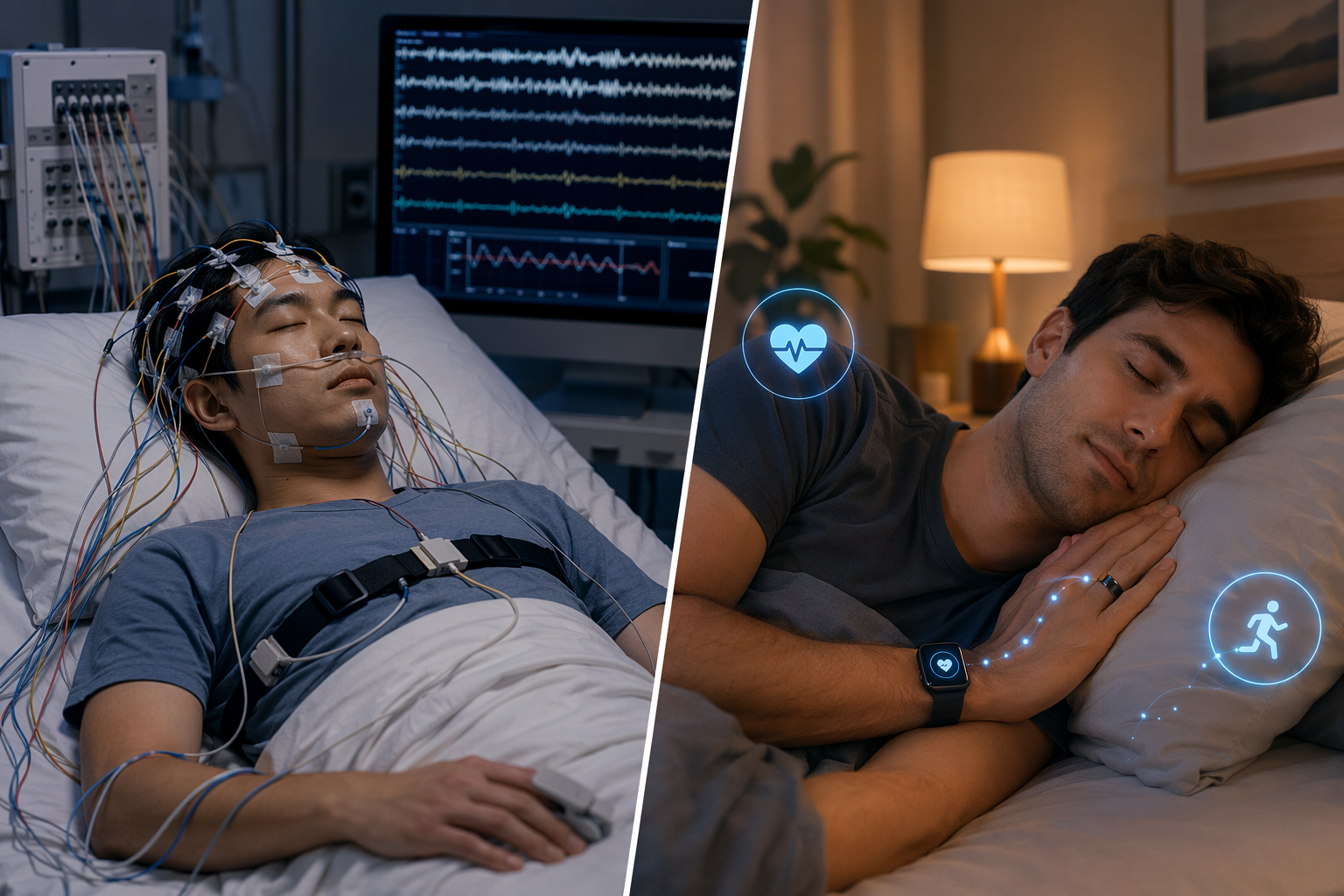
If you are looking for the best fitness tracker for sleep, the first question is not which device has the nicest app or the most confident sleep score. It is which part of sleep the device is being asked to measure. Most consumer wearables are much better at detecting that you were probably asleep than at telling you exactly how much time you spent in light, deep, or REM sleep.
That distinction matters because sleep trackers are no longer a niche habit. The American Academy of Sleep Medicine says nearly 1 in 3 U.S. adults has used an electronic sleep tracker, which means a large number of people are waking up to a score before they have even decided how they feel [1].
The practical verdict is fairly clear: use a good tracker for broad sleep timing, consistency, bedtime drift, and rough trends. Be much more cautious with wake after sleep onset, deep sleep minutes, and any nightly score that turns several uncertain estimates into one authoritative-looking number.
What fitness trackers can measure well — and where they start guessing
Clinical sleep staging is based on polysomnography, usually shortened to PSG. In a sleep lab, PSG uses signals such as brain activity, eye movement, muscle tone, breathing, oxygen level, and heart rhythm to identify sleep and classify stages. Consumer rings and watches do not directly measure brain activity. They infer sleep from proxy signals: movement, heart rate, heart rate variability, skin temperature in some devices, and patterns learned by proprietary algorithms.
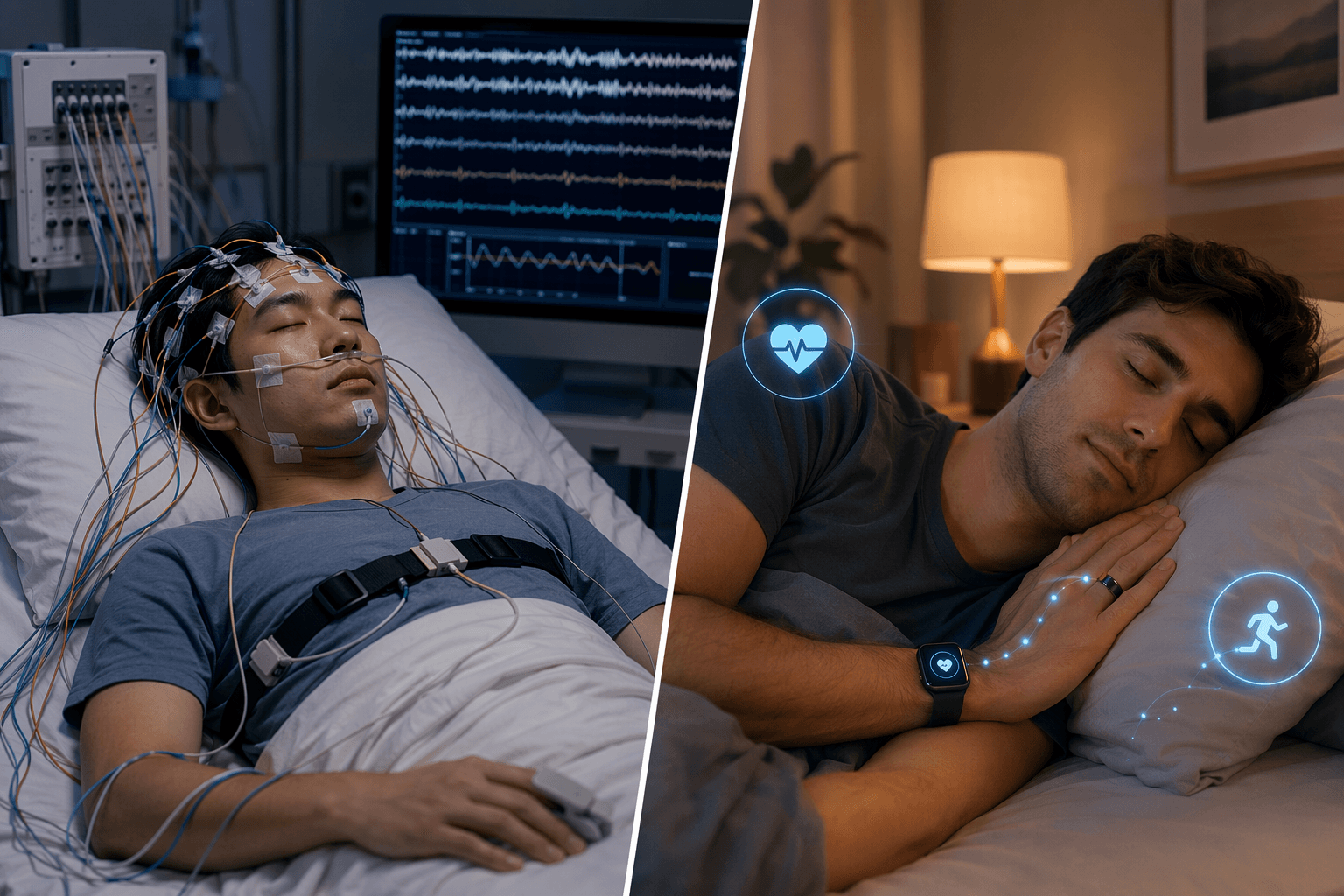
That is why a tracker can be useful and still be wrong in specific ways. A quiet, motionless person may look asleep to a wrist or finger sensor. A restless sleeper may look awake. A change in heart rate can help an algorithm estimate sleep stage, but it is not the same thing as reading EEG brain-wave patterns.
Johns Hopkins Medicine puts the consumer caveat bluntly: trackers “make some guesstimate as to how much you're actually sleeping” [2]. That does not make them useless. It does mean their output should be treated as an inference, not a lab result.
The strongest head-to-head evidence: Oura, Apple Watch, and Fitbit against PSG
The most useful comparison is a 2024 validation study by Robbins and colleagues that tested the Oura Ring Gen3, Fitbit Sense 2, and Apple Watch Series 8 against polysomnography in the same sleep-lab frame. The study included 35 healthy adults ages 20 to 50, tested over a single in-lab night, and reported sleep/wake and sleep-stage performance for each device [3].
Those caveats belong next to the result, not buried under it. The study was funded by Oura, used one night of laboratory sleep, and did not test people with insomnia, sleep apnea, or other sleep disorders. It also tested specific device generations: Oura Ring Gen3, Apple Watch Series 8, and Fitbit Sense 2. Newer models may perform differently, and the findings should not be stretched into a claim that any consumer wearable is clinically equivalent to PSG.

Within those limits, the comparison is still unusually helpful. All three devices showed high sleep sensitivity, at or above 95%, meaning they were strong at identifying sleep when PSG also scored sleep [3]. That is the part many users can reasonably rely on: whether bedtime shifted, whether sleep duration changed substantially, whether a late workout or travel night appears to have disrupted the usual pattern.
The devices separated more sharply when they had to classify stages. Oura was not significantly different from PSG for 7 of 8 overnight sleep measures in the Robbins study [3]. That does not make it a diagnostic device. It does make it the strongest performer among the three consumer devices tested when the question is stage-level agreement with PSG.
| Device in Robbins et al. 2024 | What the study supports | Main caution |
|---|---|---|
| Oura Ring Gen3 | Not significantly different from PSG for 7 of 8 overnight sleep measures | Single-night lab study in healthy adults; funded by Oura; not evidence of diagnostic equivalence |
| Apple Watch Series 8 | Strong sleep detection, but weaker stage accuracy | Overestimated light sleep by about 45 minutes and underestimated deep sleep by about 43 minutes; deep sleep agreement was poor |
| Fitbit Sense 2 | Strong sleep detection, with smaller stage biases than Apple Watch in this study | Still systematically overestimated light sleep and underestimated deep sleep |
The Apple Watch result is a useful warning against treating a familiar smartwatch interface as proof of sleep-stage precision. In the Robbins study, Apple Watch Series 8 overestimated light sleep by about 45 minutes and underestimated deep sleep by about 43 minutes. Its deep sleep intraclass correlation coefficient was 0.13, which the study characterized as poor agreement [3].
Fitbit Sense 2 had smaller stage biases in the same study, but they pointed in a similar direction. It overestimated light sleep by about 18 minutes and underestimated deep sleep by about 15 minutes [3]. That is less dramatic than the Apple Watch result, but it is still systematic enough that a user should hesitate before treating exact deep sleep minutes as a personal target.
Why wake time is often the number users distrust first
The most irritating tracker error is not always a sleep-stage label. It is the morning after a broken night, when you know you were awake and the app calmly reports that you slept through it. This happens because wake detection is harder than sleep detection for devices built around movement and cardiac patterns.
Miller’s 2025 explanation in The Conversation, drawing on sleep-tracker research, reports that correct wake identification across devices can range from 26% to 73% [4]. That wide range is exactly why wake after sleep onset deserves more skepticism than total time asleep. A tracker may be very good at recognizing consolidated sleep and still miss quiet awakenings.
This is also why two people can have opposite complaints about the same device. One user sees a low sleep score after feeling fine; another sees an optimistic night after lying awake. Both are plausible outcomes when the algorithm is estimating internal sleep state from external and cardiovascular signals.
So which device is the best fitness tracker for sleep?
If “best” means strongest published PSG comparison among the three devices in the Robbins study, Oura Ring Gen3 has the best evidence. It came closest to PSG across the overnight measures reported there, while Apple Watch Series 8 and Fitbit Sense 2 showed clearer light-sleep and deep-sleep bias [3].
If “best” means useful for broad sleep timing, the field is less narrow. Apple Watch, Fitbit, Oura, and other mature wearables can help many people notice bedtime consistency, short nights, irregular schedules, and broad recovery patterns. That is a different claim from saying their sleep-stage charts are equally accurate.
Whoop and Garmin are often part of the consumer conversation, but they should not be folded into the Robbins head-to-head result. Whoop and Garmin were not tested in that Brigham validation study. Older Whoop validation evidence may be informative for historical context, but it should not be treated as a direct comparison with the Oura Gen3, Apple Watch Series 8, and Fitbit Sense 2 results in that paper.
The awkward part is that device accuracy can also change without the hardware in your drawer changing. Sleep scoring depends on proprietary algorithms, and firmware or app updates can alter how raw signals are converted into stages. Because these systems are largely black boxes, independent validation can age quickly and may not generalize cleanly across versions.
How to read your sleep data without giving it too much authority
A sleep tracker is most useful when it changes the scale of attention. Night-to-night stage numbers are noisy. Multi-week patterns are more informative. If your device consistently shows that sleep duration drops after late alcohol, late-night work, travel, or irregular bedtimes, that pattern is worth your attention even if the exact stage breakdown is imperfect.
- Trust broad timing more than exact staging: bedtime, wake time, sleep regularity, and large changes in total sleep are usually more useful than a precise deep sleep number.
- Treat deep sleep and REM minutes as estimates: the device may be directionally helpful, but PSG validation does not support using every nightly stage value as fact.
- Be careful with wake after sleep onset: quiet awakenings are easy for wearables to miss, especially if you lie still.
- Do not optimize for the score alone: a low score can reflect algorithmic weighting, not just your physiology.
- Use symptoms as evidence too: daytime sleepiness, snoring, gasping, insomnia, and impaired functioning deserve more weight than a dashboard.
The worst use of a sleep tracker is to turn an uncertain estimate into a command. If the app says your deep sleep was poor but you feel rested and function well, the number should not automatically overrule your experience. If the app says your sleep was fine but you are exhausted, snoring heavily, or waking unrefreshed, the cheerful score should not reassure you out of seeking medical advice.
When tracking starts making sleep worse
For most people, the problem is interpretation. For a smaller group, the tracker itself becomes part of the sleep problem. The term orthosomnia describes an unhealthy preoccupation with achieving perfect sleep data. Jahrami and colleagues reported orthosomnia prevalence estimates of 3% using a conservative threshold and up to 14% using a more lenient threshold [5].
The clinical issue is not that sleep data should be avoided. It is that anxious checking can shift attention from sleep habits to score management. Someone may extend time in bed, cancel normal activities, or worry through the evening because an app produced a disappointing number. At that point, the device is no longer just measuring sleep; it is changing the user’s relationship with sleep.
A reasonable boundary is simple: if sleep tracking helps you notice patterns and make calmer decisions, keep using it. If it makes you dread the morning score or feel less able to judge your own body, reduce the detail you review, stop checking stages, or take a break from tracking.
The bottom line on sleep tracker accuracy
Fitness trackers are strongest at the simple question: were you probably asleep or awake? They are less reliable when they divide the night into light, deep, and REM sleep, and wake detection remains a particular weak spot.
Among the consumer devices compared against PSG in Robbins et al. 2024, Oura Ring Gen3 has the strongest evidence for sleep-stage accuracy. Apple Watch Series 8 and Fitbit Sense 2 can still be useful sleep-timing tools, but their stage estimates showed systematic bias in that study. No consumer tracker’s deep sleep number should be treated as a clinical fact.
References
- Comparing sleep features of popular smartwatches, American Academy of Sleep Medicine, https://aasm.org/comparing-sleep-features-of-popular-smartwatches/
- Do Sleep Trackers Really Work?, Johns Hopkins Medicine, https://hopkinsmedicine.org/health/wellness-and-prevention/do-sleep-trackers-really-work
- Evaluation of Consumer and Research-Grade Activity Trackers to Measure Sleep in Adults, Sensors, 2024, https://pmc.ncbi.nlm.nih.gov/articles/PMC11511193/
- How do sleep trackers work, and are they worth it? A sleep scientist breaks it down, The Conversation, 2025, https://theconversation.com/how-do-sleep-trackers-work-and-are-they-worth-it-a-sleep-scientist-breaks-it-down-258304
- Orthosomnia: A Systematic Review, Brain Sciences, 2024, https://pmc.ncbi.nlm.nih.gov/articles/PMC11592250/
Comments
Join the discussion with an anonymous comment.