
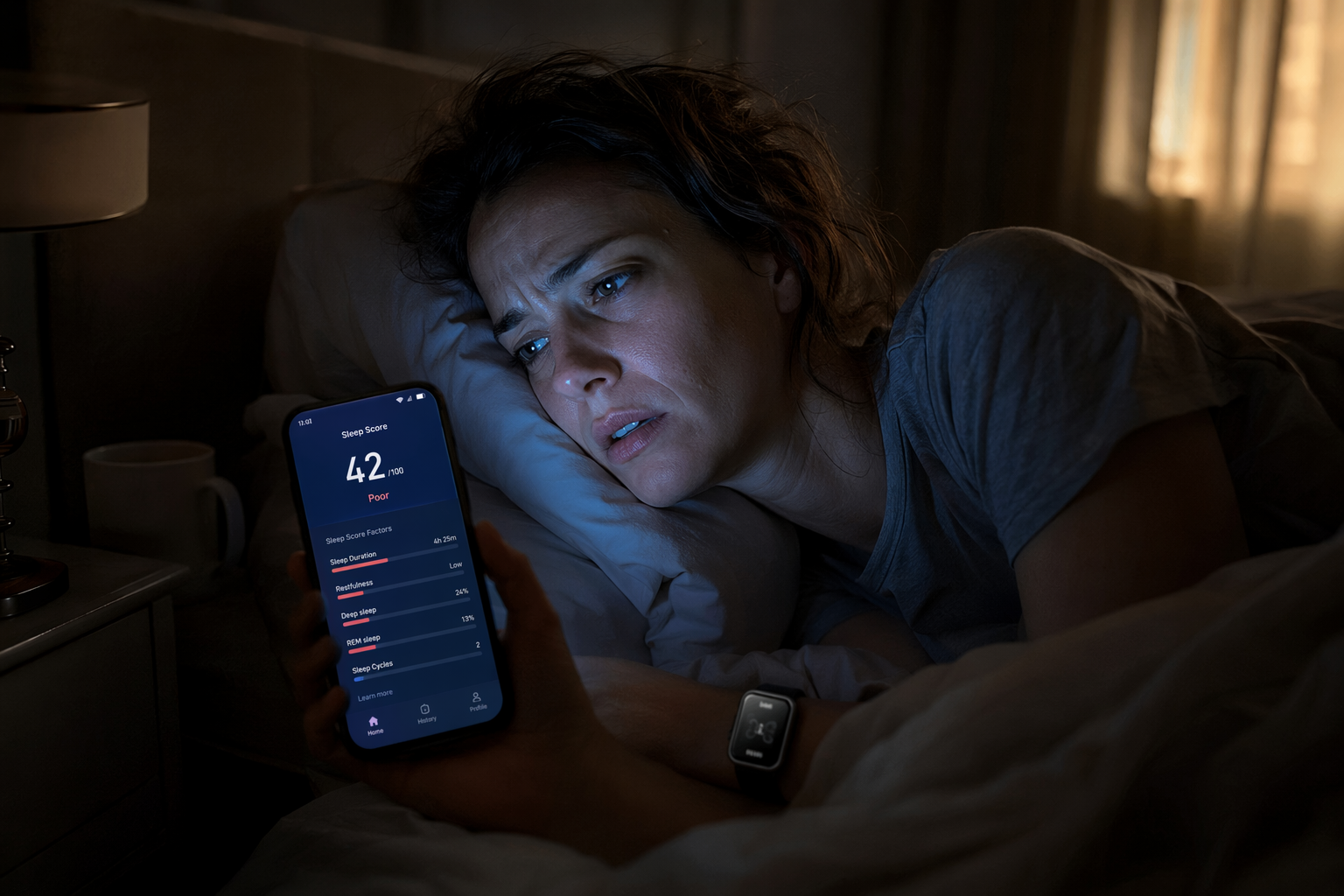
The roughest moment with a sleep tracker often arrives after the night is already over. You wake up feeling ordinary, maybe even a little better than expected, and then the app tells you the story was worse: low score, not enough deep sleep, disappointing REM, too many wake-ups. Suddenly the morning has a verdict attached to it.
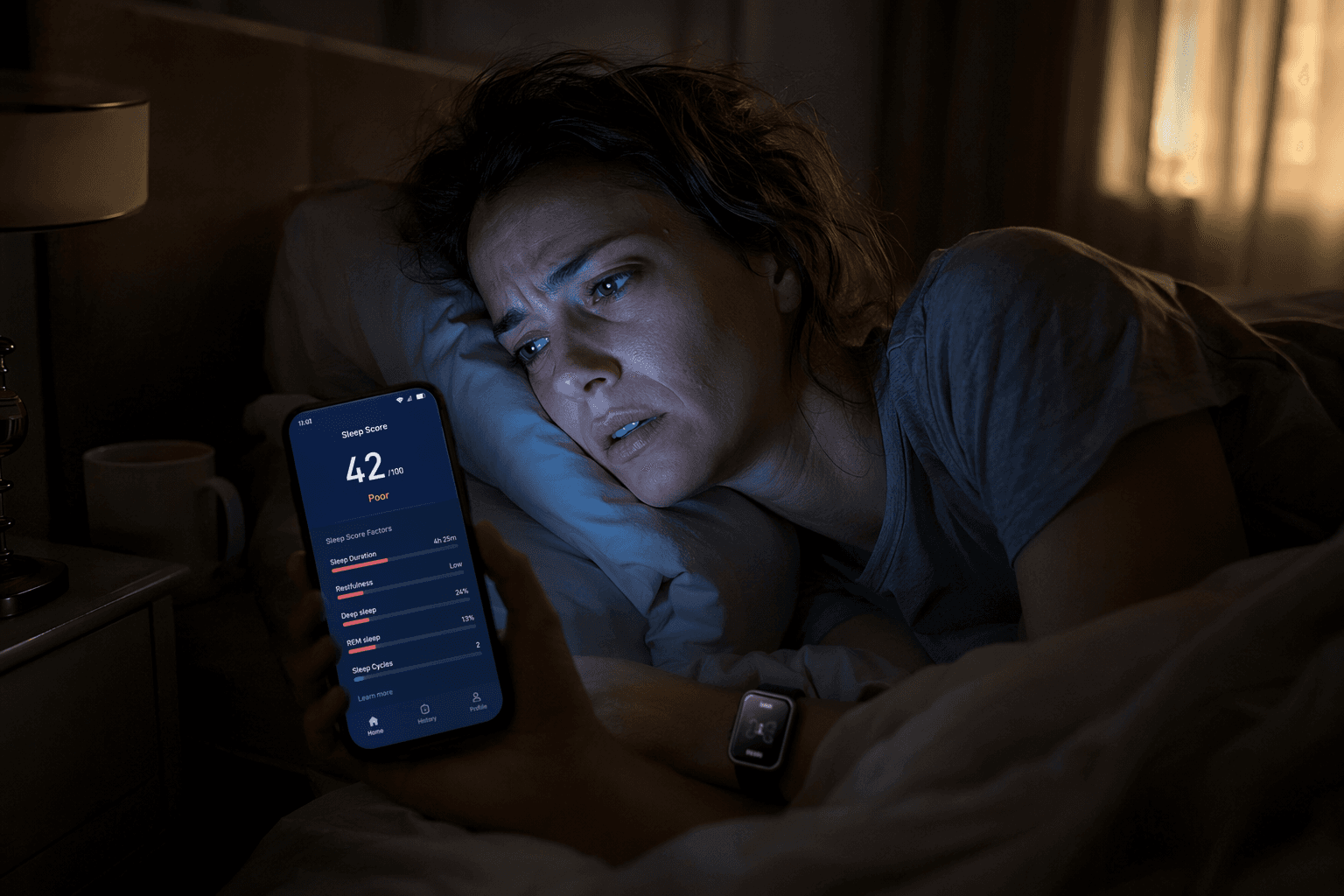
That is the point at which a wearable device to track sleep can stop feeling like a useful measuring tool and start acting like a nightly judge. The device may still be doing something valuable. It may show that bedtime is drifting later, that weekend wake times are chaotic, or that alcohol and late caffeine are leaving fingerprints on sleep. But for some people, the number does not stay in its proper place. It becomes something to chase, repair, defend against, or dread.
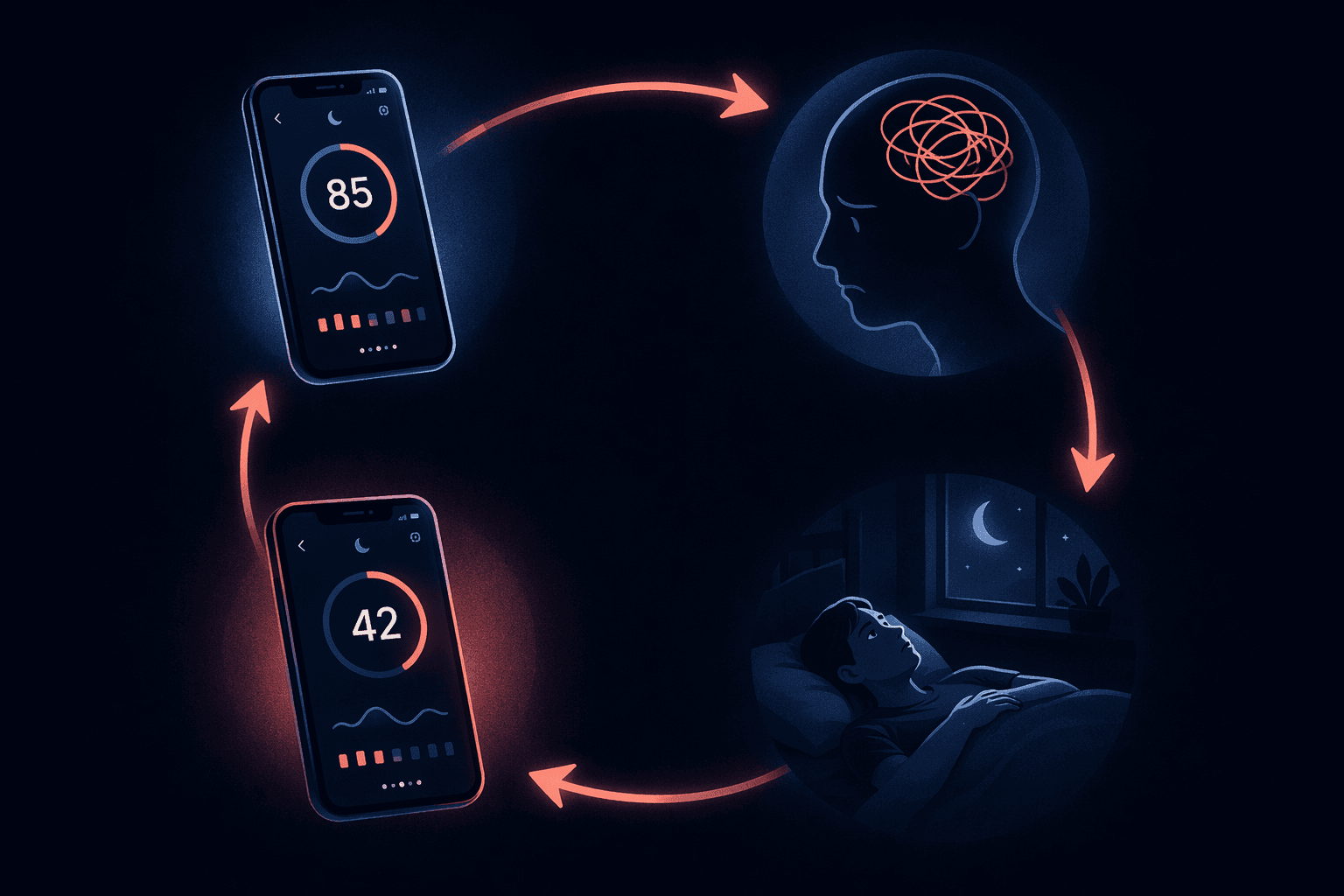
Sleep researchers gave that pattern a name in 2017: orthosomnia. In a Journal of Clinical Sleep Medicine case series, Baron and colleagues described three patients whose pursuit of “correct” or “perfect” sleep data appeared to reinforce sleep anxiety and perfectionism strongly enough to interfere with cognitive behavioral therapy for insomnia, or CBT-I.[1] Orthosomnia is not a formal DSM or ICSD diagnosis. It is better understood as an observed behavioral loop: the data creates worry, the worry changes sleep behavior, the changed behavior worsens sleep, and the worse sleep creates more data to worry about.
The case series that named the problem
The 2017 case series is small—three patients—so it cannot tell us how common orthosomnia is or prove that sleep trackers cause insomnia. Its value is different. It shows the mechanism clearly enough that many tracker users will recognize the shape of it.
In the cases Baron and colleagues described, patients brought consumer sleep-tracker data into clinical care and treated the device estimates as more authoritative than their own experience or the clinician’s assessment. One patient extended time in bed in an attempt to increase recorded sleep. Another became preoccupied with achieving the right amount of sleep as displayed by the device. The tracker numbers did not simply document distress; they became part of the distress.[1]
That distinction matters. A person who checks a tracker once, shrugs, and moves on is in a different situation from someone who lies in bed calculating whether enough REM has happened, stays under the covers longer to “make up” for a low score, or distrusts a decent-feeling morning because the app says the night was poor. The problem is not curiosity. It is the moment sleep becomes a performance review.
The pattern is plausible partly because trackers have become so ordinary. Sleep Foundation reports that about 30% of American adults use wearable health trackers and describes orthosomnia as a growing behavior pattern observed by clinicians.[2] A large user base does not mean a large clinical problem, but it does mean that even a minority reaction can affect many people.
Why sleep data can feel more certain than it is
The most tempting sleep numbers are the ones that look precise: 17% REM, 42 minutes deep sleep, 81 sleep score. Precision is not the same as certainty. Most consumer trackers estimate sleep from indirect signals such as movement, heart rate, and heart-rate variability. They are not reading sleep stages the way an overnight polysomnography study does in a lab.
That does not make them useless. It does make stage-by-stage interpretation fragile, especially for people whose sleep is already fragmented. AP News reported in 2026 that sleep neurologist Dr. Chantale Branson sees patients fixate on reaching particular REM targets even though individual sleep needs vary by age, genetics, and other factors.[3] The REM number can feel personal and actionable, but it may not be the lever a tired person should be pulling.
This is also where device accuracy gets uncomfortable. The people most drawn to sleep tracking are often the people who feel their sleep is broken. Yet consumer sleep trackers can be least accurate in clinical populations with disrupted sleep—the very populations most likely to seek reassurance from them.[4] For a deeper look at the evidence landscape, including when trackers help and when they can distort the picture, see this broader guide to sleep tracker accuracy and orthosomnia risk.
Device differences are real, so it is too crude to say all trackers are equally wrong. A 2024 study comparing three commercial wearable devices with polysomnography in healthy adults found that the Apple Watch overestimated light sleep by about 45 minutes and underestimated deep sleep by about 43 minutes, while Oura showed no significant bias for any sleep stage in that study.[5] Those findings are useful, but they need careful handling: the study was funded by Oura, and the lead author’s role on Oura’s Medical Advisory Board was disclosed.[5]
There is another limit. Much of the validation work for wearables is done in healthy adults, often in single-night lab settings. A device can perform reasonably well in that context and still be less helpful for someone with insomnia, repeated awakenings, irregular sleep timing, or high anxiety about sleep. Accuracy studies answer one question: how closely did the device match a reference measure under the study conditions? They do not fully answer another: what does an anxious person do tomorrow morning after seeing the score?
The feedback loop: score, worry, compensation, worse sleep
Orthosomnia usually does not start with an obviously unreasonable act. It starts with checking. Then checking becomes interpreting. Then interpreting becomes planning the next night around yesterday’s number.
A low score can make a person go to bed earlier than they are sleepy, cancel morning plans to allow more time in bed, avoid normal evening activities out of fear that they will damage sleep, or spend the day monitoring how tired they feel. None of those responses is absurd on its own. The trouble is that sleep does not respond well to pressure. More time in bed can mean more time awake in bed. More monitoring can make normal wake-ups feel threatening. More effort can train the bed to feel like a place where sleep must be achieved.
Stage fixation adds a second layer. REM and deep sleep are real biological states, but consumer estimates are not nightly report cards on whether the brain did its job. If the app says deep sleep was low, a user may try to engineer the next night around deep sleep. If REM looks short, the morning may feel ruined before the day has begun. Over time, the person is no longer asking, “How did I sleep?” but “Did I satisfy the device?”
This is why score guides have to be read with restraint. It is reasonable to learn what an Oura Ring sleep score measures, for example, if the goal is to understand the inputs and stop overreacting to them. It is less helpful if the score becomes a nightly exam that decides whether you are allowed to feel rested.
The loop can become especially sticky when it creates conditioned hyperarousal. The person gets into bed already scanning: Will I fall asleep fast enough? What if I wake up at 3 a.m.? How much deep sleep have I lost? That mental activity is not a character flaw. It is the nervous system learning that bedtime is a high-stakes event. If that sounds familiar, this guide to a racing mind at night may be more useful than another deep dive into last night’s sleep stages.
The CBT-I irony: better treatment can look worse on the app
The sharpest clinical conflict appears when someone is doing CBT-I. One core CBT-I tool is sleep restriction: temporarily limiting time in bed to consolidate sleep and rebuild the association between bed and sleep. On a tracker, that can look like failure. Time in bed may go down. Total recorded sleep may dip at first. A sleep score that rewards duration may punish the very step a clinician prescribed.
That is not a small misunderstanding. If a person is using the tracker as the final authority, they may abandon a treatment step because the number looks worse before the sleep system improves. In the Baron case series, tracker use reinforced anxiety and perfectionism in ways that counteracted CBT-I treatment.[1] The device was not merely inaccurate or annoying; it competed with the clinical logic of care.
If you are in CBT-I or considering it, the tracker should be subordinate to the treatment plan. A clinician may care more about sleep efficiency, wake patterns, daytime function, and reduced fear of the bed than about whether a proprietary score rose this week. This overview of the CBT-I framework for chronic insomnia explains why sleep restriction can be therapeutic even when it looks counterintuitive from a tracking perspective.
How to keep the tracker without letting it run the night
Throwing away the device is not the only sane option. For some people, tracking remains useful once the data is put back in its lane. The goal is to make the tracker boring again.
| Use the tracker for | Treat with caution |
|---|---|
| Bedtime and wake-time consistency across a week or more | Single-night sleep scores |
| Broad changes after alcohol, late caffeine, travel, illness, or schedule shifts | Exact REM, deep sleep, and light sleep percentages |
| Patterns that help you make calm adjustments | Numbers that make you extend time in bed, cancel plans, or panic-check the app |
| A simple sleep diary companion, if it reduces guesswork | A replacement for clinical assessment when insomnia or daytime impairment persists |
A practical rule: do not change tonight solely to repair last night’s score. If the data shows a pattern over a week or more—bedtime slipping later, wake time swinging wildly, late alcohol repeatedly coinciding with worse sleep—then it may be worth a calm adjustment. If one bad score makes you go to bed before you are sleepy, stay in bed long after waking, or spend the day bracing for exhaustion, the number is doing more harm than work.
It can also help to stop checking the app immediately after waking. Give the body a chance to report first. How alert do you feel after getting up? Did sleepiness ease with light, movement, breakfast, or time? Are you functioning poorly, or are you upset because the graph looks wrong? Subjective experience is not perfect either, but it belongs in the room.
Some people do better with a tracking break: a week or two without sleep-stage data, or with the morning score hidden if the app allows it. Others may prefer a less intrusive device form, fewer notifications, or a simpler sleep diary. If the device itself feels too provocative, this guide to choosing a sleep tracker for your situation can help you think about form factor and data style rather than chasing the most elaborate dashboard.
When the data is a sign to get help
A tracker can show that sleep is irregular. It cannot tell you, by itself, why insomnia is persisting or whether anxiety, medication effects, sleep apnea symptoms, menopause-related changes, pain, depression, or another health issue is involved. If poor sleep continues, daytime functioning is suffering, or anxiety about sleep is growing, the next step is not more granular stage analysis. It is a clinician who can look beyond the dashboard.
That is especially true if you are spending more time in bed but sleeping less, dreading bedtime, or feeling trapped between how you feel and what the app says. This resource on when trouble sleeping warrants a doctor’s visit may help you decide when to bring the pattern into care.
Keep tracking if the data helps you make calm, boring adjustments. Change how you track—or pause tracking—if the morning check reliably makes your bed feel like a performance review. The point of measuring sleep is to support rest, not to give worry a better interface.
References
- Orthosomnia: Are Some Patients Taking the Quantified Self Too Far? — Journal of Clinical Sleep Medicine, 2017.
- What is Orthosomnia? — Sleep Foundation.
- Sleep-tracking devices have limits. Experts want users to know what they are — AP News, 2026.
- Do Sleep Trackers Really Work? — Johns Hopkins Medicine.
- Accuracy of Three Commercial Wearable Devices for Sleep Tracking in Healthy Adults — 2024.
Comments
Join the discussion with an anonymous comment.