
Why a Power Outage Wrecks ADHD Sleep (and How to Fix It)
Severe wind power outages strip away the sensory anchors many ADHD adults rely on to sleep. This article explains why the brain stays hypervigilant and what battery-free strategies actually help—foam earplugs, weighted blankets, and the 'one check and stop' rule—so you can settle into sleep even in a novel, unfamiliar environment.
The first thing you notice is not the storm. It is the fan stopping.
A room that made sense ten minutes ago suddenly has the wrong texture. The ceiling fan hangs still. The low mechanical hum that used to cover the house noises is gone. The darkness is different because the clock, charger light, hallway spill, and familiar tiny glows have all vanished at once. Outside, wind pushes branches against the window in irregular bursts. Somewhere down the street, a transformer pops, or something heavy scrapes, and your body answers before you have a chance to reason with it.
If you have ADHD or strong sensory sensitivity, this can feel embarrassing out of proportion to the event. You may be safe in your own bed and still unable to stop monitoring the room. That does not mean you are being dramatic. A severe wind power outage can remove the exact sensory anchors your brain has been using to hand off from “awake and scanning” to “asleep enough to let go.”
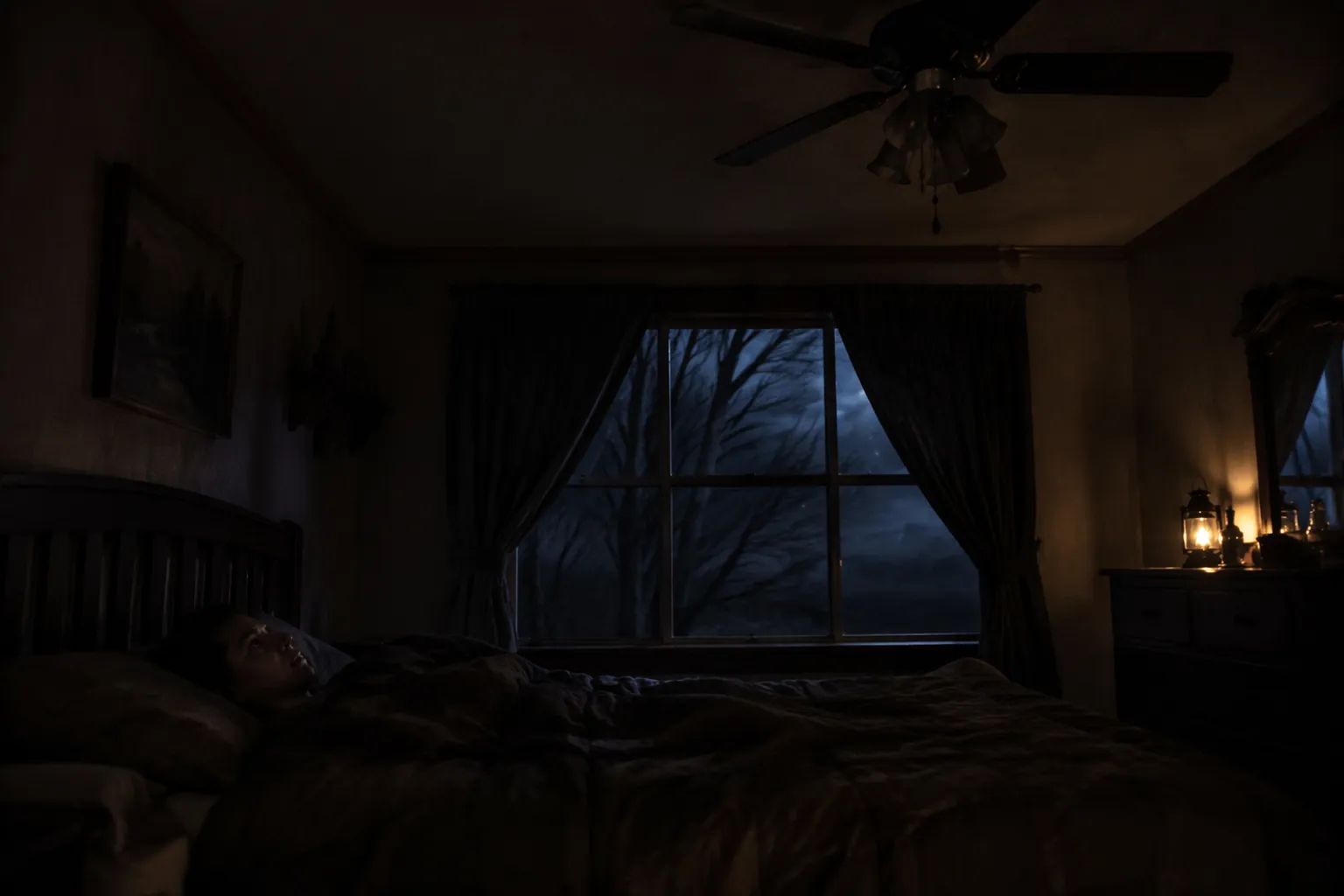
Your familiar bedroom can become neurologically “new”
Sleep is not only a decision to close your eyes. The brain has to decide that the environment is predictable enough to lower its guard. That is why the first night in a hotel, guest room, or unfamiliar bed often feels thin and half-alert even when nothing is wrong.
A 2016 Current Biology study on the “first-night effect” found that during sleep in a novel environment, one brain hemisphere showed a more vigilant pattern than the other, responding more strongly to external sounds. The researchers were not studying ADHD adults in power outages; that boundary matters. But the study gives a useful anchor for what many people feel during an outage: when the environment changes enough, the sleeping brain may treat it as territory that needs watching. [1]
A severe wind outage can make your own bedroom novel without moving a single piece of furniture. The soundscape changes. The light map changes. The air movement changes. The routine sequence changes: no normal fan switch, no usual charging ritual, no guaranteed alarm, no clear sense of when power returns. For an ADHD brain that already has trouble shifting states, that is not a small inconvenience. It is a stack of interrupted cues.
That baseline matters. Sleep Foundation summarizes that an estimated 25% to 50% of people with ADHD report chronic sleep problems, including insomnia, delayed bedtimes, and restless sleep. [2] An outage does not create ADHD sleep vulnerability from nowhere; it presses on a system that may already be using routine, repetition, sound, and body feedback to get through bedtime.
For general storm sleep barriers—noise, flashes of light, and anxiety—see our guide to sleeping through severe storms at night. The ADHD-specific problem is narrower: the outage removes the supports that made the storm sleepable in the first place.
What the outage took away
The missing fan is the easiest place to start because it was probably doing more than cooling the room. It was masking small sounds, making the room’s audio floor steady, and giving your attention something boring to rest on. When it stops, the house gets too detailed. Every branch, gutter rattle, distant siren, and refrigerator click becomes available to the brain.
White noise research helps explain why that matters. A 2021 Sleep Health study found that white noise improved sleep quality in a high-noise environment by raising the auditory arousal threshold—the level of sound needed to wake or disturb someone. [3] In plain terms, a steady background sound can make irregular noises less commanding. When the power goes out and the fan dies, you have not merely lost ambience. You have lost a filter.
| Anchor the outage removed | What it may have been doing for ADHD sleep | What to replace first |
|---|---|---|
| Fan or steady white noise | Masked unpredictable sounds and reduced sudden auditory salience | Foam earplugs; battery sound only if already available |
| Usual light pattern | Made the room recognizable and reduced visual novelty | Keep the environment simple and avoid scanning the room repeatedly |
| Normal bedtime sequence | Reduced decisions and helped the brain shift states | Use one short, repeatable outage routine |
| Certainty about power and safety | Closed the planning loop enough to rest | Check once, make a basic plan, then stop refreshing |
| Body comfort from airflow or bedding | Helped the body feel regulated and located | Use pressure, breathable layers, and heat judgment |
This is why generic sleep hygiene can land badly during a wind outage. “Keep your room cool” may be impossible if the air conditioning is off. “Follow your normal routine” may be impossible if the routine depends on lights, charging, fans, smart speakers, or a working thermostat. “Avoid screens” is too blunt when the screen is also how you confirm whether a downed line or outage estimate changes what you need to do next.
Restore predictability in the order your brain is missing it
The goal tonight is not an ideal sleep routine. It is to replace enough of the lost structure that your threat system stops treating the bedroom as a new assignment. Start with the anchor that changed most sharply: sound.
Use foam earplugs as the battery-free replacement for the fan
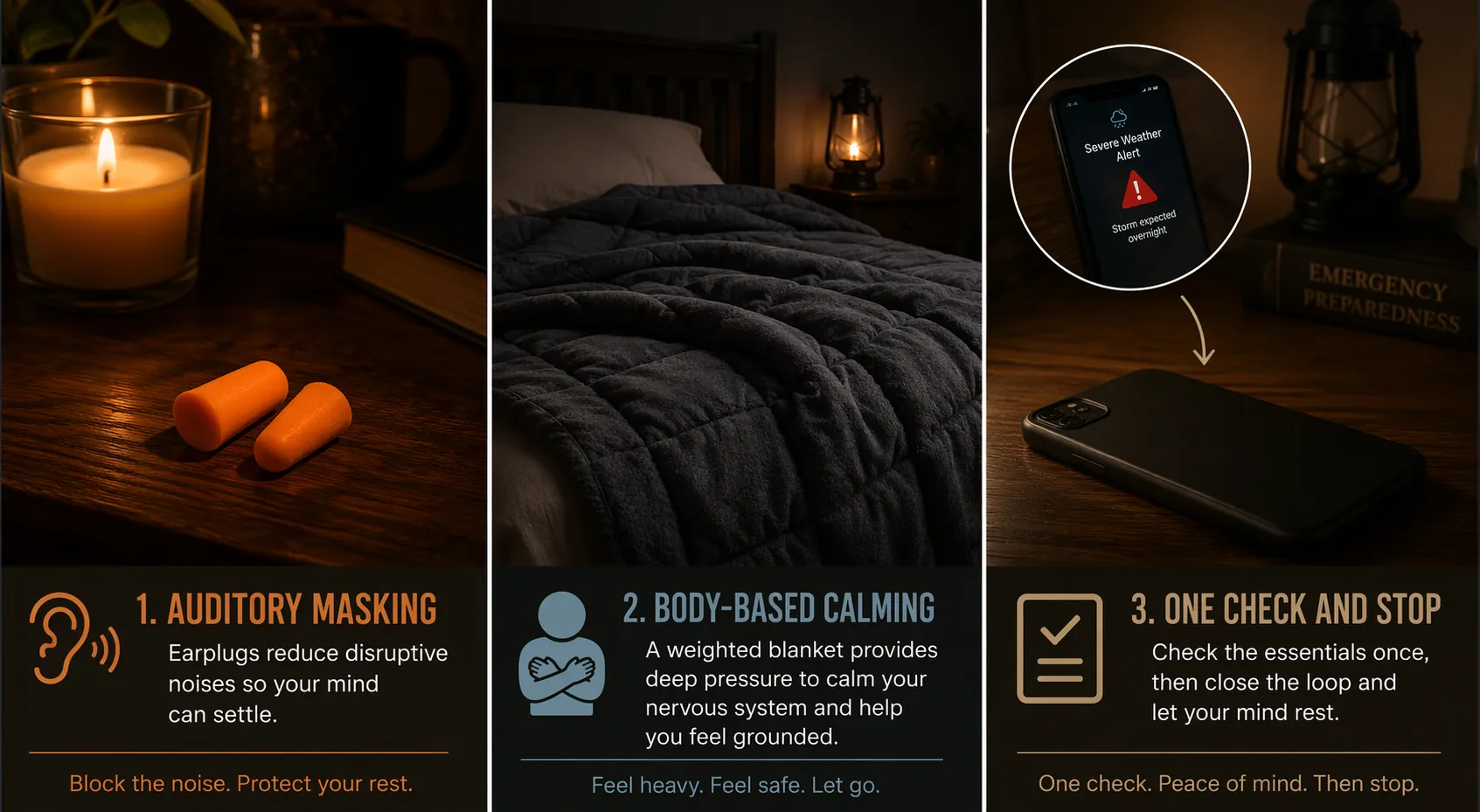
If your fan normally masks sound, foam earplugs are the most practical first move because they do not ask the power grid, your phone battery, or your executive function to cooperate. Foam earplugs rated NRR 32 are commonly described as reducing ambient noise by roughly 20 to 30 dB in real-world use, depending on fit. [4]
Put them where your hand can find them in the dark: nightstand drawer, pillowcase pocket, small dish beside the bed, storm kit, or the inside pocket of the hoodie you always grab when the house gets cold. The best earplugs are not the theoretically perfect ones. They are the ones you can insert correctly at 2:17 a.m. while half your brain is listening for falling branches.
A battery-powered sound machine can help if you already own one, it is charged, and it will not become one more thing to manage. It should not be the whole plan. During an outage, any strategy that depends on a device also depends on battery level, volume settings, and whether you can tolerate the sound once the room is otherwise silent. Earplugs are less elegant, but they are sturdier.
Add body pressure if the room feels too open
A weighted blanket should not be treated like a magic sedative. Its better role on an outage night is sensory predictability. Pressure gives the body a clear boundary when the room feels unfamiliar, the wind is irregular, and your attention keeps reaching outward. For some ADHD sleepers, that “I know where my body is” signal is the difference between lying exposed in the dark and feeling contained enough to drift.
Use the least complicated version. Pull the weighted blanket over your torso or legs rather than building a complicated nest. If heat is part of the outage, pressure has to compete with temperature. A heavy blanket that calms you for ten minutes and then overheats you for two hours is not helping. During summer outages, especially if air conditioning is down, use breathable layers and move the weight off quickly if your body starts to feel trapped or hot. For heat-specific guidance, see our summer 2026 guide to how heatwaves disrupt sleep by life stage.
If you are in perimenopause or prone to hot flashes, treat no-AC sleep as its own constraint, not a minor footnote. Pressure can still be useful, but overheating will keep the alert system active. In that situation, a smaller weighted throw, pressure over the legs only, or firm pillows against the body may be more realistic than a full blanket.
Do one outage check, then close the loop
Uncertainty is a sleep disruptor with a special grip on ADHD. The brain wants one more update because the next update might solve the waiting. Power company map. Weather radar. Neighborhood thread. Text from a friend three blocks over. Then the nervous system is no longer preparing for sleep; it is running an overnight command center from bed.
The useful version is not “never check.” It is one deliberate check for practical information, followed by a deliberate stop.
- Check the outage source you actually trust, not five sources that mostly repeat each other.
- Look only for information that changes your next action: estimated restoration, safety alert, downed-line warning, road closure, or a reason to move rooms.
- Set the phone face-down, out of hand reach if possible, with only the alarm or emergency notifications you truly need.
- Say the next action plainly: “Nothing changes until morning,” “I will move to the cooler room if I wake sweating,” or “I will check again at 6:30.”
That last sentence matters because ADHD working memory does not always hold closure quietly. If the plan stays vague, the brain keeps reopening it. A simple verbal rule gives the loop somewhere to land.
Keep the routine small enough to perform in the dark
An outage routine should not require calm, organization, or ten clean steps. It should be short enough that you can do it while annoyed, overstimulated, and slightly ashamed that you are this awake.
- Make the room mechanically safe enough: clear the path to the bathroom, put the flashlight in one obvious spot, and stop rearranging.
- Replace sound masking: insert foam earplugs or turn on a battery sound source if it is already ready.
- Add body predictability: weighted blanket, firm pillow pressure, or a stable position that does not require constant adjustment.
- Close the information loop: one outage check, one next-action rule, phone down.
- Let sleep be partial: resting with fewer inputs is still better than refreshing, scanning, and renegotiating the whole night.
There is some clinical recognition that blackout conditions can disturb sleep beyond ordinary annoyance. The Sleep Institute of Madrid reported an increase in sleep-disorder consultations after a widespread blackout, which does not prove a universal pattern but does validate that power-loss sleep disruption shows up in real care settings. [5]
If the outage reveals a larger ADHD sleep pattern
One bad storm night does not require a full sleep-life audit. But if the outage makes visible how much your sleep depends on fragile cues—one exact fan, one exact podcast, one exact light level—it may be worth building more routine anchors that do not collapse when one device fails.
For broader ADHD routine support, see natural sleep aids for the ADHD circadian clock and why ADHD adults often need circadian sleep support rather than another pill. Environmental disruption places an unequal burden on some sleepers; that broader pattern also appears in our discussion of permanent daylight saving time and sleep burden.
Tonight, the repair is smaller. Reduce the sudden sounds. Give the body a clear boundary. Check what needs checking once, then stop asking the outage to explain itself. Perfect sleep during a severe wind power outage may be too much to demand. Enough sensory predictability for the ADHD brain to stand down is a more honest target.
References
- Night Watch in One Brain Hemisphere during Sleep Associated with the First-Night Effect. Current Biology. 2016.
- ADHD and Sleep Problems. Sleep Foundation.
- The effects of white noise on sleep and duration in individuals living in a high noise environment in New York City. Sleep Health. 2021.
- Noise Reduction Rating (NRR): A Beginner’s Guide. CDC/NIOSH.
- Blackout sleep disruption report. Sleep Institute of Madrid.
Explore the mechanism
Next step
Spot an error or have clinical feedback?
Because this article covers clinical, medication, or safety information, we use a moderated correction channel instead of open public comments. Let us know if something about “Why a Power Outage Wrecks ADHD Sleep (and How to Fix It)” needs a closer look.
Send feedback on this article