
Why millennial tiredness at work is not one problem
Millennial exhaustion is usually blamed on stress or aging, but for many 30- to 45-year-olds it is a life-stage sleep problem. The evidence separates it into distinct patterns — perimenopause, early parenting, and caregiving — each with its own interventions and evidence tier.
The search for “why millennials are so tired at work sleep solutions” often starts with the assumption that one generation has one exhaustion problem. The evidence does not line up that neatly. One time-use comparison reported by AASM SleepEducation found that millennials, at the same age, clocked about 22 more minutes of sleep per day than Gen X — 8.9 hours versus 8.5 hours.[1] That does not mean millennial tiredness is imaginary. It means total sleep time is too blunt a measurement to explain who is arriving at work depleted.
In 2026, millennials are roughly 30 to 45. That is not one life stage. Some are in the thin-sleep years of babies and young children. Some are in the older half of the cohort, where perimenopause can begin to fracture sleep in ways that get mislabeled as stress or aging. Some are carrying family care before and after paid work. Others are exhausted by work itself, or by a sleep disorder that has nothing especially “millennial” about it.
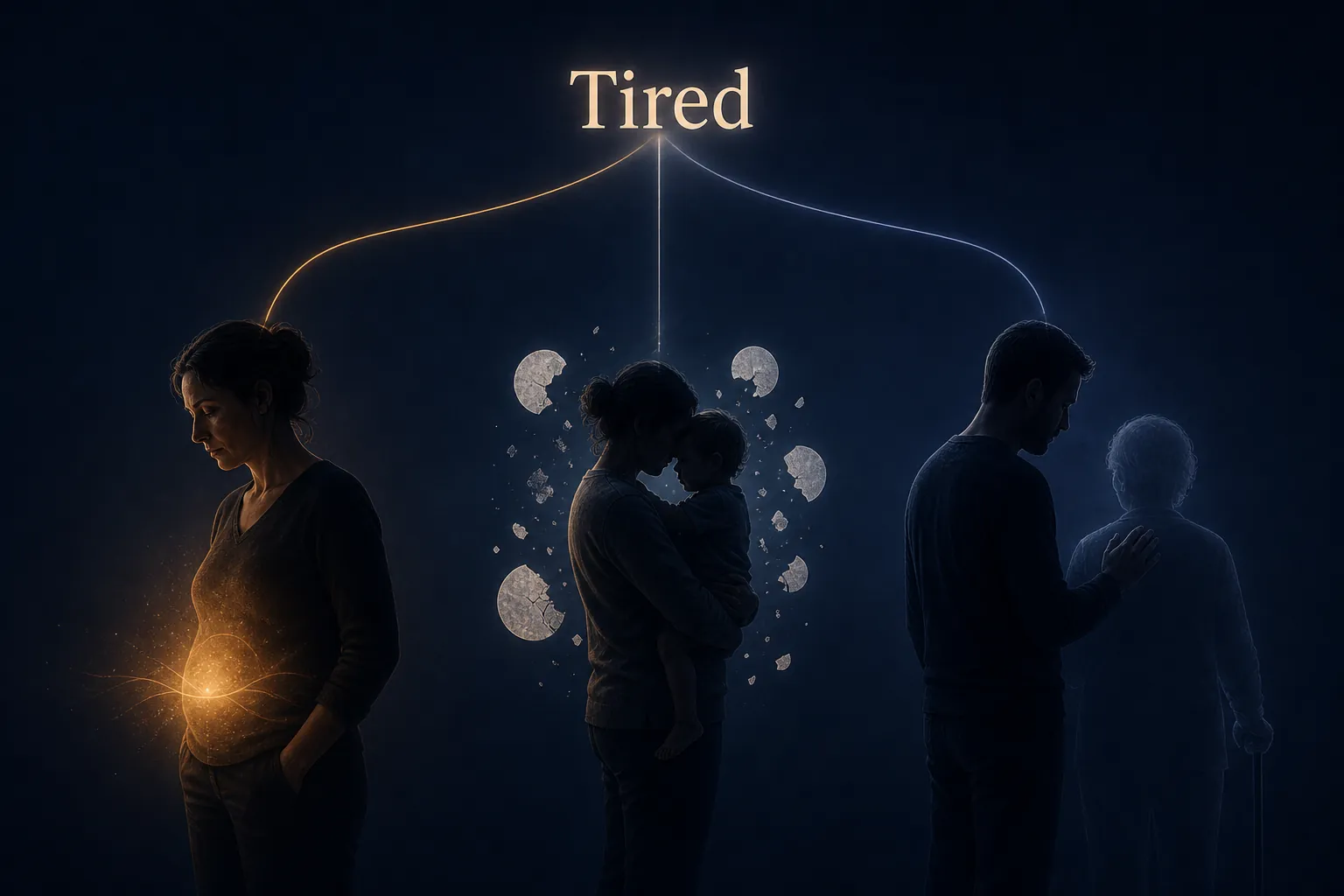
The useful question is therefore not whether millennials are uniquely tired. It is whose sleep is breaking, when it is breaking, and what kind of intervention belongs in the conversation.
“Millennial” is now a wide sleep calendar
A 31-year-old who is up with a teething baby, a 42-year-old waking drenched at 3 a.m., and a 45-year-old taking late-night calls about an aging parent can all look the same in a morning meeting. They may all answer Slack slowly. They may all need more coffee than they want to admit. But the sleep problem underneath is not the same.
That distinction matters because generic sleep advice often assumes the person has voluntary control over the main disruption. Dim the lights. Stop scrolling. Keep a consistent bedtime. Those habits can help at the margins, and evening screens can be a real issue for some people, as any wind-down routine discussion should acknowledge. But they are a poor fit when the main event is a hormonal transition, a baby waking every few hours, or a caregiving call that cannot be scheduled for after breakfast.
This is where the calendar becomes clinically useful. It does not diagnose anyone by birth year. It separates likely patterns so a tired worker can stop being treated as a failed time manager.
The older millennial sleep problem that is easiest to miss: perimenopause
Perimenopause does not apply to every millennial. It mainly concerns the older half of the cohort, especially people in their early-to-mid 40s, though individual timing varies. But for that subgroup, it is too important to bury under “you’re just stressed.”
A review in Sleep Medicine Clinics gives this pattern a recognizable clinical shape. Sleep disturbances are reported by 40% to 60% of menopausal women. In a meta-analysis of 24 cross-sectional studies, the odds of sleep disturbance were higher in perimenopause, postmenopause, and surgical menopause, with reported odds ratios of 1.60, 1.67, and 2.17 respectively. The same review notes that 26% of perimenopausal women met DSM-IV insomnia criteria.[2]

The detail to listen for is not simply “I’m tired.” It is sleep that starts normally and then breaks apart: waking after sleep onset, hot flashes or night sweats, earlier-than-usual morning waking, and insomnia symptoms arriving around cycle changes or the menopausal transition. That pattern can look like workplace burnout from the outside because the consequence shows up at work. The mechanism may have started in the middle of the night.
The 2026 Apple Women’s Health Study update is useful here because it measured nights rather than relying only on memory. In 338 participants across 94,118 tracked nights, 60% showed increased wake-after-sleep-onset in the 18 months before menopause, with an average increase of 7%. The update also reported that 84% of participants attributed sleep changes to the menopausal transition, and that the menopause-related increase in time awake — about 4 minutes per 8-hour night — exceeded what aging alone would predict, about 1 minute per two years.[3]
Four minutes can sound small if it is read like a stopwatch. In a symptom story, it may mean something else: more awakenings, more alertness during awakenings, more anxiety about whether sleep will return, and more mornings that begin with the feeling that the night never fully consolidated. The point is not that every midlife sleep complaint is hormonal. The point is that perimenopause creates a plausible, studied sleep pathway that deserves to be asked about before the person is handed another stress-management worksheet.
Where CBT-I belongs in this conversation
For chronic insomnia, cognitive behavioral therapy for insomnia — CBT-I — should not be treated as a wellness extra. The Baker review describes CBT-I as the primary intervention for chronic insomnia and notes that it is superior to sleep medication alone in the long term. In an 8-week randomized controlled trial involving perimenopausal and postmenopausal women with hot flashes, CBT-I reduced insomnia symptoms, with gains maintained at 6 months.[2]
That is evidence of benefit, not a guarantee that one protocol fixes every night waking. Hot flashes, mood symptoms, medications, sleep apnea, pain, and caregiving can all complicate the picture. Still, when the pattern is chronic insomnia in the perimenopausal years, CBT-I belongs near the front of the discussion, ahead of supplement roulette or another lecture about willpower.
For new parents, the workday may begin long before work
Early parenting creates a different sleep problem. It is less about the body waking itself after sleep onset and more about another person repeatedly interrupting the night. That distinction sounds obvious until the same parent is later judged at work as distracted, unmotivated, or bad at boundaries.
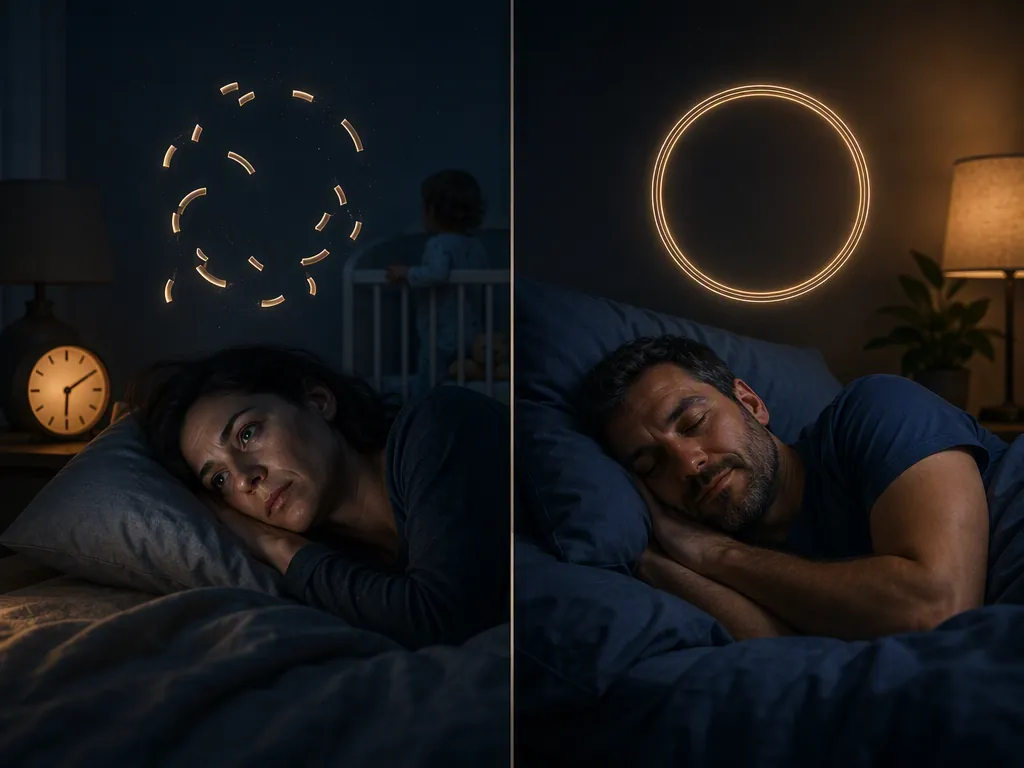
The gender contrast is not subtle. Sleep Foundation statistics report that new mothers lose about 62 minutes of sleep per night, compared with 13 minutes for new fathers, and that the effects can last up to 6 years.[4] For a millennial parent, especially one in the late 30s or early 40s, those years can overlap with peak job responsibility, fertility treatment, pregnancy recovery, or the first signs of perimenopausal sleep disruption.
Single parents face another layer. The same Sleep Foundation statistics report that 43% of single parents sleep under 7 hours, compared with 33% in two-parent homes and 31% of childless adults.[4] That number does not tell the whole story of parenting, but it does name a structural difference. A single parent does not simply need better bedtime discipline if there is no second adult to trade the 2 a.m. shift.
The sleep solution here depends on what is actually causing the fragmentation. If the child is still waking, the first intervention may be protected sleep shifts, a realistic division of night care, outside help when available, and work expectations that acknowledge the sleep loss instead of pretending it is private. If the child is no longer waking but the parent now lies awake anticipating the next interruption, an insomnia pattern may have taken on a life of its own. That is where CBT-I can become relevant, not because parenting is a thought error, but because conditioned wakefulness can remain after the original disruption improves.
Pregnancy and postpartum sleep deserve their own attention. A person looking for pregnancy-specific approaches should be reading material tailored to that stage, such as safe pregnancy insomnia remedies or pregnancy sleep problems and remedies, rather than advice written for a generic overworked adult.
Work stress is real, but it is often where the sleep loss becomes visible
Workplace stress still belongs in the picture. Poll data can show where tiredness is clustering, even when it cannot diagnose the cause. In a December 2023 Gallup poll of 1,013 adults, 57% of U.S. adults said they would feel better if they got more sleep, while 42% said they get as much sleep as they need. Among adults ages 18 to 49, 27% of women reported adequate sleep compared with 46% of men, a 19-point gender gap; younger women were also the most stressed group, with 69% reporting frequent stress.[5]
Those figures are broad poll data, not a map of perimenopause, parenting, or caregiving. They do, however, make one thing harder to dismiss: younger and midlife women are not merely complaining more. They are reporting less adequate sleep and more stress at the same time, which is exactly the overlap that can turn a night problem into a work problem.
The familiar millennial burnout frame adds context, but it should stay in its lane. Gallup’s 2018 data from about 7,500 full-time U.S. employees found that 28% of millennials reported frequent or constant burnout, compared with 21% of older workers, and about 7 in 10 millennials reported some burnout.[6] That was a pre-pandemic workplace snapshot, not a current sleep study. It helps explain why exhaustion is seen and named at work. It does not explain which nights are being broken, or by what.
Caregiving belongs in the picture, but with a lighter evidence claim
Caregiving has a lighter evidence base than perimenopause and early parenting. That does not make it trivial. It means the claim should be narrower.
A millennial caregiver may be sleeping lightly because a parent might call, because medication schedules run late, because hospital portals update at strange hours, or because family logistics occupy the only quiet part of the day. The sleep disruption may be intermittent rather than nightly. It may also overlap with parenting or perimenopause, which makes the workday tiredness look diffuse.
The practical move is to name the caregiving load without pretending the evidence here is as specific as the menopause-transition data. If the night is repeatedly interrupted by family care, the solution is not just sleep hygiene. It is respite, shared coverage, boundaries around nonurgent communication where possible, and a clinician’s help if insomnia, anxiety, depression, or another sleep disorder persists beyond the caregiving event itself.
A self-triage lens for the tired millennial worker
Self-triage is not self-diagnosis. It is a way to arrive at the right conversation faster. The first question is not “Am I bad at coping?” It is “What is waking me, and what else is happening in my body and calendar?”
| Pattern to look for | Who it most likely fits | What belongs in the next conversation |
|---|---|---|
| Waking after sleep onset, hot flashes or night sweats, cycle changes, new insomnia in the early-to-mid 40s | Older millennial women and others entering the menopausal transition | Perimenopause assessment; CBT-I for chronic insomnia; discussion of vasomotor symptoms and other medical contributors [2][3] |
| Fragmented nights because a baby or child wakes, or because the parent remains hyper-alert after repeated child wakings | New parents, especially new mothers and single parents | Protected sleep shifts, realistic redistribution of night care, childcare and work accommodations where possible; CBT-I if an insomnia pattern persists [4] |
| Sleep interrupted by elder care, family medical logistics, or being on call for another adult | Caregivers, often overlapping with parenting or midlife work responsibility | Respite planning, shared coverage, limits on nonurgent overnight contact, clinical support if insomnia or anxiety persists |
| Loud snoring, witnessed pauses in breathing, choking or gasping, morning headaches, severe daytime sleepiness | Any millennial, regardless of life stage | Screening for sleep apnea or another sleep disorder rather than assuming burnout |
| Racing mind, delayed sleep timing, inconsistent routines, attention regulation problems, or long-standing difficulty initiating sleep | People with stress, anxiety, ADHD traits, or other neurotype-related sleep patterns | Clinical screening and targeted behavioral treatment; ADHD may be a parallel axis, but it is not the core evidence base for this question |
The last two rows matter because not every exhausted millennial is perimenopausal, parenting, or caregiving. Sleep apnea, restless legs, circadian rhythm problems, medication effects, depression, anxiety, pain, and ADHD-related sleep difficulties can all sit outside the life-stage story. If snoring, gasping, or severe daytime sleepiness is part of the picture, a sleep apnea screening conversation belongs higher on the list than another productivity system.
What “sleep solutions” should mean here
A useful sleep solution matches the pattern. Perimenopausal insomnia is not solved by pretending hot flashes are a motivation problem. Parenting sleep loss is not solved by telling the only available parent to set firmer boundaries with an infant. Caregiving sleep disruption is not solved by a lavender routine if the phone may ring from the emergency department.
For chronic insomnia, CBT-I has the strongest role in the supplied evidence, especially in the perimenopause literature. That can include stimulus control, sleep restriction or sleep compression, cognitive work around conditioned arousal, and schedule regularity under clinical guidance. It is not the same as generic sleep hygiene, and it should not be demoted below supplements simply because it takes more structure.
For disrupted nights caused by children or caregiving, the first solution may be less clinical and more logistical: who is awake, who is allowed to sleep, who has backup, and whether work expectations have absorbed the reality that the person’s night shift happened before their paid shift began. If insomnia continues after the external wakings ease, then the clinical insomnia pathway becomes more relevant.
Millennial tiredness at work is real. “Millennial” is just too blunt a diagnosis. The better next step is to identify the life-stage sleep pattern — perimenopause, early parenting, caregiving, another sleep disorder, or workplace stress without those overlays — and match the response to the evidence instead of flattening every exhausted person into the same burnout story.
References
- Millennials clock more sleep than Gen X, AASM SleepEducation
- Sleep Disturbances During the Menopausal Transition, Sleep Medicine Clinics, 2018
- Sleep Patterns and Changes in Perimenopause, Harvard Chan Apple Women’s Health Study, May 2026
- Sleep Facts and Statistics, Sleep Foundation
- Americans Sleeping Less, More Stressed, Gallup, Dec. 2023
- Millennials Are Burning Out, Gallup, 2018
Safety & eligibility read
Cross-check against other interventionsExplore the mechanism
Next step
Spot an error or have clinical feedback?
Because this article covers clinical, medication, or safety information, we use a moderated correction channel instead of open public comments. Let us know if something about “Why millennial tiredness at work is not one problem” needs a closer look.
Send feedback on this article