
Time-restricted eating boosts menopause brain function, Rutgers study
A new Rutgers University pilot trial presented at NUTRITION 2026 found that time-restricted eating (an 8-hour eating window) improved spatial planning and problem-solving in postmenopausal women beyond the effect of weight loss alone. This article explains how aligning your eating schedule with circadian biology may also support sleep during menopause, and how to apply the findings responsibly.
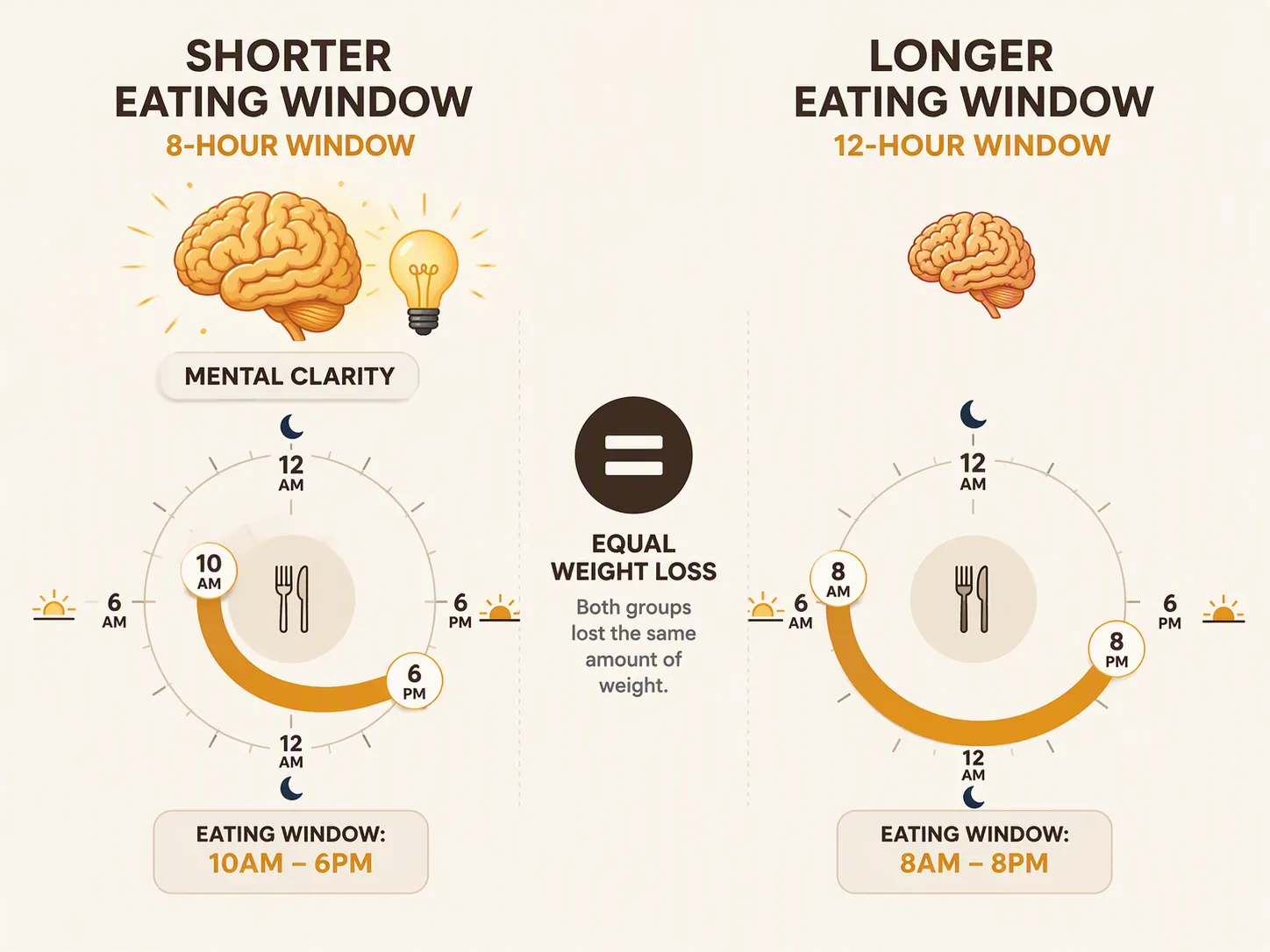
Rutgers researchers have put a sharper question on the table than the usual menopause diet advice: what if the timing of eating matters for brain function even when weight loss is the same? Preliminary findings presented at NUTRITION 2026 on July 26 reported that women assigned to time-restricted eating compressed their meals into an average 8.2-hour window over six months, while a control group ate across an average 12.3-hour window. Both groups lost about 15 pounds, but the time-restricted eating group performed better on spatial planning and problem-solving tasks, with a trend toward fewer memory and learning errors.[1]
That is the useful part of the Rutgers study for anyone searching for the “best diet for menopause sleep and brain function.” It gives timing a serious role instead of treating it as a wellness flourish. But it also needs a boundary line drawn around it early: this was a small pilot trial in older women with overweight or obesity, and it did not directly measure menopause sleep outcomes. The sleep connection is plausible because meal timing affects circadian biology, not proven because this trial showed women slept better.
What Rutgers Actually Studied
The Rutgers pilot trial followed 47 women ages 50 to 79 for six months. The time-restricted eating group was asked to eat within a shorter daily window, often described as roughly 10 a.m. to 6 p.m., while the control group followed a calorie-restricted diet without the same narrow timing rule. In the data reported from the conference presentation, the average eating window was 8.2 hours in the time-restricted eating group and 12.3 hours in the control group.[1]
The finding is more interesting because weight loss did not explain away the difference. Both groups lost about the same amount of weight — approximately 15 pounds — yet the time-restricted eating group scored higher on tests tied to spatial planning and problem-solving.[1] In plain terms, this was not simply a “lost weight, felt sharper” story. The study suggests that a shorter, earlier eating window may have had an effect beyond the scale.
It was not a sweeping cognitive rescue. The reported improvements were specific, modest, and tied to certain tasks. The study also remains preliminary because it was presented at a scientific meeting and has not yet gone through journal peer review. That does not make it meaningless. It means the result belongs in the “promising and worth testing in daily life if it is safe for you” category, not the “Rutgers found the menopause diet” category.
| Trial detail | What it means for readers |
|---|---|
| 47 women ages 50 to 79 | Relevant to many postmenopausal readers, but not proof for younger perimenopausal women or normal-weight women |
| Six-month duration | Long enough to be more meaningful than a one-week timing experiment |
| 8.2-hour eating window vs. 12.3-hour window | The active difference was meal timing, not just generic diet quality |
| Both groups lost about 15 pounds | The cognitive difference may not be explained by weight loss alone |
| Better spatial planning and problem-solving in the TRE group | The result concerns specific cognitive domains, not all memory or all brain function |
Why the Equal Weight Loss Detail Matters
Menopause diet advice often collapses into weight advice. Lose weight, reduce sugar, avoid alcohol, eat more protein, repeat. Some of that can be clinically sensible, especially when insulin resistance, sleep apnea risk, or cardiometabolic health are part of the picture. But women are also asking a more specific question: why does the brain feel slower, less organized, less reliable?
The Rutgers result gives that question a cleaner shape. If two groups lose similar weight but only the shorter-window group does better on certain cognitive tasks, timing becomes harder to dismiss. It does not prove the mechanism, and it does not prove that every woman should eat from 10 a.m. to 6 p.m. It does suggest that the body may respond differently when calories arrive in a more circadian-aligned pattern.
Spatial planning and problem-solving are also not trivial complaints dressed up in lab language. They overlap with the daily frustrations women describe as “brain fog”: planning errands, sequencing work tasks, remembering what has to happen before dinner, holding a mental map of the day. A test score is not the same as lived ease, but it is a better starting point than telling women to accept fogginess as inevitable.
Where Sleep Fits — and Where It Does Not
Sleep disturbance is common enough in menopause that readers do not need to be convinced their problem is real. Reviews report that sleep disturbance affects about 40% to 60% of menopausal women, and insomnia prevalence increases by 56% compared with premenopause.[2] The Rutgers trial matters to this audience because sleep disruption and brain fog often travel together, not because the trial measured both.
The responsible bridge is circadian timing. Late eating can push digestion, glucose handling, body temperature rhythm, and melatonin timing into the part of the evening when the body is supposed to be preparing for sleep. Menopause can already make that preparation more fragile because estrogen decline affects thermoregulation, circadian entrainment, and glucose regulation.[2] A shorter daytime eating window, especially one that stops several hours before bed, may reduce one avoidable source of circadian noise.
That is different from saying time-restricted eating treats menopause insomnia. If you wake from hot flashes, untreated sleep apnea, restless legs, anxiety, pain, medication effects, or a partner’s schedule, an eating window will not magically solve the night. But if dinner regularly slides toward bedtime, snacks fill the late evening, and sleep onset feels delayed or shallow, the timing experiment is reasonable enough to discuss and structured enough to try safely for many people.
A Practical Version of the Rutgers-Style Timing Plan
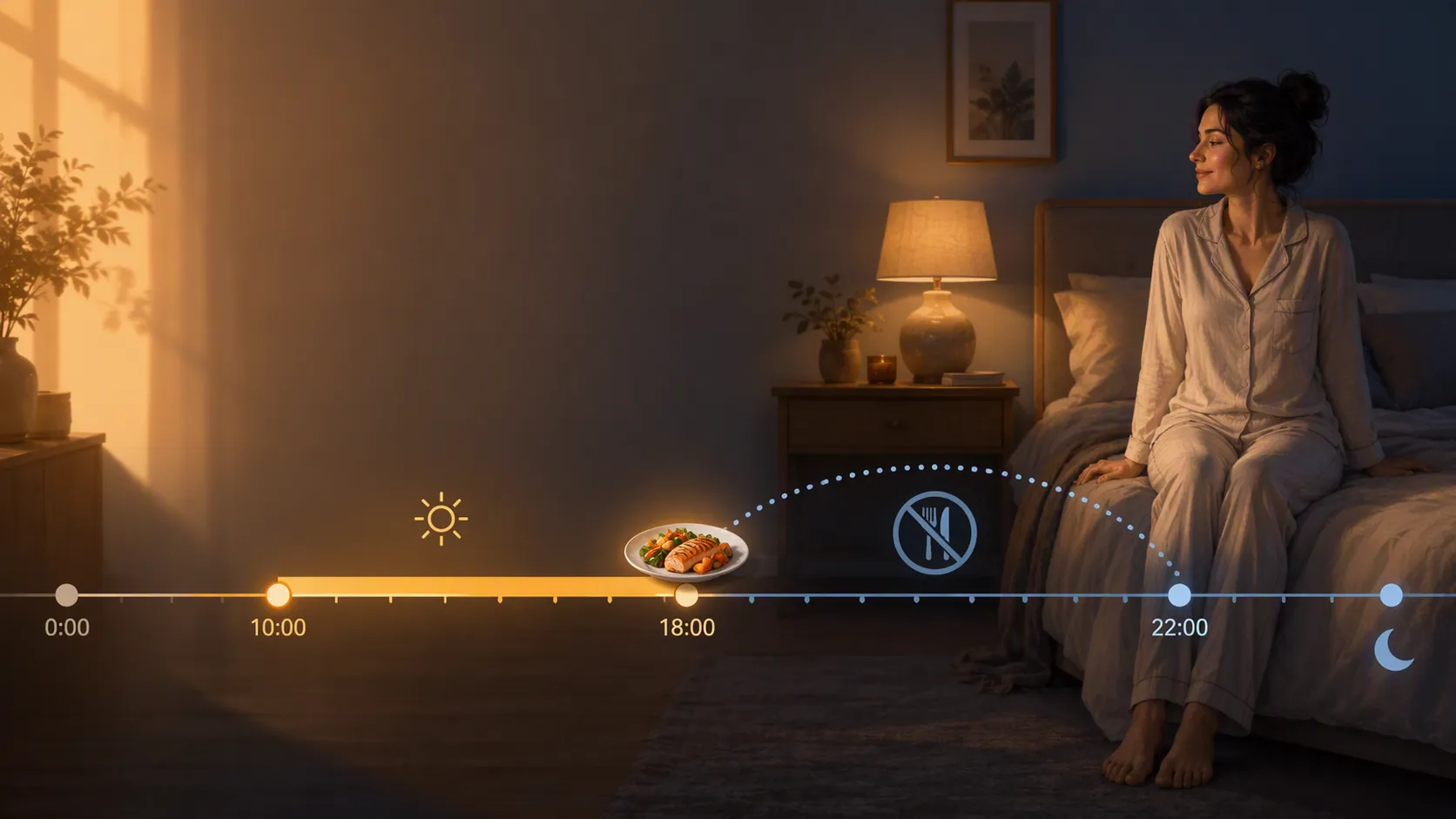
The most usable translation is not “fast as long as possible.” It is a daytime eating window of about 8 to 9 hours, with the last food at least four hours before bed. A common version is 10 a.m. to 6 p.m. for someone aiming to sleep around 10 p.m. That schedule gives the body a clearer separation between feeding time and sleep preparation.
- Choose an 8- to 9-hour eating window you can repeat most days, such as 10 a.m. to 6 p.m. or 9 a.m. to 5:30 p.m.
- Stop eating at least four hours before your intended bedtime; water or unsweetened non-caloric drinks are usually the simplest default.
- Keep the first meal substantial enough to prevent a rebound late-night snack cycle.
- Put protein, fiber-rich carbohydrates, and healthy fats inside the window instead of using the window as permission to under-eat.
- Track sleep timing, night waking, hot flashes, next-day alertness, and evening hunger for two to four weeks before judging whether the routine is livable.
The hard part is not understanding the schedule. It is living it. A 10 a.m. to 6 p.m. window may be tidy on an infographic and awkward in a real house where work runs late, caregiving compresses dinner, medication must be taken with food, or hot flashes already make sleep unpredictable. The best window is not the earliest one you can endure for three days; it is the one that reduces evening eating without turning the rest of life into a negotiation.
Some readers should not start this casually. If you use insulin or glucose-lowering medication, have diabetes, have a history of disordered eating, take medications that require food at specific times, are underweight, are in active cancer treatment, or have another medical condition affected by fasting, bring the plan to a clinician first. Time-restricted eating is behavioral, but behavioral does not mean medically neutral.
Meal Timing Is a Layer, Not the Whole Diet
The Rutgers study makes timing more interesting; it does not make food quality irrelevant. A shorter eating window built out of low-protein snacks and late caffeine is still a poor menopause sleep plan. Broader reviews of nutrition in menopause and perimenopause continue to emphasize dietary patterns that support metabolic and brain health, including antioxidant-rich foods, omega-3 sources, phytoestrogens, and lower-glycemic approaches.[3]
For the nutrient side of the question — magnesium, omega-3s, B vitamins, tryptophan, and meal composition — use the companion guide on what to eat for better sleep and memory in menopause. For a deeper look at why earlier windows tend to make more sense than late windows, see the explainer on meal timing in time-restricted eating and sleep.
Resistance training belongs beside this conversation too, not as decoration but because midlife sleep, insulin sensitivity, muscle, and cognition are connected in daily life. If meal timing is one lever, strength work is another. A practical starting point is the 12-week weight training routine for perimenopause sleep, especially for readers who are trying to improve sleep without turning every solution into a supplement or a stricter diet.
What to Watch If You Try It This Week
A useful self-trial should measure the complaints that brought you here, not just the fasting hours. Write down when you stop eating, when you get into bed, how long sleep onset seems to take, how often you wake, whether hot flashes feel different, and how your brain works the next morning. Keep the notes simple. The goal is to see whether moving food earlier reduces friction in your own evening.
Also watch for signs the plan is backfiring: intense morning fatigue, dizziness, headaches, irritability, binge-like hunger at night, or a growing fear of eating outside the window. Those are not signs of discipline forming. They are signs the schedule may be too narrow, too early, too low in calories, or wrong for your medical situation.
The strongest reading of the Rutgers study is also the most restrained one. Time-restricted eating looks promising because women in the shorter-window group improved on certain cognitive tasks even though the comparison group lost similar weight. The same circadian logic makes an earlier eating window and a four-hour pre-bed fast plausible for menopause sleep support. It is not yet proof that time-restricted eating is the single best diet for menopause sleep and brain function.
References
- Eating within 8 hours may help keep the aging brain sharp, ScienceDaily, July 27, 2026.
- Sleep and Brain Function at Menopause, PMC.
- The Importance of Nutrition in Menopause and Perimenopause—A Review, PMC.
Safety & eligibility read
Cross-check against other interventionsExplore the mechanism
Next step
Spot an error or have clinical feedback?
Because this article covers clinical, medication, or safety information, we use a moderated correction channel instead of open public comments. Let us know if something about “Time-restricted eating boosts menopause brain function, Rutgers study” needs a closer look.
Send feedback on this article