
How to Sleep During Wildfire Evacuation Stress in Perimenopause
Wildfire evacuation stress hits perimenopausal sleep through three specific physiological mechanisms. Understanding them explains why standard tips fall short and points to the few interventions that can work in a shelter or hotel room.
At 3 a.m. in a hotel room, shelter cot, or someone else’s spare bedroom, ordinary sleep advice can start to sound insulting. A consistent bedtime is hard to protect when evacuation alerts keep changing. A cool, dark room is not always yours to control. “Relax before bed” does not mean much when your body is hot, your ears are scanning for sirens or hallway noise, and your brain is still sorting out what might burn, what was left behind, and whether the next message on your phone matters.
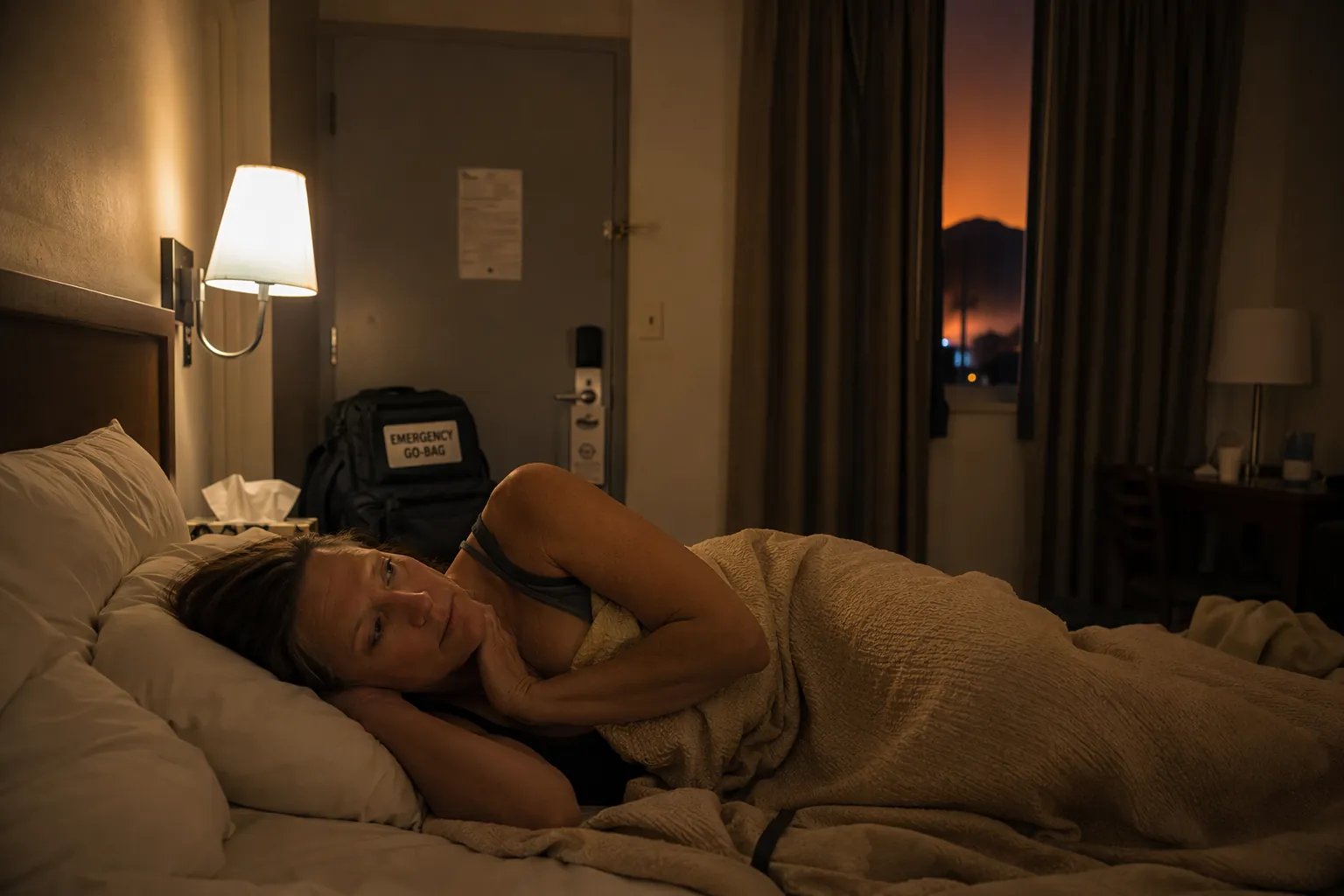
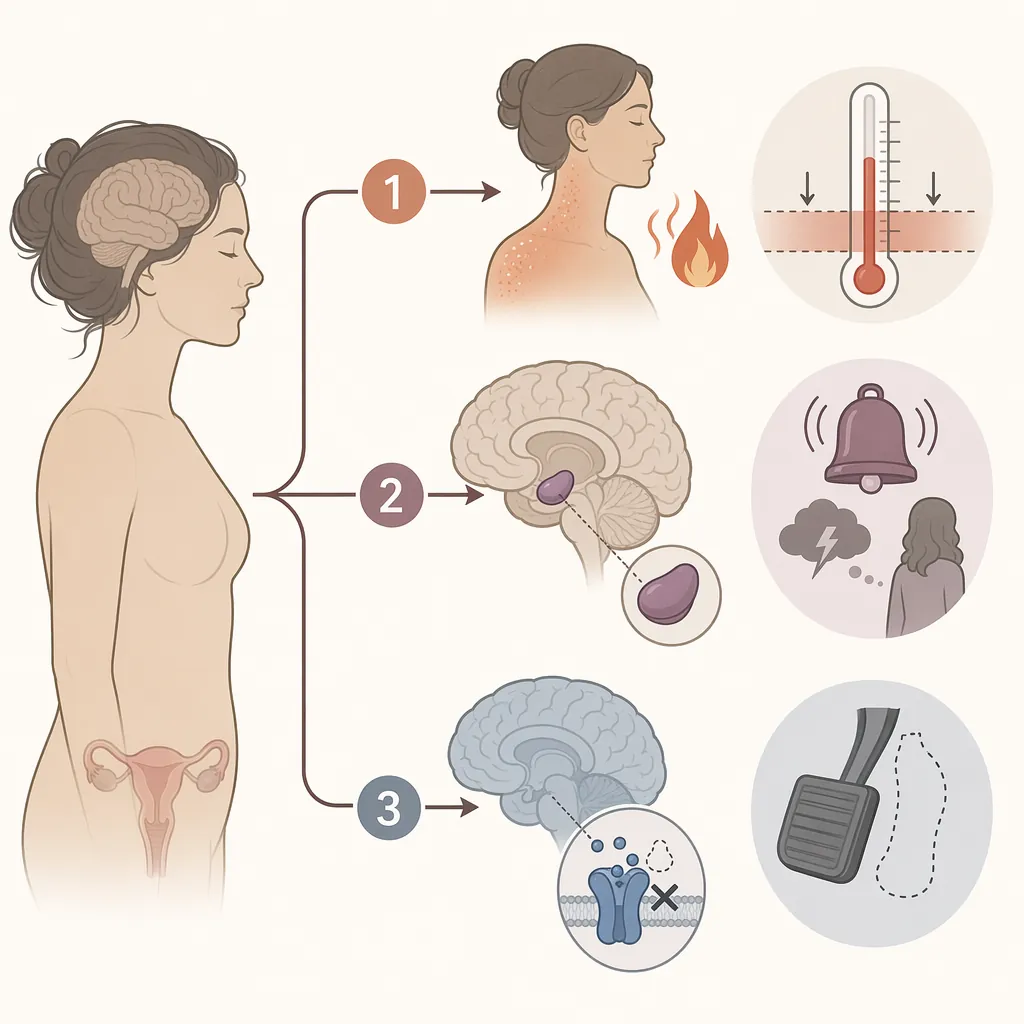
If you are trying to figure out how to sleep during wildfire evacuation stress in perimenopause, the calm answer is this: yes, the evacuation stress matters. It is also not the whole story. Perimenopause can make that stress land harder on sleep through temperature regulation, threat circuitry, and the brain chemistry that normally helps put a brake on wakefulness.
That does not mean every bad night is a diagnosis. It means your body may be doing exactly what it is primed to do under threat, heat, disrupted hormones, smoke exposure, and unfamiliar surroundings. The useful question is not “Why can’t I be normal tonight?” It is “Which part of this physiology can I reduce enough to get some sleep?”
The numbers are high, and the evidence is still thinner than it should be
Wildfire survivors in a systematic review reported insomnia rates ranging from 63% to 72.5%, and nightmares from 33.3% to 46.5%.[1] Those figures are useful because they make one thing clear: sleep disruption after wildfire is common enough that no one should be treating it as a personal weakness.
They also need to be read carefully. The review included only five studies, the studies were too different for a meta-analysis, and self-reported insomnia can run higher than rates based on clinical diagnosis.[1] So the point is not that a precise percentage predicts your night. The point is that wildfire exposure and displacement often break sleep.
The perimenopause-specific wildfire evidence is even narrower. One Greek post-wildfire study found that perimenopausal women had a 3.16 times greater likelihood of insomnia after wildfire exposure.[2] That is important, but it is not a universal law; it is one study, in one setting, and it may not generalize neatly to women evacuating from fires in the United States. The stronger conclusion is more modest: direct research on perimenopause plus wildfire evacuation plus sleep is scarce, but the separate bodies of evidence point in the same direction.
Three mechanisms can stack on top of evacuation stress
The practical map looks like this:
| What you feel at night | Likely mechanism | What to target first |
|---|---|---|
| You wake suddenly hot, damp, uncovered, and fully alert | A narrowed thermoneutral zone makes small temperature shifts more likely to trigger hot flashes and awakenings | Fast cooling at the neck or wrists, lighter moisture-wicking layers, easy-to-remove bedding |
| Every hallway sound, phone vibration, smoke smell, or distant siren restarts your nervous system | Estrogen fluctuation may make fear-extinction and threat-calming circuits less reliable | Reduce sensory threat cues, protect ears and eyes, use breathing that does not fight the hot flash |
| You are exhausted but feel under-braked, restless, and unable to drop into sleep | Declining progesterone may reduce a GABA-ergic sleep-supporting signal | Lower stimulation, avoid alcohol, keep necessary sleep treatments going, and do not expect willpower to supply the missing brake |
Heat can wake you before you have time to talk yourself down
Perimenopause can narrow the body’s thermoneutral zone—the range where your core temperature feels stable enough that your body does not have to dump heat. In evacuation conditions, that narrowed range gets tested all night: a too-heavy hotel comforter, polyester pajamas, a crowded room, a closed window because of smoke, or a shelter that alternates between chilly air conditioning and trapped heat.
This is not just “feeling warm.” In an ambulatory sleep study of women in the menopausal transition, hot flashes accounted for about 27% of objective wake-after-sleep-onset, and 69% of hot flashes coincided with an awakening.[3] The same study reported that each awakening could cost 20 to 30 minutes of lost sleep.[3] That matches the miserable lived sequence: heat first, then the jolt, then the brain comes online and remembers the fire.
The implication is simple and unglamorous: cooling has to be fast and local. Telling an evacuee to “keep the bedroom cool” is not enough when she does not control the room. A cold pack at the back of the neck, a damp cooling towel, or even a wrapped bag of ice from the hotel machine placed near the wrists can interrupt the heat surge more realistically than trying to redesign the sleeping space.
Smoke and heat can also compound the problem. If outdoor air is unsafe, opening a window may not be an option; if the room is sealed, trapped heat can become its own sleep trigger. That overlap is why advice for extreme heat and smoke belongs in the same conversation, not in separate boxes. For more on that combined load, see Summer Heat and Wildfire Smoke Create a Triple Threat to Sleep.
Threat cues can keep reloading the alarm system
Evacuation sleep is not quiet sleep interrupted by stress. It is sleep attempted inside an active monitoring state. The phone is not just a phone; it may carry the next evacuation update. A hallway door is not just a door; it may sound like movement you need to assess. Smoke smell, orange light, aircraft noise, text alerts, and other people’s distress can all become threat cues.
Perimenopause may make that harder to shut off. In trauma-exposed women, perimenopausal status was associated with significantly higher PTSD hyperarousal symptoms than premenopausal or postmenopausal status, even after adjusting for trauma history.[4] The study used age cutoffs rather than formal STRAW+10 reproductive staging, so it should not be read as a perfect hormonal map.[4] Still, it supports what many women notice before they have language for it: the body can become more reactive to threat at the same life stage when sleep is already more fragile.
This is where generic relaxation advice usually fails. If your nervous system is tracking danger, it may reject a long body scan or a soothing sleep story because those ask you to stop monitoring. A more realistic goal is to reduce the number of cues your brain has to process. Earplugs do not make the fire safe. An eye mask does not undo evacuation. They do, however, lower the amount of hallway light, movement, and unpredictable sound your brain must classify while it is trying to sleep.
The same applies to wildfire smoke as a psychological cue. Smoke can be a physical irritant and also a reminder that danger is still nearby. If smoke exposure is part of what keeps your brain on alert, Why wildfire smoke keeps your brain on high alert at night goes deeper into that hyperarousal loop.
The missing brake can feel like anxiety even when you are exhausted
Progesterone is not only a reproductive hormone. It also interacts with GABA-A receptor systems, one of the brain’s major inhibitory pathways, and has sedative effects.[5] During perimenopause, progesterone commonly becomes less reliable as ovulation becomes irregular. Reviews of progesterone and sleep point to this GABA-ergic pathway as one reason hormonal change can affect sleep depth and continuity.[5][6]
That matters during evacuation because the body is already being asked to sleep in a biologically unfriendly setting. You may be exhausted from packing, driving, checking on family, calling insurers, calming children, or breathing smoky air. Exhaustion is not the same as inhibition. A tired body can still be under-braked.
Once that is understood, the goal changes. You are not trying to prove you can overpower wakefulness. You are trying to remove the accelerants: alcohol, excess heat, phone checking, bright light, untreated sleep apnea, and unnecessary sensory input. None of those are moral failures. They are load.
What can actually help tonight in a shelter, hotel, or spare room
This is not a perfect sleep plan. It is a damage-reduction plan for a body trying to sleep during displacement.
- Put cooling within arm’s reach before you lie down. A cooling towel, a cold washcloth in a plastic bag, a wrapped ice pack, or a chilled water bottle near the neck or wrists is more useful than a cooling strategy that requires getting fully up and waking everyone.
- Dress for sweat, not for the room temperature at bedtime. Cotton can feel comforting when dry and miserable when damp. A light moisture-wicking base layer, loose bottoms, and layers you can remove quietly are usually more practical than one warm sleep outfit. For more detail, see Choosing Sleepwear That Works With Menopause Night Sweats.
- Make bedding easy to vent. If you have a heavy hotel comforter, consider using the top sheet plus a light blanket instead. If you are on a cot, keep one layer folded at your feet so you can pull it up after the hot flash passes without fully waking yourself.
- Use earplugs and an eye mask if they feel safe. The point is not to block emergency information entirely; keep required alerts on and reachable. The point is to reduce nonessential light and sound so your nervous system is not sorting every door slam, vending machine hum, or hallway shadow.
- Modify box breathing at hot-flash onset. A strict long hold can feel awful when heat is rising. Try a softer version: inhale for 3 or 4, pause briefly, exhale for 4 to 6, pause briefly, and repeat for a few rounds while cooling the neck or wrists. Let the hot flash crest; do not try to win a wrestling match with it.
- Do not use alcohol as the emergency sleep aid. It may feel like the most available off-switch after a frightening day, but it can worsen hot flashes, fragment sleep, and feed next-day anxiety. If bedtime drinking has become part of the evacuation routine, Alcohol Before Bed Ruins Sleep Quality in Perimenopause explains why the rebound can be so punishing.
- If you have diagnosed sleep apnea and use CPAP, treat the machine as essential medical equipment, not optional luggage. Keep the mask, hose, power supply, distilled water if needed, and any battery backup with evacuation items when possible. If you are in a shelter, ask staff early about access to an outlet. If you are unsure whether apnea or perimenopause is driving your awakenings, see Sleep Apnea or Perimenopause? How to Spot the Difference.
- Be cautious with melatonin. If a clinician has already recommended a timed low-dose prolonged-release melatonin product for you, evacuation is not the moment to turn it into a knockout drug or stack extra doses. Melatonin is a timing signal, not a sedative hammer. If you have not used it before, are taking other medications, or are dealing with complex medical issues, ask a clinician or pharmacist rather than improvising in a shelter.
Phone behavior is where disaster reality and sleep advice collide. You may need alerts on. You do not need every app open. Set the emergency channels you truly need, put the phone face down or under a cloth to cut light, and decide in advance what kind of alert justifies getting up. Otherwise every small vibration becomes a rehearsal for danger.
What to continue after the immediate displacement eases
Once you are no longer solving the night minute by minute, the evidence base gets better. Cognitive behavioral therapy for insomnia has stronger support than most quick fixes, including for perimenopausal women with vasomotor symptoms. In the MsFLASH randomized clinical trial, six telephone-delivered CBT-I sessions over eight weeks significantly reduced insomnia severity, and the gains were maintained at six months.[7]
That does not mean CBT-I can make a shelter quiet tonight. It means that if wildfire evacuation has exposed a sleep system that was already fragile, the longer-term repair should not be limited to buying products or rotating supplements. CBT-I can help rebuild sleep timing, reduce conditioned arousal around the bed, and address the fear of not sleeping that often remains after the immediate danger has passed.
If grief, loss, or uncertainty is now tangled into the insomnia, it may need to be named directly. Displacement can involve lost homes, lost routines, lost neighborhoods, lost work, and the strange guilt of being physically safe while still feeling wrecked. Coping with Grief and Insomnia During Perimenopause may be a better fit when the wakefulness is less about the room and more about what the fire changed.
When it may be more than ordinary insomnia
Bad sleep during evacuation is expected. Persistent hyperarousal is different. If more than a month has passed and you are still having intrusive memories, nightmares, avoidance of reminders, emotional numbness, panic-like reactions to smoke or sirens, or a constant sense that you cannot stand down, it may be time to think beyond insomnia and talk with a trauma-informed clinician.
In the U.S., the SAMHSA Disaster Distress Helpline is 1-800-985-5990. The PTSD Coach app can also help you track symptoms and use grounding tools while you arrange more support. Those resources are not a sign that you failed to sleep correctly. They are for the point where the body’s alarm system keeps firing after the immediate emergency has moved on.
References
- Sleep and Sleep Disorders in Wildfire Survivors: A Systematic Review — PubMed Central, 2021
- Insomnia and PTSD One Month after Wildfires — International Journal of Environmental Research and Public Health, 2019
- The Association Between Hot Flashes and Sleep in Women in the Menopausal Transition: An Ambulatory Polysomnographic Study — PubMed, 2014
- Perimenopausal Status and Posttraumatic Stress Disorder Symptoms in Trauma-Exposed Women — PubMed Central, 2023
- Sleep and Sleep Disorders in the Menopausal Transition — PubMed Central, 2018
- Efficacy of Micronized Progesterone for Sleep: A Systematic Review and Meta-analysis of Randomized Controlled Trial Data — PubMed, 2021
- Telephone-Based Cognitive Behavioral Therapy for Insomnia in Perimenopausal and Postmenopausal Women With Vasomotor Symptoms: A MsFLASH Randomized Clinical Trial — JAMA Internal Medicine, 2016
Explore the mechanism
Next step
Spot an error or have clinical feedback?
Because this article covers clinical, medication, or safety information, we use a moderated correction channel instead of open public comments. Let us know if something about “How to Sleep During Wildfire Evacuation Stress in Perimenopause” needs a closer look.
Send feedback on this article