
When hazardous air quality reaches your neighborhood, the bedroom needs to become the cleanest room in the home, not just the room where you hope to sleep. For tonight, the basic plan is simple: close the room, reduce leaks where practical, run a properly sized HEPA air purifier, stop indoor particle sources, and wait to ventilate until local outdoor readings improve. The U.S. EPA describes this as creating a “clean room” during wildfire smoke events: one room with windows and doors closed, a portable air cleaner sized for the space, and as few particle sources as possible inside it.[1]
That may sound too plain for a night when the air outside looks wrong and the room already feels stale. But most bad smoke-night decisions happen because the bedroom is treated as an afterthought: a window gets cracked because it is hot, candles stay lit because they feel calming, vacuuming happens because ash dust is visible, or a blanket gets pulled over the head because the air smells smoky. Those moves can make the breathing zone worse.
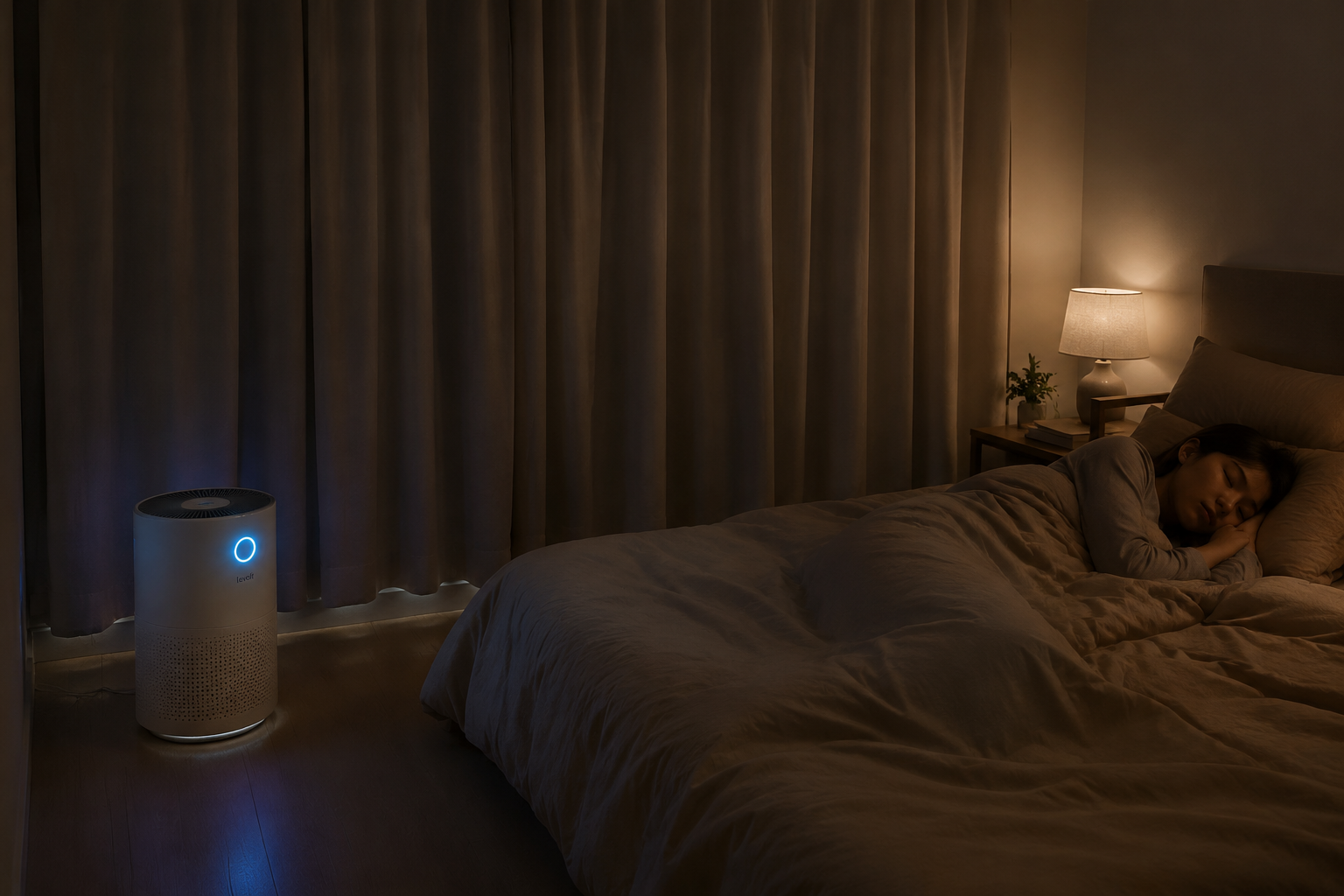
The safest sleep setup for tonight
If outdoor PM2.5 or AQI is unhealthy, very unhealthy, or hazardous, start with the room where you will spend the longest uninterrupted stretch of time. You are not trying to fix the whole apartment or house by midnight. You are trying to reduce what reaches your nose and mouth for the next several hours.
- Choose one sleeping room and keep its door and windows closed.
- Run a portable HEPA air purifier sized for that room, ideally before bedtime and continuously while you sleep.
- Turn off or avoid particle sources: candles, incense, fireplaces, smoking, frying smoke, and anything that burns.
- Do not vacuum during the event unless you have a high-efficiency setup and a strong reason; ordinary vacuuming can resuspend fine particles.
- Keep windows closed while outdoor readings are poor, then air out the space only when local AQI or PM2.5 improves.
CDC wildfire smoke guidance gives the same practical warning about indoor sources: avoid burning candles, using fireplaces, and vacuuming because these activities can add particles indoors or stir them back into the air.[2] During a smoke event, “cozy” habits are not neutral. Combustion inside the bedroom is just another source layered on top of what has already leaked in from outside.
Why the bedroom matters more after dark
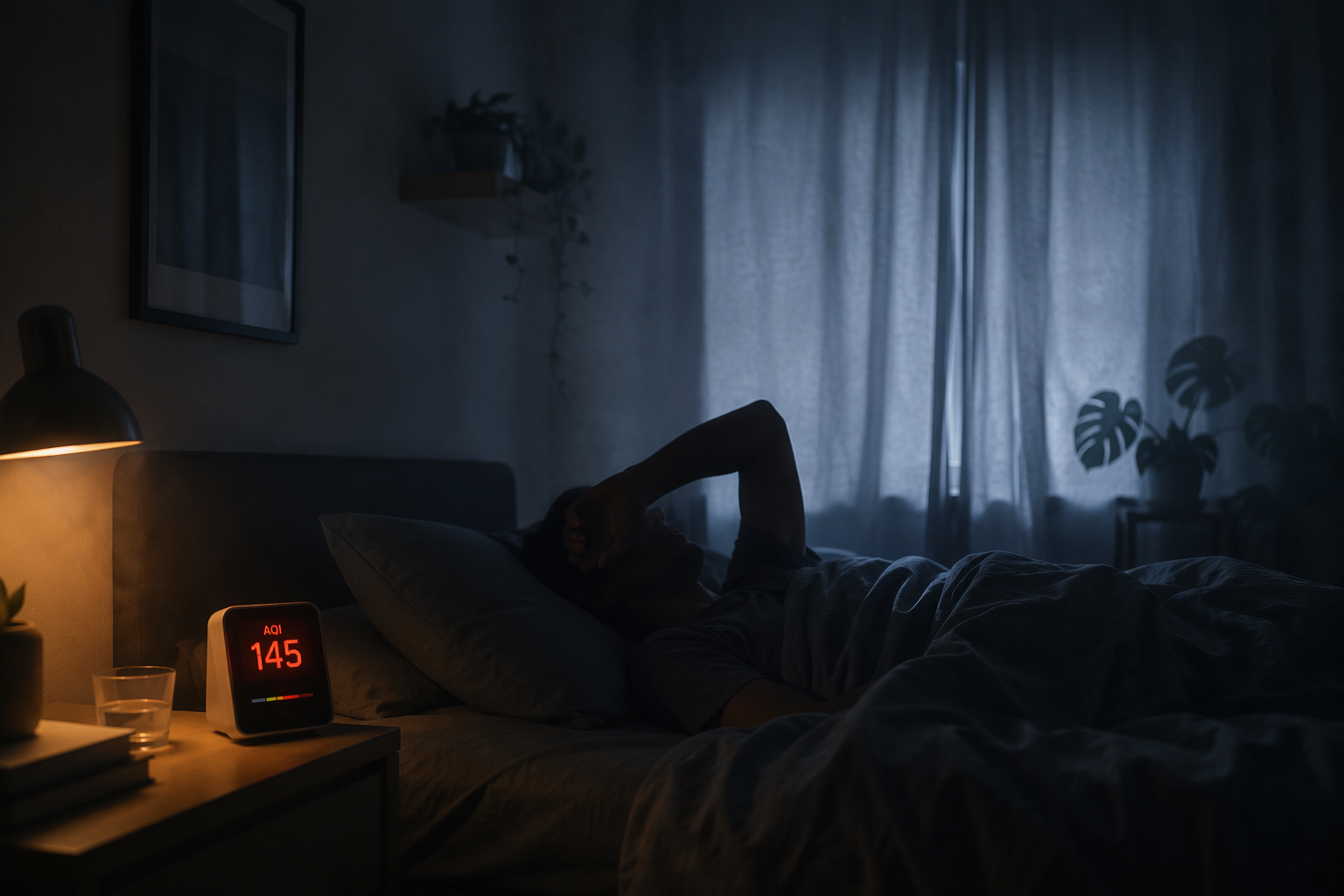
Sleep problems during hazardous air quality are not only about irritation or worry, although both are real. The overnight air itself can be worse than people expect. PurpleAir, citing Penn Medicine research, reports that PM2.5 concentrations tend to peak globally between 9 p.m. and 11 p.m., partly because the loss of sunlight reduces vertical mixing and slows processes that help disperse or break down pollutants.[3]
That timing changes the job. If fine particles rise after sunset and remain elevated into the morning, sleep is not merely happening during an air quality event. Sleep is happening during a long exposure window, with the same room, the same pillow, the same fan pattern, and the same small leaks repeating breath after breath.
The broader sleep evidence points in the same direction, though it is not as tidy as a single number. A 2020 systematic review by Liu and colleagues examined 22 studies across 17 countries; 21 of the 22 studies reported a positive association between air pollution exposure and poorer sleep outcomes.[4] The review also noted important limits: the studies varied too much for a meta-analysis, many were cross-sectional, and only 5 of the 22 assessed indoor exposure.[4] In other words, the relationship is consistent enough to take seriously, but the bedroom-specific dose-response story is still incomplete.
Build one clean sleeping room, not a perfect home
The clean-room approach works because it narrows the problem. A whole home has exterior doors, kitchen activity, laundry dust, bathroom fans, hallway gaps, and people moving in and out. A bedroom is smaller, easier to close, easier to filter, and easier to keep boring for one night.
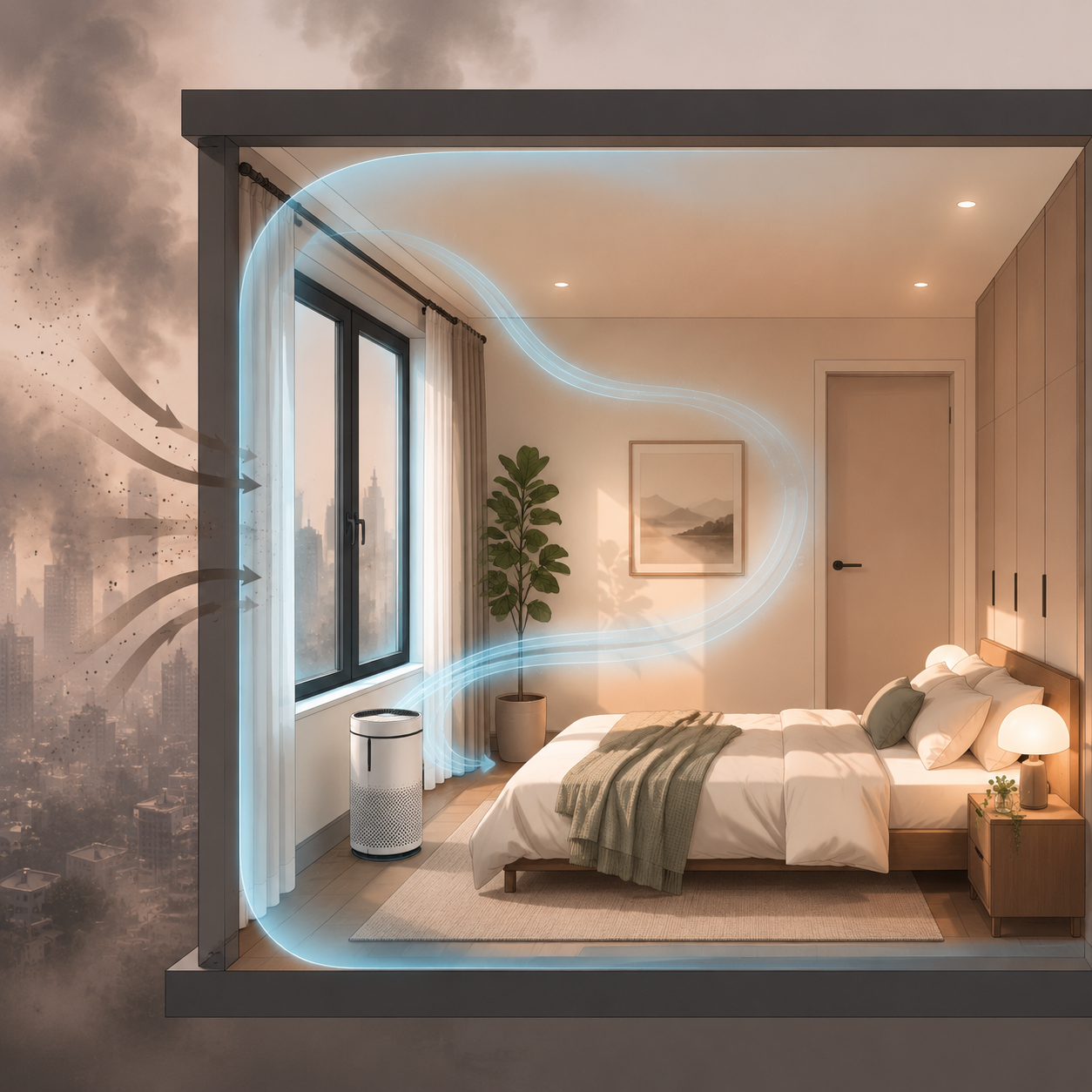
Start with the obvious openings. Close windows. Close the bedroom door. If there are visible gaps around a window or an exterior door and you have painter’s tape, weatherstripping, or a rolled towel, reduce the draft without creating a safety problem. Do not tape yourself into a room in a way that blocks escape, hides alarms, or prevents someone from checking on you. The point is leakage reduction, not sealing the room like equipment.
Then give the air cleaner the best chance to work. Put the purifier in the sleeping room, not down the hall. Keep air intake and outlet areas unobstructed. Run it on the highest setting you can tolerate before bed, then use the highest sleep-compatible setting overnight. If noise bothers you, raise filtration earlier in the evening rather than waiting until you are already trying to fall asleep.
A purifier also has to be large enough for the room. Look for CADR, or clean air delivery rate, on the product label or manufacturer specifications. CADR is not a decoration; it is the measure that tells you whether the unit can clean the room’s air at a useful rate. A tiny desktop unit in a large bedroom may make light and noise without moving enough clean air to matter. If the label gives a recommended room size, match it to the actual bedroom, and remember that smoke particles are the relevant category during wildfire events.
| Bedroom decision | What to do during hazardous outdoor air |
|---|---|
| Room choice | Use the smallest comfortable sleeping room that can safely fit the sleeper, purifier, and needed supplies. |
| Windows | Keep closed while local outdoor PM2.5 or AQI remains poor. |
| Door | Keep closed as much as practical, especially if cooking, cleaning, or hallway traffic is happening elsewhere. |
| Air purifier | Use a HEPA unit with CADR or room-size guidance appropriate for the bedroom. |
| Indoor sources | Avoid candles, incense, fireplaces, smoking, frying smoke, and unnecessary vacuuming. |
There is some intervention evidence that bedroom filtration can help sleep, but it should be kept in proportion. A 2023 clinical study covered by Health.com found that people using HEPA air purifiers in bedrooms slept an average of 12 minutes longer per night and spent more time in bed.[5] That is useful evidence for filtration as a sleep-supporting environmental change. It is not a guarantee that a purifier will add 12 minutes to every smoke-night sleep, especially when heat, anxiety, noise, asthma symptoms, and evacuation alerts may be part of the same night.
Source control is the part people skip
A purifier is not a license to keep making particles indoors. During hazardous air quality, the cleanest particle is the one you never release into the room. This is where ordinary evening routines need to change for a few days.
Skip candles and incense, even if they normally help you wind down. Do not use a fireplace for atmosphere. If you need to cook, avoid smoky frying or broiling, and keep the bedroom door closed while cooking happens elsewhere. If the home uses wood, coal, or another solid fuel for heating or cooking, treat that as a serious indoor exposure source, not just a background condition.
A Johns Hopkins metastudy reported by The Guardian in 2025 reviewed 25 studies involving about 1.2 million people across 6 countries and found that using wood, coal, or other solid fuels for heating or cooking was associated with worse sleep quality, including insomnia and shorter sleep duration.[6] The same coverage reported that using an extractor fan or opening a window during cooking reduced the impact, but during a wildfire smoke night that window decision has to be weighed against outdoor readings.[6]
Cleaning also needs restraint. It is tempting to attack dust when the air smells dirty, but dry sweeping and ordinary vacuuming can push settled particles back into the air. If a surface truly needs cleaning, use a damp cloth or mop rather than stirring dust into the bedroom. Save deep cleaning for when the outdoor event has passed and ventilation is possible.
Ventilation depends on local air, not the clock
The hard part of sleeping with windows closed is that the room can become hot, stuffy, or heavy-feeling. That discomfort is real. It is also why people crack a window at the worst possible time: not because they misunderstand smoke, but because the bedroom feels unlivable.
Use local readings rather than a fixed rule like “open the window in the morning.” Smoke and PM2.5 can vary block by block and hour by hour. If outdoor AQI or PM2.5 is still unhealthy, keep the window closed and lean on filtration, shade, light bedding, and safe cooling options. If local readings improve, that may be the time to air out the room, especially if indoor heat or carbon dioxide has built up overnight.
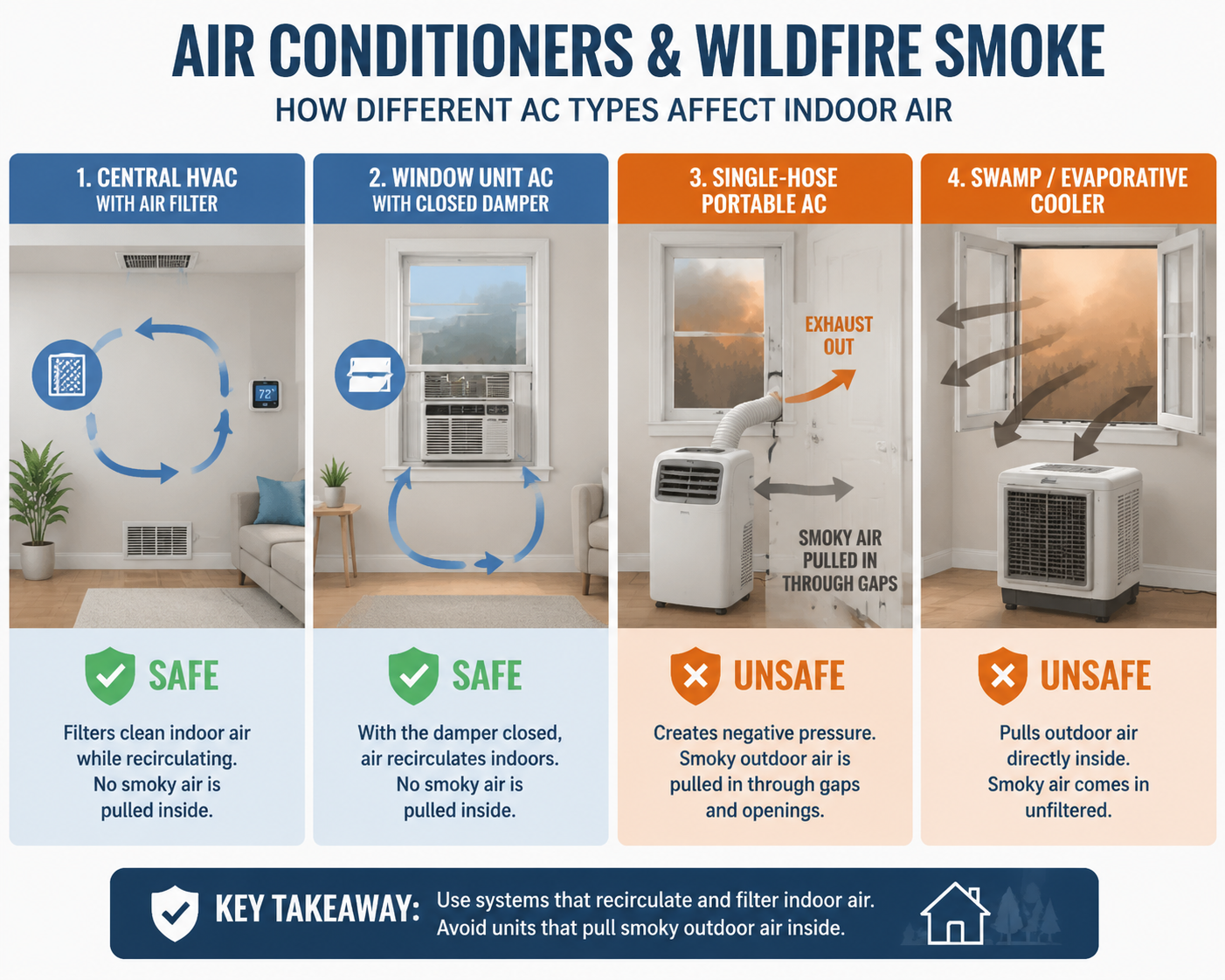
If you have a window fan, do not use it to pull smoky air into the sleeping room during poor outdoor readings. If you have central HVAC, use the best filter the system can safely handle and run the fan mode if your system and filter setup support that use. If you do not have central air, a bedroom HEPA unit becomes more important because it is the main active cleaning tool you control.
Heat can force tradeoffs. If the room becomes dangerously hot, heat risk may outweigh the benefit of keeping a window closed. In that situation, look for a safer air-conditioned location, a community clean-air or cooling space, or guidance from local emergency officials. Hazardous air guidance does not cancel heat safety.
Keep the breathing zone boring
The space closest to your face matters. That includes pillows, blankets, pets, carpets, and the urge to hide under bedding when the air smells bad.
Do not pull a blanket over your head to “filter” smoky air. Scientific American, via PurpleAir, described a modeled estimate in which lying with a blanket over the head could increase inhaled PM2.5 roughly 20-fold because bedding can trap and concentrate particles near the breathing zone.[7] Treat that number as illustrative rather than universal; the exact exposure would depend on the blanket, room, particle levels, and airflow. The practical lesson is still clear: bedding is not a respirator.
If bedding smells smoky, change pillowcases and the top layer when you can do so without stirring up more dust. Wash bedding according to fabric instructions once laundry is practical. If there are extra throws, decorative pillows, or dusty textiles on the bed, move them out of the sleeping zone. The goal is not a showroom bedroom; it is fewer reservoirs close to your mouth and nose.
Pets complicate the room because they bring comfort and particles. If a pet sleeps with you and that is the only way anyone settles, do the realistic thing and keep the purifier running. If the pet has been outdoors in smoky air, wipe fur and paws with a damp cloth before bed when possible. Do not create a battle at midnight that costs everyone sleep unless there is a clear health reason.
What to watch in your body
A cleaner bedroom can reduce exposure, but it does not make hazardous outdoor air harmless. CDC guidance emphasizes that wildfire smoke can affect people differently, with higher concern for children, older adults, pregnant people, people with heart or lung disease, and people who work outdoors.[2] Anyone with asthma, COPD, cardiovascular disease, or another condition affected by smoke should follow their clinician’s action plan and local health instructions.
Do not try to sleep through worsening symptoms because the room is “set up.” Chest pain, severe shortness of breath, confusion, blue lips or face, or symptoms that feel urgent need medical attention. If breathing symptoms are escalating, the next step is not a better pillow arrangement; it is help.
For milder irritation, keep the routine plain. Use prescribed medications as directed. Keep water nearby. Avoid alcohol or sedatives as a way to force sleep through breathing discomfort unless a clinician has told you they are safe for you. Check emergency alerts before bed, then avoid refreshing AQI maps all night unless conditions are changing and you need to make a decision.
A realistic smoke-night routine
A workable routine starts earlier than bedtime. Close the room before outdoor air worsens if you can. Start the purifier while you are still awake. Cook in the least smoky way available, then stop generating particles. Check local air once before the final window decision. Set the room for heat management before you are exhausted.
| Time | Action |
|---|---|
| Late afternoon or early evening | Choose the sleeping room, close windows, reduce obvious drafts, and start the HEPA purifier. |
| Dinner | Avoid smoky cooking; keep the bedroom door closed while food is prepared. |
| Before bed | Check local AQI or PM2.5, confirm windows stay closed if outdoor air is still poor, and remove unnecessary dusty textiles from the bed. |
| Overnight | Keep the purifier running, avoid blanket-over-head breathing, and do not crack a window unless local conditions improve or heat safety requires another plan. |
| Morning | Ventilate only if outdoor readings have improved; otherwise keep filtering and reassess later. |
This is not a promise of perfect sleep. Smoke nights can be loud, hot, frightening, and interrupted. The win is narrower and more useful: one controlled breathing zone, fewer indoor particle sources, a purifier that is actually matched to the room, and a ventilation decision based on local air rather than panic or discomfort alone.
If evacuation guidance is issued, follow it. If symptoms worsen, seek medical help. If outdoor air remains hazardous, keep the bedroom strategy going until readings improve. The room does not have to feel normal to be better protected; it has to be closed, filtered, quiet on particle sources, and ready for the night ahead.
References
- Wildfire Smoke: A Guide for Public Health Officials, U.S. Environmental Protection Agency
- Wildfire Smoke and Your Patients’ Health, Centers for Disease Control and Prevention
- Air Quality and Sleep: How Pollution Impacts Your Rest, PurpleAir
- Air pollution exposure and adverse sleep health across the life course, Environmental Pollution, 2020
- Air Purifiers May Help You Sleep Better, Study Finds, Health.com, 2023
- Household air pollution linked to worse sleep, study finds, The Guardian, September 19, 2025
- Can Sleeping under a Blanket Protect You from Wildfire Smoke?, Scientific American

Comments
Join the discussion with an anonymous comment.