
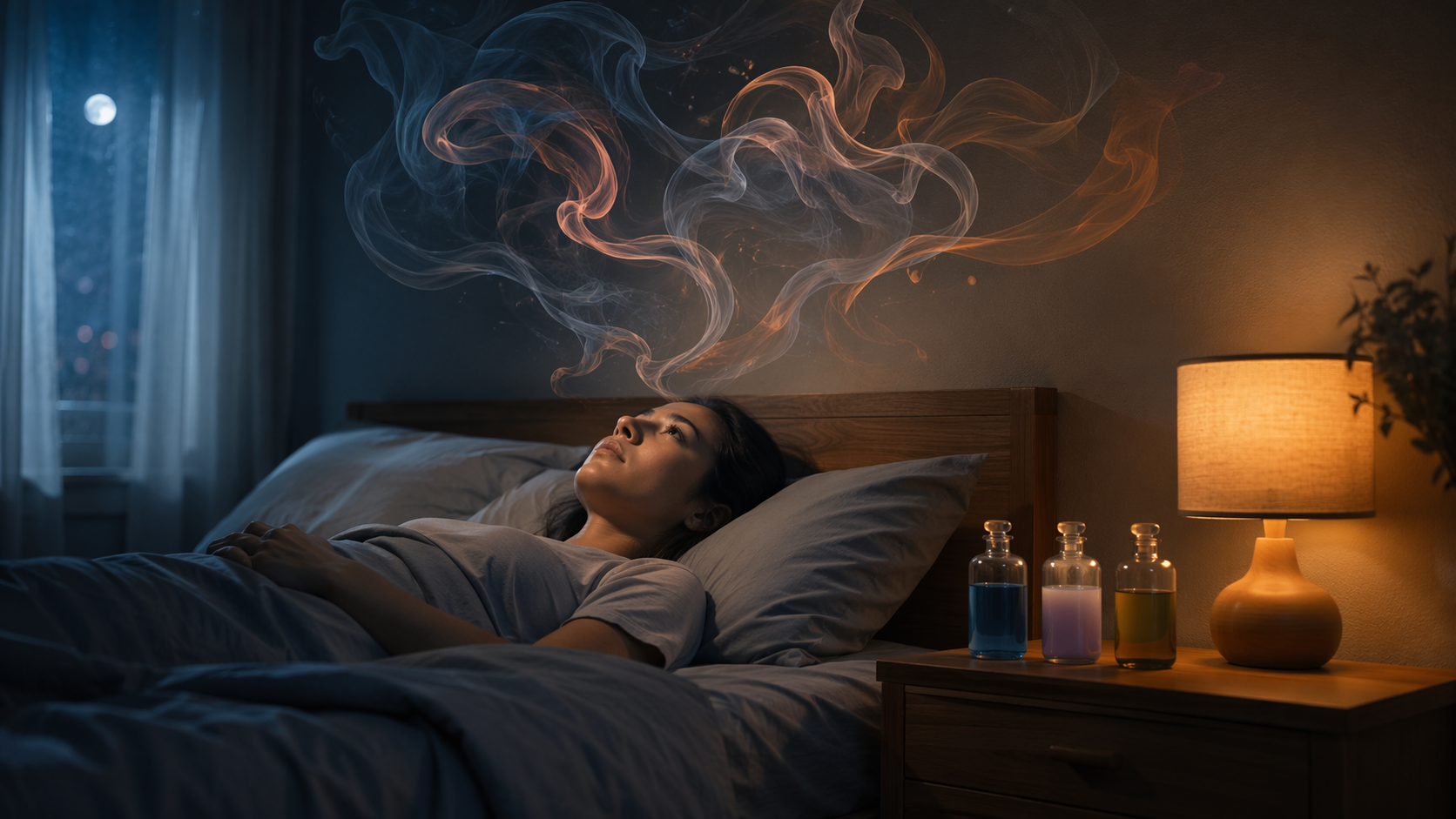
The fastest way to protect sleep from wildfire smoke is to stop trying to fix the whole home at midnight. Pick one bedroom and turn it into a clean room: close it off, reduce leaks, filter the air that enters through the HVAC system if you use one, and run a properly sized portable air cleaner inside the room. The useful thresholds are plain: MERV 13 or higher for the HVAC filter if the system can handle it, and a portable HEPA purifier with a clean air delivery rate of at least 200 cubic feet per minute for a standard bedroom.
That is a different plan from “close the windows.” Closing windows matters, but smoke season exposes every weak assumption in that sentence: a warped rental window, a bathroom fan someone forgot about, a central air system with a low-grade filter, a bedroom door that keeps opening, a purifier bought for a room twice the size it can actually serve. The bedroom deserves special treatment because sleep is long, continuous exposure. If the air in that room is dirty for eight hours, the body does not get to opt out just because the windows are technically shut.
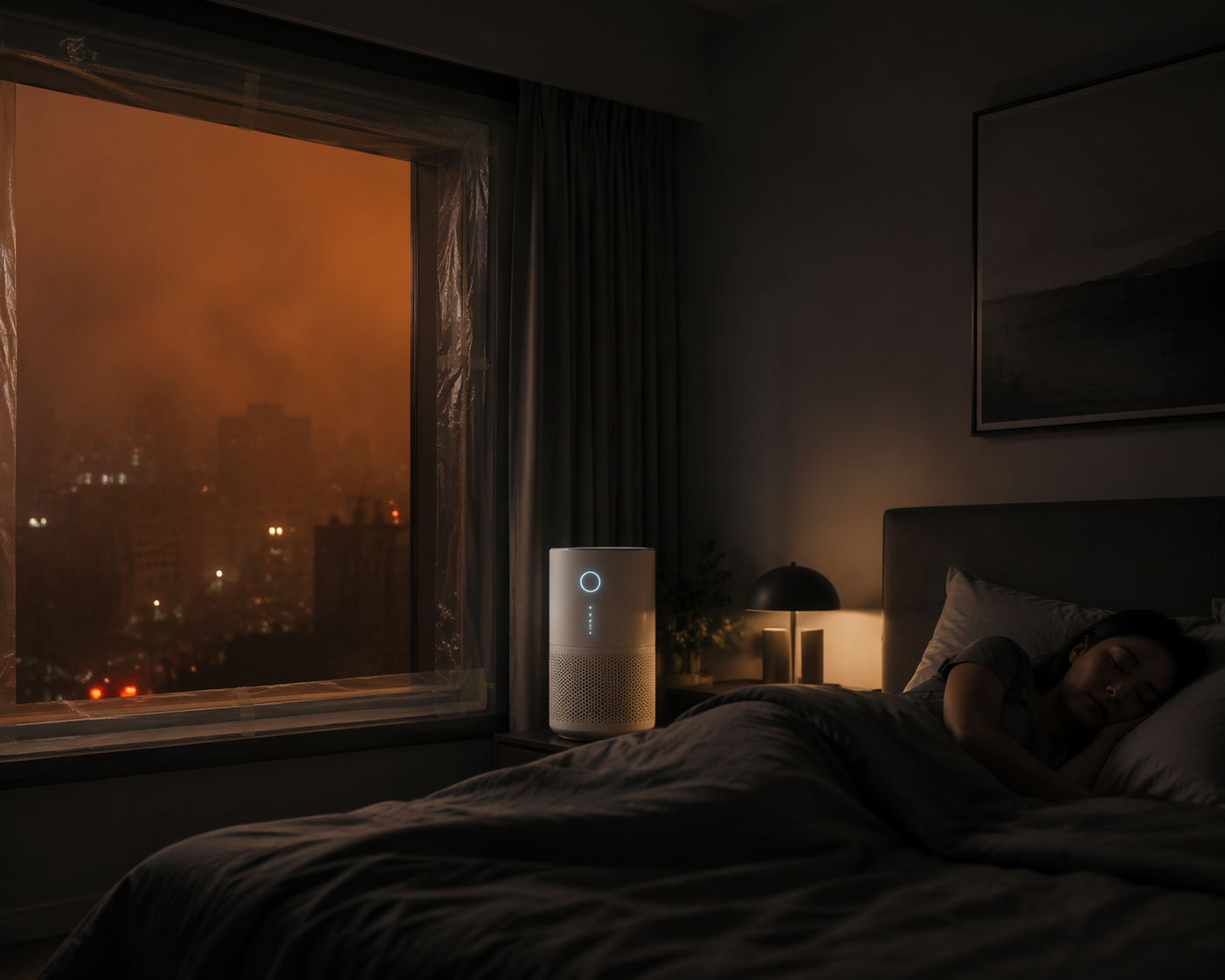
The EPA’s clean room guidance is the most practical frame here: designate one room, preferably with few windows and doors, keep it closed off from smoke, and use a portable air cleaner sized for that room to reduce indoor fine particle exposure during wildfire events.[1] The goal is not a perfect house. It is one sleep space that can be made reliably better before bedtime.
There is also a reason to treat smoke-disrupted sleep as more than discomfort. In a 2023 EPA-linked animal study, researchers reported that combined sleep disruption and eucalyptus smoke exposure produced cardiovascular strain that neither exposure produced alone.[2] That finding should be kept in its lane: it was a rat study, used only male rats, involved species differences in sleep architecture, and used smoke exposure around 964 micrograms per cubic meter. It does not prove the same outcome in a person sleeping through a smoky week. It does make the priority easier to defend: during smoke, protecting the sleep environment is health protection, not bedtime fussiness.
Build the bedroom as a clean room
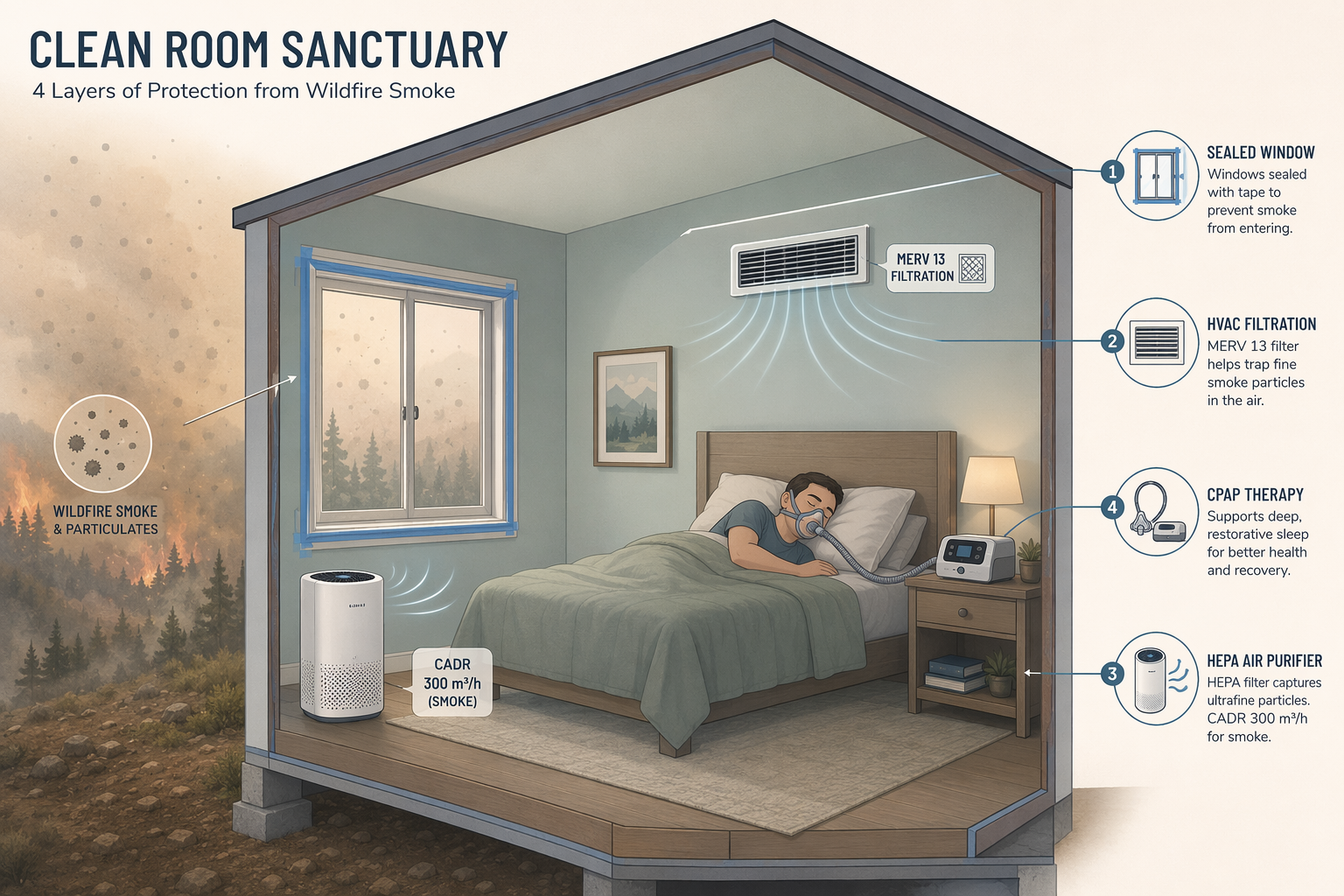
Start with the room, not the machine. A good purifier in a leaky, constantly opened bedroom is working uphill. A taped window without filtration is only a partial defense. The clean-room approach works because each layer reduces the load on the next one.
| Layer | What to do | Measurable threshold |
|---|---|---|
| Room control | Choose one bedroom, close doors and windows, reduce obvious leaks | One closed sleep space, not the whole home |
| HVAC filtration | Use a higher-efficiency filter if your system can handle it | MERV 13 or higher |
| Portable filtration | Run a HEPA purifier sized for the bedroom | CADR at or above 200 CFM for a standard bedroom |
| Equipment maintenance | Replace filters before they become the failure point | Check purifier, HVAC, and CPAP filters on a smoke-season schedule |
Choose the bedroom that is easiest to control. Fewer exterior walls help. Fewer windows help. A door that latches cleanly helps. If someone in the household has asthma, COPD, a CPAP machine, pregnancy, heart disease, or a history of reacting badly to smoke, that person’s room gets priority. This is not the moment to distribute effort evenly across every room so that none of them is actually protected.
Before the smoke is overhead, look for the boring leaks: window gaps, door sweeps, unused window air conditioners, fireplace dampers, and exhaust fans that pull outdoor air through the building. Temporary painter’s tape, weatherstripping, rolled towels, or a door draft stopper can make a real difference in a bedroom because the volume of air is small enough to defend. If you rent, this is often the layer you can control even when you cannot change the building system.
Use MERV 13 as the HVAC line, not a vague upgrade
If the home has forced-air heating or cooling, the HVAC filter can reduce the amount of smoke particles recirculating through the house. The number to look for is MERV 13 or higher, if the system can accommodate that filter without airflow problems. The EPA identifies MERV 13 as the recommended minimum filter rating for smoke conditions, while basic MERV 1-4 filters capture mainly larger visible particles and miss most fine particle pollution that matters during smoke events.[1]
The “if the system can handle it” clause matters. A filter with higher resistance can strain some systems, reduce airflow, or create comfort problems if the equipment was not designed for it. Check the furnace or air handler manual, the filter slot size, and any manufacturer limits before forcing in a thicker or higher-rated filter. If the only filter that fits today is lower than MERV 13, do not pretend it is doing the same job. Treat it as one partial layer and make the bedroom purifier carry more of the load.
Run the HVAC fan in a mode that actually circulates air through the filter when smoke is present, if your system and energy budget allow it. A high-rated filter sitting in an idle system is not cleaning bedroom air. At the same time, avoid settings that bring in outdoor air unless your system has a specific, filtered fresh-air setup you understand. Many households do not know exactly how their ventilation is configured; during heavy smoke, uncertainty should push you toward the controlled bedroom and portable filtration rather than heroic whole-house assumptions.
Pick the purifier by CADR, then keep it running
For a standard bedroom, use a portable HEPA air purifier with a CADR of at least 200 CFM. CADR is useful because it ties a purifier’s claim to how much clean air it can deliver, not just how sleek it looks or how loudly the box says “true HEPA.” Room size, ceiling height, furniture layout, open doors, and leaks still affect the result, but CADR gives you a defensible starting point.
Wirecutter cites the Coway Airmega Mighty2 as a top pick for bedroom-sized rooms and reports a CADR of about 260 CFM, enough to exchange the air in a 350-square-foot room about 4-6 times per hour.[3] That does not make it the only right purifier. It is useful because the number lands above the bedroom threshold and shows what a smoke-season spec should look like. A pretty tabletop purifier with a weak CADR is not equivalent just because both have a filter inside.
Placement is not decoration. Put the purifier in the bedroom, not out in the hallway hoping clean air drifts in politely. Keep the intake and exhaust clear. Avoid tucking it behind curtains, under a desk, or tight against bedding. Run it before sleep so the room has time to clear, then keep it running overnight at the highest setting you can sleep through. If the bedroom door opens repeatedly for pets, children, or bathroom trips, the purifier has to recover from each air exchange.
The quiet setting is the trap on many machines. It is often designed for tolerable noise, not smoke emergencies. If the air outside is visibly smoky or the AQI app is the reason you are awake at 2 a.m., start the purifier high, then reduce only as much as sleep requires. A lower fan speed may still help, but it is not the same performance as the CADR number printed for a higher tested setting.
When purifiers are sold out, a Corsi-Rosenthal box is not a consolation prize
Smoke season has a way of making the recommended purifier unavailable exactly when people finally believe they need one. A Corsi-Rosenthal box exists for that problem: usually four MERV 13 furnace filters taped into a cube with a box fan mounted on top. It is not as polished as a commercial purifier, and it needs careful assembly, but the performance can be serious.
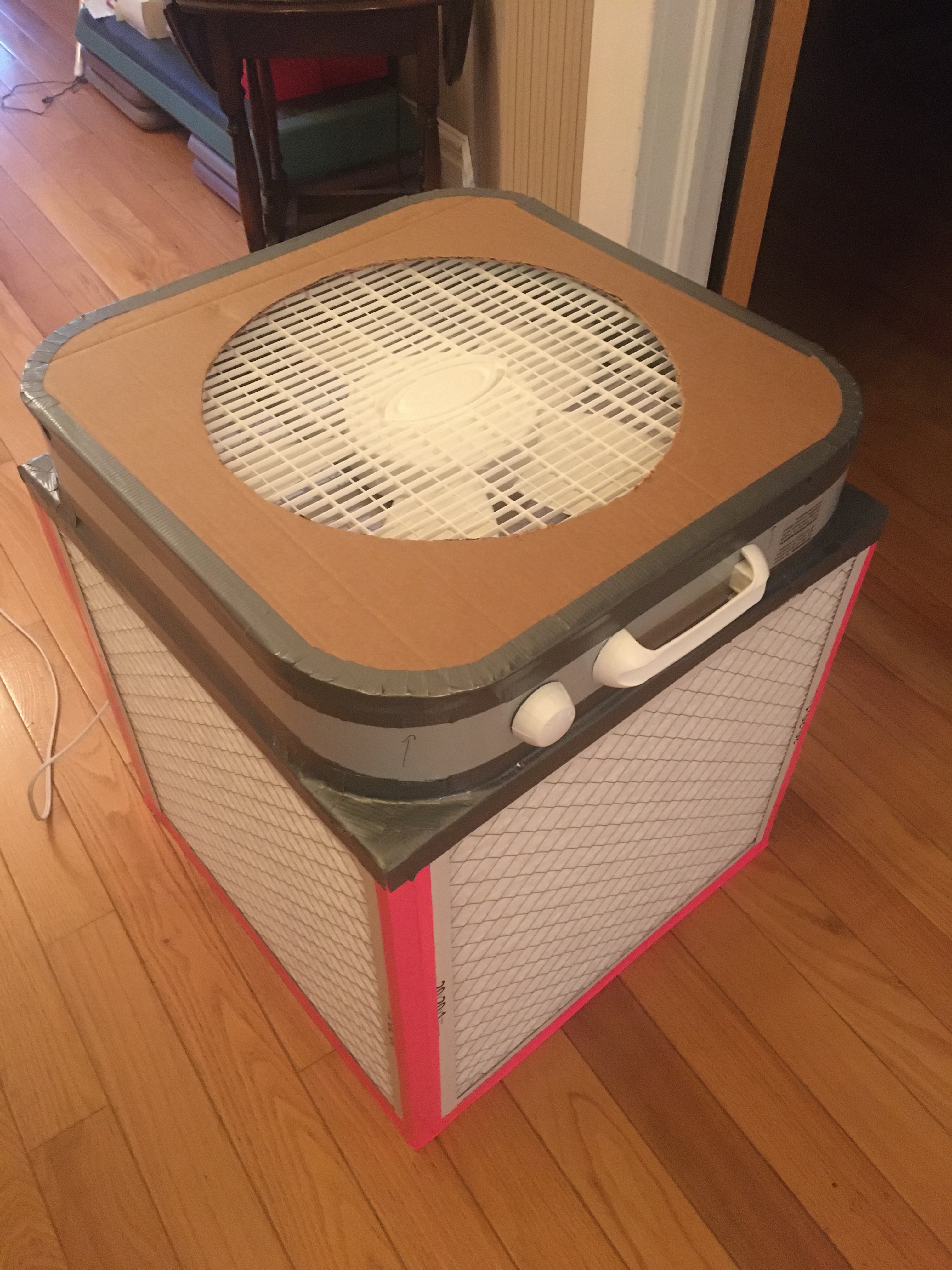
HouseFresh reported that a four-filter MERV 13 Corsi-Rosenthal box achieved a CADR of about 462 CFM in its testing, a result it compared with commercial units costing more than $800, based on its testing of 141 air purifiers.[4] That does not mean every homemade box will perform identically. Fan model, filter size, tape seal, shroud design, and filter quality all matter. But it does mean DIY filtration can be performance-relevant, not merely symbolic, when the alternative is waiting out smoke with no filtration at all.
Use new, matching filters. Make the airflow direction clear before taping. Seal the edges well enough that air is pulled through the filter media rather than around it. Keep the fan stable, keep cords out of walking paths, and do not run improvised equipment unattended if the setup is unstable or damaged. In a bedroom, noise and footprint may be the limiting factors, so some households use the DIY box to scrub the room hard before bedtime and a quieter HEPA unit overnight if they have both.
Maintenance is where clean-room plans usually fail
A smoke plan is only as good as the filter that is still able to pass air. Fine particles load filter media faster during heavy smoke, and the penalty is practical: weaker airflow, more noise, less clean air delivered to the room, and a false sense that the machine is still doing yesterday’s job.
Check the portable purifier filter before wildfire season, not after the room already smells smoky. If the unit uses a washable prefilter, clean it according to the manufacturer’s instructions so hair and dust are not blocking the main filter. If the HEPA filter is near the end of its life, replace it before the first serious smoke event if you can. A filter-change light is helpful, but it may not know that the last two weeks were full of smoke.
Do the same with the HVAC filter. Confirm the size printed on the old filter before buying replacements; guessing at the store is how people come home with a filter that bows, gaps, or will not fit the slot. Install it with the airflow arrow in the correct direction. Keep at least one spare MERV 13 filter on hand if your system can use it. During active smoke, inspect it more often than your normal calendar reminder.
CPAP users need their own smoke-season rule. Snore MD Canada advises replacing CPAP filters every 1-2 weeks during wildfire season rather than the usual monthly rhythm because smoke can clog the filter media faster.[5] That is a small maintenance habit with a large consequence: the machine is pulling room air all night and delivering it through equipment meant to support breathing. If the bedroom air is the clean room, the CPAP filter should not be the neglected final gate.
Keep spare CPAP filters with the smoke-season supplies, not in a vague online cart. Check mask seals and tubing while you are there. If smoke irritation is worsening, pressure feels different, or therapy becomes uncomfortable, contact the clinician or durable medical equipment provider who manages the machine. Filter replacement is practical; changing therapy settings on your own is a different matter.
What to do before bed on a smoke night
The smoke-night routine should be boring enough to repeat when everyone is tired. Do the leak and filter work before bedtime, then leave the room alone as much as possible.
- Choose one bedroom as the clean room and keep its door and windows closed.
- Block obvious leaks around windows, doors, unused window units, or other gaps you can safely seal temporarily.
- Use a MERV 13 or higher HVAC filter if the system can handle it, and run filtered circulation if your setup allows it without drawing in outdoor air.
- Run a bedroom HEPA purifier with CADR at or above 200 CFM, placed with clear intake and exhaust.
- Start filtration before sleep and keep it running overnight at the strongest setting you can tolerate.
- For CPAP users, replace filters every 1-2 weeks during active smoke and keep spares ready.
If you cannot do every layer, do the ones that most directly protect the room where someone will sleep: close and seal the bedroom, run the strongest available filtration in that room, and replace the filters that smoke is loading faster than usual. The point is not to buy the perfect setup. It is to make one room measurably safer by bedtime, then keep the system from quietly failing the next night.
References
- Create a Clean Room to Protect Indoor Air Quality During a Wildfire, EPA
- Cardiovascular effects of sleep disruption and wildfire smoke exposure in rats, Frontiers in Environmental Health, 2023
- How to Use an Air Purifier During a Wildfire, Wirecutter / The New York Times
- The best air purifiers for wildfire smoke, HouseFresh
- Wildfires and Your Sleep, Snore MD Canada

Comments
Join the discussion with an anonymous comment.