
If you searched for a sleep aid while pregnant because chamomile, pillows, earlier bedtimes, and “try to relax” have not touched the problem, the strongest answer is probably not another supplement or over-the-counter medication. For insomnia during pregnancy, the best-supported first option is cognitive behavioral therapy for insomnia, usually called CBT-I.
That may sound disappointingly clinical when what you want is sleep tonight. But CBT-I is not a vague wellness routine. In a randomized trial of 179 pregnant women with insomnia, in-person CBT-I led to insomnia remission in 64% of participants, compared with 52% in the control therapy group. The CBT-I group also reached remission faster: a median of 31 days, compared with 48 days in the control group.[1]
Digital CBT-I has pregnancy-specific evidence too, though the numbers are more modest. In a randomized trial published in JAMA Psychiatry, 44% of participants assigned to digital CBT-I reached remission, compared with 22.3% assigned to standard care, and benefits were maintained at a 2-month follow-up.[1] That makes digital CBT-I a credible route when trained providers are hard to find, not an identical substitute for in-person care.

Pregnancy Insomnia Is Common, But It Is Not Nothing
Sleep disturbance in pregnancy is common enough that many people stop expecting it to be treated. Reviews have reported that 66% to 97% of pregnant women experience sleep disturbances, and prevalence tends to rise later in pregnancy.[2] That context matters because a person in the third trimester may be told, implicitly or directly, that being awake for hours is simply part of the deal.
Some disrupted sleep really is driven by ordinary pregnancy discomfort: fetal movement, reflux, bathroom trips, hip pain, nasal congestion, or anxiety before delivery. Insomnia is different when it becomes a pattern: difficulty falling asleep, difficulty returning to sleep, waking too early, and then dragging through the next day. At that point, better pillows and a cooler room may help around the edges, but they are rarely the whole treatment.
This is where the usual “ask your doctor” advice is correct but incomplete. Medication safety in pregnancy is individualized, and an OB-GYN or midwife should be involved. But if the conversation only sorts through diphenhydramine, doxylamine, melatonin, herbal teas, and sleep hygiene, it can miss the treatment with the clearest pregnancy-specific trial evidence.
What CBT-I Actually Does
CBT-I is a structured insomnia treatment. It works on the loop that keeps insomnia going after the original trigger has already done its damage: spending more time in bed to “catch up,” watching the clock, napping unpredictably, bracing for another bad night, and slowly teaching the brain that bed is a place for wakefulness.
A full CBT-I program usually combines five components: cognitive restructuring, stimulus control, sleep restriction, sleep hygiene, and relaxation training.[1] The important word is combines. Sleep hygiene by itself is usually the gentlest piece of the package, not the engine.
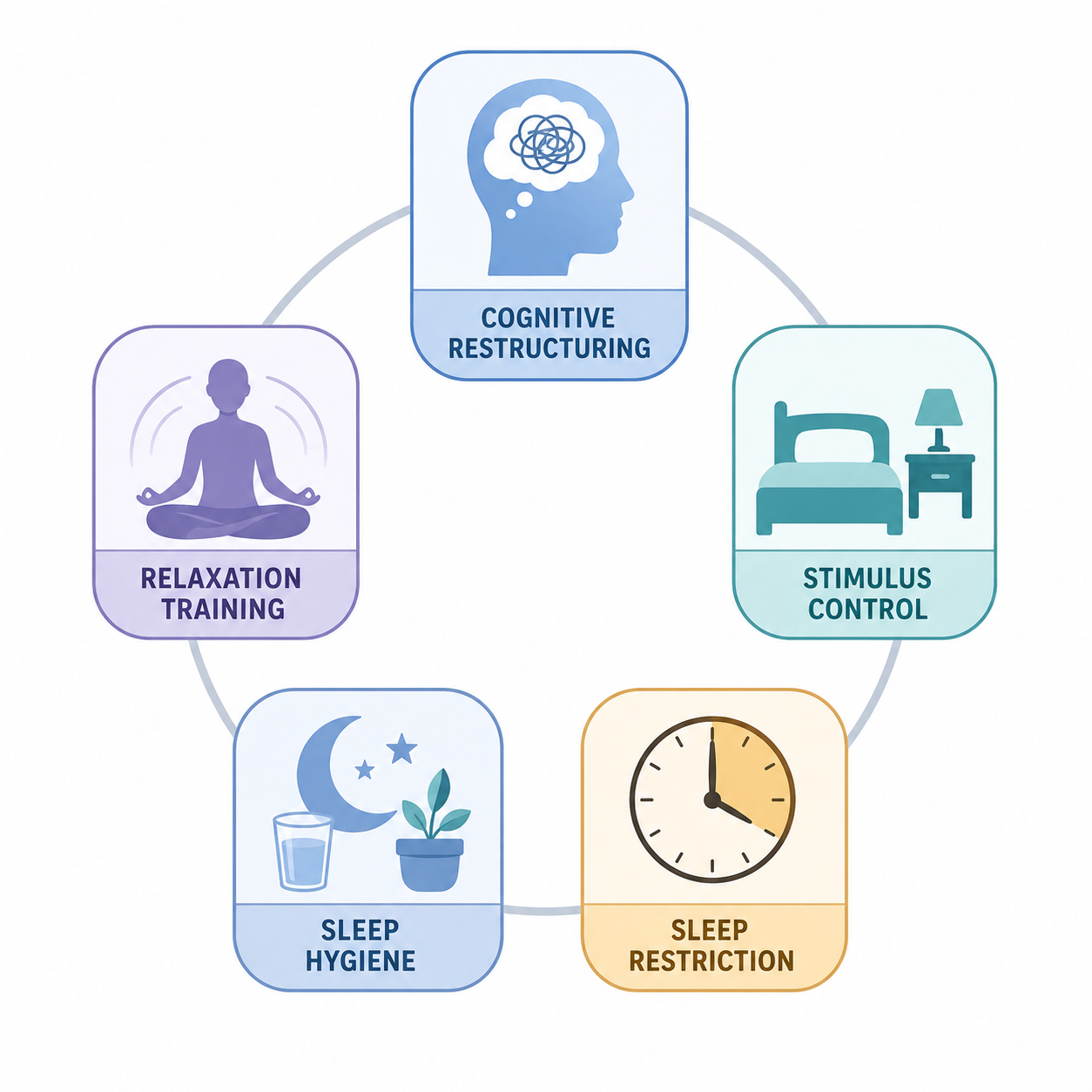
| CBT-I component | What it means during pregnancy insomnia |
|---|---|
| Cognitive restructuring | You learn to challenge sleep-related thoughts that make the night more threatening, such as assuming one bad night means you will not function at all the next day. |
| Stimulus control | You rebuild the bed-sleep connection by reducing awake time in bed and using the bed mainly for sleep, within pregnancy-safe limits. |
| Sleep restriction | You temporarily narrow the sleep window to consolidate sleep, then expand it as sleep becomes more efficient. |
| Sleep hygiene | You adjust supportive habits such as caffeine timing, light exposure, bedroom temperature, and wind-down routines. |
| Relaxation training | You practice calming strategies that lower physical arousal without pretending relaxation alone cures insomnia. |
Stimulus control and sleep restriction are often the parts people have not been offered before. They are also the parts that can feel hardest when pregnant. If you have already been awake for half the night, the instruction to get out of bed instead of staying there and bargaining with sleep can feel almost cruel. Sleep restriction can also sound alarming if it is described poorly. In CBT-I, it does not mean depriving a pregnant person of sleep for the sake of toughness. It means matching time in bed more closely to actual sleep time for a limited period, then increasing the window as sleep consolidates.
That distinction matters. Many pregnant patients have already tried “sleep hygiene”: no late caffeine, less phone time, a pillow between the knees, a wind-down routine. Those steps can be useful, and an evidence-based sleep hygiene checklist can still support treatment. But CBT-I asks a different question: what are you doing, often understandably, that is training the insomnia pattern to persist?
The In-Person Trial: Strong Results, With Important Boundaries
The Manber trial is the main reason CBT-I deserves to be named early in any serious discussion of pregnancy insomnia. It was not a loose recommendation based on adult insomnia studies outside pregnancy. It was a randomized controlled trial in pregnant women with insomnia, and it measured remission, not just whether participants felt somewhat better.[1]
The 64% remission figure is encouraging, but it should be read with the comparison group beside it. The control therapy group also had a 52% remission rate.[1] Pregnancy insomnia can change over time, attention from a clinician can help, and some people improve without the active CBT-I package. The larger practical signal is not only that more people remitted with CBT-I, but that remission came sooner: 31 days versus 48 days by median time to remission.[1]
For a pregnant person, that time difference is not trivial. In the second or third trimester, 17 days can mean fewer exhausted workdays, fewer nights spent dreading the next night, and less time trying to decide whether to add a medication. It also means CBT-I is not merely a long-term philosophical preference. In the trial, improvement often happened within the same pregnancy.
The boundary is just as important: the trial excluded women with major psychiatric disorders.[1] That does not make the results weak. It means they should not be stretched to claim that a pregnant person with significant depression, severe anxiety, bipolar disorder, trauma symptoms, or another major psychiatric condition should self-manage insomnia with a generic program and no added support.
Digital CBT-I Helps When Access Is the Problem
The cleanest version of the recommendation is in-person CBT-I with a trained clinician. The real world is messier. Many communities do not have enough behavioral sleep medicine providers. Some pregnant patients cannot fit weekly appointments around work, childcare, transportation, nausea, fatigue, or insurance limits. A treatment that exists only in a specialty clinic is not much help to someone lying awake tonight.
That is why the Felder digital CBT-I trial matters. Digital CBT-I delivered through an online or app-based program produced a 44% remission rate, compared with 22.3% in standard care.[1] Those results do not erase the gap between 44% and the 64% remission reported in the in-person trial, and the studies should not be compared as if they were the same design with the same participants. But digital treatment did outperform standard care in a pregnancy-specific randomized trial.[1]
| Option | Best fit | Tradeoff |
|---|---|---|
| In-person CBT-I | Someone who can access a trained CBT-I provider and wants individualized adjustment during pregnancy | Stronger remission figure in the cited pregnancy trial, but access and insurance can be barriers |
| Digital CBT-I | Someone without a local provider, with scheduling constraints, or waiting for an appointment | More available and supported by pregnancy-specific RCT evidence, but the remission figure was lower than in the in-person trial |
| Sleep hygiene alone | Supportive care for habits and environment | Helpful around the edges, but not the same as CBT-I |
| Medication or supplements | A possible backup or short-term option after individualized pregnancy safety discussion | Safety depends on the substance, dose, trimester, medical history, and clinician guidance |
If you are comparing digital options, start with pregnancy-specific caution. A general CBT-I app selection guide can help you look for the basics: a structured program, sleep diary, stimulus control, sleep-window guidance, and a clear explanation of how the algorithm adjusts recommendations. During pregnancy, it is also worth asking your OB-GYN whether any sleep-window limits or daytime sleepiness concerns should change how aggressively you follow the program.
What to Ask for at an OB-GYN Appointment
A useful appointment starts with a specific request, not a general complaint that you “cannot sleep.” Bring enough detail to show the pattern: when insomnia started, how long it takes to fall asleep, how often you wake, how early you wake, naps, caffeine, work schedule, medications, mental health symptoms, snoring, restless legs, reflux, pain, and whether you feel unsafe driving or caring for others because of sleepiness.
- “Can you refer me to a CBT-I provider or behavioral sleep medicine clinician?”
- “If there is a waitlist, is digital CBT-I reasonable for me while I wait?”
- “Do any pregnancy complications, blood pressure issues, mood symptoms, or safety concerns change how I should use sleep restriction?”
- “Should I also be screened for depression, anxiety, restless legs, sleep apnea, reflux, or another condition that could be driving the insomnia?”
- “If we consider medication, where does it fit after CBT-I and what are the trimester-specific risks and benefits?”
The point is not to arrive with a demand for one perfect treatment. It is to make sure CBT-I is on the table before the conversation collapses into “take something” or “tough it out.” If you want a shorter overview to bring into that conversation, this site’s guide to CBT-I for insomnia during pregnancy can work as a starting point.
Where Medication Fits
Medication is not a moral failure, and pregnancy is not a contest to endure symptoms without help. Some people need medication. Some need short-term support while another condition is treated. Some have vomiting, pain, panic, shift work, or medical complications that make a simple non-drug plan unrealistic.
Still, for a pregnant person who is trying to avoid medication if possible, CBT-I is the first option to discuss because it treats the insomnia pattern without adding fetal drug exposure. That is a different claim from saying every supplement or medication is unsafe. For a broader comparison of doxylamine, diphenhydramine, melatonin, herbal products, and prescription options, use a pregnancy-specific guide to sleep aids during pregnancy and review the decision with your clinician.
The Mental Health Signal Is Encouraging, Not a Guarantee
Both the in-person and digital CBT-I pregnancy trials reported reductions in depressive and anxiety symptoms.[1] That makes clinical sense: when sleep improves, the emotional load of pregnancy may become more manageable. But it should not be oversold as proof that CBT-I prevents postpartum depression.
A separate randomized trial of women with third-trimester insomnia found that treating insomnia reduced postpartum depressive symptom severity.[3] That is a meaningful signal, especially because the postpartum period is already a high-demand time for sleep and mood. It is still a narrower finding than “CBT-I prevents postpartum depression,” and it should be treated as supportive, not conclusive.
If insomnia is occurring alongside persistent sadness, panic, intrusive thoughts, loss of interest, trauma symptoms, or any thoughts of self-harm, that is not a situation for an app-only plan. CBT-I may still be useful, but the care plan should be individualized and coordinated with an OB-GYN, mental health clinician, or perinatal psychiatry specialist.
What to Expect Once You Start
In-person CBT-I is commonly delivered over 6 to 8 sessions with a trained provider. A digital program may move through similar material with automated sleep-diary feedback and weekly adjustments. Either way, the first week can feel like data collection: bedtime, wake time, time awake during the night, naps, sleepiness, and patterns that are easy to miss when every night feels like a blur.
The uncomfortable part is that CBT-I asks for consistency before it has fully paid you back. You may be asked to leave the bed when awake, keep a fixed wake time, reduce long naps, or follow a temporary sleep window. Pregnancy fatigue can make those instructions feel especially unfair. That is one reason clinician support is valuable: the plan can be adjusted for safety, functioning, and medical context rather than followed like a punishment.
For the mechanics behind these steps outside pregnancy, a general guide to how CBT-I treats chronic insomnia can help. During pregnancy, use that background to ask better questions, not to override individualized medical advice.
The practical judgment is straightforward: for pregnant women with insomnia, CBT-I is the safest and best-supported first option to bring to an OB-GYN or midwife. In-person care is preferable when it is accessible. Digital CBT-I is a reasonable evidence-based alternative when it is not. And when insomnia is tangled with significant depression, anxiety, or another medical condition, the next step should be more individualized care, not private endurance.
References
- Essential Reads: Cognitive Behavioral Therapy for Insomnia During Pregnancy, MGH Center for Women's Mental Health.
- Sleep disturbances in pregnancy, PMC.
- The treatment of insomnia during pregnancy: A study protocol for a randomized controlled trial, PMC.


Comments
Join the discussion with an anonymous comment.