
The best over-the-counter sleep aid is not the one with the most reassuring front label. It is the one whose active ingredient fits the sleep problem you actually have, after the safety exclusions are out of the way. That distinction matters because OTC and supplement sleep-aid use is not fringe behavior: in 2024, 12.9% of U.S. adults reported using sleep aids most days or every day, and 5.7% used OTC products or supplements, the most common category. Use also rose with age, from 3.9% among adults 18–34 to 7.6% among adults 65 and older.[1]
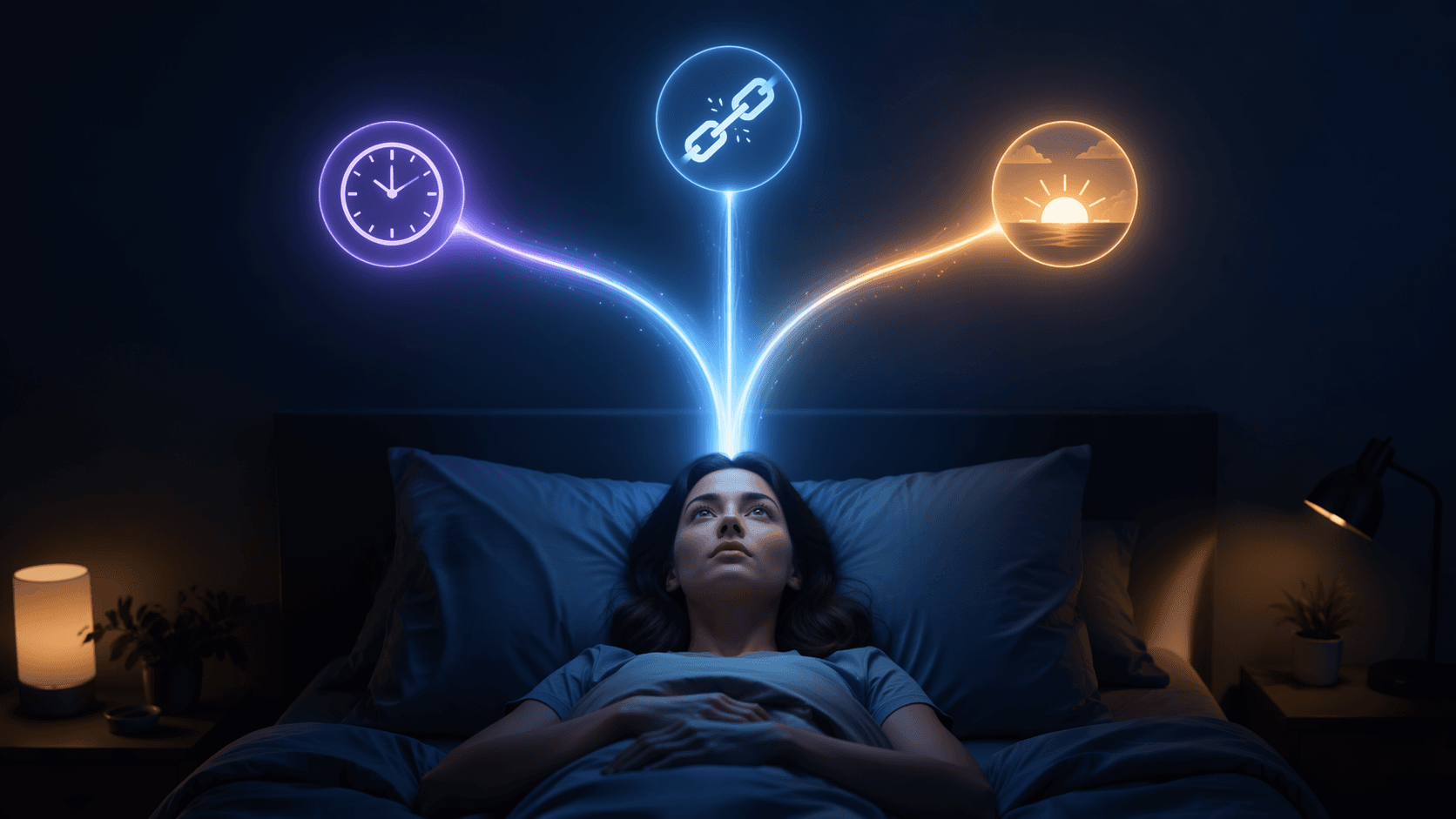
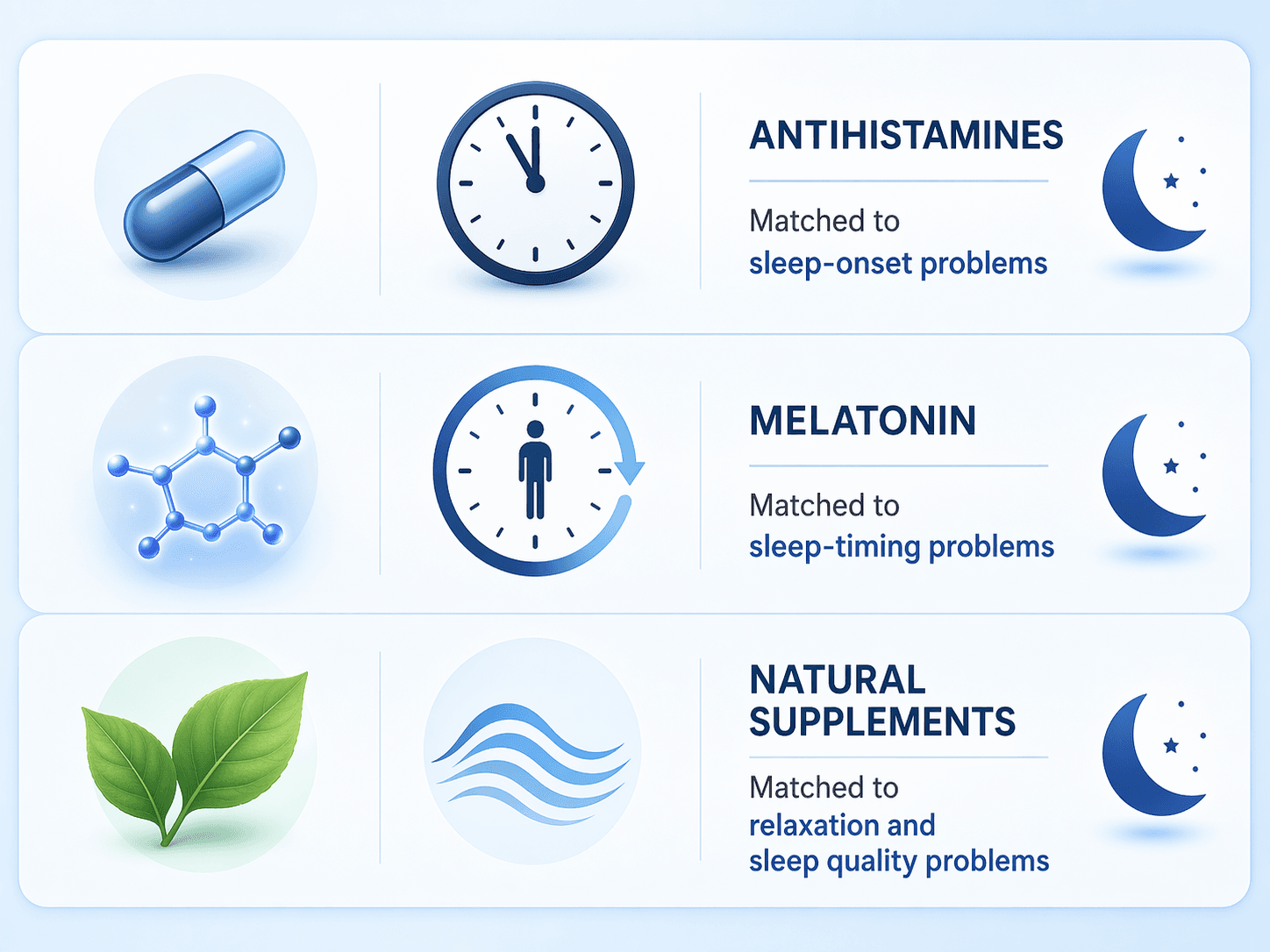
Start with the complaint, not the brand. “I can’t fall asleep” is a different problem from “I wake up at 3 a.m.” or “I sleep, but I cannot afford to feel drugged tomorrow.” Benadryl, ZzzQuil, and many Unisom products are not gentler or stronger versions of melatonin; they are often sedating antihistamines. Melatonin is a timing signal. Magnesium, L-theanine, and valerian sit in the supplement aisle with weaker and more variable evidence. If you want a deeper explanation of why that regulatory line matters, see what “over the counter” actually means for sleep aids.
The Fastest Useful Comparison
| If your main problem is... | Ingredient category that may fit | Why it may help | Main reason to hesitate |
|---|---|---|---|
| An occasional night when you need sedation | Diphenhydramine or doxylamine | First-generation antihistamines cause drowsiness | Tolerance, anticholinergic effects, and next-day impairment |
| Trouble falling asleep because your sleep timing feels shifted | Low-dose melatonin | Signals circadian timing rather than forcing sedation | Many products use higher doses than needed, and gummies may not match the label |
| Light sleep, tension, or mild restlessness with low grogginess tolerance | Magnesium glycinate or L-theanine | May support relaxation or sleep quality without direct drug-like sedation | Evidence is less consistent than the packaging usually implies |
| Chronic insomnia or escalating use | Do not keep rotating OTC products | The pattern itself needs attention | CBT-I or condition-specific care is usually the more serious next step |
This table is useful only if it does not make the choices look cleaner than they are. A sedating antihistamine can knock out an occasional bad night, but that does not make it a good nightly insomnia plan. A supplement can feel gentler, but “dietary supplement” does not mean precisely dosed, proven, or risk-free. The active ingredient panel is where the decision starts.
Antihistamines: Better for Occasional Sedation Than for Repeated Insomnia
Diphenhydramine and doxylamine are the classic OTC sleep-drug ingredients hiding behind many familiar boxes. Diphenhydramine appears in products such as Benadryl and ZzzQuil; doxylamine appears in some Unisom products. They work because first-generation antihistamines cross into the brain and cause drowsiness. Doxylamine is generally longer-acting than diphenhydramine, which can make it more likely to spill into the next morning for some people.[2]
That next-morning spillover is not just a vague “sleep hangover.” First-generation antihistamines can linger for 6–12 hours or longer and may impair memory, reaction time, and focus the next day.[3] If you have to drive early, operate equipment, supervise children, make medical decisions, or perform work where alertness matters, the cost of being sedated tonight may show up tomorrow.
The other problem is tolerance. The American Academy of Sleep Medicine does not recommend OTC antihistamines for chronic insomnia, and tolerance to their sedating effect can develop within days.[4] That is the trap behind “non-habit-forming” language: it may not mean addiction in the way people fear, but it also does not mean the product keeps working well if you take it night after night. For a closer look at that wording, see what “non-habit-forming” on a sleep aid actually means.
Melatonin: A Timing Tool, Not a Stronger Sleeping Pill
Melatonin makes the most sense when the problem is sleep timing or sleep onset: your body does not seem to be getting the “night has started” message at the right time. It is less persuasive as a general-purpose answer for waking at 3 a.m. or for people who want something that behaves like an antihistamine without the antihistamine label.
Dose is where many melatonin products become less sensible. The body produces roughly 0.3 mg of melatonin daily, while supplements commonly contain 5–10 mg, more than 30 times that amount.[5] Lower doses, often in the 0.5–3 mg range, may be as effective as higher doses for many adults, while doses above 5 mg can increase morning grogginess, vivid dreams, and headaches without proportional benefit.[3][6] If melatonin is the right category, a lower-dose product is usually the more disciplined place to start than a high-dose gummy.
There is also a labeling problem, especially with gummies. More than 70% of melatonin gummies in one JAMA analysis had dosage discrepancies between the label and the actual content, but that finding should not be stretched to every melatonin capsule, tablet, or liquid on the shelf.[4] It does, however, make the “just take a gummy” habit look less harmless than the packaging suggests.
Magnesium, L-Theanine, and Valerian: Lower-Key Does Not Mean Identical
Magnesium glycinate is usually considered when the goal is sleep quality or fewer nighttime awakenings without a strong sedating effect. One cited systematic review range places magnesium glycinate around 127–166 mg of elemental magnesium per dose, with low grogginess risk.[5] That does not make magnesium a sleeping pill; it makes it a possible fit for someone whose main objection to antihistamines is feeling dulled the next day.
L-theanine belongs in a similar “relaxation, not forced sedation” lane. A 200 mg dose is commonly discussed for promoting relaxation through alpha-wave activity, and animal safety data cited in secondary reviews reported no adverse effects up to 4,000 mg/kg body weight.[5] Animal safety data is not the same as proof that a supplement will solve adult insomnia, so the useful claim is narrower: L-theanine may be reasonable when tension is part of the bedtime problem and morning clarity matters.
Valerian root is more of a cautionary example than a clean answer. Evidence for valerian is mixed, and it can still cause morning grogginess.[7] If the reason you are avoiding diphenhydramine is that you cannot risk being foggy in the morning, valerian does not automatically solve that problem just because it comes from a plant.
The Safety Check Comes Before the Purchase
Older adults should be especially cautious with diphenhydramine and doxylamine. These drugs have anticholinergic effects, and the Beers Criteria advises avoiding them in older adults; Johns Hopkins also discusses observational research linking anticholinergic exposure with dementia risk in exposure windows extending as far back as 20 years.[8] That association is not proof that one dose causes dementia. It is still enough reason not to treat these products as harmless nightly sleep insurance, especially when falls, confusion, urinary retention, and next-day impairment are already more consequential with age.
Certain medical conditions should also stop the shelf decision and move it to a clinician. Mayo Clinic lists closed-angle glaucoma, peptic ulcer, and urinary retention among conditions that can make antihistamine sleep aids a poor fit.[2] The same caution applies if you take other sedating medications, drink alcohol near bedtime, or are already using medicines with anticholinergic effects.
Pregnancy deserves its own lane. Doxylamine has pregnancy-related use in some contexts, including nausea treatment, but that is not the same as casual permission to self-treat insomnia with whatever sleep aid is nearby. Mayo Clinic and Johns Hopkins both advise medical consultation around sleep aids in pregnancy.[2][8] A pregnancy-specific treatment ladder is a better tool than aisle improvisation; see pregnancy sleep aid safety for a more careful route.
Do not escalate diphenhydramine because the usual dose stopped working. FDA warnings cited by Sleep Foundation note that high doses can lead to seizures, heart attack, coma, and other severe outcomes, with particular concern around misuse by teens and young adults.[4] If you are taking more because the product is losing its effect, the useful signal is not “try stronger.” It is “stop and reassess.”
A Practical Buying Decision
If this is an occasional rough night and you have no safety exclusions, an antihistamine may be the most direct sedating option, provided you can tolerate possible next-day grogginess and are not planning to use it repeatedly. If your issue is more about falling asleep at the wrong biological time, low-dose melatonin is usually a cleaner match than a high-dose gummy. If your priority is morning clarity and the problem feels more like restlessness or light sleep than true insomnia, magnesium glycinate or L-theanine may be more consistent with that goal, while valerian deserves more caution.
The “best over the counter sleep aid” is therefore a filtered choice, not a winner. Name the sleep problem, read the active ingredient, check the morning consequences, and rule out age, pregnancy, medical-condition, medication-interaction, and dose-escalation concerns before buying. If insomnia is chronic, if OTC products are becoming routine, or if you are rotating products to keep them working, the next useful comparison is no longer between boxes. It is between self-treatment, CBT-I, and condition-specific care; this evidence-based guide to choosing a sleep aid can help with that broader decision.
References
- CDC/NCHS Health E-Stat, CDC/NCHS, April 2026.
- Sleep aids: Understand options sold without a prescription, Mayo Clinic, January 2026.
- Best OTC Sleep Aids That Actually Work Without Morning Grogginess, Ubie Health, March 2026.
- Over-the-Counter Sleep Aids, Sleep Foundation.
- Best OTC Sleep Aid, Innerbody Research, December 2025.
- Are drugstore sleep aids safe?, Harvard Health, February 2021.
- Natural Sleep Aids, Sleep Foundation.
- Sleep Aids, Johns Hopkins Medicine, August 2024.
Comments
Join the discussion with an anonymous comment.