
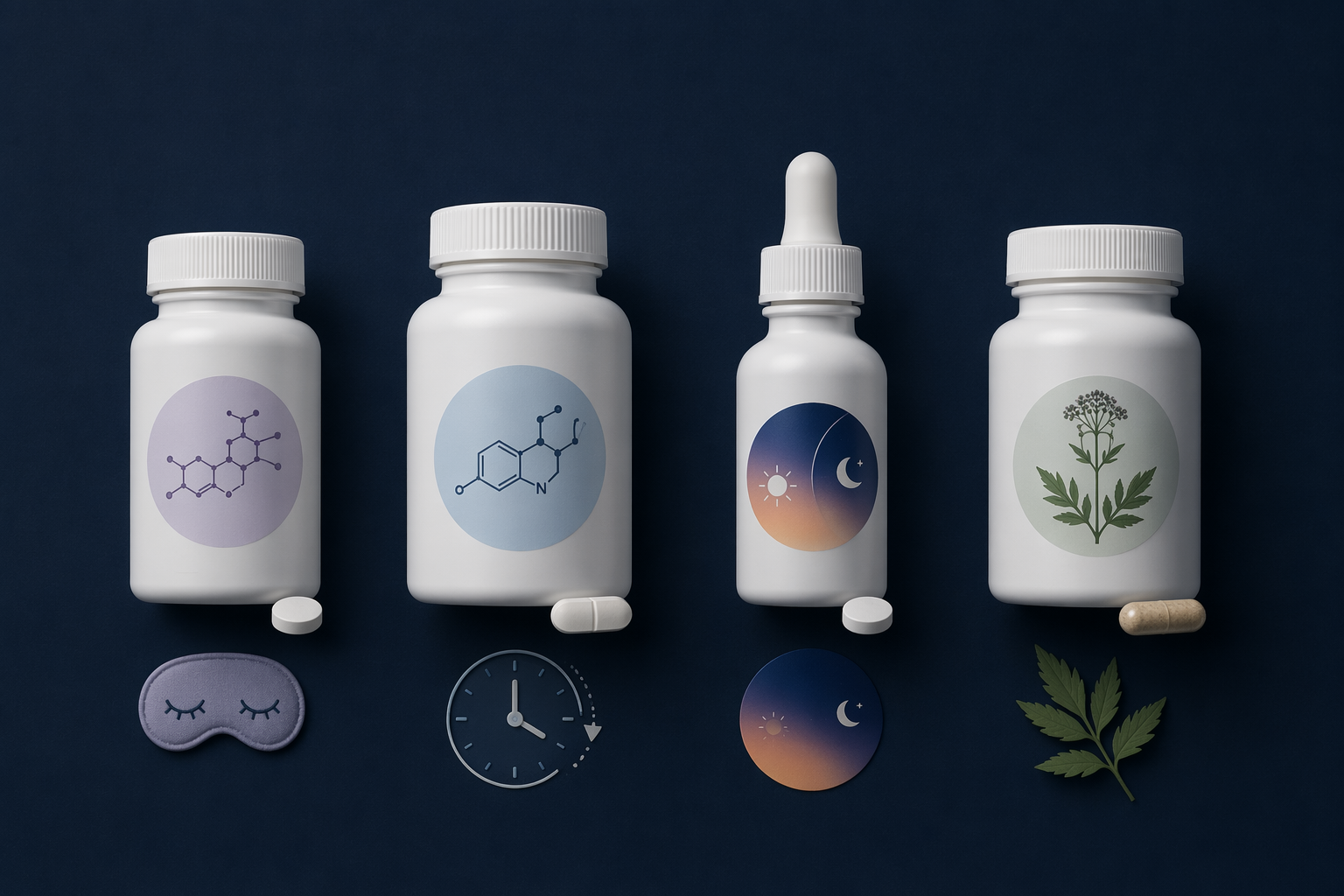
The useful part of a sleep medicine over the counter is usually not the brand name on the front. It is the active ingredient line on the back. That line tells you whether you are holding an FDA-monographed sedating antihistamine, such as diphenhydramine or doxylamine, or a dietary supplement, such as melatonin or valerian. Those are not small differences in packaging language; they are different regulatory categories, different mechanisms, and different safety questions.
This matters because OTC sleep-aid use is not rare. CDC data for 2024 found that 5.7% of U.S. adults used OTC sleep aids most days or every day, and the rate was highest among adults 65 and older, at 7.6%.[1] The CDC category combines OTC medications and supplements, so it does not tell us how many people were taking antihistamines versus melatonin gummies. Still, it is enough to make regular self-treatment a public-health question, not just a private nightstand habit.
The older-adult data are especially hard to shrug off. In a University of Pittsburgh study of older adults using OTC sleep products, 52% of the products contained diphenhydramine or doxylamine, both listed in the Beers Criteria as potentially inappropriate for adults 65 and older. Among older OTC users, 59% took products containing one of those ingredients, only 28% had consulted a healthcare professional, and users of diphenhydramine or doxylamine were less likely to recognize safety risks than other OTC users, at 38% versus 49%.[2] The sample was predominantly white, educated, and from Western Pennsylvania, so it should not be stretched into a national rate. But it captures the problem clearly: shelf access does not equal informed use.
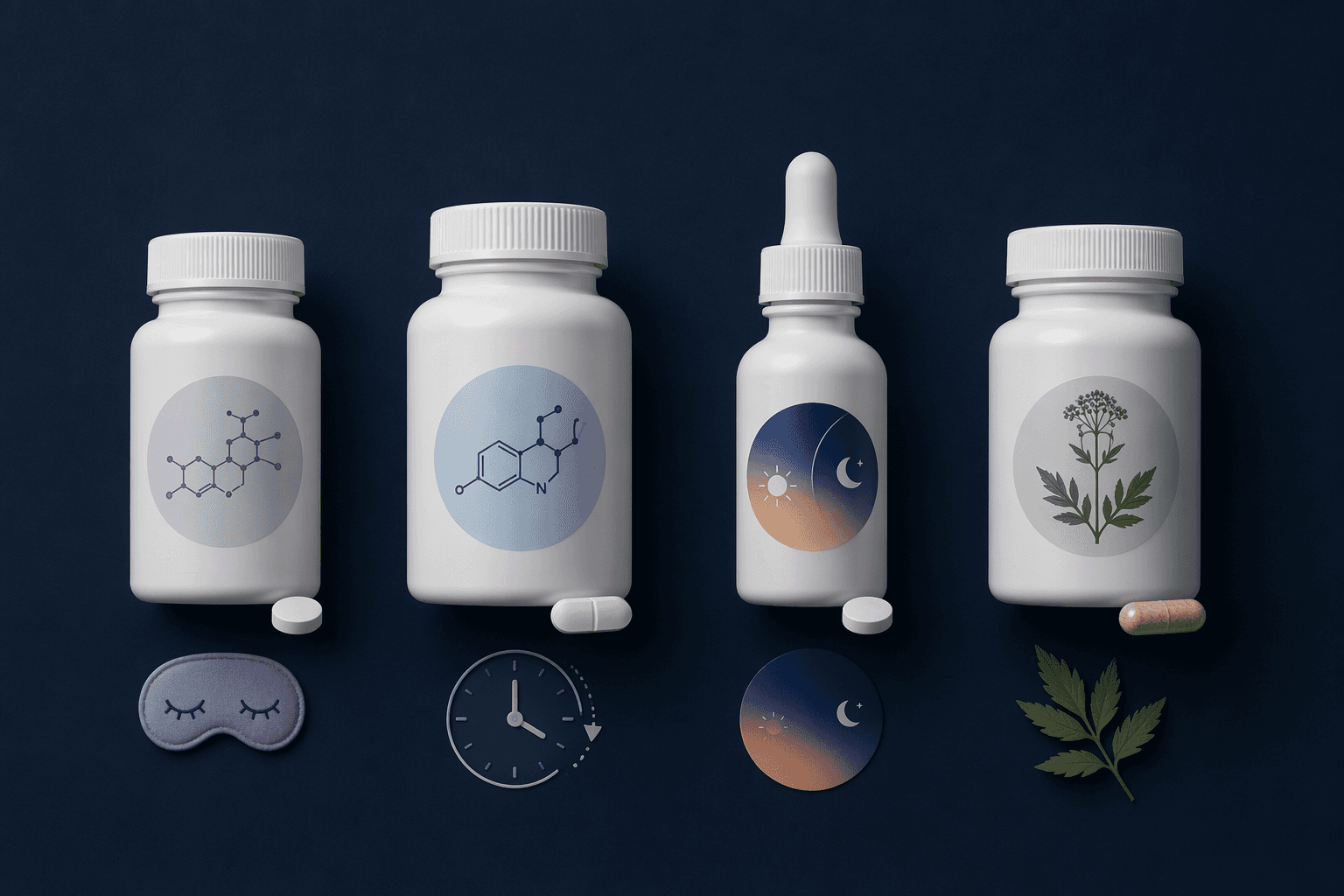
The Ingredient Comparison That Actually Helps
A brand may sell comfort. The ingredient decides what your body is being asked to do. Before choosing among ZzzQuil, Unisom, store brands, melatonin gummies, or a botanical blend, sort the product into this simpler table.
| Ingredient | What it is | What it mainly does | Evidence signal | Main safety concern | Best-fit sleep bottleneck |
|---|---|---|---|---|---|
| Diphenhydramine | FDA-monographed OTC drug; first-generation antihistamine | Sedates by blocking histamine activity and also has anticholinergic effects | Can increase sedation, but evidence for chronic insomnia is limited | Next-day drowsiness, dry mouth, constipation, urinary retention, cognitive effects in older adults, tolerance with regular use | Occasional short-term trouble falling asleep, not nightly use |
| Doxylamine | FDA-monographed OTC drug; first-generation antihistamine | Similar sedating antihistamine effect, often longer-lasting | Sedating, but not a strong long-term insomnia solution | Same anticholinergic concerns; longer hangover risk because of duration | Occasional short-term sleep onset trouble when next-day impairment risk is low |
| Melatonin | Dietary supplement; hormone signal | Helps shift or reinforce circadian timing | Most useful evidence is for timing-related problems; sleep-latency benefit is modest | Variable product content, morning grogginess in some people, interaction and pregnancy questions | Jet lag, delayed sleep-wake timing, circadian disruption |
| Valerian | Dietary supplement; botanical | Proposed calming effect, mechanism not settled | Mixed to negative evidence for insomnia | Variable preparations, side effects, interactions, uncertain benefit | Weak match; not a high-confidence insomnia tool |
For a fuller explanation of why OTC drug products and dietary supplements are regulated differently, see what “over the counter” actually means for sleep aids. That distinction is not academic. FDA-monographed antihistamine sleep aids have standardized active drug ingredients. Supplements do not go through the same premarket approval pathway for insomnia treatment.
Diphenhydramine and Doxylamine: Sedation Is Real, but It Is Not the Same as Good Sleep Treatment
Diphenhydramine and doxylamine are the ingredients most likely to make a person feel that an OTC product “works” on the first night. They are first-generation antihistamines. They cross into the central nervous system and cause drowsiness, which is why they show up in many nighttime products and sleep-aid boxes.
That quick drowsiness is also why people can overestimate them. A sedating drug can make you feel knocked down without fixing the reason you are awake. It can also leave traces the next morning. Mayo Clinic lists daytime drowsiness, dry mouth, constipation, urinary retention, and confusion among concerns with OTC sleep aids such as diphenhydramine and doxylamine, with particular caution for older adults.[3]
The evidence does not support turning these into nightly insomnia tools. A systematic review of OTC medications used in older people for primary insomnia found that diphenhydramine showed a statistically significant increase in sedation, but the evidence base for chronic insomnia was limited; the same review noted that the American Academy of Sleep Medicine guideline recommended against diphenhydramine for chronic insomnia because of insufficient efficacy and safety evidence.[4] That is a narrower conclusion than “never use it.” It is also narrower than the packaging mood some products create.
The practical line is short-term versus regular use. A bad week after travel, grief, a noisy hotel, or a temporary schedule disruption is one situation. Taking the same antihistamine most nights because sleep has become unreliable is another. Tolerance can develop within days of regular use, so the person may get less sleep benefit while still carrying the side-effect burden.
Doxylamine Is Not Just “Another Benadryl”
Doxylamine and diphenhydramine are often treated as interchangeable because both are sedating antihistamines, but the duration matters. Doxylamine may have a half-life up to 8 hours and is described as more sedating than diphenhydramine in comparator data, which can be exactly the problem if you need to drive early, care for someone overnight, or wake up clear-headed.[5]
Doxylamine also shows up in pregnancy-related contexts because it has been used for nausea and vomiting of pregnancy, but that should not be casually converted into “safe as a routine sleep aid in pregnancy.” Routine sleep-aid use during pregnancy deserves a clinician conversation, especially when the reason for poor sleep may be reflux, pain, anxiety, restless legs, medication effects, or another treatable issue.[5]
For a deeper doxylamine-specific safety discussion, use doxylamine as a sleep aid. If the issue is that Unisom SleepTabs helped briefly and then seemed to stop, the more relevant next read is when Unisom SleepTabs stop working.
The Older-Adult Problem Is Not Theoretical
The concern in adults 65 and older is not simply “may feel sleepy.” First-generation antihistamines add anticholinergic burden. That can mean confusion, constipation, urinary retention, blurred vision, dry mouth, and falls. The Beers Criteria flag matters because older adults are more likely to be taking other medications, to wake during the night, and to pay a higher price for morning unsteadiness.
Johns Hopkins Medicine has also highlighted research linking anticholinergic medication exposure, including diphenhydramine, with increased dementia risk over long follow-up periods.[6] That kind of evidence should be read carefully: observational risk is not the same as proof that one occasional dose causes dementia. It does, however, make routine, casual use in older adults look like a poor bargain.
For the Beers Criteria angle in product-aisle terms, see Walgreens sleep aids and older adults. The principle applies beyond one store brand: check the active ingredient, not the shelf label.
Melatonin: A Timing Signal, Not a General Knockout Aid
Melatonin belongs in a different mental box from diphenhydramine and doxylamine. It is not an antihistamine and should not be judged as if it were a milder version of one. Melatonin is a hormone signal involved in circadian timing. Its best fit is a timing problem: your body clock is shifted, travel has crossed time zones, or your natural sleep window is drifting later than your life allows.
That is why the melatonin evidence can sound more impressive than it feels at 2 a.m. A meta-analysis found about a 9-minute reduction in sleep onset latency. Statistically, that can be a real effect; clinically, it is modest. It does not mean melatonin is a reliable sedative for generalized insomnia, and it does not mean taking more will create better sleep.
Among OTC options reviewed for older adults with primary insomnia, melatonin had the most positive evidence for sleep measures, but even that should be kept in proportion.[4] If the sleep bottleneck is circadian timing, melatonin may be worth discussing. If the bottleneck is pain, untreated sleep apnea, alcohol-related waking, anxiety spikes, medication timing, or a bedroom schedule that changes nightly, melatonin is not aimed at the main cause.
Supplement quality adds another wrinkle. A 2017 Journal of Clinical Sleep Medicine study found melatonin content ranged from 83% below the labeled amount to 478% above it, and more than 70% of supplements had significant discrepancies.[7] That study is old enough that current products may not match the same pattern, and a newer large-scale replication was not identified. Still, it is a useful reminder that a supplement label can look precise without delivering a precise dose.
For supplement-only comparisons, the best sleep supplement depends on your specific sleep problem. For a product example built around low-dose melatonin rather than antihistamine sedation, see the MidNite sleep aid review.
Valerian and Botanical Blends Deserve Less Certainty Than Their Labels Often Suggest
Valerian is usually sold with a softer promise: botanical, traditional, calming, natural. Those words can lower a buyer’s guard, but they do not solve the evidence problem. The American Academy of Sleep Medicine has not recommended valerian for insomnia, and the broader evidence is mixed to negative rather than reassuringly positive.
The practical issue is not that every valerian capsule is dangerous. It is that weak evidence plus variable preparations leaves a tired person with little to judge. Botanical blends can also stack multiple calming ingredients without making clear which one is supposed to do the work, whether the dose matches the studies, or whether the combination adds side effects.
If the choice is between a valerian product and a clearer plan for a specific sleep problem, the clearer plan is usually the better use of attention.
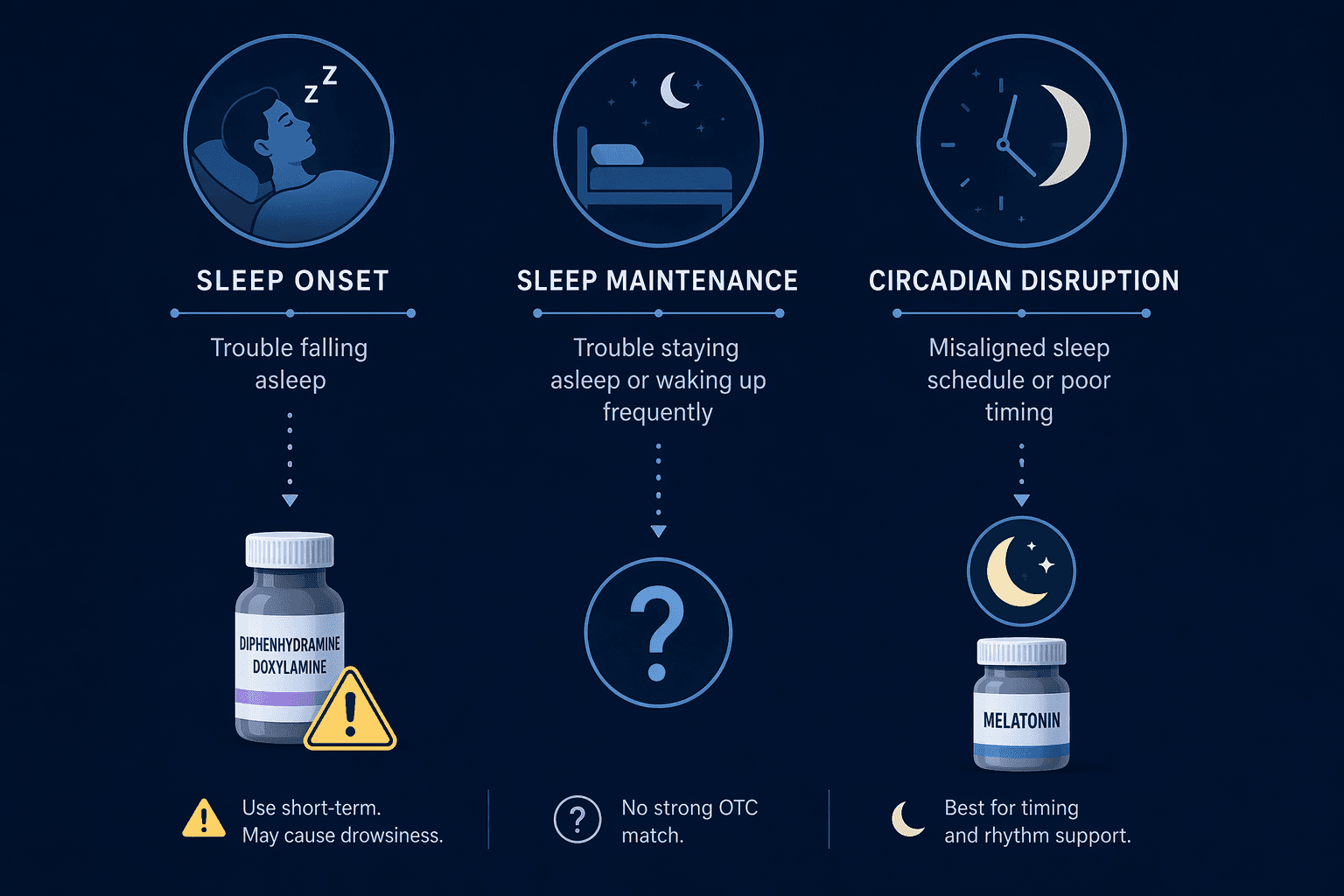
Match the Ingredient to the Sleep Bottleneck
The better question is not “What is the strongest OTC sleep medicine?” It is “What is keeping me awake?” These ingredients do not solve the same problem.
| Your main problem | What that usually means | OTC ingredient match | Why the match is limited |
|---|---|---|---|
| Trouble falling asleep after a short-term disruption | You are sleepy but activated, stressed, or temporarily off routine | Diphenhydramine or doxylamine may sedate briefly | Poor choice for regular use; next-day impairment and anticholinergic effects matter |
| Waking during the night | Sleep maintenance problem, often driven by alcohol, pain, urination, apnea, stress, reflux, or medication timing | No strong OTC match | Sedation may not fix the cause and can increase nighttime fall risk |
| Body clock is too late | You do not feel sleepy until late and struggle with required wake times | Melatonin may fit if timing and dose are appropriate | It is a timing signal, not a knockout drug |
| Jet lag or schedule shift | Circadian rhythm is misaligned with local time or work demands | Melatonin may fit better than antihistamines | Timing matters; taking it at the wrong time can be unhelpful |
| Chronic insomnia | Sleep trouble persists and starts to shape behavior, anxiety, and daytime function | Repeated OTC self-treatment is a weak path | Clinical evaluation and insomnia-specific treatment are more appropriate |
Sleep onset is where antihistamines can look most useful, because they create drowsiness. Even there, they are best thought of as occasional tools, not sleep training. If the bottle has become part of the nightly routine, the decision has already shifted from “Can I get through this short patch?” to “Why has sleep become dependent on this?”
Sleep maintenance is where OTC products often disappoint. Waking at 3 a.m. can come from many causes that a sedative does not address: apnea, pain, alcohol rebound, bladder symptoms, reflux, depression, anxiety, hot flashes, medication effects, or an irregular sleep schedule. Adding a long-lasting antihistamine may make the next morning worse without removing the trigger.
Circadian disruption is the cleaner melatonin lane. A person who cannot fall asleep because her internal clock is late is facing a different problem from a person who is sleepy but anxious. In that situation, timing, light exposure, wake time, and dose matter more than finding the product with the boldest “sleep” claim.
For a broader matching framework, use how to choose the best sleep aid for your sleep problem. If the question is whether a store brand is meaningfully different from a national brand, CVS sleep aid vs. national brands keeps the comparison where it belongs: on active ingredients and labels.
When the OTC Aisle Is the Wrong Place to Keep Looking
An OTC sleep aid can be reasonable when the situation is brief, the person is not in a higher-risk group, the label is understood, and the next day does not require full alertness. That is a much narrower use than many people drift into.
- Avoid treating chronic insomnia with repeated OTC antihistamines.
- Be especially cautious with diphenhydramine or doxylamine in adults 65 and older.
- Do not combine multiple nighttime products without checking for duplicate antihistamines.
- Treat melatonin as a circadian-timing tool, not a general sedative.
- Do not let “natural” substitute for evidence, dose accuracy, or interaction checks.
- Ask a clinician before routine sleep-aid use during pregnancy, in older age, with cognitive symptoms, with urinary retention, or when taking multiple medications.
The American Academy of Sleep Medicine guidance cited here is from 2017, so clinicians and policy writers should check whether newer society guidance has been issued. The direction of the practical advice remains restrained: antihistamines may sedate briefly but are poor regular-use tools, especially for older adults; melatonin is mainly for timing problems; valerian does not deserve strong confidence; and persistent insomnia needs a different pathway than buying another box.
References
- Use of Sleep Aids Among Adults Age 18 and Older: United States, 2024 — CDC / NCHS, April 2026.
- Over-the-counter medications containing diphenhydramine and doxylamine used by older adults to improve sleep — PMC / University of Pittsburgh, 2017.
- Sleep aids: Understand options sold without a prescription — Mayo Clinic.
- A Systematic Review of the Efficacy and Safety of Over-the-Counter Medications Used in Older People for the Treatment of Primary Insomnia — PubMed.
- How Doxylamine Compares to Diphenhydramine — Verywell Health.
- Sleep Aids — Johns Hopkins Medicine.
- Melatonin Natural Health Products and Supplements: Presence of Serotonin and Significant Variability of Melatonin Content — Journal of Clinical Sleep Medicine, 2017.


Comments
Join the discussion with an anonymous comment.