
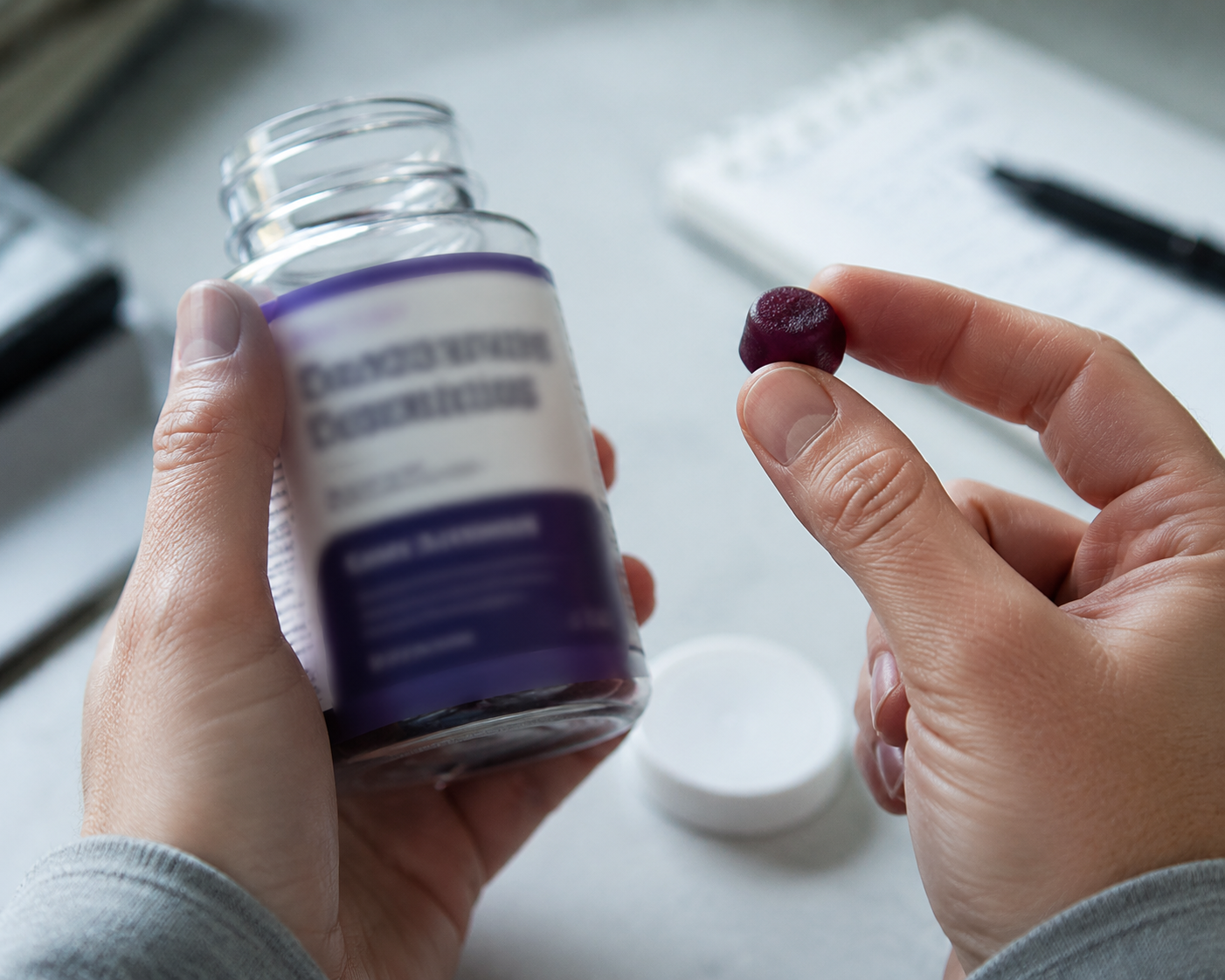
The first thing many people do when shopping for the best gummies for sleep is also the most reasonable thing: turn the bottle around, find the milligrams, scan for reassuring phrases, and compare one label with another. A 2 mg gummy sounds gentler than a 10 mg gummy. “Natural” sounds less medical. “Non-habit-forming” sounds safer at 1 a.m. than a pill bottle from the pharmacy aisle.
The problem is that a melatonin gummy label may not be telling you what is actually in the gummy. In a 2023 JAMA research letter, investigators tested 25 melatonin gummy products sold in the United States. Twenty-two were inaccurately labeled. The actual amount of melatonin ranged from 74% to 347% of the amount declared on the label, and one product contained no melatonin at all while containing 31.3 mg of CBD instead.[1]
That finding does not prove that every melatonin gummy is mislabeled. The study was small, focused on gummies, and drew products from a 2022 NIH dietary supplement label database rather than from every shelf, website, and formulation on the market.[1] It also does not tell us whether tablets, drops, or liquids have the same problem. But it does make one consumer habit much less comforting: choosing by the number printed on the front of the bottle.
What the JAMA gummy study actually found
The most useful part of the JAMA study is not the headline number by itself, although 88% mislabeled is hard to ignore. It is the spread. A person buying a gummy labeled with one dose could receive substantially less melatonin than expected, or more than three times the declared amount.[1] Those are different consumer problems. Too little may lead someone to assume melatonin “doesn’t work” and take more. Too much may increase next-day grogginess or other side effects, especially when the person thought they were choosing a modest dose.
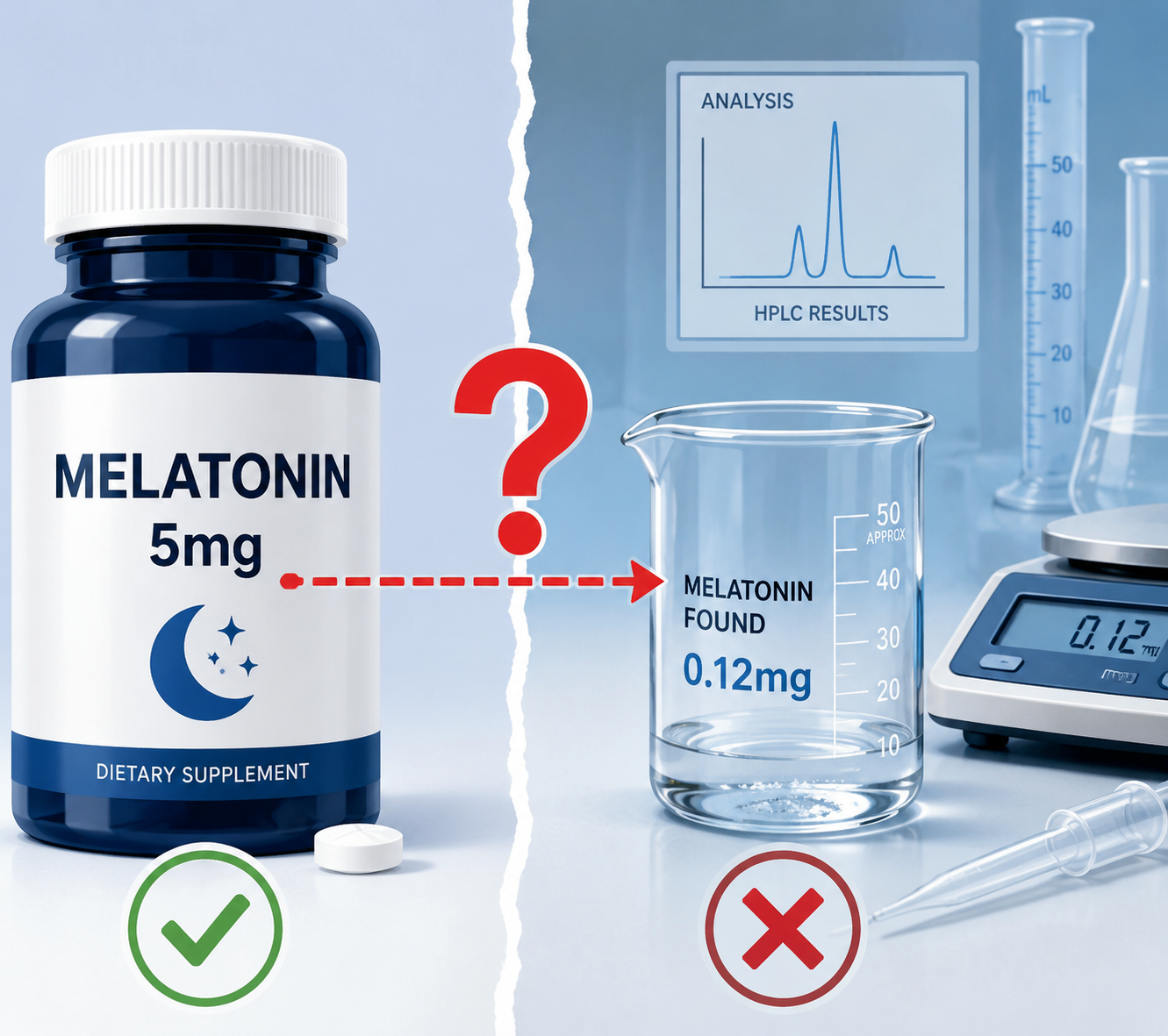
The product with no melatonin and 31.3 mg of CBD is especially clarifying.[1] It is not evidence that CBD is common in melatonin gummies, and it should not turn this into a CBD scare story. Its importance is narrower and more practical: a buyer can think they selected a melatonin product and still end up with something chemically different from what the label led them to expect.
For a supplement used casually, often in the dark, often by tired people, that matters. Sleep gummies are marketed in a way that borrows the confidence of medicine without passing through the same premarket gate. A consumer may read the bottle the way they read an over-the-counter drug label. The regulatory category does not work that way.
Why the label can look firmer than the rules behind it
Melatonin products sold as dietary supplements are not FDA-approved for safety or effectiveness before they reach the market. The FDA also does not premarket test dietary supplements to confirm that the dose on the label matches the amount in the product.[2] That difference is easy to miss because the shelf experience looks familiar: a bottle, a Supplement Facts panel, a dose, a serving size, and claims written in careful retail language.
This is why the JAMA results should be read less as a strange one-off scandal and more as a predictable weakness in the category. If a company’s label accuracy is not verified before sale, the burden shifts toward manufacturer quality systems, voluntary testing, and whatever independent verification the brand chooses to pursue.
There are other quality concerns beyond dose. NCCIH notes that a 2017 study found serotonin, an undeclared ingredient, in 26% of melatonin supplement samples tested.[2] That does not mean your gummy contains serotonin. It does mean that “melatonin supplement” is not a single, tightly controlled product class in the way many shoppers assume.
So what should “best gummies for sleep” mean?
In this category, “best” should not mean strongest, trendiest, or the gummy with the calmest-looking label. It should mean the product is less likely to mislead you about what is inside and less likely to be the wrong tool for your sleep problem.
That starts with third-party verification. USP, NSF, and ConsumerLab are the names to look for because they evaluate supplement quality independently of the brand. Their programs are not identical, and none of them proves that melatonin will fix your insomnia. A seal is not a sleep study. But independent verification can reduce the risk that the ingredient, strength, purity, or manufacturing quality is being represented only by the company selling the bottle.

The distinction matters because a brand can use laboratory language without giving you much to verify. “Clinically tested,” “lab tested,” and “quality checked” may refer to an ingredient, a formulation, a facility, or an internal process. They do not necessarily tell you that the exact bottle in your hand was independently checked for the dose printed on the label.
A shelf-side reliability check
- Look for a real third-party seal from USP, NSF, or ConsumerLab, not a generic “tested” badge designed by the brand.
- Prefer products that publish a Certificate of Analysis for the specific batch or lot number on your bottle.
- Avoid proprietary blends when they hide the amount of each active ingredient.
- Choose a product with one clearly listed active sleep ingredient if your goal is to evaluate melatonin itself.
- Be wary of serving directions that quietly make the real dose larger, such as “take 1–2 gummies” when the front label highlights only the per-gummy amount.
A batch-matched Certificate of Analysis is more useful than a decorative lab badge because it ties the test result to the product lot you actually bought. The document should identify the product, batch or lot number, test date, and measured amount of melatonin. If the certificate is old, belongs to a different formula, omits the dose result, or cannot be matched to your bottle, it is much less helpful.
There is still no need to pretend this creates certainty. Certification and batch testing lower the odds of being misled; they do not turn a supplement into an FDA-approved sleep drug, and they do not answer whether melatonin fits the reason you are awake.
If you are trying to match ingredients to a specific sleep complaint, the broader guide to sleep gummies for adults is the better next read. First, though, the product has to clear the more basic question: can you verify what is in it?
When a correctly labeled gummy still may be the wrong choice
Melatonin is often described as a sleep hormone, but the practical consumer point is simpler: it is better suited to some timing-related sleep problems than to every form of insomnia. If your sleep schedule is shifted after travel or your bedtime has drifted later than you want, melatonin may fit the problem better than it does for months of unexplained nighttime waking, pain-related sleep disruption, anxiety-driven insomnia, or loud snoring with daytime sleepiness.
Short-term use is the safer frame. UC Davis Health describes melatonin as generally recommended for no more than 1–2 months of nightly use and notes that long-term safety has not been adequately studied.[3] That does not mean everyone is harmed after that point. It means a recurring sleep problem deserves a better explanation than simply increasing the dose or staying on gummies indefinitely.
Medication interactions are another reason not to treat melatonin as just a candy-like sleep nudge. NCCIH notes potential interactions with blood-thinning medicines, immunosuppressants, diabetes medicines, and contraceptive drugs, and it also notes concern for people taking anticonvulsants.[2] If any of those apply, the responsible move is to ask a clinician or pharmacist before using melatonin, even if the bottle is certified and the dose is modest.
People with dementia also need special caution. NCCIH states that the American Academy of Sleep Medicine recommends against melatonin use in people with dementia.[2] That is not the kind of warning a front label is likely to make prominent, but it is more important than whether the gummy is raspberry flavored or “doctor recommended.”
The gummy format changes the household risk
Gummies solve one adult problem and create another household problem. They are easy to take because they look and taste less like medicine. That same feature makes them more attractive to children.
NCCIH, citing CDC data, reports that pediatric melatonin ingestion calls to U.S. poison centers rose 530% from 2012 to 2021, reaching 52,563 calls annually. Among those calls, 94.3% involved accidental ingestion by children age 5 or younger. CDC data also estimated about 11,000 emergency department visits from 2019 to 2022 for unsupervised melatonin ingestion by children.[2]
That is not an argument that every adult household should avoid melatonin gummies. It is an argument that gummies should be stored like medication, not like snacks. Child-resistant packaging helps only if the cap is closed and the bottle is kept out of sight and reach.
For children, the threshold should be higher. Banner Health advises that children under 2 should not take melatonin and that children age 2 and older should use it only with pediatrician guidance.[4] A child who is repeatedly unable to sleep may need assessment of schedule, anxiety, breathing, medications, neurodevelopmental factors, or another health issue rather than a parent’s best guess from the supplement aisle.
A practical decision, not a product ranking
| If this is true | What to do |
|---|---|
| The product has no third-party seal and no batch-matched Certificate of Analysis | Do not treat the printed dose as verified. |
| The label uses a proprietary blend or hides ingredient amounts | Choose a clearer product or skip it. |
| You need melatonin nightly beyond 1–2 months | Stop treating the gummy as the plan and look for the reason sleep is failing. |
| You take interacting medicines, are pregnant, are buying for a child, or have dementia | Ask a clinician before using melatonin. |
| Your main issue is not sleep timing but persistent insomnia or unexplained sleep disruption | Consider medical evaluation rather than a stronger gummy. |
The best sleep gummy, if one belongs in your situation at all, is a clearly dosed, independently verified melatonin product used for a short period and for a sleep problem that plausibly fits melatonin’s role. That is a narrower answer than “buy this popular bottle,” but it is more useful in a market where the label may be the least reliable part of the product.
It is also not the only over-the-counter path. If you are comparing melatonin with other nonprescription sleep aids, the guide to which over-the-counter sleep aid is most effective can help separate timing aids from sedating products and other approaches.
Return to the bottle in your hand. If the dose cannot be verified, the product should not be treated as trustworthy. If the sleep problem keeps returning, the next step is not a stronger gummy; it is a better explanation for why sleep is failing.
References
- Quantity of Melatonin and CBD in Melatonin Gummies Sold in the US, JAMA, 2023.
- Melatonin: What You Need To Know, National Center for Complementary and Integrative Health.
- Melatonin and your sleep: Is it safe, what are the side effects and how does it work?, UC Davis Health, February 2025.
- Do Sleep Gummies Work? 5 Things to Know, Banner Health.


Comments
Join the discussion with an anonymous comment.