
The best sleep gummies for adults are not the ones with the loudest reviews or the longest ingredient list. They are the ones whose active ingredient matches the reason sleep is failing in the first place: a body clock that is running late, a mind that will not downshift, muscles that stay tense, or a broader insomnia pattern that a gummy is unlikely to fix.
That distinction matters before brand shopping begins, because the label itself may not be as reliable as it looks. A 2023 JAMA study of 25 melatonin gummy products found that 22 were inaccurately labeled; actual melatonin content ranged from 74% to 347% of the amount declared on the label, and one product contained 31.3 mg of CBD with no detectable melatonin. The study tested one gummy per brand, so it is not a complete survey of the market, but it is enough to make “trusted name” a weak first filter. [1]
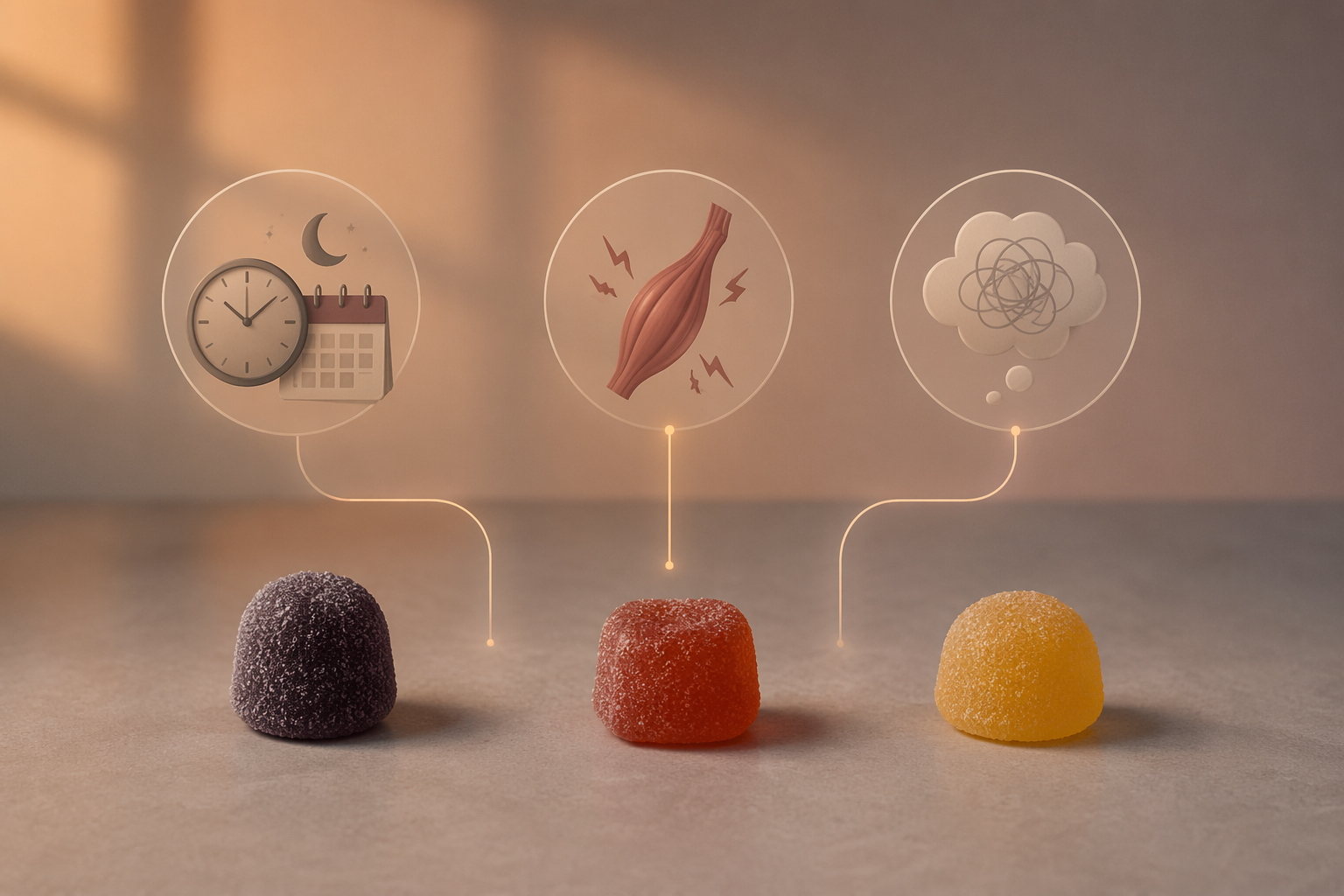
Start With the Sleep Barrier, Not the Flavor
A gummy can be convenient. It can also make a vague supplement feel more precise than it is. Before comparing bottles, name the main pattern you are trying to change.
| If your main problem is... | The ingredient that most plausibly fits | Why the match matters |
|---|---|---|
| You feel sleepy too late, have jet lag, or your schedule keeps shifting | Melatonin | It works on circadian timing, not as a general knock-out sleep drug |
| You lie down tired but mentally activated or worried | L-theanine | It supports relaxation without acting like a sedative |
| Your body feels tense, restless, or physically wound up | Magnesium | It is slower support for relaxation and muscle tension, not an immediate sleep switch |
| You wake often, have chronic insomnia, or have months of poor sleep | Usually not a gummy-first problem | CBT-I, medical review, and condition-specific care matter more than adding ingredients |
| You are curious about CBD or CBN sleep gummies | Cautious, case-by-case consideration | Evidence is still early, products are not FDA-approved for sleep, and interactions matter |
This is why a ranked list of “best sleep gummies for adults” can be misleading even when the products are real. A melatonin gummy and an L-theanine gummy are not two versions of the same tool. They are aimed at different barriers.
Melatonin Gummies: Best Fit for Timing Problems
Melatonin is most defensible when the problem is circadian timing: jet lag, delayed sleep-wake timing, or a schedule that has pushed the body clock out of sync. It signals biological night. It does not simply force the brain into sleep the way many people expect from a sleep aid.
The National Center for Complementary and Integrative Health describes melatonin as a hormone involved in the sleep-wake cycle and notes its use for circadian rhythm problems such as jet lag and delayed sleep-wake phase disorder. The American Academy of Sleep Medicine recommends against using melatonin for chronic insomnia in adults because the evidence is insufficient for that use. [2]
That boundary is not a technicality. If the real issue is anxious rumination, pain, alcohol-fragmented sleep, untreated sleep apnea, perimenopause symptoms, depression, or a learned insomnia loop, a stronger melatonin gummy may only add side effects while missing the problem. Readers who are using melatonin because their sleep schedule is drifting can go deeper with melatonin for adults or the underlying circadian rhythm mechanisms.
The shopping standard for melatonin gummies should therefore be stricter than “contains melatonin.” Look for a clearly stated amount per gummy, third-party testing or a quality certification, a lot-specific testing claim if available, and cautions for pregnancy, breastfeeding, medical conditions, and medication use. The JAMA finding does not prove every product is wrong, but it does mean a polished front label is not enough. [1]
Mayo Clinic has also warned that melatonin gummies can create dose confusion, especially because they may look and taste like candy. That concern is more urgent in homes with children, but it also matters for adults who casually take a second or third gummy because “natural” sounds harmless. [3]
L-Theanine Gummies: Better Matched to Racing Thoughts
L-theanine belongs in a different aisle of the decision tree. It is not mainly a body-clock ingredient. It is more relevant when an adult feels sleepy but cannot settle because the mind stays alert, worried, or mentally busy.
At 100–200 mg, L-theanine is described as promoting relaxation without sedation, partly through increased alpha brain wave activity. Clinical trials have reported sleep-onset time reductions of 30–40% without morning drowsiness, which makes the ingredient more interesting for anxiety-driven onset delay than for circadian disruption or structural sleep problems. [4]
The “without sedation” part is not a weakness. For someone who has to be functional in the morning, a relaxation-oriented ingredient may be preferable to a heavier sleep aid. It also makes the expectation clearer: the goal is to lower cognitive arousal enough that sleep can arrive, not to override a body clock that is set to the wrong time.
If the anxiety component is obvious, it may be worth comparing L-theanine with other over-the-counter categories rather than assuming all calming gummies work alike. The more focused guides on L-theanine for sleep and OTC sleep aids for anxiety are better routes than choosing a gummy because it has the word “calm” on the label.
Magnesium Gummies: Slower Support for Tension and Restlessness
Magnesium is often sold in the same sleep-gummy language as melatonin, but the fit is different. It is more plausible when the barrier feels physical: muscle tension, restlessness, or a body that will not unclench at night.
Magnesium sleep support is often discussed in the 320–500 mg/day range, with proposed pathways including muscle relaxation, GABA activation, and cortisol reduction. But many gummy labels blur a practical limitation: the tolerable upper intake level for supplemental magnesium in adults is 350 mg/day, and benefits may take up to 8 weeks rather than appearing the first night. [4]
That upper-limit issue deserves plain handling. The 350 mg/day limit applies to supplemental magnesium, not magnesium from food. A gummy that stacks magnesium with other powders or asks for multiple servings can make it easy to exceed the supplemental limit, especially if the person is also taking a multivitamin, electrolyte mix, or separate magnesium capsule.
Magnesium also should not be evaluated like a “fall asleep now” product. If an adult wants something for tonight’s post-travel schedule shift, magnesium is not the obvious match. If the complaint is a repeated pattern of evening physical tension, it becomes more reasonable to consider, ideally with attention to the form and total daily dose. For more detail, see magnesium glycinate for sleep.

CBD and CBN Gummies Need a Different Level of Caution
CBD and CBN sleep gummies are usually marketed with a confidence the evidence has not earned. They may be relevant for some adults, but they should not be treated as a proven sleep-gummy category in the same way a shopper might compare flavors or milligrams.
A 2023 review of 34 studies reported improvement in insomnia symptoms for some participants, but CBD research for sleep remains early. CBD is not FDA-approved for sleep, and as of 2026 no gummy product carries FDA approval for sleep use. Medication interactions are also a real concern, especially for people taking prescriptions that affect sedation, liver metabolism, mood, seizure threshold, or blood thinning. [5]
The other problem is label interpretation. A bottle may combine CBD, CBN, melatonin, botanicals, and a “relaxation blend,” leaving the shopper unable to tell which ingredient is supposed to be doing what. The 2023 melatonin gummy analysis even found a product with CBD but no detectable melatonin despite the label context, which is a reminder that cannabinoid-containing gummies add another layer of verification rather than a shortcut around it. [1]
Melatonin-Free Does Not Automatically Mean Simpler
Melatonin-free sleep gummies can be a good idea when the problem is not circadian timing or when someone does not tolerate melatonin well. But “melatonin-free” is only the beginning of the question. The replacement ingredient still needs a plausible job.
- GABA is often positioned for racing thoughts, with common sleep-gummy doses around 100–200 mg. The claim should be treated as pathway-specific, not as proof it fixes every form of insomnia. [6]
- Chamomile is usually framed around apigenin and modest sleep-quality support, with 50–150 mg standardized doses commonly noted. It is a gentle botanical option, not a substitute for diagnosing persistent insomnia. [6]
- Reishi and other adaptogens are marketed for stress-response support, with 150–300 mg reishi ranges often cited. These are slower, less direct ingredients than a timing cue like melatonin. [6]
- Valerian, passionflower, and similar botanicals deserve separate evidence checks rather than being accepted because they appear in a “natural sleep blend.” For one example, see the evidence review on valerian root for sleep.
The dose ranges above come partly from a commercial formulation guide, so they are useful for reading labels but not enough to prove effectiveness by themselves. This is where shoppers should keep their skepticism intact: a blend can be thoughtfully designed, underdosed, overdosed, or simply vague.
How to Read a Sleep Gummy Label Without Getting Distracted
Once the likely ingredient category is clear, the label has to answer a few concrete questions. If it cannot, the product is asking for trust it has not earned.
- Active ingredients: Each sleep-related ingredient should be named with an amount per serving, not hidden inside a proprietary blend.
- Dose math: The serving size should make clear whether “one gummy” and “one serving” are the same thing.
- Testing: Prefer products that disclose third-party testing, quality certification, or batch-level verification.
- Cautions: The label should flag medication interactions, pregnancy and breastfeeding cautions, age limits, and medical-condition warnings.
- Regulatory category: Melatonin, magnesium, L-theanine, botanicals, and most CBD sleep gummies are dietary supplements, not FDA-approved insomnia drugs.
Flavor, vegan gelatin alternatives, and sugar content can matter for preference and adherence. They should not outrank dose transparency or ingredient fit. A pleasant gummy with an unclear blend is still an unclear product.
When a Gummy Is the Wrong Size Tool
Some sleep problems are too persistent, too risky, or too medically loaded for supplement shopping. Chronic insomnia is the clearest example. If poor sleep has become a pattern rather than an occasional barrier, the first serious comparison may not be between gummies. It may be between evidence-based behavioral treatment, medical evaluation, and condition-specific care.
CBT-I is especially important when the pattern involves long-term difficulty falling asleep, staying asleep, or returning to sleep after waking. A reader in that situation may get more practical value from learning how to choose a CBT-I app than from rotating through stronger supplements. A basic sleep hygiene checklist can also help separate fixable environmental patterns from problems that need clinical care.
Shift work is another case where the problem may look like ordinary insomnia while behaving like circadian misalignment. If the schedule itself is fighting the body clock, read about shift work disorder symptoms, causes, and treatment before assuming the answer is a stronger gummy.
The cleanest decision rule is simple: identify the sleep barrier first, choose the ingredient whose mechanism fits that barrier, reject vague blends or labels that cannot be verified, and treat chronic insomnia, medication interactions, pregnancy, complex medical conditions, or safety-sensitive work as reasons to look beyond gummies. If there is a best sleep gummy for an adult, it is not the most famous one. It is the one that matches the problem and can prove what is inside.
References
- Melatonin Gummies May Have Dangerous Level of Hormone, AARP
- Melatonin: What You Need To Know, National Center for Complementary and Integrative Health
- Mayo Clinic Minute: What are the benefits, risks of sleeping with melatonin gummies?, Mayo Clinic News Network
- Magnesium vs. Melatonin, Verywell Health
- The Best CBD Gummies for Sleep and Relaxation in 2026, Medical News Today
- Sleep Gummies Without Melatonin: What to Look For and What to Avoid, Plant People


Comments
Join the discussion with an anonymous comment.