
The most effective over-the-counter sleep aid depends on what you mean by effective. If you mean the strongest same-night sedation, first-generation antihistamines such as diphenhydramine and doxylamine usually have the edge. If you mean the best fit for a shifted body clock, melatonin is more defensible. If you mean something safer to use repeatedly, magnesium, L-theanine, or glycine may be easier to live with, but their effects are modest.
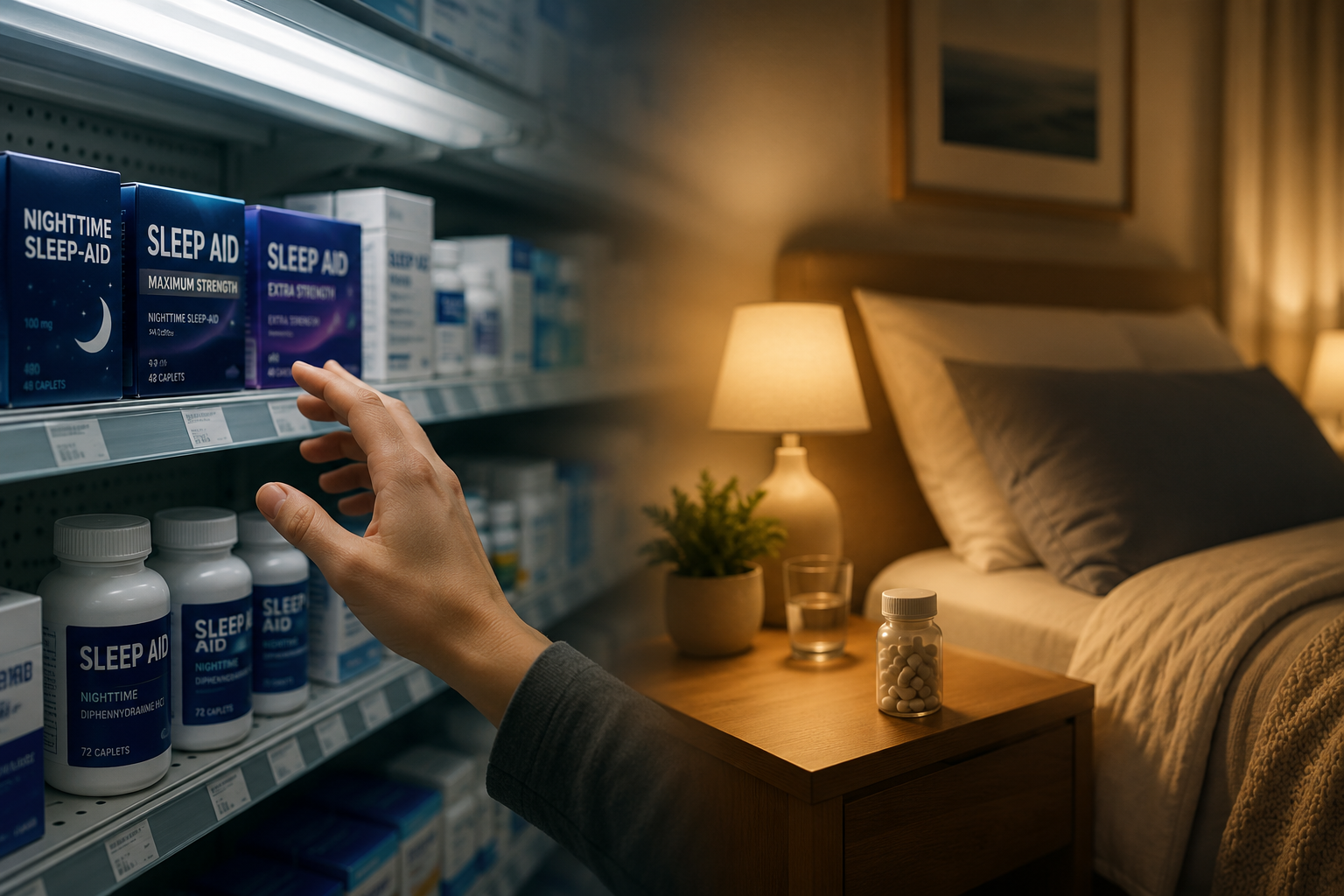
That distinction matters because the pharmacy shelf does not make it for you. It lines up drug ingredients, hormones, minerals, amino acids, and herbal blends under the same promise of “sleep support,” even though they answer different sleep problems and carry very different next-morning risks.
The Evidence-Ranked Short Answer
| OTC option | What it is most likely to do | Best fit | Evidence strength | Main concern |
|---|---|---|---|---|
| Diphenhydramine or doxylamine | Strongest acute sedation | Occasional one-night use in low-risk adults | Sedation is real, but insomnia trial evidence is thin | Next-day grogginess, tolerance, anticholinergic risk, falls in older adults |
| Melatonin | Helps shift sleep timing more than it sedates | Jet lag, delayed sleep phase, some shift-work timing problems | Better supported for circadian problems than for chronic insomnia | Modest average effect; supplement dose may not match the label |
| Magnesium, L-theanine, glycine | May slightly improve relaxation or sleep quality | People prioritizing low downside over strong sedation | Modest and ingredient-specific | Benefits are often small enough to disappoint people expecting a knockout effect |
| Valerian | Possible sleep benefit, inconsistent results | People who prefer herbal options and understand the uncertainty | More studied than many herbs, but heterogeneous | Variable preparations and mixed outcomes |
| Chamomile, passionflower blends | Gentle, uncertain sleep support | Wind-down routines rather than treatment of insomnia | Thin evidence | Labels may imply more certainty than the research can support |
This is why a single “best OTC sleep aid” answer is usually misleading. A product can feel powerful tonight and still be a poor choice for repeated insomnia. Another can be safer and better matched to jet lag, yet feel underwhelming if what you want is immediate sedation.
Why Antihistamines Feel Strongest, but Do Not Win Every Category
Diphenhydramine and doxylamine are the ingredients behind many familiar nighttime products. They are first-generation antihistamines, and drowsiness is one of their central effects. For the exhausted adult who wants to be asleep soon, that can feel like the most concrete help on the shelf.
The clinical evidence for treating insomnia is much less impressive than the lived experience of drowsiness suggests. A 2016 systematic review found only three diphenhydramine randomized controlled trials that met its inclusion criteria and concluded that the evidence showed “limited beneficial effects” for sleep. No doxylamine-specific randomized trials met inclusion criteria in that review, which means the evidence base was sparse rather than conclusively negative.[1]
The American Academy of Sleep Medicine recommends against OTC antihistamines for treating chronic insomnia in adults.[2] That recommendation does not mean nobody gets sleepy after taking them. It means sedation, by itself, is not the same as a well-supported insomnia treatment.
The next morning is part of the bargain. Diphenhydramine and doxylamine can last long enough to spill into the next day, and clinical consumer guidance commonly warns about grogginess and impaired alertness. Mayo Clinic and Harvard Health also note that tolerance can develop after several consecutive nights, often within about 3 to 7 days, so the same dose may stop feeling as effective quickly.[3][4]
For a low-risk adult facing an unusual bad night, an antihistamine may be the strongest occasional OTC sedative. For someone who is older, prone to falls, taking other sedating medications, driving early, or using it night after night, that same strength becomes a liability.
Ingredient names matter here. If you are comparing diphenhydramine with doxylamine directly, an ingredient-level guide such as this doxylamine vs. diphenhydramine safety guide can help you avoid choosing by brand name alone.
Melatonin Is More of a Timing Tool Than a Knockout Pill
Melatonin is often sold beside sedating antihistamines, but it works in a different lane. It is a hormone signal involved in circadian timing. Its strongest argument is not “this will overpower insomnia tonight,” but “this may help your sleep schedule move in the right direction.”
Meta-analyses have found that melatonin shortens sleep onset by about 7 minutes and increases total sleep time by about 8 minutes on average. Those are measurable effects, but they are modest enough that many people with severe sleeplessness will barely notice them.[5]
That modest average is one reason the American Academy of Sleep Medicine recommends against melatonin for chronic insomnia in adults.[2] The stronger case is for circadian misalignment: jet lag, delayed sleep phase, and some shift-work timing problems. If the problem is that your body wants sleep at the wrong clock time, melatonin is more rational than if the problem is anxiety, pain, alcohol rebound, untreated sleep apnea, or a bedroom schedule that changes every night.
The label adds another wrinkle. A 2017 analysis found that 71% of tested melatonin supplements contained amounts outside 10% of the label claim, with measured content ranging from 83% below to 478% above the labeled amount.[6] A 2025 FDA study of children’s melatonin products found labeled-dose discrepancies ranging from 0% to 667% of the stated amount.[7] Those findings do not prove that every bottle is unreliable, but they do make precision dosing harder than the package suggests.
Among OTC options, melatonin still has one of the more substantial research bases. A 2025 scoping review of 51 randomized controlled trials found that melatonin and valerian had the most substantial evidence among OTC sleep products, while also noting small samples and heterogeneous outcome measures.[8] That is a useful endorsement of relative study volume, not a promise of large effects.
For adults trying to use melatonin thoughtfully, the question is less “how much will knock me out?” and more “when am I trying to shift my sleep signal?” A dedicated melatonin guide is a better next stop than escalating the dose because the first night felt subtle.
Natural Options Are Often Safer, Not Necessarily Stronger
Magnesium glycinate, L-theanine, and glycine appeal to people who do not want the next-day heaviness of antihistamines. That instinct is reasonable, especially for people considering repeated use. The trade-off is that “gentler” usually means “less dramatic.”
Magnesium is a good example. The largest magnesium trial found about a 1.6-point improvement on the Insomnia Severity Index compared with placebo, and 81% of participants did not reach the 6-point threshold generally considered clinically meaningful.[9] That is not nothing, but it is not the kind of effect most people imagine when they ask for the most effective over-the-counter sleep aid.
L-theanine and glycine sit in a similar practical category: plausible, generally low-drama options for people who want help settling down, but not well supported as powerful insomnia treatments. They make the most sense when the goal is to reduce friction around sleep rather than force sleep to happen.
Valerian deserves a little more attention than many herbal blends because it appeared alongside melatonin as one of the better-studied OTC options in the 2025 scoping review. Even there, the review noted heterogeneity, which makes confident product-level recommendations difficult.[8] Chamomile and passionflower have thinner evidence and are better thought of as calming ritual ingredients than as proven sleep medicines.
For a broader ranking of these options, see this natural sleep aid ranking or the more detailed natural sleep remedies evidence guide.
Match the Aid to the Sleep Problem
A tired person usually wants a product name. A safer first move is to name the sleep problem.
| Sleep situation | Most defensible OTC direction | Why |
|---|---|---|
| One unusually bad night before a flight or early obligation | An antihistamine may be the strongest occasional option for a low-risk adult | It is more sedating than most supplements, but next-day grogginess matters |
| Jet lag or delayed sleep timing | Melatonin | It is better matched to circadian timing than to general insomnia |
| Repeated mild sleep trouble with low appetite for side effects | Magnesium, L-theanine, glycine, or a non-drug routine | The expected benefit is modest, but the downside is usually lower |
| Chronic insomnia, escalating doses, or nightly dependence on OTC products | Clinical evaluation | The issue has moved beyond choosing a better shelf product |
| Older adult use, fall risk, memory concerns, or multiple medications | Avoid casual antihistamine use unless a clinician says otherwise | First-generation antihistamines carry anticholinergic and fall-risk concerns |
This is also where product format can mislead. Gummies, capsules, liquids, and “PM” pain relievers can contain very different active ingredients. If the front of the box is vague, the active ingredient panel is the part that matters. An ingredient explainer is often more useful than comparing brand promises.
Safety Changes the Ranking, Especially After 65
OTC does not mean low-risk for everyone. This is especially important for older adults, who are both more likely to use sleep aids and more vulnerable to the side effects of sedating antihistamines.
CDC data published in 2024 reported that 5.7% of U.S. adults used OTC sleep aids most days or every day, while 12.9% used any sleep aid. OTC sleep aid use rose with age, from 3.9% among adults ages 18 to 34 to 7.6% among adults ages 65 and older. Women reported OTC sleep aid use more often than men, 7.0% versus 4.3%.[10]
That age pattern is uncomfortable because first-generation antihistamines are listed in the American Geriatrics Society Beers Criteria as potentially inappropriate for adults 65 and older due to anticholinergic burden and fall risk.[11] A 2015 JAMA Internal Medicine prospective cohort study also found that cumulative anticholinergic use equivalent to 3 or more years was associated with increased dementia risk.[12]
That dementia finding should be handled carefully. It is observational, it concerns cumulative anticholinergic exposure, and it does not prove that a younger adult taking an occasional antihistamine has caused long-term harm. It does, however, add weight to the advice not to turn diphenhydramine or doxylamine into a nightly habit, particularly later in life.
People taking antidepressants, anxiety medications, opioids, alcohol, other sedatives, bladder medications, or multiple prescriptions should be more cautious with OTC sleep products than the packaging tone suggests. For a population-specific safety breakdown, see this sleep aid safety guide.
Why Pharmacist Rankings Do Not Settle It
Pharmacist rankings are useful, but they answer a narrower question than many shoppers assume. U.S. News 2026 pharmacist rankings placed Unisom, a diphenhydramine product, at number one among pharmacist-recommended sleep aids.[13] That tells you something about professional familiarity and recommendation habits. It does not override insomnia guidelines, comparative effect sizes, or safety concerns by age.
A pharmacist may reasonably point a low-risk adult toward a sedating antihistamine for occasional use. The same pharmacist may steer an older adult, someone taking interacting medications, or someone using sleep aids nightly toward a different plan. The product that is easiest to recommend in a quick retail encounter is not automatically the best long-term answer.
A Practical Decision Rule
If you are a low-risk adult who needs the strongest occasional same-night sedation, diphenhydramine or doxylamine is the likely OTC winner, with the important caveat that next-day impairment and rapid tolerance are real concerns.
If your sleep problem is timing — jet lag, delayed sleep phase, or a schedule that has drifted late — melatonin is usually the more logical choice, even though its average effect on sleep onset and total sleep time is modest.
If you want something you might use repeatedly with less concern about sedation hangover, magnesium, L-theanine, glycine, or a low-risk herbal option may fit better, as long as you do not expect them to perform like a drug.
If insomnia is persistent, if you are increasing doses, if you are 65 or older, or if sleep aids are becoming part of most nights, the next step is not another OTC comparison. It is a clinical conversation about why sleep is failing in the first place. A guide to when sleeplessness needs medical care can help draw that line.
References
- Over-the-Counter Agents for the Treatment of Occasional Disturbed Sleep or Transient Insomnia: A Systematic Review of Efficacy and Safety, PubMed
- Clinical Practice Guideline for the Pharmacologic Treatment of Chronic Insomnia in Adults: An American Academy of Sleep Medicine Clinical Practice Guideline, Journal of Clinical Sleep Medicine, 2017
- Sleep aids: Understand options sold without a prescription, Mayo Clinic
- Trouble sleeping? Experts say skip antihistamines, Harvard Health Publishing
- Meta-Analysis: Melatonin for the Treatment of Primary Sleep Disorders, PLOS ONE, 2013
- Melatonin Natural Health Products and Supplements: Presence of Serotonin and Significant Variability of Melatonin Content, Journal of Clinical Sleep Medicine, 2017
- FDA study of children’s melatonin products, U.S. Food and Drug Administration, 2025
- Over-the-counter sleep aid medications and supplements: a scoping review of randomized controlled trials, Sleep Medicine, 2025
- The effect of magnesium supplementation on primary insomnia in elderly: A double-blind placebo-controlled clinical trial, PubMed, 2012
- Sleep Medication Use in Adults: United States, CDC, 2024
- American Geriatrics Society 2023 updated AGS Beers Criteria for potentially inappropriate medication use in older adults, American Geriatrics Society, 2023
- Cumulative Use of Strong Anticholinergics and Incident Dementia: A Prospective Cohort Study, JAMA Internal Medicine, 2015
- Best OTC Medicine & Health Products, U.S. News, 2026


Comments
Join the discussion with an anonymous comment.