
If you take melatonin supplements for sleep every night, the first answer is the least dramatic one: no, a new study does not prove you have harmed your heart. Short-term use, roughly a month or two, still appears safe for most healthy adults. The harder answer is that nightly use for months or years rests on much thinner evidence than the product shelf suggests, and a large 2025 American Heart Association analysis has made that uncertainty harder to ignore.
That distinction matters. Melatonin is not just a “natural sleep vitamin.” It is a hormone people take to shift or support sleep timing, and the practical safety question changes with dose, age, health status, timing, and duration. A few nights after travel is one situation. Two tablets on the nightstand every evening for two years is another.

What the 2025 AHA study actually found
The 2025 study that triggered renewed concern was presented as preliminary research at the American Heart Association Scientific Sessions. It analyzed 130,828 adults with chronic insomnia and compared people with documented long-term melatonin use, defined as at least 12 months, with people who had no documented melatonin use in the medical record. Over five years, melatonin users had about 90% higher odds of developing heart failure: 4.6% versus 2.7% in non-users. The study also reported nearly 3.5 times higher risk of hospitalization for heart failure and 1.8 times higher all-cause mortality among long-term users.[1]
Those are not small signals. They are also not proof that melatonin caused heart failure, hospitalizations, or death. The research was preliminary and had not yet gone through peer review. It was observational, so it could find an association but not establish cause and effect. The analysis also could not fully answer whether the melatonin group had more severe insomnia, more complex health problems, or other differences that made poor outcomes more likely regardless of melatonin use.[1]
There is another unusually important limitation: the study relied on medical records. In the United States, many people buy melatonin over the counter without telling a clinician. That means some people counted as “non-users” may have been taking melatonin outside the record, while the “user” group may represent a narrower set of patients whose sleep problem was documented enough for melatonin use to appear in medical data. The American Academy of Sleep Medicine’s public discussion of the study emphasized the same caution: the findings raise questions, but they do not show that melatonin itself caused the outcomes.[2]
Still, dismissing the study because it is preliminary would be too easy. A large unresolved cardiovascular signal in chronic insomnia patients should lower the confidence with which anyone presents nightly long-term melatonin as obviously harmless. The honest reading is narrower and more useful: this study does not convict melatonin, but it does make indefinite, self-directed use look less evidence-secure.
The quiet shift from short-term help to long-term treatment
Most people do not decide, in one clean moment, to start a long-term hormone regimen. They try melatonin during a bad stretch. It helps enough, or seems to help enough, that stopping feels risky. Then the bottle gets replaced. The dose may creep from a low-dose tablet to a common 5 mg or 10 mg product. What began as a temporary workaround becomes part of bedtime, often without anyone asking what problem is being treated anymore.
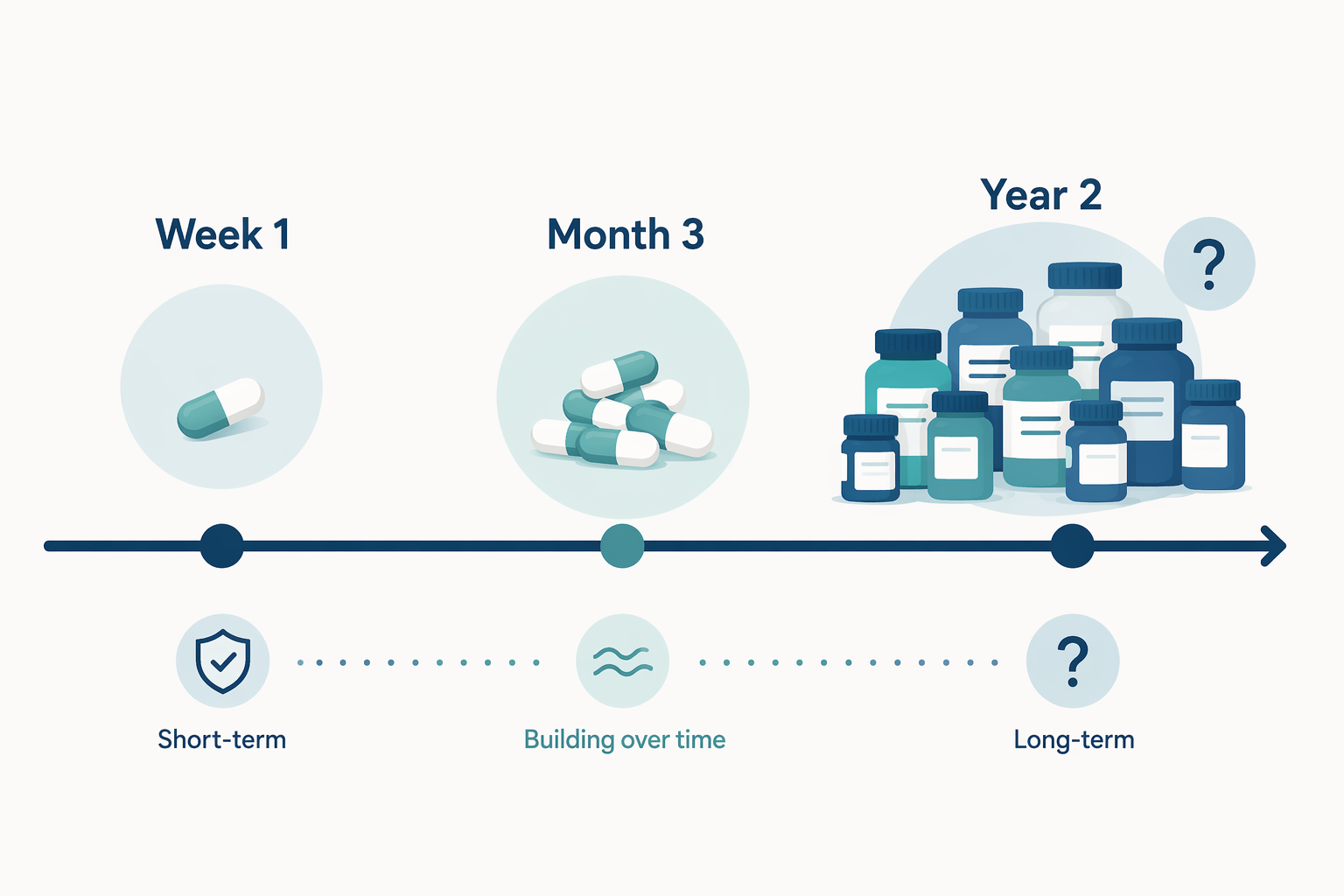
That drift is exactly where the evidence becomes less comforting. A 2023 narrative review concluded that low-to-moderate doses, around 5 mg daily or less, appear safe for short- and long-term use, but the same review also stated that “the long-term effects of taking exogenous melatonin have been insufficiently studied.”[3] Both parts of that sentence matter. The available literature is not screaming danger. It is also not strong enough to make years of nightly use feel settled.
Long-duration data exist, but they do not neatly answer the adult chronic-use question. One pediatric long-term study followed children with chronic sleep-onset insomnia for a mean of 7.1 years and reported few mild adverse effects, while also noting parental concern about delayed puberty in 31.3% of cases.[3] That is reassuring in one sense: long exposure did not obviously produce a broad safety disaster in that group. But children with a specific sleep-onset problem are not the same population as middle-aged or older adults taking over-the-counter melatonin for years while also managing blood pressure, diabetes, heart disease risk, depression, pain, or other medications.
Why “natural” does not answer the safety question
The word natural does a lot of unpaid labor in the sleep aisle. The body makes melatonin, so a melatonin pill feels categorically different from a sedative. That instinct is understandable. It is also incomplete. A hormone can be familiar to the body and still behave differently when taken as a product, at a chosen dose, at a chosen time, night after night.
In the United States, melatonin is sold as a dietary supplement. The National Center for Complementary and Integrative Health notes that dietary supplements are regulated differently from prescription and over-the-counter drugs, and manufacturers do not have to prove safety and effectiveness to the FDA before marketing them in the same way drug makers do.[4] That regulatory category helps explain why a product can be widely available before the kind of long-term safety evidence many users assume must already exist.
This is not an argument that melatonin should be feared. It is an argument that it should be treated as an active sleep aid, not as a consequence-free bedtime ritual. The standard question should not be “Is it natural?” It should be “What dose am I taking, for what problem, for how long, and who is checking whether the original reason still applies?”
Dose and age change the calculation
A low-dose melatonin tablet taken briefly is not the same exposure as a higher-dose product used indefinitely. In practice, it helps to separate low-dose use, often 0.5 mg to 3 mg, from common over-the-counter doses such as 5 mg to 10 mg, and from higher clinical doses that may reach 20 mg in specific contexts. That spread matters because people often talk about “melatonin” as if all use were interchangeable.
Older adults deserve particular caution. The 2023 review discusses evidence that adults taking more than 2 mg of controlled-release melatonin may have elevated blood levels persisting for about 10 hours, which could matter for next-day sedation and fall risk.[3] Clinical guidance has also cited research associating melatonin with a 44% higher fracture risk in adults age 65 and older.[3] These findings do not mean every older adult who takes melatonin will fall or fracture a bone. They do mean that “I feel fine in the morning” may not be enough of a safety check, especially when balance, nighttime bathroom trips, other sedating medicines, or osteoporosis risk are already in the picture.
The same caution applies, for different reasons, to people with complex medical histories, people taking multiple medications, and people who are pregnant or trying to become pregnant. The evidence base is not equally strong across all groups, and the risk of guessing wrong is not evenly distributed.
What “insufficient long-term data” means for someone taking it tonight
Insufficient data can sound abstract, but for a chronic user it has a practical meaning: you are no longer in the best-studied use case. That does not mean you must panic-stop tonight. It does mean the decision should move out of autopilot.
| Current pattern | What the evidence suggests |
|---|---|
| A few nights or occasional short stretches | This is closer to the use pattern most clinicians consider low concern for healthy adults. |
| Nightly use for 1-2 months | This is a reasonable point to reassess whether it is still needed and whether the underlying sleep problem has changed. |
| Nightly use for many months or years | This is where evidence becomes thinner, and the 2025 AHA signal makes medical review more important. |
| Older age, medical complexity, or multiple sedating medications | The threshold for clinician involvement should be lower. |
Johns Hopkins Medicine advises that if melatonin for sleep does not help after a week or two, people should stop using it, and if it does help, most people can take it nightly for one to two months before stopping to see how sleep is without it.[5] Mayo Clinic describes melatonin as generally safe for short-term use and says it should be treated as you would any sleeping pill, including using it under medical supervision when appropriate.[6]
That advice is not glamorous, but it is the right kind of boring. If the bottle has become permanent, the next step is not self-reproach. It is a review: the dose, the timing, the reason you started, whether the sleep problem is still sleep onset or something else, what else you take at night, and whether morning grogginess, vivid dreams, dizziness, headaches, mood changes, or nighttime unsteadiness have crept in quietly.
A more sensible way to use melatonin
For many adults, melatonin makes the most sense as a short-term tool for a defined sleep-timing problem, not as an indefinite nightly answer to chronic insomnia. If it is being used because the brain will not shut off, work stress is relentless, caregiving has broken the sleep schedule, or sleep has been poor for months, the supplement may be covering a problem it cannot fully treat.
Chronic insomnia usually deserves a treatment plan that does not depend on escalating or indefinitely continuing a supplement. Cognitive behavioral therapy for insomnia, often called CBT-I, is one non-supplement option clinicians commonly use for persistent insomnia. It is not a quick substitute for the feeling of taking something at bedtime, but it is aimed at the learned sleep patterns, wakefulness, and anxiety loops that often keep insomnia going.
If you decide with a clinician that melatonin still has a role, the safer posture is usually the smallest effective dose, a clear reason for use, and a planned reassessment rather than an open-ended refill cycle. For someone who has been taking it for years, that conversation may include tapering, changing timing, checking for interacting medications, or looking for untreated contributors such as sleep apnea, restless legs, pain, depression, anxiety, alcohol use, or irregular work schedules.
The bottom line for long-term nightly users
Melatonin is not newly proven dangerous. The 2025 AHA study cannot show that melatonin caused heart failure, hospitalization, or death, and its limitations are too important to treat as footnotes. At the same time, the study is large enough and specific enough that chronic users should not wave it away as meaningless.
The most defensible position is calibrated caution: short-term melatonin use appears safe for most healthy adults, but long-term nightly use is not as evidence-secure as its reputation suggests. If your pattern is measured in nights or a few weeks, the concern is usually modest. If it is measured in months or years, especially at higher doses or with age and medical complexity in the mix, it is time to stop treating the bottle like a vitamin and start treating it like a sleep aid that deserves review.
References
- Long-term use of melatonin supplements to support sleep may have negative health effects — American Heart Association Newsroom, 2025
- New study raises questions about long-term melatonin use — AASM Sleep Education
- Chronic Administration of Melatonin: Physiological and Clinical Considerations — PMC, 2023
- Melatonin: What You Need To Know — NCCIH/NIH
- Melatonin for Sleep: Does It Work? — Johns Hopkins Medicine
- Melatonin — Mayo Clinic


Comments
Join the discussion with an anonymous comment.