

If you are pregnant, awake again at 3 a.m., and staring at a bottle of melatonin because it is sold next to teas and vitamins, the honest answer is frustrating: melatonin is not clearly approved as one of the safer sleep aids for pregnancy, but the current evidence also does not support panic or blanket alarm. The wrong move is treating it as an ordinary over-the-counter sleep supplement and self-prescribing it without your OB-GYN involved.
That distinction matters because this is not a rare, abstract question. An estimated 4% of pregnant people take melatonin supplements, which means many real pregnancies are already moving ahead of the evidence base. The task is not to shame someone who needs sleep. It is to separate what has actually been studied from what supplement labels and casual advice may imply.
Why melatonin is a different kind of pregnancy question
Melatonin is often described as “natural,” which is true in the narrow sense that the body makes it. During pregnancy, the story becomes more interesting: maternal melatonin levels rise as pregnancy progresses, are highest in the third trimester, and the placenta can produce melatonin locally.[1] That physiology is one reason the melatonin question should not be dismissed with a simple “foreign chemical” frame.
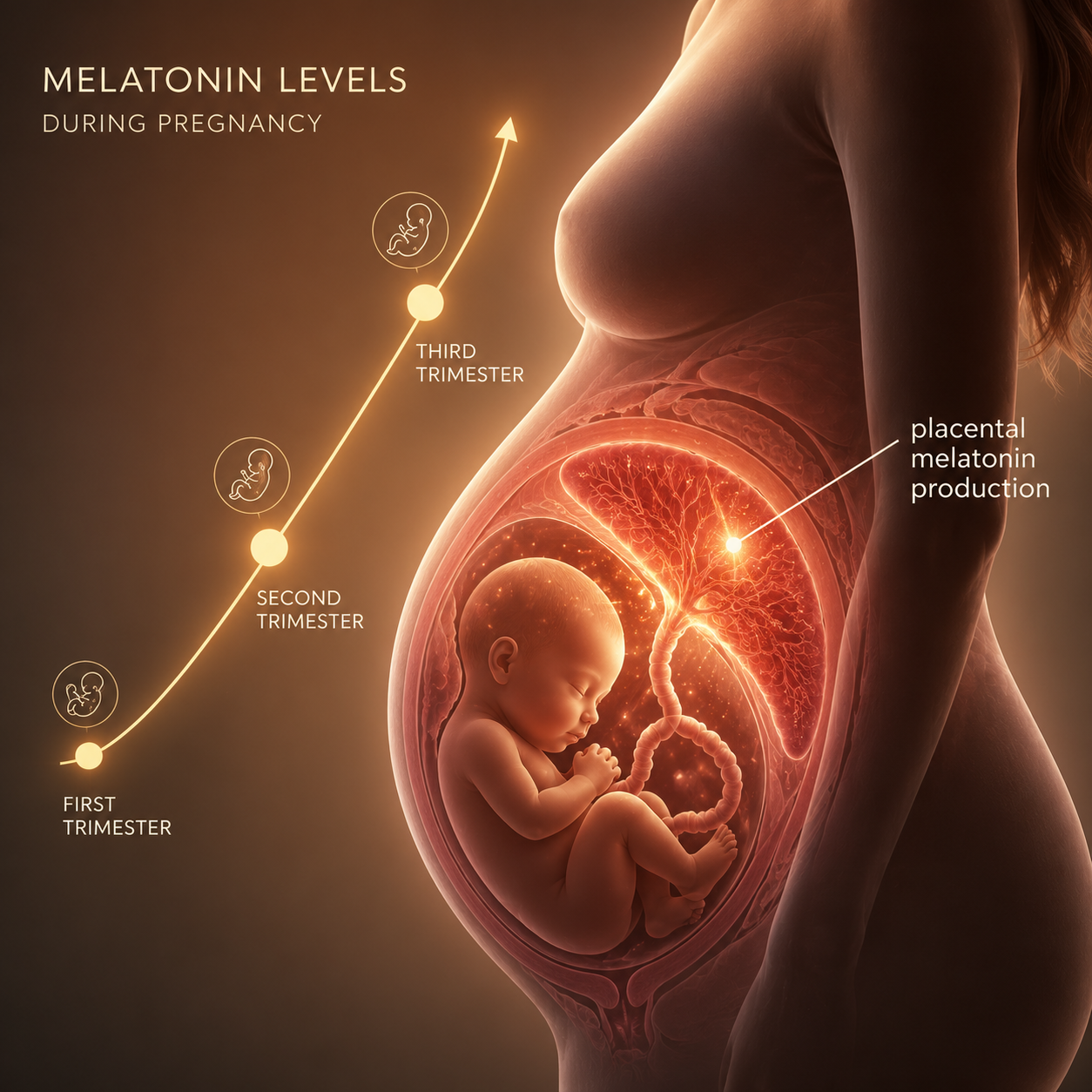
But the same physiology is also why the question cannot be waved away. Melatonin can cross the placenta, so taking a supplement is not only about whether it makes the pregnant person sleepy. It may also raise fetal melatonin exposure. The concern is not a generic fear of supplements; it is the possibility that extra melatonin could affect fetal circadian signaling or the infant’s later rhythm development, an area where human evidence is still limited.
This is where “your body already makes it” becomes too thin to be useful. Your body also regulates timing, amount, tissue exposure, and pregnancy-stage changes. A tablet taken at night, from a bottle with variable supplement quality, is a different exposure than endogenous melatonin rising within pregnancy physiology.
What the human evidence does, and does not, show
The most useful U.S. teratology wording comes from MotherToBaby: “It is not known if taking melatonin can increase the chance of birth defects.” The same fact sheet adds that the few human studies done so far have not suggested an increased chance of birth defects.[1]
That is a careful sentence, and it should stay careful. “Not known to increase risk” is not the same as “proven safe.” The available human studies are too few and too specific to answer the everyday insomnia question many pregnant readers are asking: can I take melatonin tonight, or for several nights, because I cannot sleep?
Some of the more encouraging human data comes from pregnant women with PCOS or PMOS who were given 3 mg of melatonin along with other treatment. In those studies, melatonin use was associated with reduced risks of preeclampsia, fetal growth restriction, and preterm birth.[1] That is worth knowing. It is also easy to overuse.
| What the evidence says | What it does not prove |
|---|---|
| A 3 mg dose appears in some human pregnancy studies involving specific higher-risk groups. | 3 mg is not an established safe dose for routine pregnancy insomnia. |
| The few human studies have not suggested an increased chance of birth defects. | They do not amount to large, controlled safety trials of melatonin as a sleep aid. |
| Some studies explored possible benefits in PCOS/PMOS or preeclampsia-risk contexts. | Those findings should not be generalized to every pregnant person who is awake at night. |
The 3 mg detail is especially easy to misread. It is a reference point from limited human data, not a recommendation and not a pregnancy-approved dose. A person taking melatonin for ordinary insomnia may have a different risk profile, a different trimester, different medications, different obstetric history, and a different product than the people in those studies.
Why mainstream caution still makes sense
Mainstream pregnancy guidance tends to be cautious about melatonin because there is not enough human safety data for routine use. That caution can feel unfair when the alternative is another night of broken sleep, but it is not empty bureaucracy. It reflects a real gap: melatonin has not been adequately studied in pregnant people as a sleep medication.
The gap is more important because insomnia during pregnancy is not automatically harmless either. If your sleep has become persistent, severe, or tied to anxiety, pain, reflux, restless legs, breathing symptoms, or daytime impairment, it deserves a broader clinical conversation. For the larger risk-benefit context, see our guide to insomnia during pregnancy and maternal-fetal risks.
That is the uncomfortable middle: untreated sleep loss can be clinically relevant, but melatonin is not the best-studied answer. For some people, an OB-GYN may first want to address the cause of the insomnia rather than add a sleep aid. For others, the discussion may include better-studied medication options, behavioral treatment, or a time-limited plan.
The trimester question is not a technicality
If melatonin comes up with your clinician, timing belongs near the top of the conversation. First-trimester exposure raises different questions than late-pregnancy exposure because organ development, placental function, and fetal signaling concerns are not identical across pregnancy. The fact that endogenous melatonin peaks in the third trimester does not automatically make third-trimester supplements safe, but it may change how a clinician thinks through the risk-benefit balance.[1]
This is also why advice that says only “ask your doctor” is incomplete. Your doctor cannot answer the question well unless you bring the details: how many weeks pregnant you are, why you are not sleeping, what you have tried, what dose you are considering or already took, how often you plan to use it, and whether you are taking other sedating medicines or supplements.
What to ask your OB-GYN before taking melatonin

A useful melatonin conversation is specific. It should not be a rushed yes-or-no question at the end of a visit, especially if you are already functioning poorly from lack of sleep.
- “Do my symptoms suggest ordinary pregnancy insomnia, or should we check for reflux, anxiety, restless legs, pain, sleep apnea symptoms, or another treatable cause?”
- “Given my trimester and pregnancy history, does melatonin raise any specific concerns for me?”
- “If we consider it at all, should it be occasional or time-limited rather than nightly?”
- “What dose would you consider the lowest reasonable starting point, and how does the limited 3 mg pregnancy research fit into that?”
- “Are there better-studied sleep aids or non-drug treatments that make more sense before melatonin in my situation?”
- “How should I choose a supplement if we decide the potential benefit outweighs the uncertainty?”
That last question is not cosmetic. In the United States, melatonin is sold as a dietary supplement, not as an FDA-approved pregnancy sleep medication. Supplement labels may not give you the same confidence about dose consistency, purity, or testing that you would expect from a regulated prescription product. If your clinician is open to melatonin, ask whether they prefer a product with independent third-party testing.
Also bring the bottle, or a photo of the front and Supplement Facts panel. “Melatonin” products can include other ingredients, including herbs or blends that have their own pregnancy questions. A plain, single-ingredient product is easier for a clinician to evaluate than a sleep blend with multiple sedating compounds.
Where melatonin fits among pregnancy sleep aids
Melatonin should not be treated as automatically safer than other sleep aids just because it is sold as a supplement. Some older antihistamines and nausea-related medications have more pregnancy exposure data than melatonin, though they come with their own side effects and are not right for everyone. If you need a broader comparison, use a structured pregnancy sleep aid treatment ladder rather than choosing based on shelf placement.
If your insomnia is new, trimester-specific, or tied to physical discomfort, it may help to review the common causes of insomnia during pregnancy and evidence-based treatments before deciding that a supplement is the next step. Sometimes the most effective “sleep aid” is treating reflux, changing iron evaluation for restless legs, adjusting pain support, or addressing anxiety directly.
If you have already taken melatonin before realizing the evidence is limited, do not spiral. The few human studies available have not suggested an increased chance of birth defects, and accidental or occasional use is not the same as a proven harm.[1] Tell your OB-GYN what you took, when you took it, and how often. That information is more useful than guilt.
The cleanest answer is not “melatonin is safe” or “melatonin is dangerous.” It is that melatonin sits in an evidence gap: biologically relevant, not well studied as a pregnancy sleep aid, not clearly linked to birth defects in the few human data available, and not something to self-prescribe casually. If sleep loss is starting to affect your days, bring the question to your OB-GYN as a risk-benefit decision with timing, dose, frequency, and supplement quality on the table.
References
- Melatonin - MotherToBaby Fact Sheet. MotherToBaby.


Comments
Join the discussion with an anonymous comment.