
Melatonin is not automatically unsafe for older adults. The problem is that it is often used as if it were too gentle to deserve the same scrutiny as a “real” sleep aid. That is where the evidence becomes uncomfortable: in older adults, melatonin appears to shorten the time it takes to fall asleep by about 7.5 to 15.6 minutes, with no strong evidence that it helps people stay asleep, and the American Academy of Sleep Medicine gives a weak recommendation against using it for sleep-onset or sleep-maintenance insomnia because the evidence is low quality.[1]
A few minutes faster sleep onset may matter to someone who has been lying awake night after night. It is not nothing. But it is also not a large enough expected benefit to ignore the parts that become more complicated after age 65: higher blood levels from the same dose, interactions with common prescriptions, and supplement labels that may not reliably describe what is in the bottle.
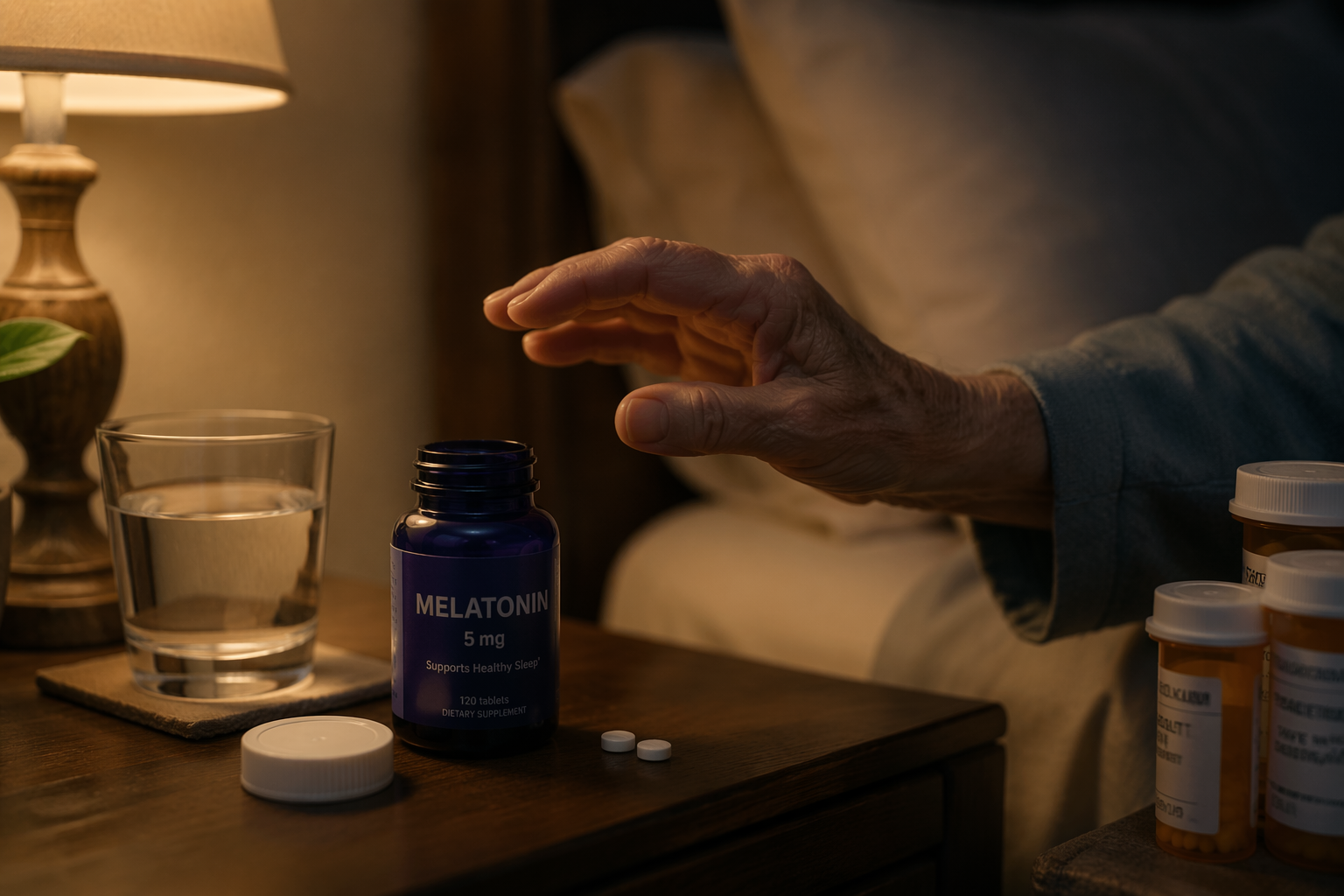
What benefit are we actually buying?
The first question should not be whether melatonin is natural. It should be whether the expected improvement is large enough to justify adding another active substance to an older adult’s medication routine.
In the Cleveland Clinic Journal of Medicine review of insomnia treatment options for older adults, meta-analyses found that melatonin reduced sleep-onset latency by roughly 7.5 to 15.6 minutes. Total sleep time increased by about 12.8 minutes in older adults, but evidence for sleep maintenance was not strong.[1] That matters because many older adults are not only struggling to fall asleep. They are waking at 2 a.m., getting up to use the bathroom, checking the clock, and then facing the day already tired.
The American Academy of Sleep Medicine’s weak recommendation against melatonin is sometimes misunderstood. It does not mean melatonin is proven dangerous for every older adult. It means the evidence is not strong enough to recommend routine use for chronic insomnia, especially when the outcome is measured in minutes and the trials are generally short.[1]
| Decision point | What the evidence supports | Why it changes the conversation |
|---|---|---|
| Falling asleep | About 7.5 to 15.6 minutes faster sleep onset in meta-analyses | A modest benefit may be reasonable for selected short-term use, but it is not a strong argument for nightly default use |
| Staying asleep | No strong benefit for sleep maintenance | Melatonin may not address the complaint that most disrupts the night |
| Long-term routine use | Most trial data in older adults are short duration | Absence of clear long-term harm is not the same as established long-term safety |
This is the practical tension: if a sleep aid gives a small average improvement, then dosing predictability and interaction risk matter more, not less. A person may accept a messy safety picture for a medicine that gives a major, reliable benefit. Melatonin usually does not meet that threshold for routine insomnia treatment in older adults.
Why older adults are different melatonin users
The same bottle does not create the same exposure in every body. A review focused on melatonin risks in older adults notes that peak melatonin concentrations can be up to 240% higher in older adults than in younger adults.[2] In ordinary terms, a dose that looks familiar on the label may act less predictably in a 72-year-old than in a 35-year-old.
That does not mean every older adult will feel oversedated. It does mean the margin for casual experimentation is narrower. Morning grogginess, dizziness, slowed reaction time, or confusion are not small inconveniences when someone is walking to the bathroom in the dark, managing blood pressure medicine, or already worried about falls.
Age also changes the setting in which melatonin is used. Many older adults are not taking it alone. It may sit beside an SSRI, a blood thinner, a blood pressure medication, a bladder medication, a pain medication, or another sleep aid. Even when each product has a reason to be there, the pile becomes harder to interpret when a new supplement is added without anyone telling the prescriber.
This is not a rare concern. In 2024 National Health Interview Survey data, 15.8% of adults age 65 and older reported using sleep aids most days or every day; 8.8% used prescription sleep aids and 7.6% used over-the-counter sleep aids or supplements.[3] Melatonin belongs in that real-world cabinet, not in a separate category where “natural” means it gets a pass.
The interaction list is not theoretical
Some interaction concerns are specific enough to change the decision before the bottle is opened. Fluvoxamine, an SSRI, has been reported to increase melatonin exposure, measured by area under the curve, by 2.8- to 12-fold.[2] That is not a gentle nudge. It is the kind of change that can turn a small bedtime dose into a much larger exposure than intended.
The same review describes documented concerns with citalopram, warfarin, nifedipine, and zolpidem.[2] The details differ: warfarin raises concern because of increased INR, nifedipine because of reduced blood pressure control, and zolpidem because sedation can compound. The caregiver’s version of this is simpler: if the person is already taking medicines that affect mood, clotting, blood pressure, or sleep, melatonin should not be added quietly.
A medication review does not have to be dramatic. It can be as plain as bringing the bottle, the prescription list, and the actual dose to a clinician or pharmacist and asking, “Does this interact with anything here, and is the expected sleep benefit worth it?” That question is more useful than asking whether melatonin is generally safe, because the risk is often person-specific.
The label may not mean what it appears to mean
Supplement quality is the part of the conversation that makes kitchen-table dosing especially frustrating. A tablet labeled 5 mg gives the impression of precision. In one Canadian study of 31 melatonin supplements, actual melatonin content ranged from 83% below the label claim to 478% above it. Serotonin was detected in 8 of the 31 products.[4]
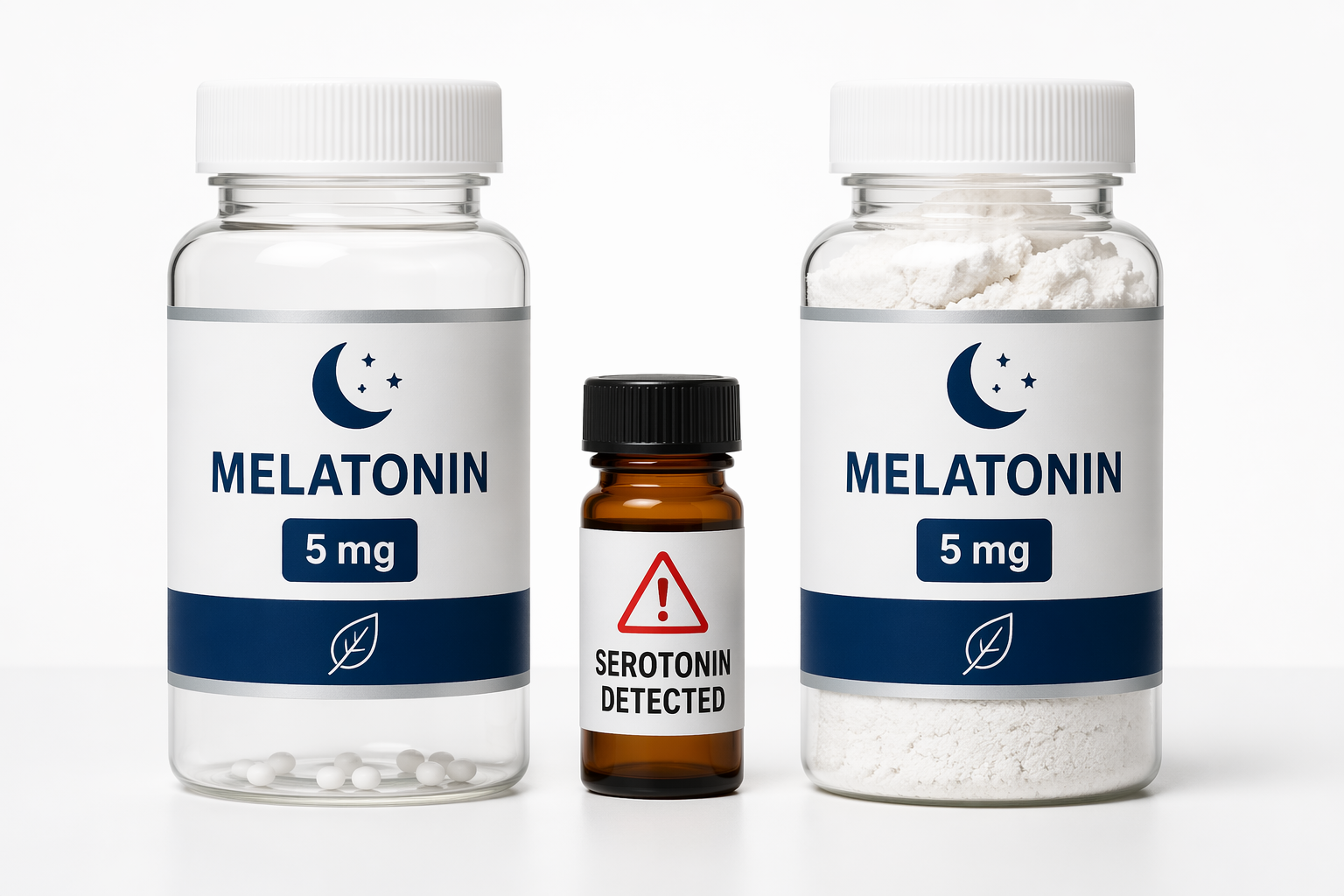
That study should not be stretched beyond what it can prove. It was a limited sample, conducted in Canada, and it does not establish that every current melatonin product is inaccurate. But it does show why consumer confidence can be misplaced. When a product category has shown that kind of variability, “start with 5 mg” is not as precise as it sounds.
For older adults, this matters because the label dose, the absorbed dose, and the clinical effect can all drift apart. A higher-than-labeled product taken by someone who already reaches higher peak concentrations is a different situation from a controlled low-dose product taken by a younger adult with no interacting medications.
Immediate-release and prolonged-release are not the same conversation
Many U.S. shoppers see melatonin as one category: gummies, tablets, liquids, and “extra strength” bottles on the same shelf. Clinically, formulation matters. Immediate-release melatonin is typically aimed at shifting or signaling sleep onset. Prolonged-release melatonin is designed to release more gradually through the night, which is a different pharmacologic goal.
There is a limited but important counterweight to the concern-heavy picture. Prolonged-release melatonin 2 mg is approved in Europe for adults 55 and older. In a 3-week randomized controlled trial of 281 patients, adverse events occurred in 6.1% of those taking prolonged-release melatonin compared with 5.3% of those taking placebo.[1] That supports short-term tolerability for that specific regulated formulation in that study setting. It does not prove that any over-the-counter melatonin bottle, at any dose, is equally predictable or safe for long-term nightly use.
This distinction is where the fairest answer sits. A low-dose, pharmaceutical-grade or otherwise well-controlled melatonin product may be reasonable for short-term use in some older adults, especially when the goal is sleep timing rather than deep sedation and when the person is not taking interacting medications. That is a narrower claim than the one implied by many supplement shelves.
When melatonin deserves a pause
The clearest reasons to pause are not exotic. They are the same things that make many health decisions harder after 65: multiple prescriptions, fall risk, cognitive changes, and symptoms that are being treated before their cause is understood.
- The person takes fluvoxamine, citalopram, warfarin, nifedipine, zolpidem, or another sedating medication.
- They wake up groggy, dizzy, confused, or less steady after taking melatonin.
- The dose has crept upward because the original dose “stopped working.”
- They are using a high-dose gummy, liquid, or multi-ingredient sleep supplement without knowing the full ingredient list.
- The main problem is waking during the night, not falling asleep.
- No clinician or pharmacist knows it is being taken.
The dose question deserves special care. Many people assume more milligrams means a stronger and therefore better sleep aid. With melatonin, that assumption is often unhelpful. If the expected average improvement is modest, increasing the dose may increase next-day effects or interaction concerns without solving the actual sleep problem.
A practical boundary
Melatonin is not in the same risk category as many prescription hypnotics, and it should not be treated as a hidden menace. Some older adults may use a low-dose, well-controlled product briefly and do fine. But routine nightly use deserves a higher bar than “it is natural,” especially when the likely benefit may be only minutes faster sleep onset.
For an older adult considering melatonin, the better first question is not “Which bottle should I buy?” It is: “Is this small expected benefit worth the dose uncertainty and medication-interaction risk for this specific person?” If the answer depends on a medication list, a fall history, or a morning-after symptom, that is exactly the point.
References
- Insomnia in older adults: A review of treatment options. Cleveland Clinic Journal of Medicine. 2025.
- Current Insights into the Risks of Using Melatonin as a Treatment for Sleep Disorders in Older Adults. PMC.
- Sleep Medication Use in Adults Aged 18 and Over: United States, 2020. CDC National Center for Health Statistics.
- Melatonin natural health products and supplements: presence of serotonin and significant variability of melatonin content. Journal of Clinical Sleep Medicine. 2017.


Comments
Join the discussion with an anonymous comment.