
If you are choosing a sleepwear base layer for cold nights, merino wool has better sleep-specific evidence than cotton or polyester. The case is strongest for adults over 65 and for people who already sleep poorly, not for every cold sleeper in every winter bedroom. Still, for a fabric choice, the evidence is unusually relevant: randomized trials measured sleep onset, wakefulness, fragmentation, and moisture behavior rather than just asking whether a shirt felt cozy.
That distinction matters on a cold night. The problem is often not simply that the room is cold; it is that the body keeps noticing small thermal changes. A damp cotton top, a sweaty synthetic layer under heavy bedding, or a too-warm blanket that leads to cooling later can all keep the nervous system checking the environment when it should be letting sleep deepen.
What the Trials Actually Found
The most important sleepwear trial for older adults used polysomnography in 36 participants aged 65 and older. Wool sleepwear was associated with a sleep onset latency of 12.4 minutes, compared with 26.7 minutes in cotton and 21.6 minutes in polyester. In the same study, cotton and polyester did not differ significantly from each other on any of the 11 measured sleep parameters.[1]
For cold-weather sleep, the direct temperature match comes from a smaller study of 17 young adults sleeping at 17°C. In that trial, wool sleepwear was associated with a sleep onset latency of 9.9 minutes, compared with 18.1 minutes in cotton.[2]
| Measure | Merino wool | Cotton | Polyester | What it means |
|---|---|---|---|---|
| Sleep onset latency, adults 65+ | 12.4 min | 26.7 min | 21.6 min | Older adults fell asleep faster in wool than in cotton or polyester. |
| Sleep onset latency, young adults at 17°C | 9.9 min | 18.1 min | Not tested in this comparison | The direct cold-room evidence favored wool over cotton. |
| Wake after sleep onset, poor sleepers | 90 min | 116 min | Not specified for this subgroup comparison | Among participants with PSQI≥5, wool reduced wakefulness after sleep began. |
| Sleep fragmentation index | 12.1 events/h | Not the key comparison reported here | 13.7 events/h | Wool showed fewer fragmentation events than polyester. |
| Dynamic moisture buffering capacity | 9.9 KJ·m⁻² | 6.9 KJ·m⁻² | 0.6 KJ·m⁻² | Wool had the greatest capacity to buffer moisture movement. |
| Moisture regain | 35% | 24% | <1% | Wool can hold more vapor relative to fiber weight without feeling wet. |
The poor-sleeper subgroup is especially relevant for someone who is cold, damp, and awake rather than merely shopping for winter comfort. In participants with baseline Pittsburgh Sleep Quality Index scores of 5 or higher, wake after sleep onset was 90 minutes with wool and 116 minutes with cotton, a 22% reduction. The same trial also reported a sleep fragmentation index of 12.1 events per hour with wool versus 13.7 events per hour with polyester.[1]
A 2024 systematic review in the Journal of Sleep Research found that wool sleepwear showed the most consistent sleep-quality benefits across the studies it reviewed, particularly for older adults and poor sleepers. That conclusion is useful, but it is not a final verdict: the review included only 9 studies with heterogeneous designs and small samples.[3]
Why Moisture Buffering Matters More Than “Warmth”
A base layer for bed has a different job from a blanket. A blanket mostly changes insulation. Sleepwear sits in the narrow microclimate between skin and bedding, where sweat vapor, skin temperature, and fabric feel can change quickly. If that layer turns clammy or traps sweat at the wrong moment, the sleeper may not wake fully every time, but the body still has to respond.
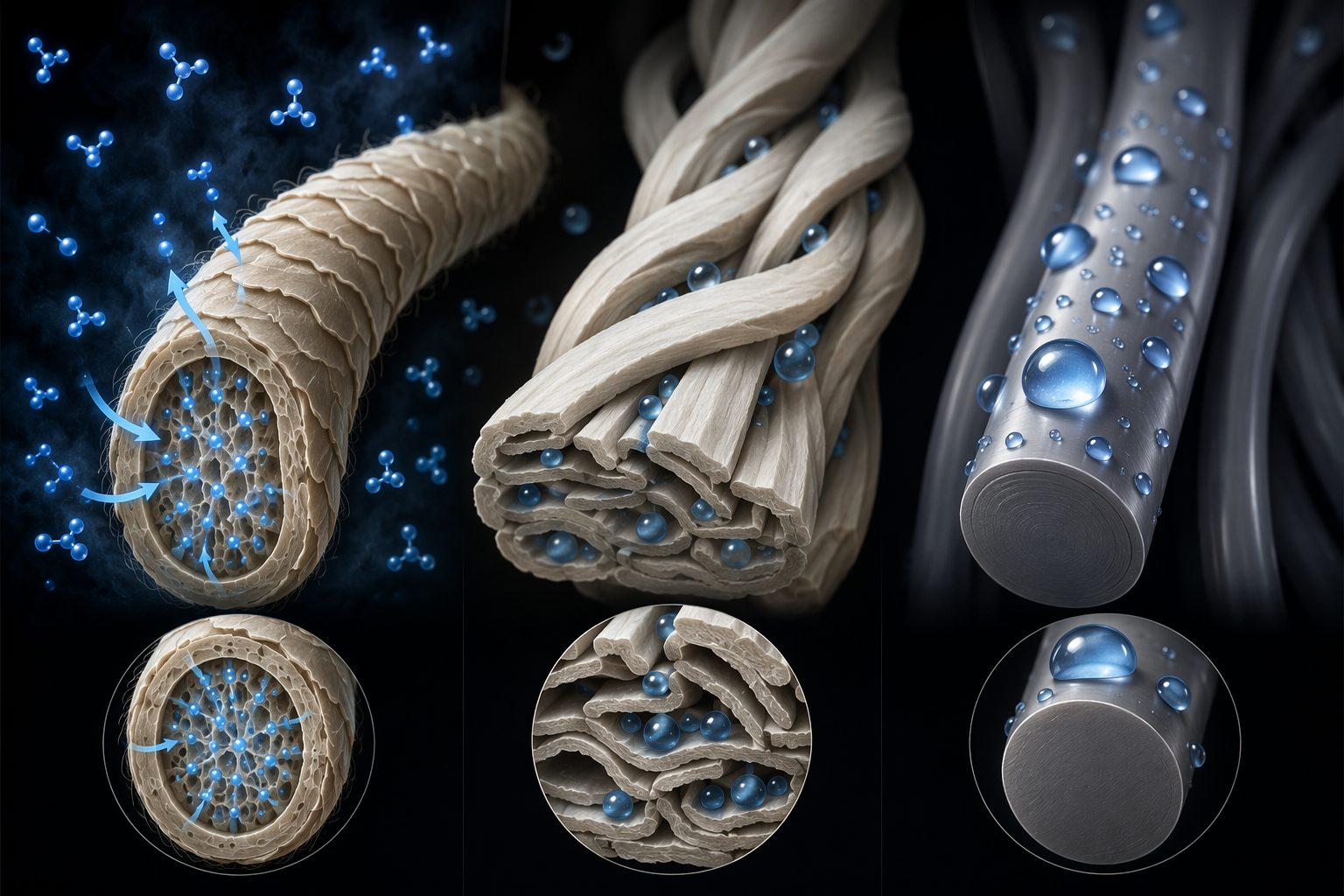
Merino wool’s advantage in the sleepwear studies is plausible because the fiber can absorb and release moisture vapor while still feeling relatively dry against the skin. In Chow 2019, dynamic moisture buffering capacity was 9.9 KJ·m⁻² for merino wool, 6.9 KJ·m⁻² for cotton, and 0.6 KJ·m⁻² for polyester. Moisture regain was 35% for merino wool, 24% for cotton, and less than 1% for polyester without feeling wet.[1]
Cotton can absorb moisture, but that is not the same as buffering it comfortably through a night of changing skin temperature. Once cotton holds moisture near the skin, it can feel cool and slow to dry. Polyester behaves differently: it absorbs very little moisture into the fiber itself, so sweat management depends more on fabric construction and movement of liquid or vapor across the surface. That can work well during activity, but the sleep trials did not show polyester matching wool on the measured sleep outcomes in older adults.[1]
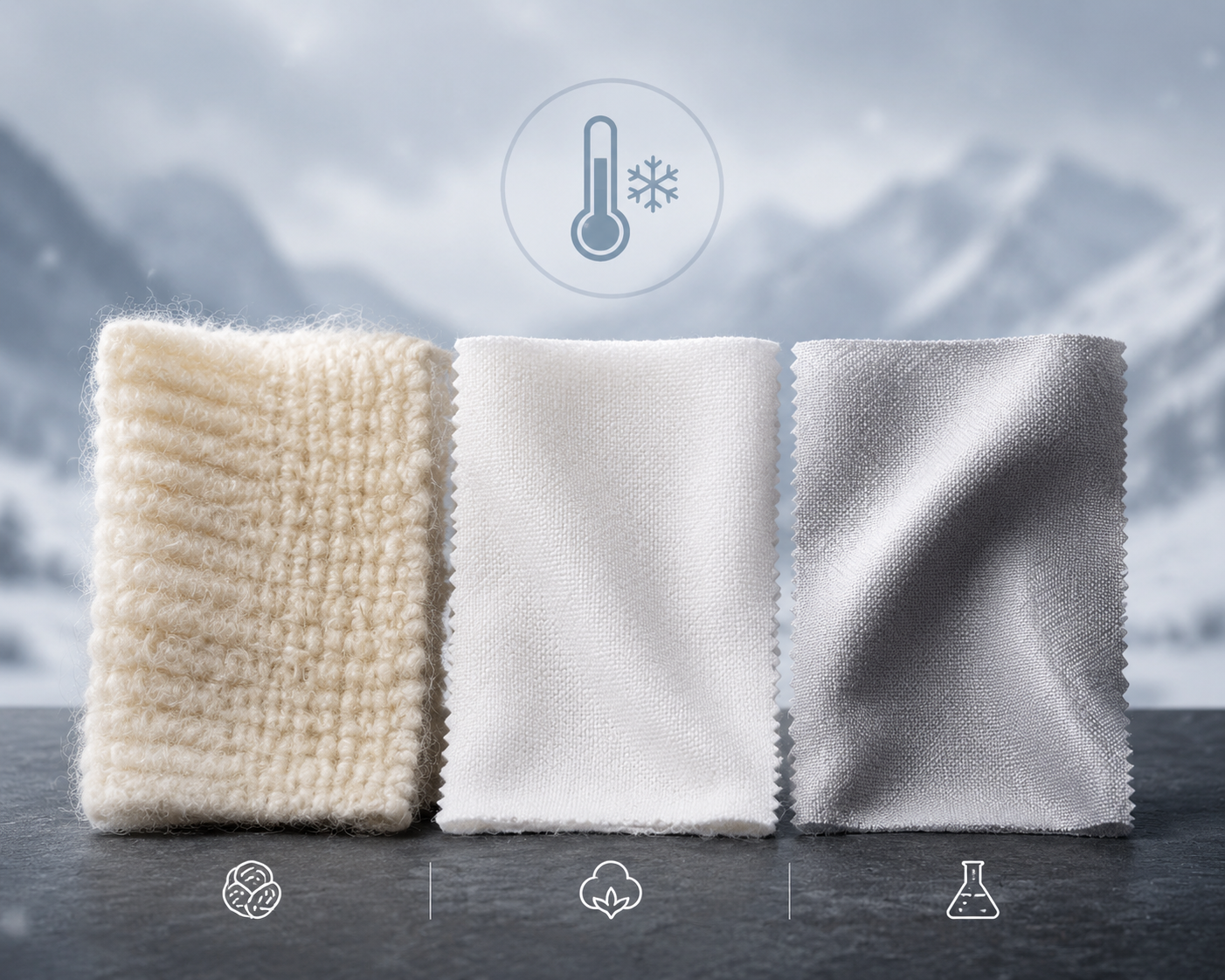
This is why the best merino wool sleepwear base layer for cold weather is not simply the thickest one. A heavy top may feel reassuring at bedtime and still become too warm under a duvet. A useful sleep layer should reduce temperature swings, not create a new overheating problem.
Who Has the Best Case for Trying It
Adults Over 65
The older-adult evidence deserves the most weight because it used polysomnography rather than only subjective reports. In that study, wool shortened sleep onset latency compared with both cotton and polyester, and cotton did not separate meaningfully from polyester across the measured sleep parameters.[1]
For an older sleeper who already wakes easily, the practical question is not whether merino feels luxurious. It is whether the layer next to the skin helps reduce the small thermal irritations that make falling asleep and staying asleep harder. The trial data fit that question better than most fabric marketing does.
People With Poor Baseline Sleep
The poor-sleeper subgroup is where wakefulness after sleep onset becomes important. A person who falls asleep eventually but spends long periods awake later in the night may not be helped by adding another blanket if the real problem is a damp or unstable skin-level microclimate. In Chow 2019, poor sleepers had less wake after sleep onset in wool than in cotton.[1]
That does not make wool a treatment for insomnia. It makes it a reasonable environmental intervention when cold discomfort, sweating under covers, or clammy sleepwear is part of the pattern.
Young Healthy Adults in Cool Rooms
The direct cold-room trial was small, but it matters because the room was 17°C. Young adults fell asleep faster in wool than in cotton under those conditions.[2]
This is the most straightforward cold-bedroom signal in the available research, but also the one with the smallest sample. It supports trying wool over cotton when a cool room is the problem; it does not prove that every healthy young adult in winter will sleep better in merino.
The Caveats Are Not Fine Print
Both primary randomized trials were funded by Australian Wool Innovation Ltd, a woolgrower industry body.[1][2] Funding does not invalidate the findings, but it does change how confidently a shopping recommendation should be stated. The right conclusion is narrower than “wool is always best.”
The temperature context also needs care. Chow 2019, the stronger older-adult polysomnography study, was conducted at 30°C rather than in a cold bedroom.[1] Its results still matter because they connect wool sleepwear to objective sleep outcomes and moisture-buffering behavior, but the cold-weather claim rests most directly on Shin 2016’s smaller 17°C study plus the mechanism of moisture buffering.[2]
The 2024 review helps by looking across studies, but it also reinforces the evidence boundary: only 9 studies, small samples, and varied designs.[3] That is enough to make merino a credible first choice for the right sleeper. It is not enough to turn a base layer into a universal sleep aid.
What to Look For in a Cold-Weather Merino Sleep Base Layer
The research points toward fabric behavior, not a specific brand. If you are shopping for the best merino wool sleepwear base layer for cold weather, start with specifications that affect overnight comfort.
- Choose midweight fabric around 200–250 g/m² for unheated bedrooms around 17–20°C. Lighter layers may not feel sufficient; heavier expedition layers can be too warm under bedding.
- Look for superfine merino around 17–19 microns if itch is a concern. Itch will ruin the experiment faster than any moisture-buffering benefit can help.
- Prefer a relaxed base-layer fit for sleep rather than a tight active fit. Outdoor base layers are designed for movement and layering under shells; sleepwear needs comfort during long, still contact with skin.
- Check seams, cuffs, waistbands, and necklines before judging the fiber. A good fabric cannot compensate for a collar that rubs or a waistband that digs in at 3 a.m.
- Be cautious with blends. A small amount of elastane may improve recovery and fit, but high synthetic content changes the moisture behavior that makes merino interesting in the first place.
Sleep-specific merino products and outdoor merino base layers can both work, but they are not identical categories. A skiing base layer may be excellent for sweat transport during exertion and still feel too compressive, too warm, or too technical for bed. For sleep, the garment should disappear once the lights are off.
How to Read Brand Claims
Brands selling merino sleepwear or base layers often cite the same academic literature. That is not a problem by itself. The problem is when a product page turns a small trial in a specific group into a broad promise that anyone will fall asleep faster.
When evaluating products from sleepwear or outdoor brands, look for claims that match the evidence. A fair claim says merino wool has trial evidence for faster sleep onset compared with cotton or polyester in studied groups, with especially relevant findings for older adults and poor sleepers. A claim that skips the study populations, sample sizes, funding source, or temperature conditions is less useful.
Product rankings can still help with sizing, return policies, durability, and price. They should not be the main reason to choose the fabric. The reason to consider merino for cold-weather sleep is the combination of measured sleep outcomes and moisture-buffering behavior.
A Calibrated Recommendation
Merino wool is a credible first choice for cold-weather sleepwear if you are older, sleep poorly, wake because of temperature changes, or find that heavier blankets leave you damp instead of comfortable. The most defensible starting point is a midweight, superfine merino top and bottom that are comfortable enough for sleep rather than merely marketed as an outdoor base layer.
Cotton is still familiar, washable, and comfortable for many people. Polyester can be useful in activewear and may suit sleepers who dislike wool. But neither has the same sleep-specific trial signal in the materials reviewed here. If the goal is a non-drug intervention for cold-night sleep disruption, merino is the fabric with the better evidence.
The confidence boundary is clear: promising, practical, and unusually well matched to a real sleep problem, but based on small, partly industry-funded research. Buy it as a testable sleep-environment change, not as a guaranteed cure for winter wakefulness.


Comments
Join the discussion with an anonymous comment.