
The confusing thing about the melatonin shelf is not that there are options. It is that the options are usually arranged as if the highest number were the most serious one. A tired adult can stand there choosing between 1 mg, 3 mg, 5 mg, and 10 mg bottles with very little help from the label about what melatonin is supposed to do in the first place. If the question is the midnite sleep aid versus a 5 mg or 10 mg melatonin product, the useful comparison is not flavor, branding, or how confidently the front panel says “sleep.” It is dose.
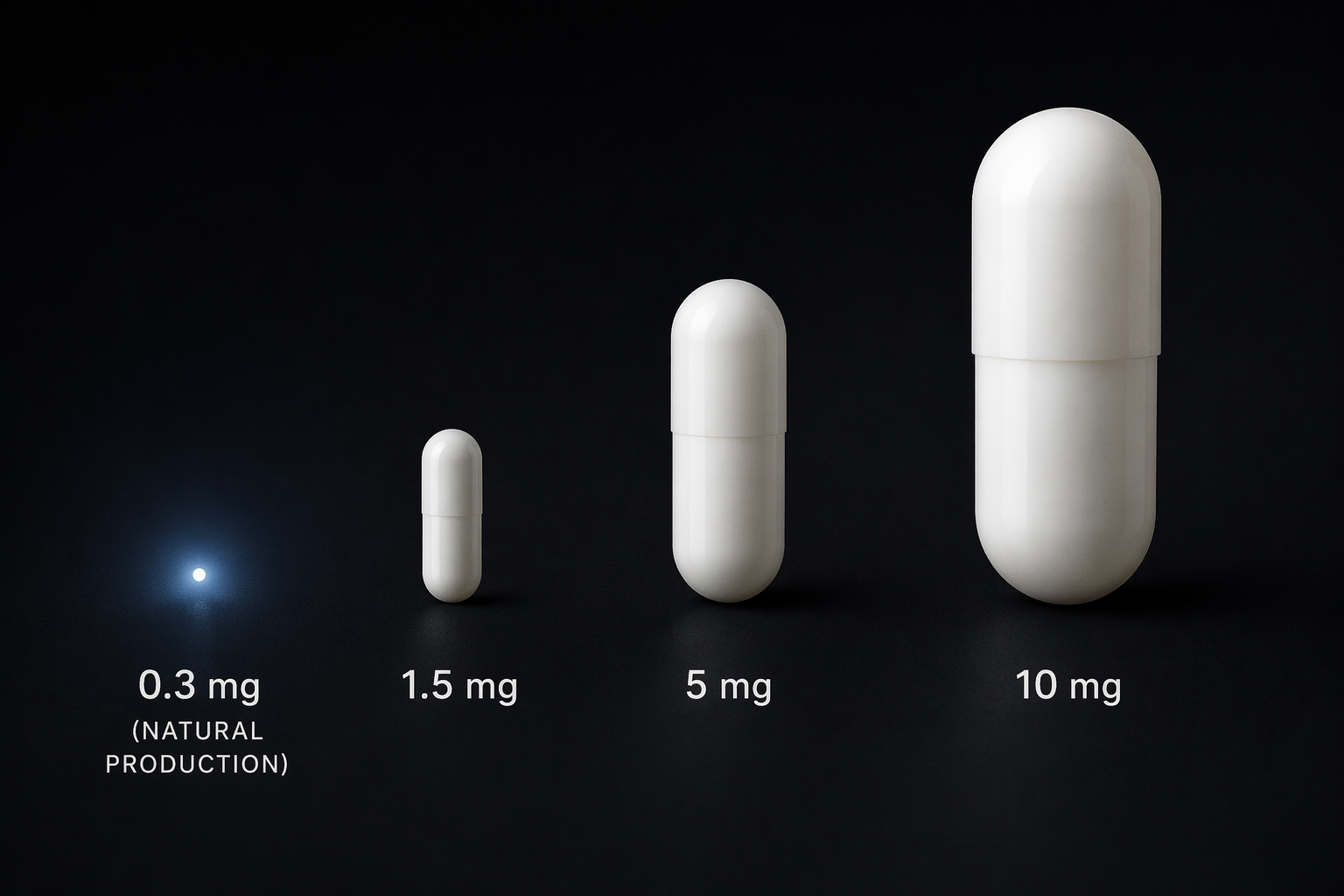
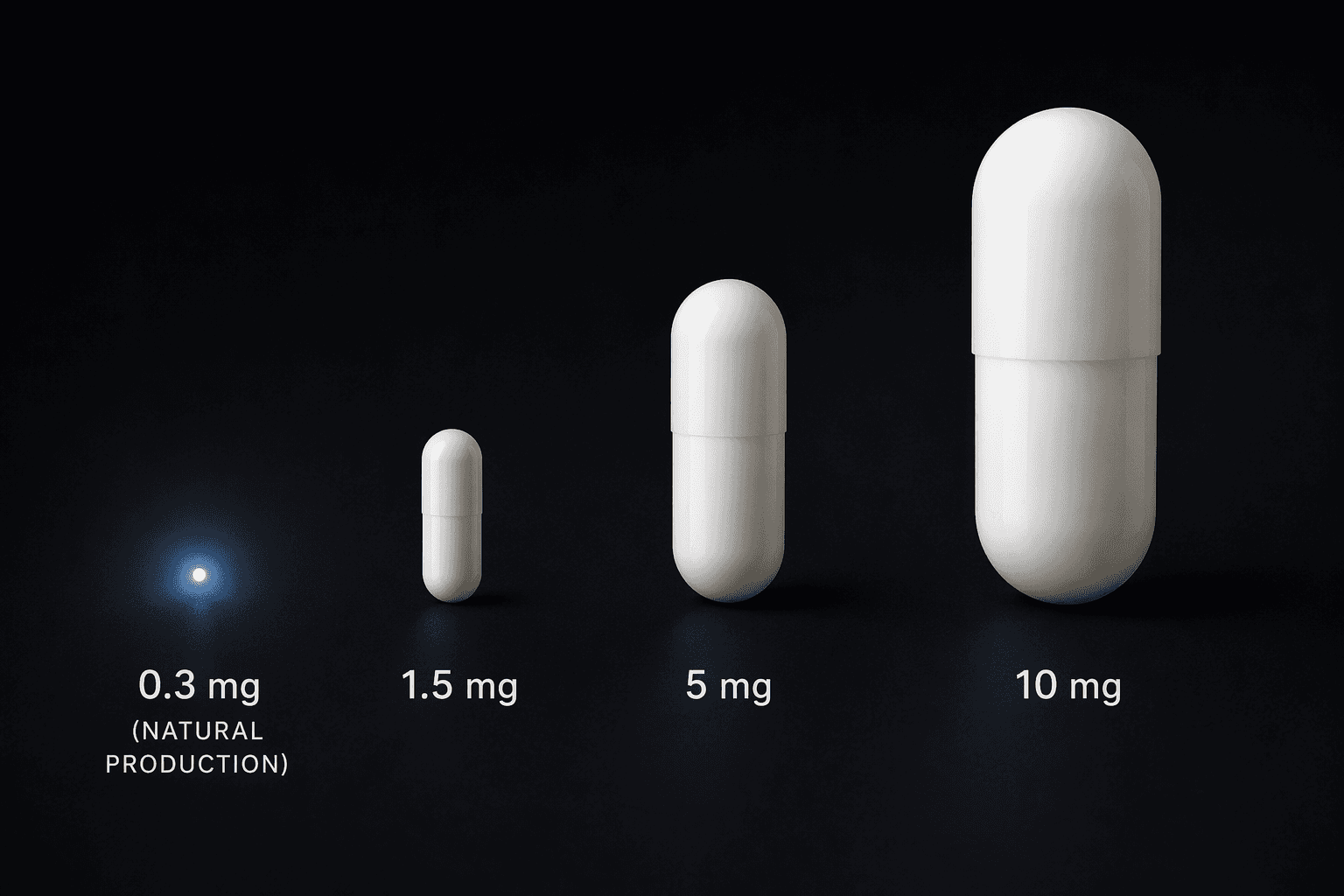
That matters because melatonin is not best understood as a knockout drug. It is a sleep-timing signal. The body naturally produces roughly 0.3 mg of melatonin per day, while many commercial supplements contain 5 mg to 10 mg per serving — about 15 to 30 times that daily physiological amount.[1] That gap does not automatically make higher-dose products dangerous for every adult, but it should make the “extra strength” language feel less reassuring. With a hormone-like signal, more is not automatically more precise.
Why melatonin doses got bigger than the biology suggests
Supplement labels tend to borrow the logic of pain relievers: if one tablet helps, a stronger tablet sounds as if it should help more. Melatonin does not fit that intuition very well. Its main clinical use for many adults is not to sedate the brain into unconsciousness; it is to nudge sleep onset when timing is off or when the body’s evening sleep signal is not lining up well with bedtime.
That is why the difference between 1.5 mg and 10 mg is not a trivial label detail. If the job is to send a timing signal, a dose can be large enough to do the job without being so large that it lingers into the next day or produces more unwanted effects. The commercial shelf, however, often makes the middle of the range look timid and the top of the range look decisive.
MidNite’s 1.5 mg dose is interesting for exactly that reason. It sits inside the low-dose range of 0.5 mg to 3 mg that current dose-response evidence supports for sleep-onset benefit, rather than competing in the 5 mg to 10 mg arms race.[2] That does not make it magic. It makes it restrained.
The evidence points toward enough, not maximum
The most useful evidence here is dose-response evidence, because it asks the question shoppers actually need answered: does taking more melatonin produce better sleep results? A 2023 dose-response meta-analysis in the Journal of Pineal Research supports the practical conclusion that low-dose melatonin, in the 0.5 mg to 3 mg range, can be as effective as higher doses for sleep onset.[2]
That conclusion is easy to understate. It does not say every adult will respond to 1.5 mg. It does not say melatonin fixes chronic insomnia. It does not say dose never matters. It says the low-dose range is clinically reasonable for the main outcome many people are chasing: falling asleep sooner. Once that signal has been delivered, multiplying the amount does not necessarily multiply the benefit.
This is where the pharmacy-shelf instinct can mislead. A 10 mg tablet may look more powerful than a 1.5 mg tablet, but the relevant question is whether the extra melatonin improves the sleep-onset signal or merely increases exposure. For many adults using melatonin occasionally, the better first question is not “What is the strongest dose I can buy?” It is “What is the lowest dose that plausibly does the job?”
| Dose or range | What it means in practical terms |
|---|---|
| About 0.3 mg per day | Approximate natural daily melatonin production; useful as a physiological scale, not a supplement target |
| 0.5–3 mg | Low-dose range supported by dose-response evidence for sleep-onset effects |
| MidNite 1.5 mg | A commercial example that falls within the evidence-aligned low-dose range |
| 5–10 mg | Common commercial range that greatly exceeds natural daily production without clear proof of proportionally better sleep-onset benefit |
Sleep onset is not the same as stronger sedation
A lot of disappointment with melatonin comes from expecting it to behave like a sedative. Someone takes it at bedtime, waits to feel drugged, and concludes that a larger dose must be the next logical step. But melatonin’s best-supported role is more modest: helping shift or reinforce the body’s sleep timing. That distinction changes how the dose should be judged.
If a person is wired from stress, drinking caffeine late, keeping irregular hours, or using bright screens in bed, a higher melatonin dose may not solve the real problem. It may simply add more melatonin to a sleep system being pushed in the opposite direction. The same is true when the underlying issue is persistent insomnia. Melatonin can be part of a short-term sleep-onset strategy for some adults, but chronic sleep problems deserve more than a supplement comparison.
This is also why next-day grogginess belongs in the dose conversation. A larger dose may leave some people feeling dulled the next morning, especially if it is taken late or if the person is sensitive to melatonin. The evidence supports the narrower and more useful point: low-dose melatonin is associated with sleep-onset benefit while carrying less risk of next-day grogginess or hormonal disruption than routine high-dose use.[1][2]
Where MidNite’s 1.5 mg dose fits
MidNite’s 1.5 mg melatonin dose lands in the middle of the evidence-aligned low-dose range. That is the main reason it is worth discussing. Not because every adult needs that product, and not because a branded supplement deserves special trust simply for existing, but because 1.5 mg reflects a dosing philosophy that is more consistent with how melatonin works.
The contrast with 5 mg and 10 mg products is straightforward. A 1.5 mg serving is still above the body’s approximate natural daily production, but it is much closer to that physiological scale than the common high-dose bottles. It also sits within the 0.5 mg to 3 mg range supported by dose-response evidence for sleep onset.[1][2]
That restraint matters in a category where labels often make excess look responsible. If a product can plausibly help with sleep onset at 1.5 mg, there is no obvious scientific virtue in starting at 10 mg just because the number looks more impressive. The burden should be on the higher dose to prove it buys something meaningful.
A supplement is not the same thing as an FDA-approved sleep drug
Melatonin products, including MidNite, are sold as dietary supplements in the United States, not as FDA-approved prescription sleep drugs. That distinction should keep expectations grounded. A supplement label can describe a sleep-support product, but it is not the same kind of evidence standard as a drug approval for treating a diagnosed sleep disorder.
For generally healthy adults considering melatonin for occasional trouble falling asleep, that does not make melatonin unusable. It makes careful dosing more important. People who are pregnant, trying to become pregnant, managing endocrine conditions, taking medications, or dealing with persistent insomnia should not treat a supplement aisle as a substitute for medical guidance. Children and adolescents are a separate conversation entirely and should not be folded into adult dosing logic.
How to think about the choice on the shelf
For an adult choosing a melatonin product for sleep onset, the practical decision can be narrowed quickly. Start with the dose, not the drama on the label. A product in the low-dose range is more consistent with current evidence than making 5 mg or 10 mg the default. MidNite’s 1.5 mg dose fits that low-dose approach.
- If the goal is falling asleep sooner, look first at low-dose melatonin rather than “maximum strength” formulas.
- Pay attention to next-day grogginess; if it appears, the dose, timing, or the supplement itself may not be right.
- Do not use a higher dose to compensate for irregular sleep habits, late caffeine, or untreated chronic insomnia.
- Treat melatonin as a short-term sleep-onset aid, not a nightly answer to every sleep problem.
The cleanest judgment is also the least flashy one: for adults considering melatonin for sleep onset, a low-dose product such as MidNite is more consistent with the available dose-response evidence than routine 5 mg to 10 mg dosing. The smarter use is cautious, short-term, and guided by how the next morning feels — not by the biggest number on the bottle.
References
- Low-Dose Melatonin for Sleep — Why MidNite's 1.5 mg Approach Makes More Scientific Sense Than 5–10 mg Products
- 2023 Wiley dose-response meta-analysis, Journal of Pineal Research


Comments
Join the discussion with an anonymous comment.