
Start With the Evidence Ladder, Not the Label “Natural”
A natural sleep aid for adults is only useful if it fits the sleep problem in front of you. Trouble falling asleep at the wrong body-clock time is not the same problem as waking at 3 a.m., and neither is the same as long-running insomnia in an older adult taking several medications. The research is uneven enough that putting every supplement into the same friendly roundup is more confusing than helpful.
The most defensible way to compare these options is to rank them by the kind of evidence behind them: meta-analyses and multiple randomized controlled trials first, then smaller positive trials, then traditional-use ingredients with signals but too little clinical support to lean on heavily.
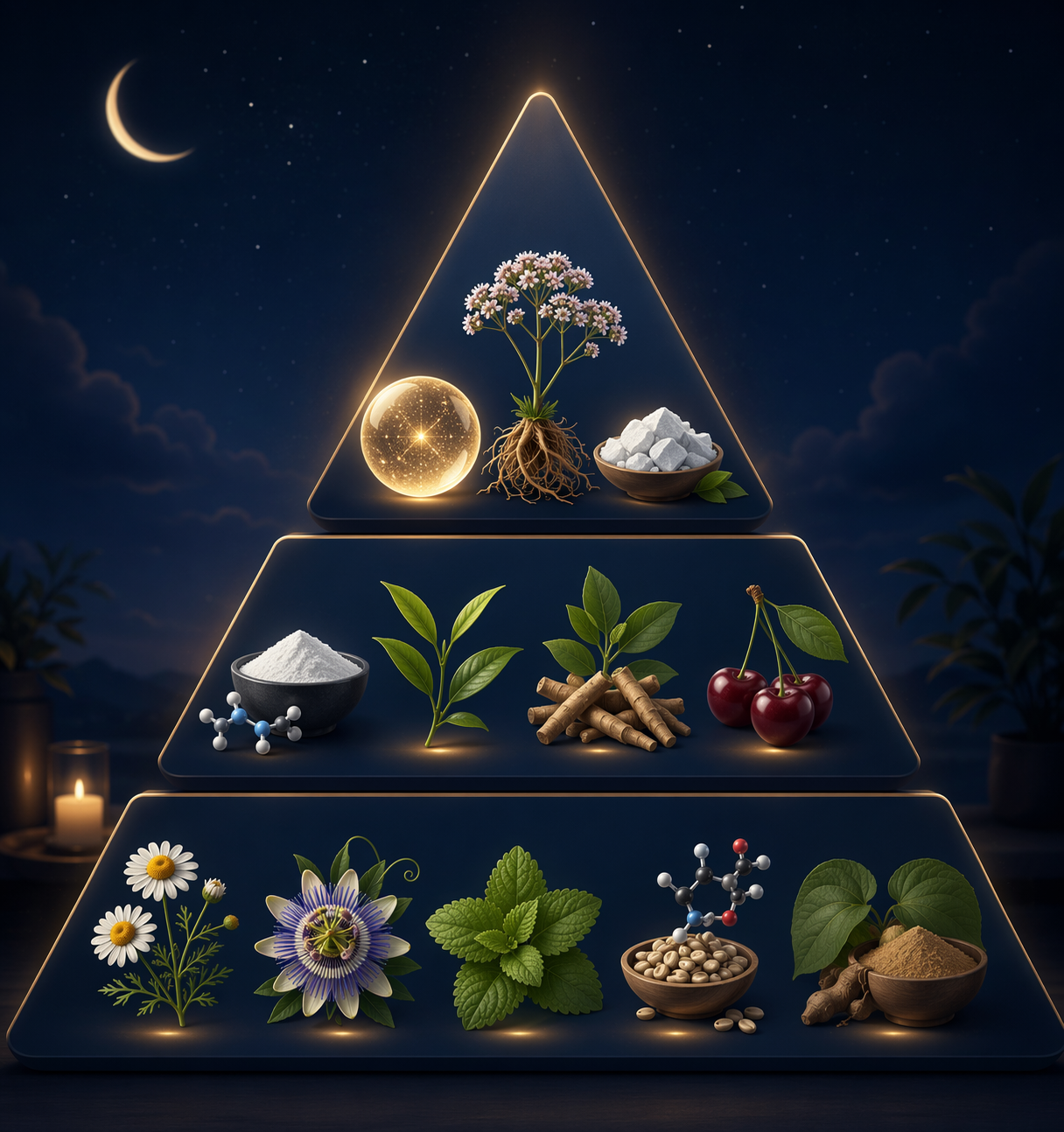
| Evidence tier | Sleep aids | Best-fitting use case | Main caution |
|---|---|---|---|
| Tier 1: strongest clinical support | Melatonin, valerian root, magnesium | Melatonin for circadian timing problems; valerian for sleep quality and sleep latency signals; magnesium mainly studied in older adults with insomnia | Melatonin is commonly misapplied to chronic insomnia; valerian trials vary in quality; magnesium evidence is useful but narrow [1][2][3][4] |
| Tier 2: moderate support | Glycine, L-theanine, ashwagandha, tart cherry | Glycine for sleep quality and next-day sleepiness signals; L-theanine for wake-after-sleep-onset; ashwagandha for insomnia symptoms; tart cherry for total sleep time and efficiency | Evidence is promising but generally smaller, shorter, or less generalizable than Tier 1 [1][5][6] |
| Tier 3: limited or traditional-use support | Chamomile, passionflower, lemon balm, 5-HTP, kava | May appeal to people looking for gentle or traditional options | Clinical evidence is thin or conflicting; 5-HTP is not a good primary choice, and kava raises safety concerns [1][6] |
That ranking does not mean Tier 1 supplements are automatically right for everyone, or that Tier 3 supplements never help anyone. It means the burden of proof is different. A supplement with multiple trials and meta-analytic support deserves a different level of confidence than one supported mainly by familiarity, tradition, or a few small studies using self-reported sleep quality.
Melatonin: Strong for Body-Clock Problems, Weak for Chronic Insomnia
Melatonin deserves its high ranking, but only after splitting the question in two. If the problem is circadian timing—jet lag, delayed sleep phase, or a sleep schedule that has drifted later than the adult wants—melatonin has a plausible mechanism and meaningful clinical support. If the problem is chronic insomnia, especially the familiar pattern of lying in bed exhausted but unable to sleep, the evidence is much less flattering.
That distinction is not academic. Harvard Health quotes sleep medicine physician Dr. Suzanne Bertisch saying that melatonin is “not effective for insomnia” and notes that multiple randomized controlled trials have not supported it for that use [2]. That is the sentence many supplement shelves do their best to blur.

The more favorable melatonin finding is about timing and sleep onset. A meta-analysis of randomized controlled trials found that melatonin reduced sleep latency, increased total sleep time, and improved overall sleep quality, with the strongest interpretation being that it can help shift or support sleep timing rather than act like a general sedative [1]. For an adult whose body clock is the problem, that matters. For an adult whose insomnia is driven by conditioned arousal, stress, pain, depression, alcohol use, medications, or untreated sleep apnea, it may be a detour.
The practical matching rule is simple: melatonin is most defensible when the desired sleep time is out of sync with the body’s current timing. It is much less convincing as a nightly answer to chronic insomnia. Dose, timing, and formulation matter, but the first question is whether the sleep problem is actually circadian.
Valerian Root: Real Signals, Messy Trials
Valerian is where evidence grading gets uncomfortable in a useful way. It is not just folklore. A 2020 systematic review and meta-analysis reported standardized mean differences of −0.46 for sleep quality and −0.71 for sleep latency across 18 randomized controlled trials [3]. Those are not trivial signals, and they justify placing valerian above many familiar herbal options.
The catch is that the trials behind the pooled result are not uniformly strong. Valerian studies vary in preparation, dose, population, duration, and outcome measurement. Some rely heavily on subjective reports, which are important—sleep quality is partly lived experience—but less clean than objective measures such as actigraphy or polysomnography. A broad literature review of herbal and natural sleep supplements highlights this recurring limitation across the field, not just for valerian [6].
So valerian earns a cautious “plausible” rather than a clean endorsement. It may be a reasonable candidate for adults whose main complaint is sleep quality or taking too long to fall asleep, especially if they are not expecting a drug-like effect the first night. It is less persuasive when marketing turns a mixed evidence base into certainty.
Magnesium: Most Interesting for Older-Adult Insomnia, Not Everyone
Magnesium often gets sold as if modern adults are universally one mineral away from good sleep. The better reason to discuss it is narrower: a double-blind randomized clinical trial in 46 older adults with primary insomnia tested 500 mg per day for 8 weeks and found improvements in sleep time, sleep efficiency, Insomnia Severity Index scores, and serum cortisol compared with placebo [4].
That is concrete evidence, and it is especially relevant because older adults are both more likely to report insomnia and more likely to face tradeoffs with sedating medications. But the same details that make the trial useful also limit it. It was small, short, and focused on older adults. It does not prove that every adult with occasional stress-related sleeplessness should add magnesium, or that higher doses are better.
Magnesium belongs near the top of the ladder because there is a controlled trial with clinically relevant outcomes in a defined population. The honest version of that sentence is not “magnesium is a proven sleep cure.” It is “magnesium has a better clinical foothold for older-adult insomnia than many supplements, while the evidence remains limited by size and duration.”
The Middle Tier: Match the Signal to the Sleep Complaint
Glycine, L-theanine, ashwagandha, and tart cherry are not evidence-free. They are also not in the same position as melatonin for circadian timing or valerian with meta-analytic sleep-latency findings. Their usefulness depends heavily on which sleep outcome you care about.
- Glycine: Small crossover trials using 3 g before bed found improvements in objective sleep quality and reduced daytime sleepiness, possibly through a slight reduction in core body temperature [1]. This is more relevant to sleep quality and next-day functioning than to a dramatic sedative effect.
- L-theanine: The cleaner match is sleep maintenance. Evidence summarized by Sleep Foundation suggests 200 mg per day may reduce wake-after-sleep-onset, while not clearly reducing sleep latency [1]. That distinction matters for someone who falls asleep easily but wakes repeatedly.
- Ashwagandha: A randomized trial in 150 adults with insomnia reported sleep-quality improvement in 72% of the ashwagandha group compared with 29% of placebo, and a meta-analysis of 5 randomized controlled trials found a small but significant effect [5]. The NIH Office of Dietary Supplements notes that most studies were conducted in India on Indian populations, so generalizability remains uncertain [5].
- Tart cherry: Randomized trials have reported increased total sleep time of about 84 minutes and improved sleep efficiency [1]. That makes it more interesting for total sleep duration than for a narrowly defined circadian problem.
This is the part of the supplement aisle where matching prevents overbuying. If the complaint is “I cannot fall asleep before 2 a.m.,” L-theanine’s wake-after-sleep-onset signal is not the obvious first fit. If the complaint is “I wake up repeatedly,” a sleep-onset-only claim is a distraction. The outcome measured in the trial should resemble the problem the adult actually has.
The Familiar Herbs Are Not Automatically the Best-Supported Ones
Chamomile, passionflower, and lemon balm are often the most comforting names on a label. They may be pleasant, and some adults may like them as part of a wind-down routine. The clinical evidence, however, is not strong enough to rank them beside melatonin, valerian, or magnesium. A pleasant bedtime tea is not the same thing as a supplement with replicated effects in controlled trials.
5-HTP is a good example of why “natural serotonin support” language can outrun the data. The evidence is conflicting: one study found improvements in older adults, while another found no benefit or slight impairment [6]. That is not a foundation for choosing it as a primary sleep ingredient.
Kava also sits poorly in a casual sleep-aid roundup because safety is part of the evidence judgment. If an option carries meaningful safety concerns, it should not be treated like a gentle equivalent to chamomile simply because both are plant-derived [1][7].
What the Evidence Often Does Not Tell You
Most supplement trials for sleep are not built like long-term medication safety programs. Many are small, often enrolling fewer than 200 participants, and short, commonly lasting 4 to 12 weeks. That means a positive result can justify cautious use for a matching problem, but it cannot answer every question about daily use for months or years.
Measurement is another pressure point. Self-reported sleep quality matters because the person sleeping is the person living with the outcome. Still, subjective improvement can be shaped by expectation, routine changes, and placebo response. Objective measures such as polysomnography and actigraphy are not used consistently across this literature, a limitation noted in reviews of natural and herbal sleep supplements [6].
Regulation also changes the buying decision. In the United States, dietary supplements are not verified by the FDA for safety, effectiveness, or label accuracy before sale in the way prescription drugs are. Mayo Clinic advises caution with nonprescription sleep aids and emphasizes checking interactions and health conditions before use [7]. For supplements, third-party testing seals such as USP, NSF, or ConsumerLab are a practical filter, not a guarantee that the ingredient will work.
How to Choose Without Turning This Into Guesswork
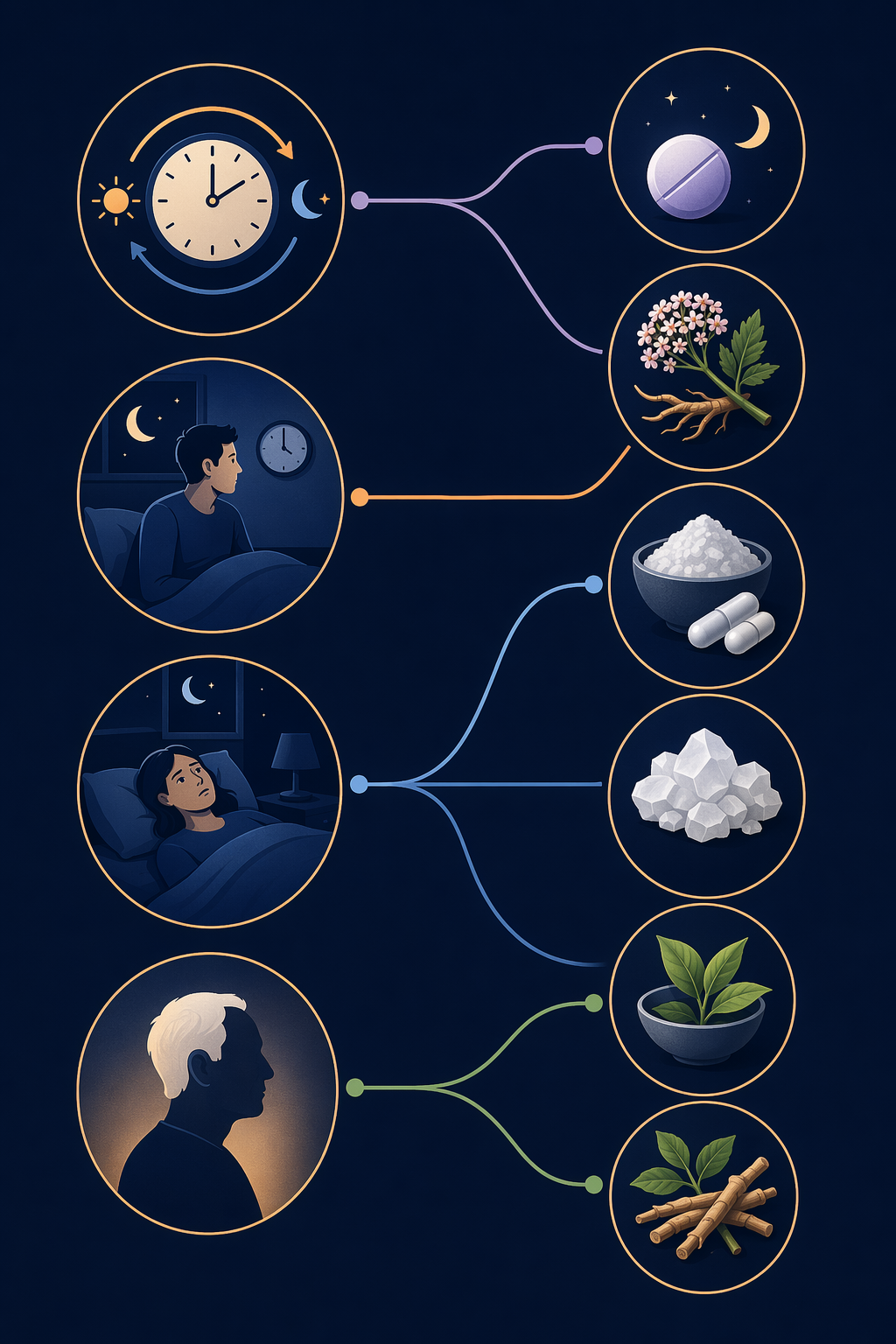
The decision should start with the sleep pattern, not the supplement name.
| If your main problem is... | Most plausible evidence-based match | Less convincing first choice |
|---|---|---|
| Your sleep schedule is shifted late, or jet lag has disrupted timing | Melatonin | Chamomile, lemon balm, or a general “relaxation” blend |
| You take too long to fall asleep, but the issue is not clearly circadian | Valerian may be reasonable; melatonin is less convincing for chronic insomnia | Assuming melatonin works like a sedative |
| You wake during the night and struggle with sleep maintenance | L-theanine may fit better than sleep-onset-focused aids | Choosing based only on “fall asleep faster” claims |
| You are an older adult with insomnia | Magnesium has a small older-adult RCT worth discussing with a clinician | Stacking multiple sedating supplements without medication review |
| You mainly want better sleep quality or less next-day sleepiness | Glycine has targeted signals; valerian may also be relevant | Treating total sleep time, sleep quality, and daytime alertness as the same outcome |
This framework does not replace medical care. Chronic insomnia, pregnancy, older age, depression or anxiety, alcohol dependence, suspected sleep apnea, restless legs symptoms, and prescription medication use all change the risk-benefit calculation. Persistent sleep problems deserve more than rotating through capsules every few weeks.
The best natural sleep aid for adults is not the one with the calmest label or the longest ingredient list. It is the one whose evidence matches the actual sleep problem, with enough safety margin to make trying it a reasonable decision rather than another form of marketing.
References
- Natural Sleep Aids: Which Are the Most Effective?, Sleep Foundation.
- Supplementing Your Sleep, Harvard Health.
- Valerian Root in Treating Sleep Problems and Associated Disorders-A Systematic Review and Meta-Analysis, Journal of Evidence-Based Integrative Medicine, 2020.
- The effect of magnesium supplementation on primary insomnia in elderly: A double-blind placebo-controlled clinical trial, Journal of Research in Medical Sciences, 2012.
- Ashwagandha: Is It Helpful for Stress, Anxiety, or Sleep?, NIH Office of Dietary Supplements.
- Herbal and Natural Supplements for Improving Sleep: A Literature Review, National Library of Medicine.
- Sleep aids: Understand options sold without a prescription, Mayo Clinic.


Comments
Join the discussion with an anonymous comment.