

The fastest way to waste another week on a sleep aid is to treat “non-habit-forming” as if it means “right for my sleep problem.” It does not. It usually means the product is not expected to produce classic physical dependence or withdrawal. It does not prove the dose is sensible, the mechanism fits your insomnia pattern, or the next morning will feel clean.
Melatonin is the usual example. It is often sold beside sedating products, but physiologically it is closer to a timing signal than a knock-out switch. That distinction matters. If your problem is jet lag, delayed sleep timing, or another circadian shift, melatonin may be a rational tool. If your problem is ordinary sleep-onset anxiety, repeated nighttime waking, or shallow sleep, taking more melatonin is often just a louder version of the wrong message.
The dose confusion makes this worse. More than 70% of melatonin supplements have significant discrepancies between labeled and actual dosage, and many over-the-counter products contain 3 to 10 milligrams even though commonly cited effective doses are closer to 0.5 to 3 milligrams.[1][2] Higher doses are also associated with exactly the things many people are trying to avoid: morning grogginess, vivid dreams, and headaches.[2]

Antihistamine sleep aids sit at the other end of the blunt-tool spectrum. They can make people drowsy, but drowsy is not the same as well-rested. Johns Hopkins Medicine warns about anticholinergic sleep aids and dementia risk, while Cleveland Clinic reports that 8 out of 10 people experience a “hangover effect” after sleep medicine.[3][4] For adults 65 and older, diphenhydramine also carries special caution under geriatric prescribing standards.[3]
So the useful question is narrower than “What is the best non habit forming sleep aid?” It is: what is keeping you awake, and which mechanism actually matches that problem?
Match the Mechanism Before the Bottle
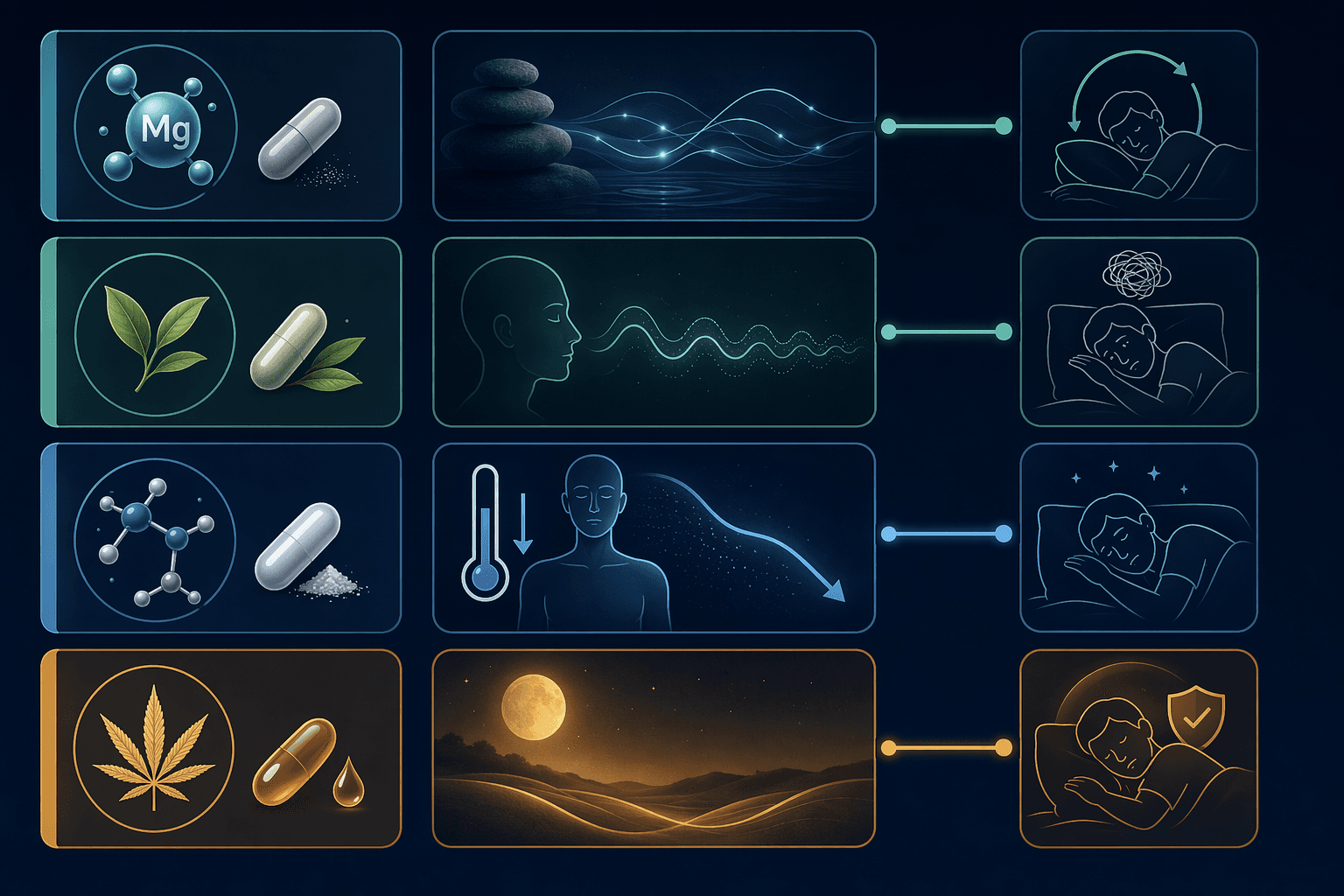
A supplement that helps with stress-linked sleep onset is not automatically useful for 3 a.m. waking. A mineral that supports sleep efficiency is not a circadian clock reset. A cannabinoid with an early randomized trial is not a settled answer for chronic insomnia. These distinctions are not academic; they determine whether you wake up clearer or spend the next day wondering why “natural” still feels like a medication hangover.
| Sleep complaint | Mechanism to consider | Option discussed here |
|---|---|---|
| Restless body, light sleep, or maintenance problems | Mineral support involved in neuromuscular relaxation and sleep regulation | Magnesium glycinate |
| Stress arousal, caffeine tension, or a busy mind at bedtime | Calming amino acid support without daytime sedation | L-theanine |
| Non-restorative sleep and next-day sleepiness | Amino acid signal linked in trials with sleep quality and daytime alertness | Glycine |
| Night waking or poor perceived sleep quality, with comfort using cannabinoid products | Cannabinoid pathway under early clinical study | CBN |
This is also why comparing magnesium glycinate and melatonin as if they are two versions of the same sleep aid leads people in circles. Melatonin asks, “Is your clock shifted?” Magnesium asks a different question: “Is your body adequately supported for sleep stability?”
Magnesium Glycinate: For Sleep Stability, Not Clock Resetting
Magnesium glycinate is usually the first alternative worth discussing because it is not trying to imitate a sedative. Magnesium participates in normal nervous system and muscle function, and the glycinate form is commonly chosen because it is typically gentler on the stomach than some other magnesium forms. That does not make it a universal sleep cure, but it makes it a more coherent choice for people who describe light sleep, physical tension, or difficulty staying asleep rather than a shifted sleep schedule.
The human evidence is not enormous, but it is more concrete than most supplement copy. A double-blind trial in elderly participants, cited by Sleep Foundation, found that magnesium supplementation improved sleep efficiency, total sleep time, and melatonin levels.[5] That population matters. Results in older adults do not automatically predict the same effect in every healthy 30-year-old with a stressful job and a bright phone. Still, the trial points toward sleep continuity and sleep efficiency, not forced sedation.
The label is where people get tripped up. “Magnesium glycinate” on the front of a bottle does not tell you how much elemental magnesium you are actually taking. The supplement facts panel matters more than the marketing name. Products can differ in elemental magnesium content, serving size, and whether the product is fully glycinate or a blend.
- Check elemental magnesium, not just total compound weight.
- Start low if you are sensitive to gastrointestinal effects.
- Avoid treating magnesium as a rescue sedative; it is better evaluated over repeated nights.
- Use extra caution if you have kidney disease or take medications that interact with minerals.
For a deeper look at formulation and timing, see magnesium glycinate for sleep. The short version is simple enough: magnesium glycinate makes the most sense when the target is sleep stability, not when the real issue is a circadian rhythm that needs shifting.
Glycine: A Small Dose With a Clearer Human Signal
Glycine is less fashionable than melatonin and less loudly marketed than cannabinoids, which is part of its appeal. It is a simple amino acid, and the sleep evidence is refreshingly specific: 3 grams before bed improved sleep quality and reduced daytime sleepiness in people with insomnia symptoms.[5]
That last part is important. A sleep aid that only makes the night feel heavier is not much of an upgrade if it steals the morning. Glycine’s trial signal is interesting because it includes daytime sleepiness, not just subjective night comfort.[5] For the person who can fall asleep but wakes feeling under-recovered, that is a more relevant outcome than “felt drowsy within 30 minutes.”
Glycine also avoids the dose creep problem that plagues melatonin. The studied bedtime dose is not a vague “take as needed” cloud; it is 3 grams.[5] That does not prove higher doses are better, and it does not turn glycine into a treatment for chronic insomnia. It simply gives the user a cleaner experiment: one dose, one timing window, and a measurable next-day question.
- Best fit: poor sleep quality, non-restorative sleep, and next-day sleepiness.
- Studied dose: 3 grams before bed.
- Main advantage: the evidence includes next-day functioning, not only nighttime perception.
- Main limitation: promising does not mean proven for every form of insomnia.
L-Theanine: When the Problem Is Mental Arousal
Some people are not awake because their clock is wrong or their body feels wired in a muscular way. They are awake because the mind will not downshift. L-theanine fits that lane better than it fits the generic promise of “deep sleep.”
At 100 to 200 milligrams, L-theanine has been associated with reduced stress and improved sleep quality without daytime sedation; it may also reduce caffeine’s detrimental effects on sleep.[5] That makes it a plausible option for people whose sleep onset is disturbed by stress, evening stimulation, or lingering caffeine tension rather than by a delayed circadian phase.
The “without daytime sedation” part deserves attention because it is exactly where many sleep aids fail. A product can solve bedtime by creating a morning problem. L-theanine’s appeal is different: it is not trying to club the nervous system into sleep, and its evidence is strongest when the target is stress-linked arousal.[5]
For dosing details and a fuller evidence review, see L-theanine for sleep. The practical decision is straightforward: if your night is being driven by rumination or stimulation, L-theanine belongs higher on the shortlist than melatonin. If you wake repeatedly from pain, alcohol rebound, untreated sleep apnea symptoms, or another medical issue, it is the wrong tool to pretend will cover everything.
CBN: Interesting, Not Settled
CBN is the option most likely to be oversold. It sits in the cannabinoid category, which means the marketing often arrives before the evidence has finished its work. There is real clinical interest here, but the honest version is narrower than the sales version.
A randomized trial by Kaul and colleagues in 2023 found meaningful improvements in sleep quality and reduced nighttime waking without tolerance or dependency.[1] That is worth paying attention to. It is also one study. “Strongest trial to date” is not the same as “settled across populations, products, doses, and long-term use.”
CBN may be most relevant for people focused on nighttime waking or poor perceived sleep quality who are already comfortable considering cannabinoid products. It should be approached more cautiously by people who are drug-tested, pregnant, using other sedating substances, sensitive to cannabinoids, or taking medications where interactions matter. Product quality and cannabinoid content are not details; they are the product.
If a CBN label leans too hard on “non-habit-forming,” read that as the beginning of your questions, not the end of them. Ask what dose was studied, whether the product matches that dose, whether THC is present, and whether the claimed effect is sleep onset, sleep maintenance, sleep quality, or simply sedation.
A Cleaner Way to Choose
The least useful sleep-aid comparison asks which ingredient is “strongest.” Strongest at what? Moving a circadian clock, reducing stress arousal, improving sleep efficiency, reducing next-day sleepiness, or cutting down nighttime waking are different targets. A product can be impressive for one and irrelevant for another.
| If your pattern sounds like this | Start your thinking here | Why |
|---|---|---|
| You fall asleep too late after travel or a shifted schedule | Melatonin, used cautiously | It is a timing signal, and dose matters. |
| You feel physically restless or sleep lightly | Magnesium glycinate | Its best-supported role is closer to sleep stability than sedation. |
| You sleep but wake unrefreshed | Glycine | The studied 3 g bedtime dose improved sleep quality and reduced daytime sleepiness.[5] |
| Stress or caffeine keeps your mind activated | L-theanine | The 100–200 mg range is linked with reduced stress and better sleep quality without daytime sedation.[5] |
| Night waking is the main complaint and cannabinoid use is acceptable to you | CBN, cautiously | A 2023 randomized trial is promising, but replication and long-term clarity are still limited.[1] |
This is also where supplement use should stay in its lane. Occasional sleep disruption after stress, travel, caffeine, or schedule strain is one thing. Persistent insomnia is another. If sleep problems are frequent, worsening, tied to breathing pauses, mood changes, pain, medications, or major daytime impairment, the better next step is not a larger stack of non-habit-forming products. It is evaluation. The insomnia FAQ can help separate a short-term sleep problem from something that needs clinical attention.
The better standard is not whether a sleep aid sounds gentle. It is whether the mechanism fits the sleep complaint, whether the dose has been studied, whether the product label is honest enough to verify, and whether the next morning is actually better.
References
- Compare Sleep Medications. Sleep Foundation.
- Best OTC Sleep Aids for No Grogginess and a Clear Morning. Ubie Health.
- Sleep Aids. Johns Hopkins Medicine.
- Sleeping Pills. Cleveland Clinic.
- Natural Sleep Aids. Sleep Foundation.
Comments
Join the discussion with an anonymous comment.