
For short-term sleep, doxylamine vs diphenhydramine is usually the wrong contest if it starts with “which one is stronger?” Both are first-generation antihistamines that can make people sleepy. The safer choice depends less on the box claim and more on who is taking it: an older adult, a pregnant person, someone with glaucoma or urinary retention risk, or someone who has quietly turned an occasional sleep aid into a nightly habit.
The most important dividing line is age. For adults 65 and older, the 2023 AGS Beers Criteria list both doxylamine and diphenhydramine as potentially inappropriate because of anticholinergic effects and fall risk.[1] That does not mean every single dose causes harm. It does mean the usual pharmacy-aisle comparison is too casual for this group.

| Decision point | Doxylamine | Diphenhydramine | What should drive the choice |
|---|---|---|---|
| Adults 65+ | Listed as potentially inappropriate in older adults because of anticholinergic effects and fall risk; longer half-life may make residual sedation more relevant.[1] | Also listed as potentially inappropriate in older adults because of anticholinergic effects and fall risk.[1] | Usually neither without clinician guidance. |
| Pregnancy | Has the stronger pregnancy-specific evidence context because doxylamine plus pyridoxine is used for nausea and vomiting of pregnancy and has extensive safety data.[1] | FDA Pregnancy Category B in the cited clinical summary; generally considered acceptable as occasional single-dose use in pregnancy.[1] | Doxylamine may have the better evidence footing, but pregnancy use should still be situation-aware. |
| Contraindications and cautions | Contraindicated or requires avoidance/caution in narrow-angle glaucoma, stenosing peptic ulcer, enlarged prostate or bladder neck obstruction, asthma, and severe liver disease.[1] | Shares the same anticholinergic-type concern set in this comparison.[1] | Existing conditions matter more than brand preference. |
| Next-day impairment | Half-life is about 10–12 hours and may be up to 15 hours in older adults.[1] | Half-life is shorter, about 4–8 hours in the research summary. | A shorter half-life does not erase risk, but a longer one can matter when someone gets up at night or drives early. |
| Regular use | Can lose effectiveness with regular use; do not use beyond short-term guidance without medical advice.[3] | Same concern: tolerance can develop with regular use.[3] | If use is becoming routine, the problem is no longer choosing between two antihistamines. |
| Chronic insomnia | Not recommended by the AASM for chronic insomnia. | Not recommended by the AASM for chronic insomnia. | Move toward insomnia evaluation and CBT-I rather than another OTC rotation. |
Why the “stronger sleep aid” framing can mislead
Doxylamine and diphenhydramine work in the same broad way: they are sedating, first-generation antihistamines with anticholinergic effects. That shared mechanism is why their side effects overlap: dry mouth, constipation, urinary retention, blurred vision, confusion, and next-day grogginess are not random add-ons. They come from the same pharmacologic neighborhood.
There also is not a clean, high-quality head-to-head insomnia trial that settles the consumer question in the way shoppers want it settled. Self-reported ratings can make one product look more popular than another, but ratings are not a safety study, and they do not tell you whether a person was older, pregnant, taking other sedating medicines, or waking up twice a night to use the bathroom.
So the practical answer is not “doxylamine wins” or “diphenhydramine wins.” It is a sorting process. First sort by age, pregnancy status, medical conditions, and frequency of use. Only after that does personal response become a reasonable part of the conversation.
If you are 65 or older, neither is a casual choice
This is the clearest part of the comparison. In adults 65 and older, both doxylamine and diphenhydramine are grouped as potentially inappropriate medications in the Beers Criteria because of anticholinergic effects and fall risk.[1] That grouping matters more than whether one box says “nighttime” and another says “sleep.”
The risk is not only feeling foggy the next morning. An older adult may wake during the night, stand up in the dark, feel sedated, have blurred vision, or be slower to react. If they already have balance problems, urinary urgency, cognitive impairment, low blood pressure, or other sedating medicines on board, a pill taken for sleep can become part of the fall-risk chain.
Doxylamine deserves special caution here because its half-life is longer: about 10–12 hours, with reports up to 15 hours in older adults.[1] A medicine taken at 10 p.m. may still be meaningfully present during a 6 a.m. bathroom trip or morning drive. Diphenhydramine’s shorter half-life may sound reassuring, but the Beers Criteria do not treat it as a safe workaround for older adults.
The dementia concern should be handled carefully. A Harvard Health summary of a JAMA Internal Medicine study reported that taking an anticholinergic for the equivalent of three years or more was associated with a 54% higher dementia risk compared with taking the same dose for three months or less.[2] That is a long-term cumulative-use signal, not proof that one difficult night with an OTC sleep aid causes dementia.
For a caregiver, the safer move is usually not to swap diphenhydramine for doxylamine or the reverse. It is to ask why sleep has changed: pain, nighttime urination, depression, restless legs, sleep apnea, medication timing, caffeine, alcohol, or a new prescription can all sit underneath “insomnia.” In this age group, the cost of guessing is higher.
Pregnancy changes the comparison, but it does not make it automatic
Pregnancy is where doxylamine has a meaningful evidence advantage. Doxylamine combined with pyridoxine is used for nausea and vomiting of pregnancy and is described in the cited clinical summary as the only FDA Pregnancy Category A medication for that condition, supported by extensive safety data.[1] Diphenhydramine is described there as FDA Pregnancy Category B.[1]
That does not turn doxylamine into a blanket “best sleep aid in pregnancy.” The evidence base is stronger in a pregnancy-specific context, but the reason for use still matters. A pregnant person using doxylamine for nausea under clinician guidance is not the same situation as someone adding an OTC sleep aid several nights a week because insomnia has become unbearable.
For occasional single-dose use, both doxylamine and diphenhydramine are generally considered acceptable in pregnancy in the research summary, but that is still a narrower claim than “safe for everyone.” If insomnia is recurring, or if there are other medications, high-risk pregnancy factors, severe nausea, anxiety, or symptoms of sleep apnea, the decision belongs in a treatment plan rather than a late-night aisle comparison.
If you are trying to place OTC options in context, start with a pregnancy-specific overview such as which sleep aids are safe during pregnancy. If sleep has become a repeated problem, a stepwise guide like the pregnancy sleep-aid treatment ladder is more useful than comparing two antihistamine labels in isolation.
Medical conditions that can make both drugs a poor fit
Some conditions do not leave much room for a doxylamine-versus-diphenhydramine preference. The contraindication and caution set in the clinical summary includes narrow-angle glaucoma, stenosing peptic ulcer, enlarged prostate or bladder neck obstruction, asthma, and severe liver disease.[1] These are not decorative label warnings. They point to situations where anticholinergic effects, sedation, breathing issues, urinary retention, or impaired drug handling can matter.
- Narrow-angle glaucoma: anticholinergic effects can be a serious problem; do not treat this as a routine OTC choice.
- Enlarged prostate or bladder neck obstruction: urinary retention risk can turn a sleep-aid decision into an urgent medical issue.
- Asthma or breathing vulnerability: sedating medications deserve extra caution, especially if nighttime symptoms are already present.
- Severe liver disease: drug metabolism and next-day impairment concerns become harder to predict.
- Other sedating medicines or alcohol: additive sedation can change the risk profile even when the OTC dose looks ordinary.
This is also where the phrase “non-habit-forming” can do too much work. It usually means the product is not marketed as carrying the same dependence profile as some prescription sedative-hypnotics. It does not mean the drug is free of next-day impairment, anticholinergic effects, interactions, or poor fit for certain conditions. For more context, see what non-habit-forming sleep aid actually means on OTC labels.
Regular use is a different problem than one bad night
A person taking one OTC sleep aid after travel, stress, or a disrupted schedule is making a different decision from someone taking it most nights. Mayo Clinic notes that tolerance can develop to OTC sleep aids and advises not using them longer than two weeks without medical guidance.[3]
Once use becomes regular, the question should shift from “doxylamine or diphenhydramine?” to “why is sleep not recovering?” Rotating between antihistamines does not solve chronic insomnia, and it may blur the pattern a clinician needs to see: sleep timing, awakenings, pain, mood symptoms, breathing symptoms, restless legs, alcohol use, or medication side effects.
For chronic insomnia, the AASM does not recommend either doxylamine or diphenhydramine. A behavioral treatment path is the safer center of gravity. Cognitive behavioral therapy for insomnia is not as instantly satisfying as buying a box, but it addresses the learned sleep-wake patterns that keep insomnia going. If this is no longer occasional, start with CBT-I for comorbid insomnia rather than looking for a stronger antihistamine.
How to choose without overreading the label
If you are younger than 65, not pregnant, do not have the listed contraindications, are not combining sedatives, and need help for a short, temporary sleep disruption, either drug may be considered as an occasional OTC option. Doxylamine may last longer; diphenhydramine may clear sooner. That distinction can matter if you need to be alert early, but it does not override the population risks.
If you are comparing doxylamine products specifically, a dedicated doxylamine sleep aid safety and dosage guide can help you check who should avoid it. If the real question is whether an antihistamine, melatonin product, or another OTC category fits your sleep problem, use a broader OTC sleep aid comparison instead of treating two antihistamines as the whole menu.
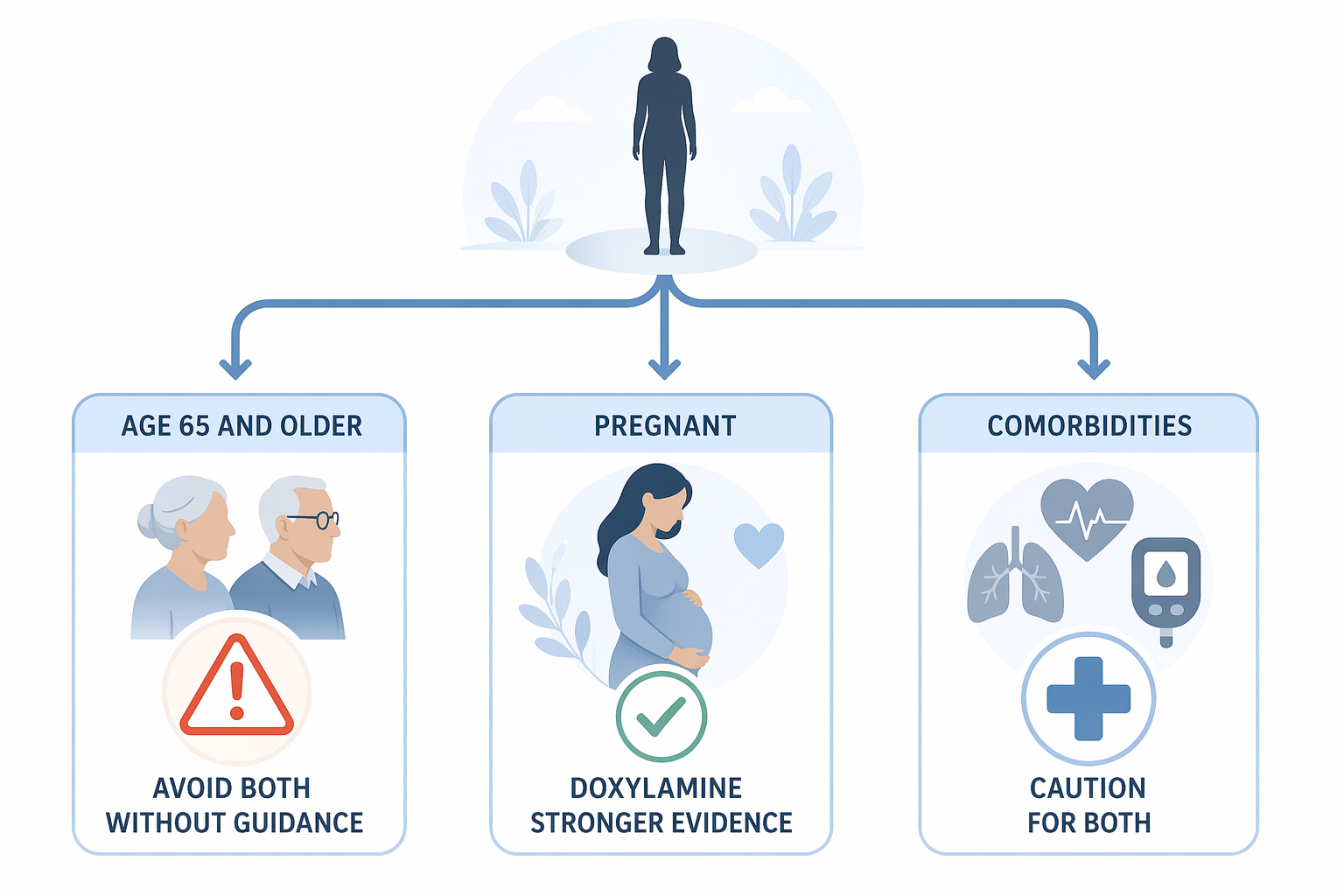
The clean next action is simple: match the drug to your risk category before you match it to your preference. Adults 65 and older should usually avoid both without medical guidance. Pregnant readers should give extra weight to doxylamine’s pregnancy-specific evidence context but still use clinician-aware judgment. Anyone using either product regularly has moved beyond an OTC brand decision and should address the insomnia pattern itself.
References
- Doxylamine, StatPearls, NCBI Bookshelf.
- Common anticholinergic drugs like Benadryl linked to increased dementia risk, Harvard Health Publishing, January 28, 2015.
- Sleep aids: Could antihistamines help me sleep?, Mayo Clinic.


Comments
Join the discussion with an anonymous comment.