

The shelf makes it look simple: one bottle says “PM,” another says “natural,” another promises no next-day grogginess. That is how many adults end up asking for the best sleep aid for adults as if there were one answer. There is not. The first safety question is not which ingredient is strongest. It is who is taking it: a healthy 35-year-old, a pregnant person, a 72-year-old who gets up twice a night to urinate, or someone with kidney disease should not be treated as the same sleeper.
That matters most with the products people tend to treat casually. Diphenhydramine and doxylamine—the sedating antihistamines found in many over-the-counter sleep aids and “PM” pain relievers—are easy to buy, but they are not low-risk for everyone. The 2023 American Geriatrics Society Beers Criteria lists first-generation antihistamines, including diphenhydramine and doxylamine, as potentially inappropriate for adults 65 and older because of anticholinergic effects and risks that include confusion, falls, and possible dementia acceleration.[1]

Start with the person, not the product
A useful sleep-aid decision starts by sorting people into risk groups before comparing ingredients. The same product that may be tolerable for one adult can be a poor choice for another because of age, pregnancy, bladder symptoms, eye disease, kidney function, or the medication list already sitting on the kitchen counter.
| If this describes you | Be especially cautious with | Why it matters |
|---|---|---|
| Age 65 or older | Diphenhydramine and doxylamine | These first-generation antihistamines are flagged by the AGS Beers Criteria as potentially inappropriate for older adults because of anticholinergic risks.[1] |
| Pregnant or breastfeeding | Melatonin, doxylamine used casually as a sleep aid, CBD, valerian | Pregnancy-specific sleep-aid safety data are limited, and use for nausea does not automatically equal broad permission for insomnia. |
| Closed-angle glaucoma, peptic ulcer, or urinary retention | Sedating antihistamines | These conditions make antihistamine sleep aids a poor fit and are listed as situations requiring avoidance or medical advice.[3] |
| Kidney disease | Magnesium supplements | Reduced kidney function can change how minerals are handled, so magnesium should not be treated as a harmless nightly add-on. |
| Chronic insomnia | Repeated OTC sedatives as a long-term strategy | Persistent insomnia usually needs a treatment plan, not a rotating set of bottles. |
Adults 65 and older: the “PM” bottle deserves extra suspicion
Older adults are where the gap between common behavior and safety guidance becomes hardest to ignore. The National Council on Aging estimates that about one in three adults over 65 takes some form of sleep aid, even though this is the same age group in which medication side effects can turn into falls, confusion, and loss of independence.[2]
The problem is not that diphenhydramine and doxylamine never make people sleepy. They often do. The problem is the way they make people sleepy. These drugs have anticholinergic effects, meaning they block acetylcholine, a chemical messenger involved in memory, attention, bladder function, bowel function, and other body systems. In real life, that can show up as dry mouth, constipation, urinary trouble, blurred vision, next-day fogginess, or a parent who seems “off” in the morning after taking something sold without a prescription.
Falls are the consequence that should stop the conversation from feeling theoretical. A medicine that leaves a younger adult mildly groggy can leave an older adult unsteady on the way to the bathroom at 3 a.m. Add blood pressure medication, bladder medication, anxiety medication, alcohol, or a dark hallway, and the risk no longer looks like a small print warning.
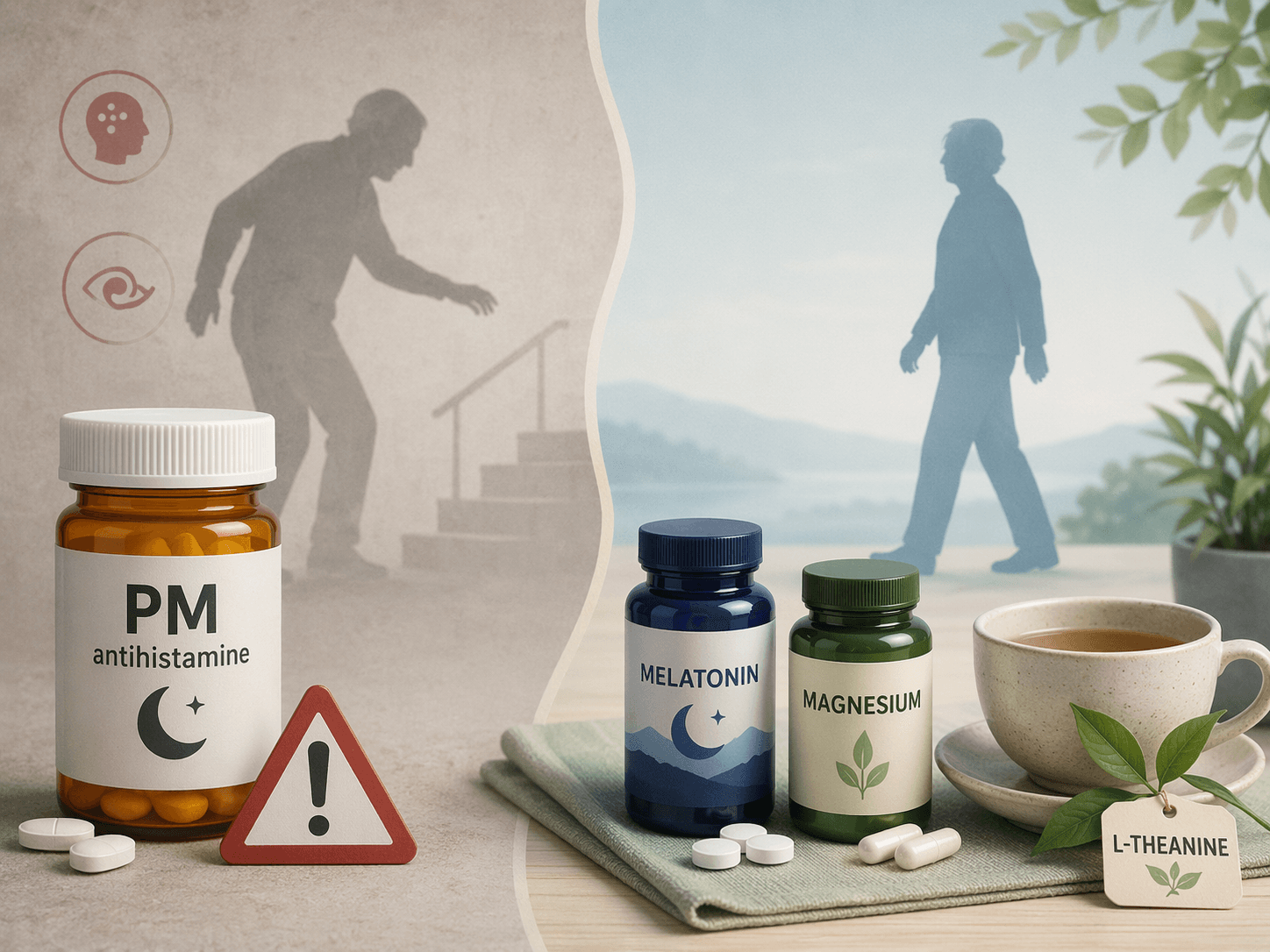
The Beers Criteria does not say every older adult who has ever taken one of these products has been harmed. It says these medications are potentially inappropriate in this population because the risk profile is unfavorable. That distinction matters. It leaves room for clinical judgment, but it should also make nightly self-treatment with diphenhydramine or doxylamine a hard sell for adults 65 and older.[1]
Lower-anticholinergic options are not the same as risk-free options
For many older adults, lower-dose melatonin, magnesium glycinate, and L-theanine are often discussed as safer alternatives because they do not carry the same anticholinergic burden as first-generation antihistamines. Sources reviewing OTC sleep options for older adults commonly describe low-dose melatonin in the 0.5–3 mg range, magnesium glycinate around 200 mg elemental magnesium, and L-theanine around 200–400 mg as options with lower next-day grogginess for many people.[4][5]
That is a more sensible starting point than a nightly “PM” antihistamine, but it is not a clean escape from safety questions. Melatonin is a hormone sold as a supplement, and supplement labels have had documented accuracy problems: a 2017 analysis found actual melatonin content ranged from 83% below to 478% above the labeled amount, and some products contained serotonin as a contaminant.[6] So “take 1 mg” is only as reliable as the product in the bottle.
Magnesium has its own boundary. It may be reasonable for some adults, but kidney disease changes the calculation. If the kidneys are not clearing minerals normally, adding magnesium without medical guidance can be unsafe. This is exactly where “natural” becomes a distracting word; the body still has to process the dose.
The evidence base for supplements also looks less reassuring when you ask who was studied. A 2025 scoping review of 51 randomized controlled trials found that most side effects reported with OTC sleep supplements were mild and transient, but many studies excluded older adults with comorbidities—the very people most likely to have trouble from added sedatives or supplement interactions.[7]
Pregnancy and breastfeeding: do not stretch reassurance beyond the evidence
Pregnancy changes the sleep-aid question because the person taking the product is not the only one being considered. Fatigue may be miserable, nausea may be constant, and sleep may be fragmented for perfectly understandable reasons. Still, vague reassurance is not enough.
Melatonin is a good example. It is easy to assume that because the body naturally makes melatonin, a supplement must be benign during pregnancy. The available safety data for melatonin in pregnancy are limited, so it should not be treated as a routine sleep aid without a clinician’s guidance.[8]
Doxylamine needs a different kind of nuance. It has a history of use in pregnancy in the context of nausea, but that does not automatically make doxylamine a broadly appropriate over-the-counter sleep aid for every pregnant person. Purpose, dose, timing, other medications, and the reason for poor sleep all matter. If the problem is reflux, restless legs, anxiety, pain, frequent urination, or untreated sleep apnea, a sedating antihistamine may only cover the signal while leaving the cause alone.
Health conditions that should change the answer immediately
Some medical histories should make sedating antihistamines a poor first choice even before age is considered. Mayo Clinic advises caution or avoidance with diphenhydramine and doxylamine in people with closed-angle glaucoma, peptic ulcer, or urinary retention, among other conditions.[3] Johns Hopkins Medicine also cautions that sleep aids can interact with health conditions and other medications, which is why the medication list matters as much as the sleep complaint.[8]
- Closed-angle glaucoma: anticholinergic effects can worsen eye-pressure concerns.
- Urinary retention or significant prostate/urinary symptoms: antihistamines can make it harder to urinate.
- Peptic ulcer: antihistamines may be inappropriate depending on the condition and other medicines.
- Kidney disease: ask before using magnesium, especially as a repeated nightly supplement.
- Multiple sedating medications: adding an OTC sleep aid can stack sedation even when each product seems modest on its own.
CBD and valerian deserve particular restraint in this group. They are often marketed as gentler or more natural, but long-term safety data in seniors and special populations are limited, and both raise interaction questions. They should not be treated as exciting loopholes around the harder work of checking health conditions and medications.[2][4]
If you still want an OTC option, make the choice smaller and more specific
For an otherwise healthy adult with short-term sleep disruption—jet lag, an unusually stressful week, a temporary schedule shift—the safety conversation may be different from the one for an older adult with urinary symptoms or a pregnant person. Even then, an OTC sleep aid should be treated as a short-term tool, not a standing nightly habit.
A safer decision is usually narrow: choose one ingredient, use the lowest reasonable dose, avoid combining it with alcohol or other sedatives, and do not add it quietly on top of a medication list that already affects balance, blood pressure, mood, bladder function, or cognition. If the product contains diphenhydramine or doxylamine and the person taking it is 65 or older, the answer should usually move from “which brand?” to “why are we using this at all?”
It also helps to separate occasional sleeplessness from insomnia. A few bad nights after travel are not the same as months of lying awake, waking too early, or depending on a sedating product to get through the week. The longer the pattern lasts, the less attractive repeated self-treatment becomes.
For chronic insomnia, the safest sleep aid may not be a bottle
This is where the safety logic lands if you follow it all the way through. If the common OTC sedatives are risky for older adults, uncertain in pregnancy, complicated by health conditions, and not well studied in many high-risk groups, then the best sleep aid for adults with chronic insomnia may be a treatment that does not add another sedating substance.
In 2026, the American Academy of Sleep Medicine recommended cognitive behavioral therapy for insomnia, or CBT-I, alone over combination therapy for chronic insomnia.[9] CBT-I is not a generic reminder to keep the bedroom dark. It is a structured treatment that works on the behaviors, timing, and thought patterns that keep insomnia going.

That can sound less convenient than picking up a bottle on the way home. But for someone at higher risk—a 70-year-old already worried about balance, a pregnant reader tired of vague assurances, a person with kidney disease, or anyone juggling several prescriptions—the lack of a new drug effect is not a weakness. It is the point.
References
- American Geriatrics Society 2023 updated AGS Beers Criteria® for potentially inappropriate medication use in older adults, American Geriatrics Society, 2023.
- Natural Sleep Remedies, National Council on Aging.
- Sleep aids: Understand options sold without a prescription, Mayo Clinic.
- Best OTC Sleep Aids With No Groggy Hangover: Senior-Safe Picks for 2026, Ubie Health, March 2026.
- Best Sleep Aid: OTC, Rx, and Natural Options for 2026, BodySpec.
- Melatonin Natural Health Products and Supplements: Presence of Serotonin and Significant Variability of Melatonin Content, Journal of Clinical Sleep Medicine, 2017.
- Scoping review of over-the-counter sleep supplement safety in randomized controlled trials, Sleep Medicine, May 2025.
- Sleep Aids, Johns Hopkins Medicine.
- Combination treatment for chronic insomnia guideline, American Academy of Sleep Medicine, April 2026.
Comments
Join the discussion with an anonymous comment.