
The unsettling part is not that Unisom SleepGels can make you sleepy. They often can. The unsettling part is the familiar fourth-night feeling: the same gelcap, the same bedtime, the same hope for a clean drop-off into sleep, and suddenly the effect feels weaker or less dependable.
The back of the box explains more than the front. Unisom SleepGels contain 50 mg of diphenhydramine HCl, a first-generation antihistamine. The DailyMed label identifies the product as an OTC Monograph drug for “occasional sleeplessness,” with adult dosing of one softgel at bedtime if needed and a warning not to use it for more than 2 weeks unless directed by a doctor.[1]
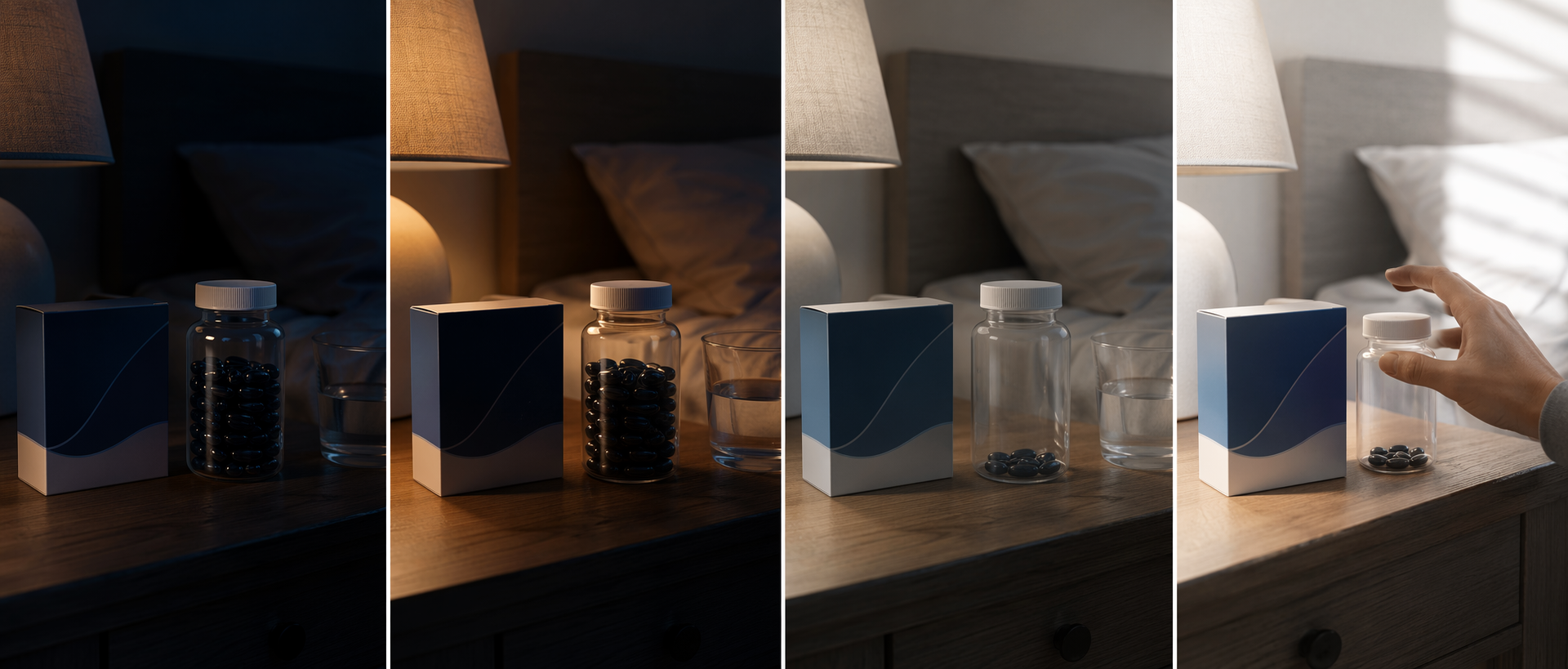
That label language matters. “Occasional sleeplessness” is not the same thing as chronic insomnia, and “may cause drowsiness” is not the same thing as repairing the sleep system that is keeping you awake.
What Diphenhydramine Is Doing
Diphenhydramine was not originally designed as a sleep medicine. It is an antihistamine, and its sleepiness effect comes largely from blocking histamine H1 receptors in the brain. Histamine is one of the chemical signals that helps maintain wakefulness, so blocking that signal can push the brain toward drowsiness.[2]
That can be useful after a bad stretch: a noisy hotel night, a short-term schedule disruption, or one evening when the body is tired but the mind will not settle. The FDA-regulated label leaves room for that kind of short-term use. It does not support turning the gelcap into a nightly insomnia plan.[1]
The difference is not a technicality. Sedation is a drug effect. Sleep quality is what happens across the night: how sleep is initiated, maintained, cycled, and experienced the next day. Insomnia treatment asks a still larger question: why sleep is not happening in the first place.
Why It Can Stop Feeling Reliable After a Few Nights
Rapid tolerance is the practical reason many people feel as if Unisom SleepGels “worked once” and then changed on them. Sleep Foundation’s review of diphenhydramine notes that tolerance can develop within 3 to 4 days of consecutive use, and it cites a study in which diphenhydramine was no better than placebo after 4 days.[2]

This is not the same as saying every person will experience the exact same timeline. It does explain a common pattern: night one feels strong, night two still seems useful, and by nights three or four the brain is no longer responding as cleanly to the same antihistamine signal.
Dr. Philip Alapat of Baylor College of Medicine has made a similar point in plain clinical terms: antihistamines are not recommended as long-term sleep aids, in part because people develop tolerance quickly and the benefit tends to fade.[4]
That fading effect can create a bad decision point. A tired person may interpret the weaker response as a reason to take more, combine products, add alcohol, or keep trying for “just one more night.” The label does not support that improvisation. It gives a dose, a purpose, and a stopping boundary.[1]
Sedated Is Not Always Rested
A diphenhydramine gelcap can make the transition into sleep feel less effortful. That does not mean the night becomes restorative. Sleep Foundation notes that antihistamines may reduce overall sleep quality even when they make a person drowsy.[2]
This distinction matters most when the original problem is not simple wakefulness. If sleeplessness is being driven by anxiety, pain, reflux, restless legs symptoms, alcohol rebound, shift work, circadian delay, sleep apnea, medication effects, or an irregular schedule, blocking histamine may only add a sedating layer over the real problem.
The American Academy of Sleep Medicine’s clinical practice guideline for chronic insomnia recommends against using diphenhydramine for sleep onset or sleep maintenance insomnia in adults. The reason is not that diphenhydramine has no sedating effect; it is that the evidence of clinically meaningful benefit is insufficient while the risks are known.[3]
That is the point at which the pharmacy-aisle question changes. For one rough night, the question may be whether a labeled OTC sleep aid is appropriate for you. For a recurring sleep problem, the better question is what pattern is being missed.
The Label Warnings Are Not Fine Print
The DailyMed label for Unisom SleepGels tells consumers not to use the product with alcohol, not to use it with other drugs that cause drowsiness unless directed by a doctor, and not to give it to children under 12. It also warns people with breathing problems such as emphysema or chronic bronchitis, glaucoma, or trouble urinating due to an enlarged prostate gland to ask a doctor before use.[1]
Those warnings are easy to underweight because the product sits in an OTC aisle. But diphenhydramine can still add to the effects of other sedating substances. Alcohol, anxiety medicines, opioid pain medicines, muscle relaxants, some nausea medicines, and other sleep aids can all turn “drowsy” into something less predictable.
Commonly reported diphenhydramine side effects include sedation and dry mouth, with Drugs.com listing those effects in the 1% to 10% incidence range. The same side-effect profile also includes anticholinergic symptoms that can matter the next day: grogginess, dizziness, blurred vision, constipation, and difficulty urinating are not trivial if someone has to drive, work, supervise children, or get up at night.[5]
| If this is the situation | The label or evidence points to this concern |
|---|---|
| You need it for several nights in a row | Tolerance may develop within 3 to 4 consecutive days, and the label says not to use beyond 2 weeks unless directed by a doctor. |
| You are drinking alcohol | The label warns against using Unisom SleepGels with alcohol. |
| You are taking another sedating medicine | The label warns against combining with other drugs that cause drowsiness unless directed by a doctor. |
| The person is under 12 | The label says not to use in children under 12. |
| You are 65 or older | Diphenhydramine appears in the AGS Beers Criteria as potentially inappropriate for older adults. |
Older Adults Need a Stricter Standard
For adults 65 and older, the risk calculation changes. The 2023 American Geriatrics Society Beers Criteria lists diphenhydramine among medications that are potentially inappropriate for older adults, reflecting concerns about anticholinergic effects, confusion, falls, and related harms.[6]
This is one of the places where “non-habit-forming” can be a distracting reassurance. A drug can be non-habit-forming in the narrow sense and still be a poor fit for an older nervous system, especially if it increases confusion, worsens balance, or layers on top of other anticholinergic medicines.
The dementia data also belongs here, but carefully. Harvard Health’s discussion of the Adult Changes in Thought study reports that people with cumulative anticholinergic exposure equivalent to 3 or more years had a 54% higher risk of dementia than those with lower or no exposure.[7]
That finding is observational. It does not prove that taking Unisom SleepGels for a few occasional nights causes dementia. It does make cumulative exposure harder to dismiss, especially for someone already taking other anticholinergic drugs or using diphenhydramine repeatedly because the sleep problem has become routine.
When Another Unisom Product Is Not the Main Answer
Some shoppers notice that the Unisom name appears on more than one sleep aid. SleepGels contain diphenhydramine HCl. Other Unisom products, including some SleepTabs, use doxylamine instead. That comparison can matter if you are checking ingredients, avoiding duplicates, or trying to understand why two boxes with similar branding do not contain the same drug.
But switching antihistamines is not the same as treating insomnia. If you are comparing the other main Unisom ingredient, the companion guide to doxylamine as a sleep aid is the more direct product-line bridge. The larger question remains whether an antihistamine is the right tool for the sleep problem you are having.
What to Do When the Gelcap Stops Helping
If Unisom SleepGels helped once and then stopped helping after several consecutive nights, the most useful response is not to chase the original effect. Stop and sort the problem. Was this a short-term disruption, or has sleep been difficult for weeks? Is the issue falling asleep, staying asleep, waking too early, or feeling unrefreshed despite enough time in bed?
- If it is occasional sleeplessness, use only the labeled dose and avoid alcohol or other sedating combinations.
- If you need it several nights in a row, treat the fading effect as a signal to reassess rather than escalate.
- If sleeplessness lasts beyond the short-term window on the label, involve a clinician instead of extending OTC use.
- If you are 65 or older, managing breathing problems, glaucoma, urinary retention, or taking multiple medications, check with a clinician before using diphenhydramine.
Mayo Clinic and Johns Hopkins both frame OTC sleep aids as short-term tools with limitations, not durable treatment for persistent insomnia.[8][9] That is the practical landing point: the drug may create drowsiness, but it cannot diagnose why sleep is failing.
For a recurring pattern, it is usually more productive to look at insomnia as a condition with drivers. Cognitive behavioral therapy for insomnia, circadian timing work, medication review, and targeted treatment for pain, anxiety, sleep apnea, restless legs symptoms, or shift-work disruption can change the underlying problem in a way an antihistamine usually cannot. If you are trying to understand that next step, start with whether there is a cure for insomnia or whether your sleeplessness is more about your mind or your clock.
Unisom SleepGels are not mysterious when they stop working after a few nights. They contain 50 mg diphenhydramine, a sedating antihistamine with labeled short-term use, a rapid tolerance problem, and real anticholinergic cautions. If the gelcap no longer delivers the dependable night it seemed to promise, that is useful information. The next question is not how to force the same drug effect back. It is what is driving the insomnia.
References
- Unisom SleepGels label. DailyMed, NIH/NLM. Revised 1/2026.
- Can Benadryl Make You Sleep?. Sleep Foundation.
- Clinical Practice Guideline for the Pharmacologic Treatment of Chronic Insomnia in Adults: An American Academy of Sleep Medicine Clinical Practice Guideline. American Academy of Sleep Medicine.
- Trouble sleeping? Experts say skip antihistamines. Baylor College of Medicine.
- Unisom SleepGels Side Effects. Drugs.com.
- American Geriatrics Society 2023 updated AGS Beers Criteria for potentially inappropriate medication use in older adults. American Geriatrics Society. 2023.
- Common anticholinergic drugs like Benadryl linked to increased dementia risk. Harvard Health Publishing. 2025 update.
- Sleep aids: Understand options sold without a prescription. Mayo Clinic.
- Sleep Aids. Johns Hopkins Medicine.


Comments
Join the discussion with an anonymous comment.