
The best melatonin sleep aid for adults is rarely the strongest bottle on the shelf. It is the one that matches the actual sleep problem: a body clock that is running late, a trip across time zones, a work schedule that asks for sleep at the wrong biological time, or a short stretch of trouble falling asleep.
That distinction matters because melatonin is not a general sedative. It is a hormone signal involved in circadian timing, and professional sleep guidance is much more comfortable with it for timing-related problems than for chronic insomnia. The American Academy of Sleep Medicine specifically warns against treating chronic insomnia as a melatonin problem, while supporting carefully timed melatonin for delayed sleep-wake phase disorder in adults and children when appropriate.[1]
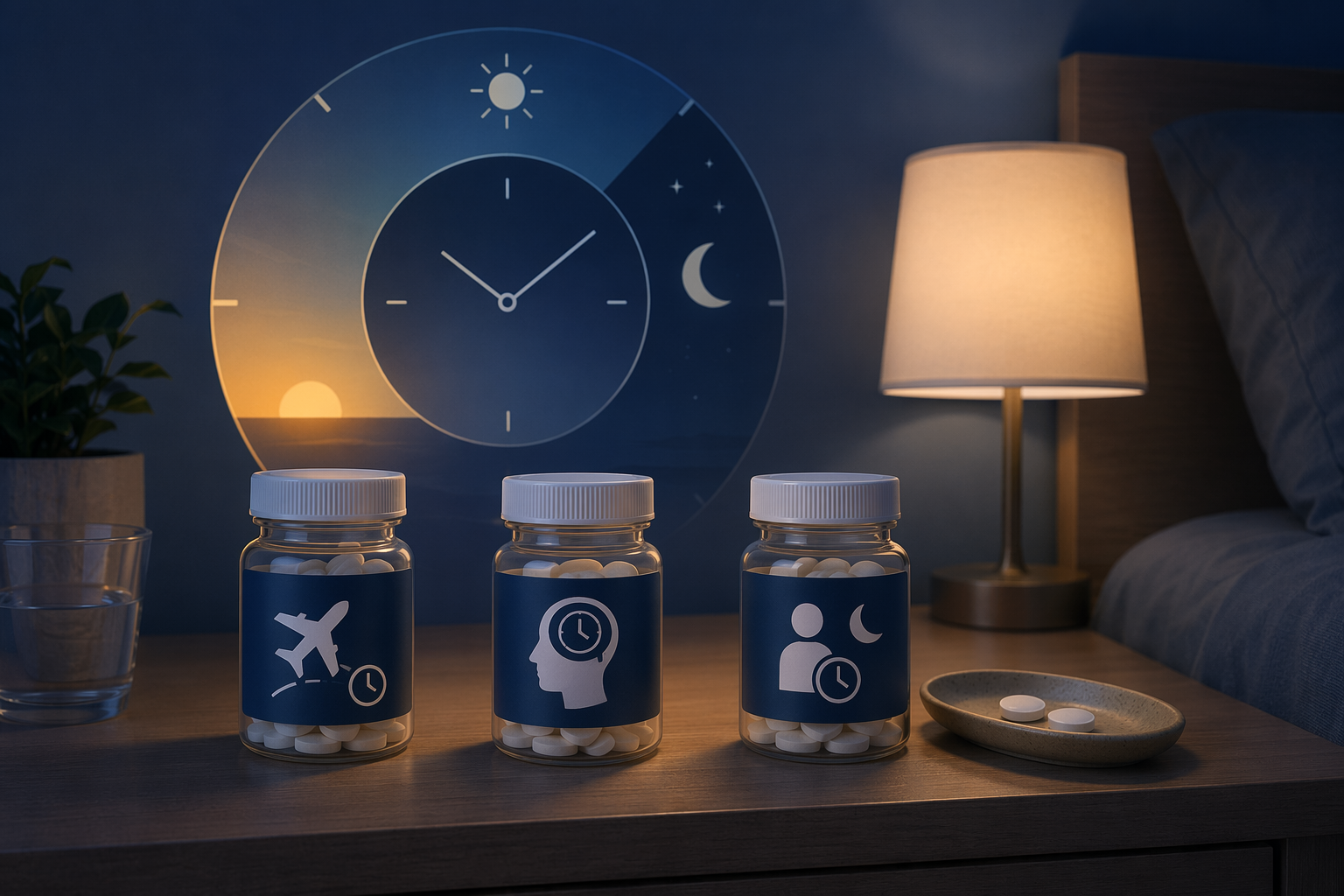
So before comparing gummies, capsules, tablets, drops, or “maximum strength” labels, name the job you are asking melatonin to do. A product that is reasonable for jet lag may be poorly timed for delayed sleep phase. A product that looks attractive for staying asleep may do little for a brain that is awake from worry. A higher dose may simply create more next-morning fog without solving the timing problem.
Start With the Sleep Problem, Not the Brand
A useful melatonin choice starts with this sorting step:
| What is happening | What melatonin may be useful for | Product characteristics to look at first |
|---|---|---|
| You are crossing multiple time zones | Reducing jet lag symptoms when timed to the destination clock | Immediate-release, low to moderate dose, travel-specific timing |
| You consistently cannot fall asleep until very late and cannot wake easily for morning obligations | Shifting the sleep window earlier | Immediate-release, low dose, taken before the desired bedtime |
| You work nights or rotating shifts and need daytime sleep | Possibly adding a small timing cue after work | Immediate-release or carefully chosen timed use; expectations should stay modest |
| You sometimes have a rough night but your schedule is otherwise normal | Short-term help with sleep onset in select situations | Lowest practical dose, short-term use, avoid treating it as nightly insurance |
| You have insomnia most nights, wake repeatedly, worry in bed, or depend on sleep aids | Usually not the main answer | Look at insomnia treatment, especially CBT-I, rather than a stronger melatonin product |
If you are not sure which row you are in, pause before buying. A late-running body clock and an anxious, exhausted mind can both feel like “I can’t fall asleep,” but they do not call for the same intervention. The distinction is important enough that it deserves its own diagnostic thinking; this site's guide to whether your sleep problem is your mind or your clock is a better next stop than another product page if the pattern is unclear.
Why Immediate-Release Usually Fits Melatonin’s Real Job
Melatonin's pharmacology is short-lived. StatPearls describes a half-life of about 1 to 2 hours, which is one reason immediate-release melatonin is usually a better match for sleep-onset and circadian-shifting problems than for keeping someone asleep all night.[2]
That short half-life is not a defect when the problem is timing. If your internal clock is telling your body that midnight is still evening, a brief signal before the desired bedtime can help tell the system that night is arriving earlier. If you are landing in a new time zone, a short signal can help align you to the destination schedule. In those situations, the goal is not to drug sleep into existence for eight hours; it is to place a time cue in the right spot.
Extended-release melatonin is a different bet. It is designed to maintain melatonin levels longer, so it sounds appealing when the complaint is waking at 3 a.m. The problem is that “waking at 3 a.m.” has many causes: alcohol timing, untreated sleep apnea, depression, pain, perimenopause, stress, an early-shifted circadian rhythm, or chronic insomnia. A longer-release pill may be relevant in some cases, but the evidence is less tidy than it is for circadian timing problems. It should not be treated as the adult upgrade from immediate-release.
Form matters mostly because it changes control. A scored tablet or low-dose capsule can make it easier to avoid overshooting. Gummies are convenient, but they often push people toward candy-like repeat dosing and may be harder to split precisely. Liquids can be adjustable, but only if the dropper and label are reliable. Flavor is not irrelevant if it affects adherence, but it is not the deciding feature.
Dose: Lower Is Often the More Sensible Starting Point
Adult melatonin products commonly come in doses that look medical because the numbers are large: 5 mg, 10 mg, sometimes more. Bigger is easy to understand on a shelf. It is not automatically more useful.
The dose ranges used in consumer guidance vary. Drugs.com lists adult dosing information in the 0.5 mg to 5 mg range for several uses and also notes a short half-life.[3] Sleep Foundation's consumer dosing guidance commonly discusses starting in the 1 mg to 3 mg range, while acknowledging that appropriate dosing depends on age, health status, and reason for use.[4] The AASM article notes that 0.3 mg is close to the amount the body may naturally produce, which is a useful reminder that “small” is not the same as “pointless.”[1]
For adults choosing without a clinician's specific protocol, the practical rule is boring but protective: start at the lowest dose that fits the problem, give timing a fair chance, and do not escalate simply because the first night was imperfect. If 0.5 mg taken at the right time is the studied approach for a circadian shift, taking 10 mg at bedtime is not a cleaner version of the same strategy. It is a different exposure with more room for side effects and confusion.
The Label Problem Makes “Start Low” Harder Than It Sounds
There is an unglamorous reason to care about third-party verification: supplement labels are not as dependable as drug labels. Melatonin is sold in the United States as a dietary supplement, not as an FDA-approved treatment for any sleep disorder, and dietary supplements are regulated differently from prescription or over-the-counter drugs.[5]
NCCIH summarizes a 2017 analysis in which most tested melatonin supplements did not contain the amount listed on the label; the actual content ranged from 83% less than the label to 478% more than the label.[5] That finding turns dosing advice from a neat chart into a real-world nuisance. A careful adult may think they are taking 1 mg and actually be taking much less or much more.
This is where brand matters, but not in the way product roundups usually imply. Popularity, flavor, influencer use, and thousands of reviews do not prove that a bottle contains what it says. A more useful filter is independent quality verification, such as a USP Verified mark, when available. Verification does not prove the product will fix your sleep problem; it reduces avoidable uncertainty about what you are swallowing.
For more on what supplement regulation does and does not check, see what the FDA doesn't check in natural sleep aids.

If the Problem Is Jet Lag
Jet lag is one of melatonin's better-supported uses, especially when travel crosses several time zones. NCCIH notes that melatonin may help with jet lag, and the evidence is strongest when the problem is circadian misalignment rather than ordinary travel fatigue.[5]
For jet lag, the best melatonin sleep aid for adults is usually immediate-release, portable, low to moderate in dose, and easy to time precisely. Extended-release is not the default choice because the job is not simply “stay asleep longer.” The job is to help the body clock accept a new light-dark schedule.
Direction matters. Eastward travel often asks the body to fall asleep earlier than it wants to, which is generally harder than staying up later. Westward travel may call for a different timing plan because the body is being asked to delay. A single bedtime rule pasted onto both trips can misfire.
That is why a travel-specific plan is more useful than a generic bottle recommendation. If jet lag is the problem, use a protocol that accounts for direction, destination bedtime, and light exposure; this site's guide to using melatonin for jet lag goes deeper than a product label can.
If Your Sleep Schedule Runs Too Late
Delayed sleep-wake phase disorder is the cleaner case people often mistake for ordinary insomnia. The person may sleep reasonably once sleep finally starts, but sleep arrives too late for work, school, parenting, or daylight life. Morning wake-up then feels brutal because it is happening at the wrong biological time.
This is where low-dose, correctly timed melatonin earns real attention. A 2018 randomized controlled trial of 307 people found that 0.5 mg of melatonin taken 1 hour before the desired bedtime helped participants fall asleep an average of 34 minutes earlier.[1] The AASM also supports strategically timed melatonin for delayed sleep-wake phase disorder.[1]
Notice what that does and does not say. It does not say that a 10 mg gummy at the moment you feel desperate will force sleep. It says that a small dose, placed before the target bedtime, can help move the clock. The best product for this situation is therefore usually immediate-release, low-dose, and easy to take consistently at the planned time.
Light matters here too. Evening bright light can push the clock later, while morning light can help anchor an earlier schedule. Melatonin alone may not overcome a late-night light environment that keeps telling the brain it is still daytime. If this pattern sounds familiar, read more about delayed sleep phase syndrome in adults rather than treating the supplement as the whole treatment.
If You Work Nights or Rotating Shifts
Shift work is where melatonin marketing often runs ahead of the evidence. The logic sounds right: if you need to sleep during the day, take a night signal after work. Sometimes that may help. But shift work also collides with light exposure, social schedules, noise, family obligations, rotating start times, commute safety, and the body's strong preference for sleeping at night.
NCCIH reports that melatonin may lengthen daytime sleep in shift workers by about 24 minutes, but it describes the overall evidence as low quality and inconclusive.[5] That is not nothing, especially for someone living on fragments of sleep. It is also not enough to sell melatonin as a reliable fix for shift work sleep disorder.
For shift workers, the better question is not “Which melatonin is strongest?” It is “Where does this fit in a shift plan?” A low-dose immediate-release product after a night shift may be reasonable for some adults, but timing has to be coordinated with morning light avoidance, a protected sleep window, caffeine cutoff, and driving safety. A slow-release product may sound tempting for daytime sleep maintenance, but it can also leave a worker groggy at the wrong time if the sleep window is short.
If rotating or night work is a recurring problem, look beyond the supplement aisle. This site's shift work sleep disorder treatment guide and overview of shift work disorder symptoms, causes, and treatment are more appropriate than trying one higher-dose bottle after another.

If It Is Occasional Trouble Falling Asleep
Occasional sleeplessness is the gray zone. Maybe you stayed up too late several nights in a row, your schedule slipped on vacation, or you have one early obligation that makes sleep feel pressured. In that kind of short-term situation, melatonin may be a reasonable sleep-onset aid for some adults, especially if the problem has a timing component.
The product choice should stay modest: immediate-release, low dose, no unnecessary blend of sedating herbs, and no assumption that more milligrams will produce cleaner sleep. Mayo Clinic's over-the-counter sleep aid guidance treats melatonin as an option that may help with jet lag and reducing the time it takes to fall asleep, while still emphasizing safety, interactions, and the need to avoid relying on sleep aids instead of medical evaluation when sleep problems persist.[6]
This is also where people can accidentally turn a short-term tool into a nightly ritual. If the same insomnia pattern keeps returning, the problem has moved out of casual supplement territory. At that point, compare melatonin with other options by sleep problem, not by shelf appeal; the guide to which OTC sleep aid is right for your sleep problem is a better framework.
If It Is Chronic Insomnia, Do Not Keep Shopping for Stronger Melatonin
Chronic insomnia is the trust test. If you struggle to fall asleep or stay asleep at least several nights a week, spend long periods awake in bed, dread bedtime, or build your evenings around whether sleep will happen, melatonin is unlikely to be the central answer. The AASM states that clinical practice guidelines recommend against using melatonin for chronic insomnia, and the American College of Physicians recommends cognitive behavioral therapy for insomnia as first-line treatment.[1]
This is not a moral lecture about supplements. It is a mechanism issue. Chronic insomnia often involves conditioned arousal, sleep effort, irregular sleep opportunity, worry about sleep, and habits that keep the bed linked with wakefulness. A circadian signal may help if a delayed clock is part of the picture, but it does not retrain the insomnia loop by itself.
If this is your pattern, spend the next dollar on better treatment direction, not a higher-dose bottle. Start with when melatonin actually works for insomnia to separate circadian timing from insomnia, then consider how to choose a CBT-I app for chronic insomnia.
A Practical Buying Filter
Once the sleep problem is named, the buying decision becomes less noisy. You do not need a universal winner. You need a product that leaves fewer ways to misuse melatonin.
- Choose immediate-release first for sleep-onset timing, jet lag, and delayed sleep phase unless a clinician has a reason to suggest otherwise.
- Reserve extended-release for a clearly defined sleep-maintenance problem, and do not assume it treats chronic insomnia.
- Start with the lowest sensible dose for the problem; many adults do not need high-dose products.
- Favor products that make dosing precise: low-dose tablets, capsules, or measured liquids are usually easier to control than high-dose gummies.
- Look for independent quality verification when available, because label accuracy is a real weakness in this category.
- Avoid combination formulas unless you understand every active ingredient and why it belongs there.
Safety still matters. Adults who are pregnant or trying to become pregnant, have seizure disorders, autoimmune conditions, significant medical illness, or take medications that may interact with melatonin should ask a clinician before using it. Johns Hopkins Medicine also advises using melatonin for short-term help rather than treating it as a permanent nightly solution.[7]
The cleanest answer is this: for adults, the best melatonin sleep aid is a verified, low-dose product with the right release profile, taken at the right time for a circadian problem. For jet lag and delayed sleep phase, that can be a useful tool. For shift work, it may help a little when placed inside a broader schedule strategy. For chronic insomnia, it is usually the wrong object to keep upgrading.
References
- Missing the Mark With Melatonin - American Academy of Sleep Medicine.
- Melatonin - StatPearls.
- Melatonin - Drugs.com.
- Melatonin Dosage - Sleep Foundation.
- Melatonin: What You Need To Know - National Center for Complementary and Integrative Health.
- Sleep Aids: Understand Options Sold Without a Prescription - Mayo Clinic.
- Melatonin for Sleep: Does It Work? - Johns Hopkins Medicine.


Comments
Join the discussion with an anonymous comment.