
The best natural sleep aid, if the word “best” has to mean “best supported by clinical research,” is melatonin — but only for the right kind of sleep problem. It is most useful when the body clock is mistimed, as with jet lag or delayed sleep timing, not when someone has chronic insomnia and is hoping a capsule will work like a quieter version of a prescription sedative. Magnesium is the more reasonable second choice when low intake is plausible. After that, the evidence gets thinner quickly: valerian is more famous than convincing, and L-theanine and glycine are plausible but still supported by smaller, narrower studies.
That answer is less satisfying than a ranked shopping list, but it is more honest. Natural sleep aids do not produce large, consistent improvements across all adults. The useful question is not “Which bottle wins?” It is “What sleep problem am I trying to solve, and does this ingredient have evidence for that problem?”
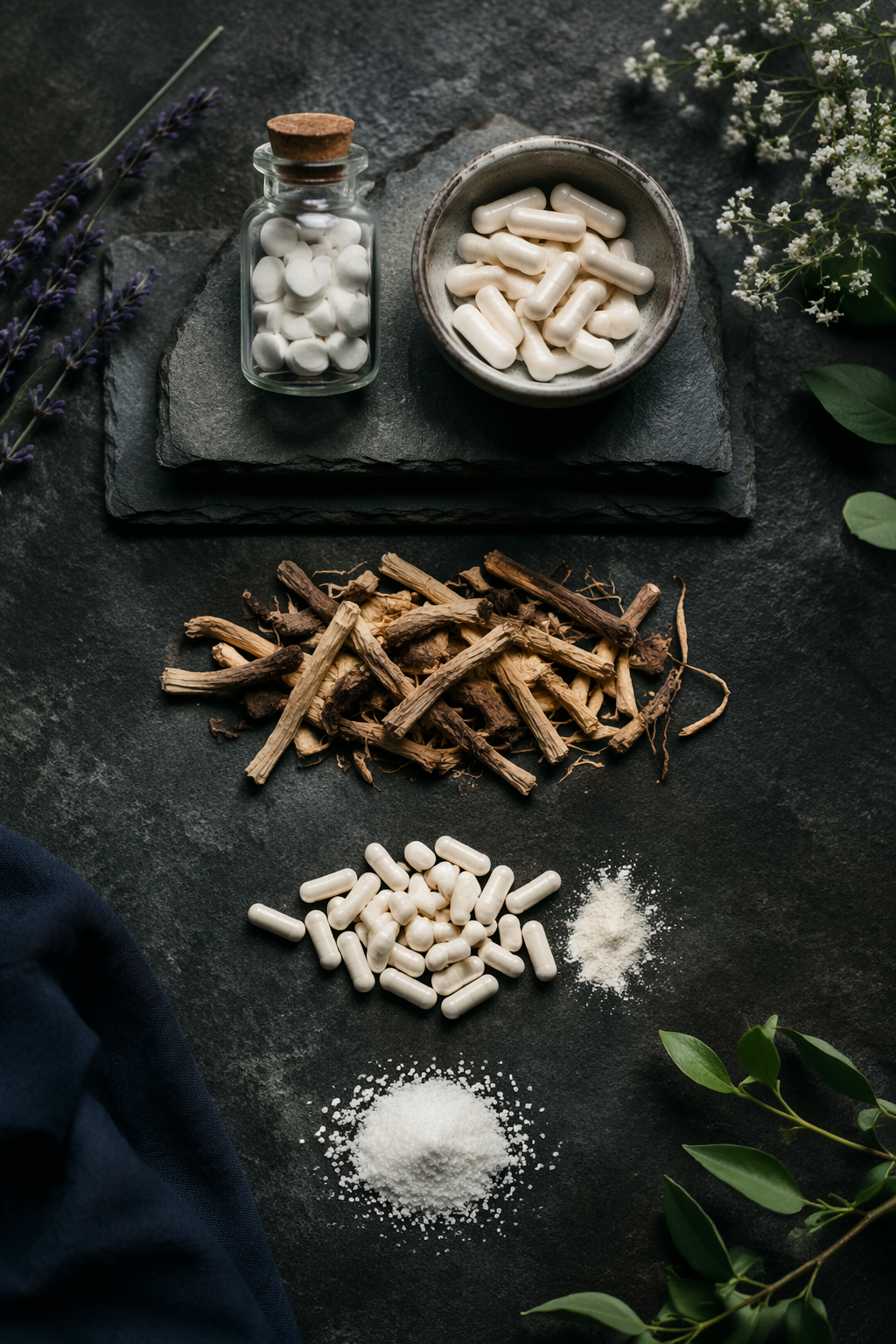
| Natural sleep aid | Evidence strength | Best-fit use case | Research-aligned dose range | Main caution |
|---|---|---|---|---|
| Melatonin | Strongest among common natural sleep aids, with randomized-trial meta-analysis support for shorter sleep latency and longer total sleep time [1] | Circadian timing problems, including jet lag and delayed sleep timing | Often 0.5–1 mg for timing; jet lag studies commonly use 0.5–5 mg [2] | Higher store doses are common but not automatically better; product labels may not reliably match contents |
| Magnesium | Moderate but mixed; benefits appear modest and may depend on low baseline intake | Possible low magnesium intake, older adults, or people whose sleep difficulty overlaps with muscle tension or restlessness | Varies by form and study; avoid assuming all magnesium products are equivalent | Can cause gastrointestinal effects and may be unsafe with kidney disease or interacting medications |
| Valerian | Weak to mixed; some reviews find small sleep-quality signals, but controlled-trial confidence is limited [3] | Short-term trial only for adults who understand the uncertainty | Doses vary widely across studies and products | Marketing confidence is stronger than the evidence; liver and medication-interaction cautions matter |
| L-theanine | Promising but limited | Calmness and sleep maintenance rather than forcing sleep onset | Commonly discussed at 200–400 mg [3] | Not a proven treatment for insomnia |
| Glycine | Small early evidence base | Subjective next-day refreshment or sleep quality in limited small trials | 3 g before bed [3] | Fewer than 100 total participants across the small Japanese trials summarized in the review [3] |
Why the “Best” Choice Splits by Sleep Problem
A supplement can fail for one sleep problem and still be sensible for another. Jet lag, delayed sleep phase, difficulty falling asleep from worry, repeated night waking, and chronic insomnia are not the same target. A product label that says “sleep support” collapses all of them into one aisle-friendly promise.
Melatonin is the clearest example. It helps signal biological night. That makes timing important. Taken at the wrong time, or in a dose chosen because the bottle looked stronger, it can leave someone groggy without actually solving the schedule problem. Magnesium is different: it is not a clock-shifting hormone. Its best case is more conditional, especially when intake is low or the person has a reason to suspect deficiency.
For chronic insomnia, the hierarchy changes again. Cognitive behavioral therapy for insomnia, or CBT-I, is treated by major clinical sources as the first-line non-drug treatment, while over-the-counter sleep aids are framed as short-term or situational tools rather than durable insomnia care [4]. That does not make supplements useless. It does mean they should not be asked to carry a diagnosis they were never built to treat.
Melatonin: Best Evidence, Often Misused
Melatonin earns the top spot because it has the strongest clinical research base among the common natural sleep aids. A meta-analysis of 19 randomized controlled trials found that melatonin reduced sleep latency and increased total sleep time in primary sleep disorders, though the improvements were modest rather than dramatic [1]. That distinction matters: the evidence supports a measurable effect, not the kind of knockout sedation people may expect after a bad week of sleep.
Its most coherent use is circadian timing. Johns Hopkins describes melatonin as a hormone that helps regulate the sleep-wake cycle and notes that it may help with jet lag and delayed sleep phase when used appropriately [2]. This is why melatonin often makes more sense for someone whose body wants to fall asleep at 2 a.m. than for someone who falls asleep at 10:30 p.m. and wakes in distress at 3 a.m.
Dose is where the supplement aisle gets sloppy. Johns Hopkins advises that less is often more with melatonin and discusses starting with low doses, such as 1 mg, rather than assuming a higher milligram count is better [2]. There is also a familiar mismatch: many store-bought products sit in the 5–10 mg range, while many research-supported uses rely on lower doses, especially when the goal is clock timing rather than sedation.
The practical consequence is simple. If melatonin is used, it should be treated like a timing signal: low dose, chosen timing, short-term purpose, and extra caution for pregnancy, children, older adults, epilepsy, autoimmune conditions, or interacting medications. The “natural hormone” framing should not be allowed to erase the fact that it is still biologically active.
Magnesium: Reasonable Second Choice, More Conditional
Magnesium is often sold as if nearly everyone is one capsule away from calm sleep. The evidence is not that broad. It is better described as modest, mixed, and most plausible when baseline magnesium intake is low. About half of Americans may have deficient or inadequate intake, which gives magnesium a more credible rationale than many herbal blends, but a rationale is not the same as a guaranteed sleep effect.
The positive findings are not nothing. A 2025 randomized controlled trial of 155 adults showed a 1.6-point greater reduction on the Insomnia Severity Index compared with placebo, a small effect rather than a transformation. A 2021 review also reported a 17-minute reduction in sleep onset latency in older adults. Those are the kinds of numbers that can matter to a person who is staring at the ceiling, but they should not be inflated into a cure.
The uncertainty is important enough to keep in the room. A reported 2026 European Journal of Nutrition study found no notable effect of magnesium supplementation on sleep quality, but the full text should be confirmed before that finding is treated as settled evidence. For now, the narrower conclusion is safer: magnesium may help some people, especially where low intake is plausible, but the average effect appears small and inconsistent.
Form also complicates the conversation. Magnesium glycinate, citrate, oxide, and other forms do not behave identically in tolerability or absorption, and sleep studies do not give every product on the shelf equal support. A person comparing bottles should care less about the calm-looking label and more about the elemental magnesium dose, gastrointestinal tolerance, kidney function, and medication interactions.
Valerian: Familiar, Traditional, and Still Not Very Convincing
Valerian root has the shape of a classic natural sleep aid: old, earthy, recognizable, and easy to imagine as gentler than pharmaceuticals. The problem is that recognition is doing too much of the work. A 2024 literature review in the American Journal of Lifestyle Medicine summarized valerian as lacking evidence, even while acknowledging that some meta-analyses have reported sleep-quality improvements with small standardized mean differences [3].
That mixed picture should change how valerian is presented. It is not impossible that some people feel better with it. It is also not well supported enough to deserve the confidence it often receives in “top natural sleep aid” rankings. If an adult tries it, the trial should be short, cautious, and separated from alcohol, sedatives, and other products that can compound drowsiness or side effects.
L-Theanine and Glycine: Plausible, but Still Small-Scale
L-theanine has a more specific appeal than many herbs because it is associated with calmness without heavy sedation. The 2024 review summarizes L-theanine as commonly used in the 200–400 mg range and more relevant to relaxation and sleep maintenance than to forcing rapid sleep onset [3]. That makes it a poor match for someone expecting a pill to “turn off” insomnia, but a more plausible experiment for someone whose main complaint is pre-bed arousal.
Glycine has an even narrower evidence base. The same review summarizes small Japanese trials using 3 g before bed, with fewer than 100 total participants across those studies [3]. The findings are interesting enough to keep glycine on the list, but not large enough to rank it above melatonin or magnesium for the average reader trying to choose one evidence-based option.
Chamomile, kava, and multi-ingredient herbal blends usually enter articles like this with a warm glow around them. The research case is weaker than the atmosphere. Kava also carries safety concerns that make it a poor casual sleep experiment, especially when liver risk and medication interactions are not being reviewed by a clinician [3].
The Safety Gap Starts Before You Swallow Anything
The first safety issue is not a rare side effect. It is the regulatory setup. In the United States, dietary supplements are not evaluated by the FDA for effectiveness before they are sold, and consumers should not assume that a sleep supplement has been verified for efficacy, safety, or label accuracy in the way a prescription drug is reviewed [5].
That matters especially for melatonin, where the purchased dose may already be higher than needed and label reliability is part of the real-world decision. A person may think they are comparing 1 mg, 3 mg, and 10 mg products, but the broader supplement category does not offer the same premarket assurance of content accuracy that many buyers assume. Third-party testing helps, but it does not turn a supplement into a personalized sleep plan.
Older adults need a separate caution. Some over-the-counter sleep products are not “natural” supplements at all; they are antihistamines such as diphenhydramine or doxylamine. These are flagged in the American Geriatrics Society Beers Criteria as potentially inappropriate for many adults 65 and older because of anticholinergic effects and related risks [6]. A sleep aisle can place these products near herbal or hormone products, but the risk profile is different.
- Avoid combining sleep supplements with alcohol, sedatives, or multiple nighttime products unless a clinician has reviewed the combination.
- Use extra caution during pregnancy, while breastfeeding, in older adulthood, with kidney disease, liver disease, epilepsy, autoimmune conditions, or complex medication lists.
- Treat persistent insomnia, loud snoring, gasping, restless legs, depression, anxiety, pain, and frequent early-morning waking as reasons for clinical evaluation rather than supplement escalation.
- Prefer single-ingredient products over proprietary blends when testing whether one ingredient actually helps.
What to Choose, Realistically
If the sleep problem is circadian — jet lag, shift-related timing disruption, or a delayed sleep schedule — melatonin has the best evidence fit. The dose should usually be lower than the most aggressive bottles imply, and the timing matters as much as the milligram count.
If low magnesium intake is plausible, magnesium is the most reasonable second-tier option, with expectations kept modest. It deserves consideration, not mythology. If the sleep problem is chronic insomnia, the better question is not which supplement to stack next; it is whether CBT-I, medical evaluation, or treatment of an underlying condition is being delayed.
Valerian, L-theanine, and glycine sit below those choices because the evidence is smaller, more mixed, or more use-case-limited. They may be reasonable experiments for some healthy adults, but they should not be sold as the answer that research has somehow been hiding in plain sight.
So the best natural sleep aid is not a universal winner. It is the one whose evidence matches the sleep problem, whose dose matches the research rather than the loudest label, and whose risks still make sense for the person taking it.
References
- “Meta-analysis: Melatonin for the Treatment of Primary Sleep Disorders,” PubMed, 2013.
- “Natural Sleep Aids: Home Remedies to Help You Sleep,” Johns Hopkins Medicine.
- “Current Insights into the Risks of Using Natural Products as Sleep Aids,” American Journal of Lifestyle Medicine, 2024.
- “Sleep aids: Understand options sold without a prescription,” Mayo Clinic.
- “Natural Sleep Aids,” Sleep Foundation.
- “Beers Criteria,” Cleveland Clinic.


Comments
Join the discussion with an anonymous comment.